
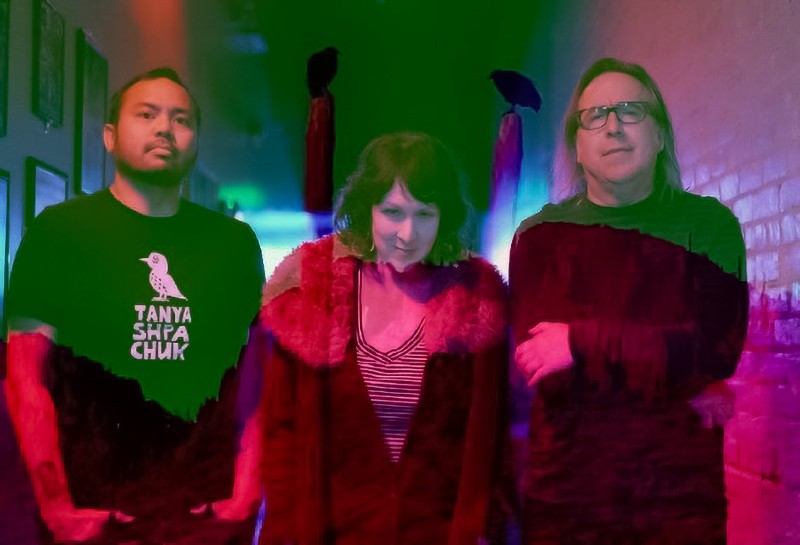
Marta DeLeon views life from a clearer perspective on In Your Dreams.
The Tucson, Arizona, vocalist-bassist examines loss and love through a new lens on Weekend Lovers’ latest album.
“My mom’s passing away was a big deal,” said DeLeon, who fronts the indie-rock trio. “My dad, sister, and I had been estranged these last few years, but we’ve come back together recently. It’s processing a lot of the grief of losing my mom for all of us.”
She tackles that shared grief on “Not Chill,” which explores the need for acceptance and closure.
DeLeon sings, “But you were lucky to have found her at all / It ain’t my peace. Is it all my fault? / I was waiting in a different time / But we don’t feel this, and it’s almost gone / Cuz deep inside we don’t know.”
“The song, ‘Not Chill,’ is about that … and it was hard to finalize the lyrics for it because I wanted it to capture that emotion,” DeLeon said. “The night before I went into the studio, I was still [figuring] out the lyrics. I didn’t want them to be too simple or too repetitive.”
DeLeon features cathartic lyrics and ethereal vocals across nine tracks on In Your Dreams. Weekend Lovers bandmates Dane Velasquez (guitars, keys) and Rick Bailey (drums, percussion) help DeLeon build that sonic world through emotive instrumentation.
“There’s a lot more band collaboration because I started playing with Rick and Dane in mid-2021,” she said. “We had been playing out for two years, and then we went into the studio in 2023 to track the first half of the songs. Then, we tracked the other half in 2024.”
I recently spoke with DeLeon about the inspiration behind the album.
Q: How did a lyric from “Here’s a Story” spark the album’s title?
A: I was trying to pick a lyric for the title, and I thought “in your dreams” covered everything on the record. It’s a little ubiquitous, and I thought it could be funny in the sense of saying, “In your dreams, man!”
I like to poke fun at it, and everybody always tells me, “It sounds like a David Lynch soundtrack, and the cover looks like a still from a David Lynch movie.” I wasn’t trying to do an homage to him, but I think it’s my vocals. I also work with a guitar player who plays with tremolo and reverb.
Q: “Rad Red” acknowledges a desire to escape and seek adventure. Why did you explore those themes in the song?
A: It’s about wanting to escape and being in a rut. It’s also about the patterns of our lives and the impact of the weather, especially here. The days are just burning away, and for me, I didn’t live here for the longest time. I’m always waiting for a rainy day because there is no variation; it’s very monotonous.
Our world is on fire, and the weather here is getting hotter. After the pandemic, more people started moving here, and some people bought second homes in places where it’s cooler. It’s also about trying to understand the ridiculousness of where we’re [at in life], whether it’s having a toxic love affair, being destructive, or feeling creative.
Q: How did you capture those themes in the video for “Rad Red?”
A: There’s a lot of stuff in the music video that was filmed in an abandoned warehouse and in my backyard. I also grew up going to goth clubs and tried to represent that with my friends in the old warehouse.
It was so hot that day, and it was nine o’clock at night. There was no air conditioning, so we turned up the fan because we had a smoke machine. There were some ladies getting red, but it came out well.
In all of my music videos, I’m always trying to represent Tucson and the desert a little differently than how I saw it growing up. I wanted to highlight the charm of it, and it’s also nice that my friends are documented in it.
Q: How did Dane Velasquez and Rick Bailey give “Rad Red” its energetic sound?
A: I thought it felt similar to Sonic Youth and Siouxsie and the Banshees, so I wanted the vocals to sound like Siouxsie. It was a riff that Dane had brought in with a twinkly, bouncy guitar delay, and we worked from there.
It was pieced together, played live for a year or two, and then finally recorded. It was another song that got captured well in the studio, too. With that one, we were pretty picky and mixed it a couple of times. There was some work here and there, but our engineer, Steven Lee Tracy, was open to it.
Q: “Marta Pinata” examines feeling vulnerable and isolated. How was writing this song cathartic for you?
A: My friend and I had these discussions during the pandemic when I was going through grief. She said, “You have to stop being Marta Pinata,” and I said, “I know.” Then I thought I should write about it because in American culture, we don’t like to talk about grief or loneliness.
It’s also about being disconnected and feeling alienated from the world. It’s not a happy song, but it’s interesting. I started writing it before I had met Dane and Rick, and then we worked on it for a while.
Q: Why did you include a cover of Sade’s “The Sweetest Taboo” on the album?
A: I call it the mountain monsoon version because at dusk in Tucson, it’s very moody and sensual with the thunder, the lightning, and the clouds. The mountains look really foreboding, and it’s a very Tucson rendition of the song.
I’ve always liked Sade’s stuff, and she has a similar vocal range to mine, so it’s easy for me to sing her songs. I covered a couple of her other songs in another band before Weekend Lovers, and it’s always been something that I go back to.
Q: Tell me about the writing process for In Your Dreams.
A: I wrote the lyrics and the melodies, and Dane came up with his guitar parts. He started off a couple of the songs on the album, and I started off some of the other songs.
I wanted to use songs that we had been playing that we thought were the best. Those were the ones that made the album. The Sade cover came together quickly, and we liked it a lot. We decided it should be the cover [song] for the album.
Q: How did the album come together with engineer Steven Lee Tracy at Saint Cecilia Studios?
A: This time, I wanted a studio that had digital, analog, and all the bells and whistles. It felt like it fit our sound more this time. I had a feeling Steven might know my references more for this album because it’s ‘90s-inspired and beyond. He helped us with some of the arrangements, too.
Q: What’s up next for you?
A: I’m trying to write more and write a little differently. I’m getting older, so I don’t feel like rocking out as hard anymore. I’m trying to play gigs that are more stripped down or at a mid-level venue where we can spread out more. I also might do a video for “The Sweetest Taboo” since my friend is working on a remix of it.
 The Stratton Setlist