
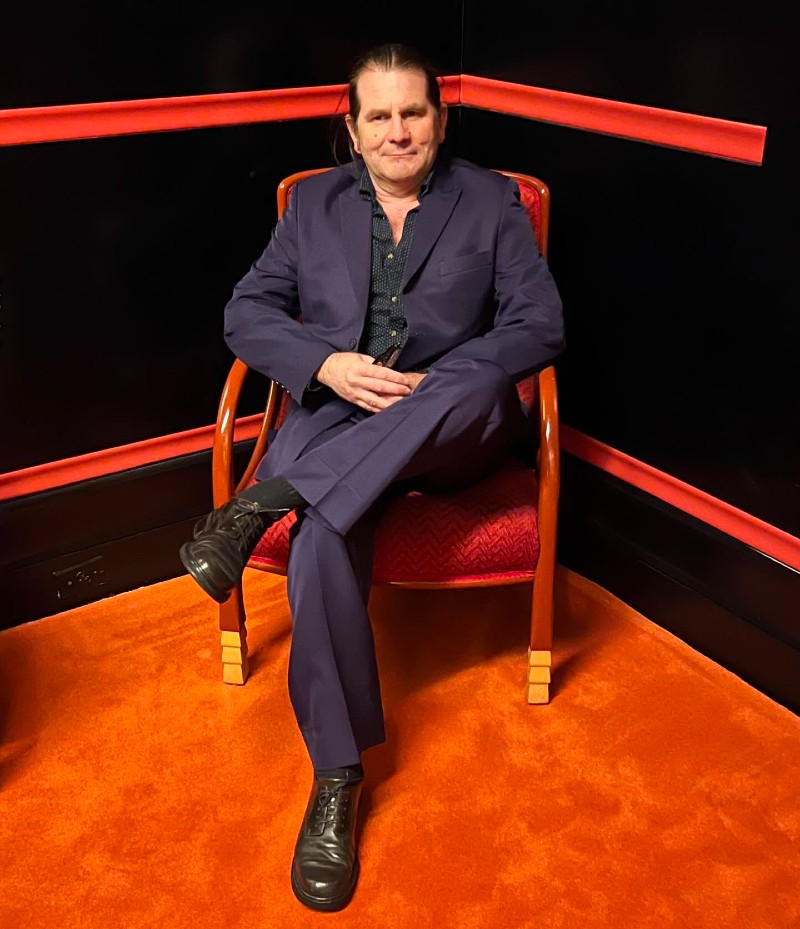
Jason Berry credits Marlon Brando with introducing him to Julius Caesar.
The San Francisco composer, multi-instrumentalist, and sequential artist saw Brando as Mark Antony in the 1953 film based on William Shakespeare’s tragedy and became intrigued.
“I said, ‘This is just amazing,’ especially with all of those fantastic actors in it,” said Berry, who also fronts Nubdug Ensemble, an experimental music collective.
“At one point, I was thinking about adapting Julius Caesar as a comic strip and thought, ‘I can do a little bit each day.’ Once I started plotting it out, I had to draw so many panels a day and realized there was no way I could do that. I kind of abandoned it, but it was always in my head.”
While the comic strip didn’t work out, Berry eventually landed on doing a musical adaptation of Julius Caesar instead.
“I said, ‘Well, I know that because I’ve done all that research already on the comic strip, so why don’t I do that?’” Berry said. “I just started fiddling around with it, seeing how the words would work over the top of it.”
Berry spent the next two years composing, arranging, and recording Third with Nubdug Ensemble. He assembled 17 notable musicians to help him record 11 tracks for the ambitious album, which includes elements of jazz, funk, and prog rock.
“Once I had a structure and the pre-existing characters of Julius Caesar, I said, ‘I can write a song from this person’s perspective and from this person’s perspective,’” Berry said. “They can be different, but they’ll be unified because it’ll be under the overarching themes of the play.”
On Third, Berry explores themes of ambition, power, corruption, and political violence. The album includes compelling instrumentals and vocal tracks to reimagine Julius Caesar as a musical adaptation for the 21st century.
“It’s talking about the end of the republic, and the story is timeless and timely,” Berry said. “It seemed like this would be the time to do it, if ever there were.”
What resulted is an innovative, genre-bending album filled with poetic lyrics and cerebral instrumentation. Third refreshingly chronicles the political assassination of Roman dictator Julius Caesar and his murder by a group of senators led by Cassius and Brutus.
“These are all archetypes, and these are things that keep coming up again and again through history,” Berry said. “Leading up to the [2024] election, I had that sinking feeling and thought, ‘I think I see how it’s gonna go, but I hope it’s not.’ I personally wanted to be able to work through those feelings in a way that could somehow be positive and not just worry myself to death.”
To learn more, I spoke with Berry about writing and recording Third.
Q: How did the themes of Julius Caesar help spark the songs on Third?
A: One of the main themes of the play is the unintended consequences of actions or the lack of foresight to take certain courses of action. Brutus, the noblest of all Romans, did it because he felt it was the right thing to do, but by taking the course of action that he did, he hastened the demise of the republic and ushered in the empire. You can’t foresee everything, and one of the things I tried to weave through there is the idea of “The Tide.”
Also, in the first vocal song, “But in Ourselves,” they talk about plunging into the water. There are also water and train references I tried to work into the [songs], even though the play doesn’t talk about trains. The sound of a train starts at the beginning of “The Ladder” and later on with “Portia and the Soothsayer” and so forth.
There are a bunch of sounds like that because it’s about momentum, and it’s about once things get put into motion. They’re getting swept along by “The Tide,” if you like, and being carried along by the train because they’re not able to stop it.
Some of the tunes have motifs, and if you listen carefully, there’s a motif in one tune that is also present in an earlier one to tie it all together. The album is meant to be listened to in its entirety. Hopefully, the audience will listen to it straight through.
Q: Third includes several references to “three” across the album’s tracks. How did the idea of “three” spark the album’s title?
A: There are a number of things that led to the title. First of all, it was just kind of a lazy title because that’s what I was calling it until I had an official name. I said, “I’ll just call it the Third one because it’s the third full-length [album].” But then once I got the theme, there were a number of things, [including] “Triumvirate” and “Put It by Thrice.” Julius Caesar denies the crown three times, but even beyond that, there are certain tunes.
I don’t want to delve too much into the music theory of it, but there are tunes for the chords. For instance, I tried not to use the interval of the third. Without the third, there’s a certain ambiguity in there because that’s a chord tone that tells you if it’s minor or if it’s major. Some of the tunes, the way the chords are voiced, they don’t have thirds, or they don’t have regular intervals.
That’s to make things ambiguous, because before the events, they could go either way. Once we get to the third act, it leads to the inevitable conclusion. The title also refers to a Soft Machine album, which is called Third. It’s one of my favorite albums.
Q: “Third Overture” is a somber and alarming instrumental. How does this opening track set the tone for the album?
A: That was the last piece written for the album. Originally, it was just an exercise, and the chords in that are called chromatic mediants. They’re chords that normally don’t go next to each other, but they share a chord tone, and they share one note. I stuck them together, and it made that creepy horror movie [sound]. In the movie of my mind, this would be the opening credits, and then you’d get the thunder and the lightning.
Q: “But in Ourselves” examines serving an egotistical leader, yet wanting to reclaim power and take control of the situation. How does this track highlight Cassius’ conflicted loyalty toward Julius Caesar?
A: Cassius is trying to get Brutus over to his side. Lyrically, it’s told from Cassius’ perspective, and a lot of the imagery in this one is taken directly from the text. For some of the others, I went off script.
Thematically, it’s about ambition and resentment, and it’s saying, “Why should this guy have the power?” Cassius is trying to manipulate or goad Brutus into joining him, not because Cassius feels that Brutus should be the one, as he’s trying to put him up to be, but because Cassius has other aims. He wants to grab the reins of power.
Compositionally, I wanted the song to have a funky sound. We go into a Puerto Rican boogaloo rhythm toward the end of the song by using a cowbell. That comes from the Latin stuff I was listening to.
I also knew I wanted to use a lot of vibraphone on this one … and Mark Clifford is an amazing player. He knocked out [those] parts and did a fantastic job. It also led to Mark’s wife, Crystal Pascucci, playing the cello.
Q: How does “The Ladder” explore Brutus’ decision to join the conspirators in assassinating Julius Caesar?
A: This is before Brutus joins the conspiracy. He’s in his garden, and he’s conflicted. He’s hashing through it—how he’s changed—and thinking about Caesar and loyalty. And yet, this could be the end result. It’s trying to get a little bit of that inner turbulence going on there.
Compositionally, the track has a slight Beatles influence, so we feature a sitar in the center to give it a psychedelic feel. I was also listening to a lot of the Four Tops, so there are some soul influences in there.
In terms of the lyrics, I wanted them to fit the need of the story—the need of the plot—at that point. I wanted them to also function outside of that, so someone could hear it and just think of it as a song about conflict and inner turbulence, or a person changing and not knowing how to deal with it.
Q: “Portia and the Soothsayer” highlights a disconnect between fantasy and reality. How did this track become a turning point in the album?
A: Portia and the Soothsayer do have this scene in the plot where I placed it, but I thought of it more as a medley track. We have the Soothsayer’s music as the first half of that composition with a Kraftwerk [influence]. Both of these characters, Portia and the Soothsayer, in my telling and my analysis, represent possibility.
The Soothsayer foresees the future, and he’s a pivot point. Portia has a scene where she wonders if Brutus is sick and questions why he’s acting so strangely. She’s offering a different possibility, and so the two of them together seem to be the axis. I wanted those characters together because they represent the point of no return.
The chords that are used in the second half get very lush and have an Andy Summers-like guitar to them. That whole track is about ambiguity. I don’t think of Portia as singing it; I see it more like a Greek chorus commenting. Plus, it’s a good way to end the first side of the record.
Q: “Midmarch” is a chaotic, forewarning jazz instrumental. How does this track represent the death of Julius Caesar on March 15?
A: Musically, it’s leading up to that and going into the senate. If I were doing a film, it would have to be tied to the images on there. It’s just trying to bring the sense of the action that’s going on that day.
Q: “Triumvirate” represents the coalition of Antony, Lepidus, and Octavius. How did the coalition inspire this jazz-funk instrumental?
A: It’s like an army marching towards what’s going to be the final confrontation. Compositionally, it started out as a double reggae [piece], but I didn’t want Calvin [Weston] to just play a reggae beat. I told him to play a shuffling groove over it, and that worked out fantastically.
And then building on the instrumentation, I was listening to a lot of David Axelrod. Across the whole album, there’s a lot of influence from Jerry Goldsmith and the great film composers. At the beginning of this little measure, there’s also a little bit of influence from Vertigo.
That one has a little bit of harpsichord on there as well, and the harpsichord was a late addition to it. I just kept building it up, and it eventually became evocative, in my mind at least, of one of those David Axelrod compositions.
Q: “The Ghost at Philippi” is a sinister and otherworldly prog-rock instrumental. How does it sonically reflect the deaths of Brutus and Cassius?
A: It’s the final battle there, and it has a free jazz middle section with a saxophone solo. It’s like spears and whatnot flying back and forth. Philippi is in Greece, and that’s where that battle happened. This piece was one of the later additions, and once I had the theme, I wanted something to express that.
Q: You recorded Third over a couple of years. How did the album evolve during that time?
A: Once I started working on it, it took time to get it all together. I couldn’t afford to do it all at once, so that’s why it took two-and-a-half years. I would start to get bits and pieces of it done, and once I had a theme, the writing became more focused. I also worked with engineer-guitarist Myles Boisen, and he did a fantastic job of moving things along. He had a lot of helpful suggestions.
Q: You invited several musicians to collaborate on Third. How did they help elevate the album’s overall sound?
A: I would say the majority of those people are Bay Area folks, but the remote contributions were from people we couldn’t bring out here. They’re all fantastic people, and I always try to expand the circle a little bit because it gives us different possibilities. People bring different things, but it also makes me hone my craft more.
I did very detailed demos on this end, and a lot of the music was meticulously written out. We used a notation system called Sibelius. I wrote out notes for songs and made templates for them.
With Calvin Weston, I gave him a demo. I also recorded a talk-through track on top of the demo, and he gave it his all. Calvin added his parts at home, and then he sent them back. It’s a system we’ve been doing for a couple of years, and it really worked out.
Once we put the real instrumentation on it, we’d start from the bottom up because the drums determined the direction. Meanwhile, Dan Cantrell recorded the harpsichord at his own studio, which was later in the process.
Sami Stevens is a fantastic singer. Sami has worked with Myles Boisen and a lot of the other musicians that we’ve worked with. We went to see Sami at the Black Cat Jazz Supper Club in San Francisco, and we both said, “That’s the singer,” because she has that range. She just nailed it.
Q: What plans do you have for new material after Third?
A: The next thing I’m doing is small-scale. I want to do a punk-rock album, and I’m going to do most of the instruments myself. I just want to find the right singer.
I also have another album of entirely instrumental music written in a jazz-fusion style, and I’m getting closer to my partner Amanda Chaudhary‘s style. That would be a smaller band as well—maybe a five or six-piece band. I just don’t want to keep doing the same thing.
 The Stratton Setlist