Chris Reed recounts his pandemic mental health challenges in a recent MABH COVID-19 Diaries Series article. Courtesy photo
Sunny State’s Chris Reed wants to demolish his pandemic wall.
The San Jose, California reggae fusion frontman and multi-instrumentalist slowly destroys each emotional barrier that arose unexpectedly over the past year. Reed successfully smashes those internal blockades by sharing his mental health struggles with family, friends and fans.
As part of Mental Health Awareness Month, The Stratton Setlist chatted with Reed about his experience and how he tackled his troubles. His story serves as a constant reminder for artists, musicians and creatives to openly discuss their mental health struggles with others. Here’s how Reed overcame the stigma and got real about his situation:
How did you come to write this piece for MAHB?
MAHB is a grassroots effort that provides a central meeting place for individuals and groups concerned about loss of biodiversity, climate change, overpopulation and other issues.
In late summer, Aminah Hughes mentioned she was looking for artists to quote about the mental and emotional struggles during the pandemic for a piece she was writing for Around the Sound. Once that article was shared, Michele Guieu, MAHB arts community coordinator, asked if I’d be interested in writing something for their COVID-19 Diaries Series.
I considered this to be a great honor and was humbled and a bit intimidated to write anything for such a prestigious organization. Naturally, I accepted and started milling over what exactly to write. I find MAHB’s mission to align with my wish for the world to be more collaborative and connective.
DASHpf’s Peter Felsman chronicles the rewarding, yet challenging parallel paths he pursues in his personal and professional life on “Fully Licensed.” Artwork – Hank Felsman
After surpassing each academic milestone, DASHpf brilliantly takes poetic license with his musical endeavors.
The Stony Brook University postdoctoral associate and New York City attic folk singer-songwriter openly reflects on life changes, internal revelations and professional accomplishments on Fully Licensed, now available on all streaming platforms.
“In 2020, the pandemic slowed things down, and I’m a little backlogged on academic milestones to mark, but Fully Licensed is sort of a catch-all marking my full license as a therapist along with a PhD and other stuff,” said Peter Felsman, aka DASHpf or “-pf,” who earned a doctorate in social work and psychology from the University of Michigan in 2019.
Filled with intimate, thoughtful storytelling, DASHpf’sFully Licensed chronicles the rewarding, yet challenging parallel paths Felsman pursues in his personal and professional life. Each track highlights an achievement or contemplation that invites listeners to deeply connect with Felsman’s rich, concise tales.
“I have a creative process where between recording and releasing an album I get severe writer’s block, and I’m excited to release this album so I can free my brain up to keep writing,” he said.
Like Father, Like Son
Felsman first shares the creative fruits of his latest DASHpf writing spurt on the heartfelt opening track, “Not Not a Morning Person,” which honors his late father. Tender acoustic strums, sorrowful vocals, buzzy electric guitars, thumping drums and spirited bass elegantly capture Felsman’s vivid memories and sorrowful moments.
He reflects, “When you first got your diagnosis/And I was stuck laying in bed/You said, Kid go smell the trees/And I knew exactly what you meant/I’m not not a morning person/I just wake up missing you/Missing all your motivations/Missing all you’d love to do.”
“It was a tribute to my dad who died of lung cancer the summer before I moved to Ann Arbor to start my undergrad. He knew that I would be a student at the University of Michigan, and I did that for 10 years. It felt important for me to acknowledge the role of grief in my Ann Arbor life,” Felsman said.
“At one point in the song, I say, ‘Stay close to your brother/Take care of your mother, too.’ Those were his last words to me. He was always supportive of my musical life, which I think was partly a consequence of his music teacher as a kid telling him to lip sync in choir because he couldn’t carry a tune. He lived vicariously through his kids being musical.”
Kevin B. Klein blazes a rock-fueled pathway through life lessons, personal growth and future dreams on “They Call It Rock-N-Roll.”
Backed by turbocharged guitar riffs, fierce vocals and candid lyrics, Kevin B. Klein reignites a fiery passion into classic rock.
The Capac singer-songwriter and guitarist blazes a scorching 13-track, rock-fueled pathway through life lessons, personal growth and future dreams on his latest explosive album, They Call It Rock -N- Roll.
“I’ve been listening to a ton of music, and I see a ton of artists, and everybody says, ‘Oh, that’s rock and roll, or this is rock and roll.’ People are saying punk rock is rock and roll, and I’m thinking, ‘You guys are the farthest thing from rock and roll.’ To me, rock and roll is good, old-fashioned classic rock,” Klein said.
“For me, life got in the way for a long time, and it was a good thing because it gave me a lot of life experiences. All the songs that I write have a great energy and great storylines because I lived them, and they’re relatable to a lot of people.”
Klein earnestly reflects on those eye-opening experiences on the album’s dynamic, hopeful Led Zeppelin-esque opener, “The Wrong from Right,” as roaring electric guitars, bold acoustic strums, clicking cymbals, throbbing bass and pounding drums charge into your soul.
He proudly sings, “Speak up and don’t you back down/You gotta make the rules, you gotta stand your ground/Be careful what you say, be careful what you do/You gotta have some hope if you’re gonna make your dreams come true/Save your soul, you gotta know the wrong from right/If you lose control, then you’re gonna lose the fight.”
“It was this dark song at first, and I changed it up and wanted it to be really positive. ‘The Wrong from Right’ is about making great life choices despite all the chaos in the world. It’s got a darkish vibe, and it’s very rhythmic, and that’s why it ended up being the first song on the album. I’m coming out full power, and it just gets in your blood instantly,” said Klein, aka KBK.
Desmond Jones takes a refreshing vintage country detour on “Pink Moon.” Artwork – Daniel Benayun
Desmond Jones elegantly casts twangy lunar magic throughout West Virginia’s sprawling Appalachian Mountains.
The Grand Rapids rock-funk-jazz quintet of John Nowak (drums, vocals), Isaac Berkowitz (guitar, vocals), Chris Bota (guitar, vocals), Taylor Watson (bass) and George Falk (sax, vocals) takes a refreshing vintage country detour on their latest jamboree-filled, celestial single, “Pink Moon.”
“The song is actually named after a music festival that used to be held in West Virginia called ‘The Pink Moon Music Festival.’ The festival was named after the lunar phenomenon we call The Pink Moon, which is a unique yearly full moon that occurred last week,” Bota said.
“I guess you could say it’s a love song I wrote to the moon. It’s meant to be sung while I’m hanging out in the Appalachian Mountains on the outskirts of a small West Virginia mountain town dancing to some wonderful live music under the moon and the stars.”
As a timeless, torchy ode to our favorite pastel-tinged satellite, “Pink Moon” awakens the youthful, nocturnal spirit as swift drums, rich pedal steel, propulsive bass, soulful sax, jubilant mandolin and vigorous violin gallop into a bright summer night.
Bota nostalgically sings, “Once a year, my dear, I’ll spend a night with you/Lookin’ at sunlight through your view/Whistlin’ a tune until the sun’s had enough of you/As you drift into the sky.”
“I wrote the song very late at night five years ago after the second Pink Moon Music Festival that we played and attended. I touched it up over a week or two of playing and singing it solo on my acoustic guitar. We recorded the drums, bass, two guitars and saxophone live at our manager Kevin McKay’s studio in the fall of 2019 three years later,” Bota said.
“The vocals, pedal steel and instrument solos were recorded at everyone’s own homes during the winter of 2020-2021. We have one guest on this track who happens to be one of our favorite Michigan musicians, Don Julin. We had the pleasure to play with Don during two of our sets at the Cowpie Music Festival in 2019, and he agreed to lend his musical talents on this album.”
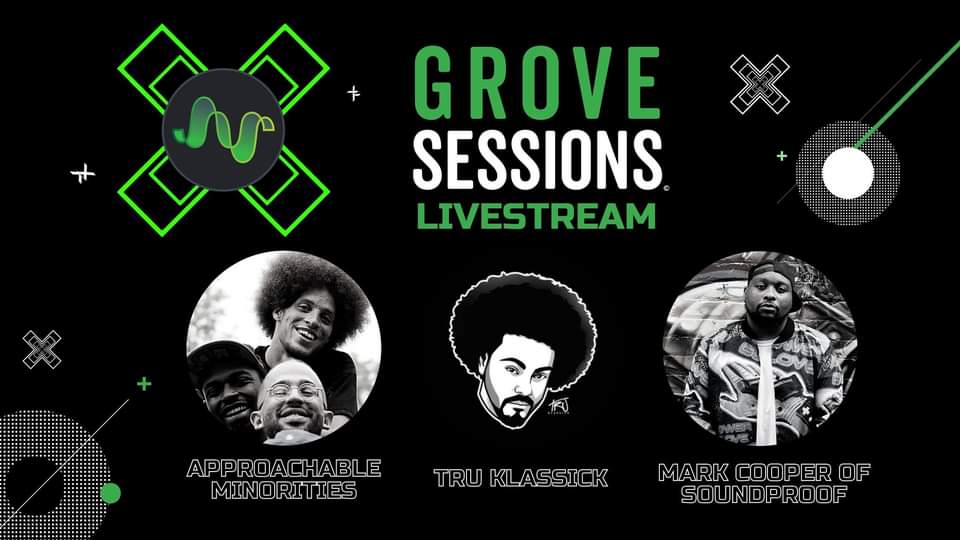
“We want to bring a full Approachable Minorities experience to all who come and watch the stream. Since last year we have been working hard to bring new material for our fans, and we are excited to share that with everyone,” said TJ Greggs, aka MC Lewy Seifer of Approachable Minorities.
“We plan to play some new songs for the Grove Sessions set to give a small glimpse of our new album that we will be releasing over the next year. We continue to practice and work on our craft regularly so that we may bring the best performance for any event that we are a part of.”
Along with his Approachable Minorities partners – MC Druzi Baby, aka Drew Denton, and DJ OnDemand, aka Marcus McKinney – Greggs relishes rejoining Tru Klassick for another live show and teaming up with Soundproof’s Mark Cooper for the first time.
“Tru Klassick always brings superior lyrical diversity and captures the true essence of hip-hop. We have worked and performed with Tru Klassick on many different occasions, and it is always a great time to watch his talent at work. We have not yet had the chance to perform with Mark Cooper, but we are excited to have the chance to share the stage with him,” said Greggs along with his bandmates.
Outside of performing, Approachable Minorities continue to write, record and release new material. The Ypsilanti party rap and conscious hip-hop trio recently contributed and produced tracks for last summer’s community-based hip-hop album, Formula 734, along with Louis Picasso, Sam Watson, Beretta Shells, Konphlict, King Ogundipe, Tru Klassick, Jamall Bufford and Wallace.
One of the project’s most compelling tracks includes Approachable Minorities’ thoughtful, percussive “See Me Dead,” which was inspired by last summer’s Black Lives Matter marches.
Together, they reflect, “Why they wanna see me dead, why they wanna see me dead/Probably cause my skin/Why they wanna see me dead, why they wanna see me dead/Probably cause my hair/Why they wanna see me dead, why they wanna see me dead/Probably cause I’m Black/Why they wanna see me dead/See another brother take two to the head.”
“We were on vacation in Florida when the protests initially began. We had to drive back through the country seeing alerts about the curfews and were worried about our safety while being in the south during these times. We spoke with Rod Wallace, Jamall Bufford and Louis Picasso on our way back, and they explained the situation in Detroit to us,” said Greggs, who formed Approachable Minorities with Denton and McKinney in 2016.
“We had friends down on the front lines being tear-gassed and shot with rubber bullets, and it was horrible to see the videos of the events. When we got back home, we immediately went into the studio and began writing.”
Weekend Lovers delightfully brings the vivid, hallucinogenic dream world of REM sleep to life.
The Tucson, Arizona dream pop-post rock collective unveils a kaleidoscopic collage of masked fashionable friends, trippy desert adventures and vintage landline phones on their latest video for “Baby.”
“I wanted a nonlinear narrative, and the song is told in bites as a tale of emotions. I think our brains also remember things not necessarily in order, and I wanted some of the best visuals I took over the course of some time,” said Marta DeLeon, Weekend Lovers’ vocalist-bassist.
“It’s basically a day in the life of my life in Tucson, and the city is one of the characters too representing the southwest and its beauty. Thrift and dollar store finds and the Halloween section at Target brought the fantasy mood and props to help my cast be funny or interpretive.”
As the video’s director, DeLeon intricately stitched together a series of brief psychedelic vignettes through a Videoleap app on her iPhone. Together, those colorful scenes created the carefree, experimental world depicted in “Baby” along with additional footage from Luke Ralston.
“I carry my iPhone everywhere, so there were more opportunities to shoot things I’d run into daily in my life that might be cool little visuals. Videoleap is a more developed aka Instagram venture with abilities like timing, speed, filters and mixers that allowed me to overlay the double exposure you see,” she said.
“That really helped me pull together all the 2-second to 4-second videos I was strewing together and gave the overall video some seamless pace and movement. I already had some random quirky storyboard images, and I love movies and write lyrics cinematically.”
DeLeon also recruited a fun cast of bandmates and friends to reside within her psychotropic realm. Along with Jungle Jazzy and Laura Eliason, Weekend Lovers’ Brandon Douglas (keys, guitars, backup vocals), Danny Perez (guitar) and Gabriela Lisk (drums, guitars) join DeLeon throughout “Baby.”
“I can’t really say the song wouldn’t soar as well or hit as much without Gaby Lisk or Danny Perez. I wrote the song with this Portishead bassline and vocal phrasing, but Gaby’s hard joyous drum downbeat propelled the opening ‘ooh-ahhs.’ Danny’s guitar is a creepy, crawling beauty, but then his smacking, slinky strumming hits you in the face,” said DeLeon, who’s inspired by shadows and murals in Tucson’s Barrio Viejo neighborhood.
“My engineer Matt Rendon came up with the backup vocals, which give the chorus its tension musically and emotional necessary angst. They were all open to my preconceived ideas with the props or locations. Some moments were just great mistakes.”
Major Murphy’s Jacki Warren, Brian Voortman, Chad Houseman and Jacob Bullard revisit personal struggles and explore newfound intrinsic possibilities on “Access.” Photo – New Archive
With Access, Major Murphy beautifully arrives at the emotive intersection of the past and the future.
The Grand Rapids indie rock quartet of Jacob Bullard (vocals, guitar), Jacki Warren (bass, vocals), Brian Voortman (drums) and Chad Houseman (guitar, keys, percussion) seamlessly navigates undiscovered internal roads filled with uncertainty, contemplation and growth on their boundless sophomore album.
“You have to go rock bottom to be able to adequately move forward. At times, it can be a little dark, scary or intense, but ultimately if you don’t face some of those things, then you’ll be missing the point. Anxiety and stress are definitely fused into the record, but it’s for the purpose of being able to identify things and put them to rest,” Bullard said.
Major Murphy deeply revisits personal struggles and explores newfound intrinsic possibilities across nine introspective, cinematic and experimental tracks on Access, which arrived April 2 via Winspear on all streaming platforms.
Each thoughtful, captivating track weaves a reflective, relatable tale about arriving at an unexpected crossroads and grappling with the amount of control one has in life. Layered with choose-your-own-adventure insights, Access prompts listeners to decide the direction of their next fateful turn.
“I was going through a lot of big changes, and I started writing songs in 2017. Part of the optimism is saying even when everything around you shifts and you don’t really recognize it, the old way of being doesn’t need to hold precedent. You have the find the strength within yourself to accept the new reality and adapt,” Bullard said.
LovelyOcean celebrates pursuing her artistic endeavors on “No Down Payment.” Illustration courtesy of artist
For LovelyOcean, a full-time focus on music will pay dividends for years to come.
The Los Angeles hip-hop singer-songwriter relishes the freedom and gratification of pursuing her emerging creative endeavors on “No Down Payment,” now available on all streaming platforms.
“I like to think of ‘No Down Payment’ as a form of background motivation. It’s like, ‘Yeah, this music isn’t paying any of the bills yet, but that doesn’t mean it won’t someday.’ I think it’s important that we continue to work on things we love as to not get worn down by work, life and other bullshit,” said LovelyOcean.
“Up until this point, I had been working in the social work field, and it was killing my spirit. But it served as the biggest motivation to work on music so I could get out. I quit my job back in March, and I’ve never felt better.”
LovelyOcean celebrates her “No Down Payment” independence as shiny, cyclical synths, jumpy bass and gentle percussion smoothly glide alongside hypnotic, ‘90s-esque beats.
She reflects, “Just trying to break the mold/They warned me as a youth/Back when I played with dough/Things come natural/Need it off top/The world is gonna feel my flow/No static/We live from the radio/Tryna make it through/Ima shine like I was radial/And have a packed house/Up at SoFi Stadium.”
“Somedays I’m like, ‘Damn, I really wish this shit would pay off soon.’ It can be really discouraging to put your all into music, but no one is really fucking with it. I don’t like to have to ask people I’m close with if they’ve listened to the song. I don’t like begging for support,” LovelyOcean said.
“I’ve been using this time to recover and refocus so I can work on an album, but at this moment my songwriting waterfall is kinda dry. I’m glad I don’t feel stressed by work anymore, but I do feel more pressure to be artistic.”
LovelyOcean started co-writing her creative autonomy anthem with Chuck Chill in January. They recorded the track together in their magical closet studio and watched it quickly flourish over several days.
“It took about two days for the song to be written and probably two days to record it. I’ll spend one day recording it so I can get comfortable with it, and then I’ll record it another day so I can really solidify the vibes. Chuck Chill came up with the concept for the song and the majority of the lyrics,” she said.
“This is the first time I have ever let someone else take over the writing, but I knew he would do the song justice because he’s an excellent artist. Chuck Chill and I have collaborated on multiple tracks so far. He was featured on ‘Theta Waves’ on my last EP, and I’ve been featured on a few of his mixtapes.”
Blank Tape Tax raises mental health awareness on “My Book.” Photo – Colleen Rose
Editor’s Note: According to John Hopkins Medicine, 26 percent of adults in the U.S. suffer from mental illness. That means for every 100 people you meet, 26 of them are struggling with mental illness. NAMI research also shows roughly 5 percent of adults in the U.S. struggle with serious mental illness, and 1 percent of Americans suffer from psychotic disorders.
Blank Tape Tax openly shares a personal chapter of past struggles.
The Detroit experimental group and rotating collective boldly recounts the internal anguish associated with lingering mental illness battles on “My Book,” which is now available on all streaming platforms.
“It’s a story about living with bipolar 1 disorder and what recovering from a psychotic break and subsequent hospitalization has been like in a recovery process that has lasted four years. Only recently has mental illness become something that is seen as less stigmatized to talk about in certain circles,” said Ben Yost, Blank Tape Tax’s drummer-vocalist.
“However, in most places, there is still a misunderstanding surrounding mental illness, especially with a disorder like bipolar psychosis, which affects 1 percent of all Americans. Although it was not written with this intention, ‘My Book’ has come to start a dialogue about mental illness and remind people that feelings are mentionable and manageable. Getting help is not a sign of weakness, but rather one of strength.”
Throughout “My Book’s” lo-fi home demo, Blank Tape Tax beautifully reveals that inner strength with Emily Parrish (vocals) and Kavon Williams (piano). Surrounded by somber piano, Parrish poignantly sings, “The words for me are hard to say/I suffer through them every day/And I just want you to hear my pain and to relate/I want to say some old cliché/But oh what the fuck/Here it goes anyway.”
“That being said, I feel conflicted about the lyrics of ‘My Book’ because I felt initially when I wrote them that they were too negative and self-pitying, but after hearing Emily perform it, I’ve come to think that the song is ultimately a positive thing,” Yost said.
“‘My Book’ was written in a few minutes as a stream-of-consciousness poem. I often write this way using free association. I recorded Logan Gaval’s first full-length, Number One, on Flesh and Bone Records, and I was listening to that at the time. I liked the way he sounded like Elliott Smith, and I wanted to write a song in that style (sort of like ‘Needle in the Hay’).”
Yost initially wrote “My Book” as a waltz on his guitar and recorded a demo. The track later blossomed once Parrish added her thoughtful vocals and Williams performed his haunting piano part in Wayne State University’s Old Main Guitar Room.
“I had always planned on re-releasing ‘My Book’ as a single. It took this long primarily because we were still forming a lineup while it was recorded, and then the pandemic hit. When Emily first sang it for us, it was awesome. It reminded me of Janis Ian, but more emotive. Emily really made the song her own while Kavon’s piano was perfect for the song,” Yost said.
Blank Tape Tax also filmed a VHS camcorder-inspired video for “My Book,” which features warm snippets of home movie style footage interspersed with a live performance of Yost, Parrish and Williams. Yost developed the raw, vintage concept for the video after watching two seminal early ‘90s skateboard videos, Blind Skateboards’ “Video Days” and Alien Workshop’s “Memory Screen.”
“The Blind video was a major influence on me as a young kid, and later in life when I saw ‘Memory Screen,’ my imagination had totally been captured by that style of filmmaking. I had also been a fan of Larry Clark and Harmony Korine, and the first two Blank Tape Tax videos for ‘Baby’ and ‘Peachy’ had been done in a similar style by visual artist Genevieve Kuzak,” said Yost, who worked with Ethan Long and Nathan Wilkey to edit the “My Book” video.
“I actually ended up being the one behind the camera while filming ‘My Book’ just out of necessity. The footage fits the audio nicely because they were both captured on tape, which gives it a warm home movie quality. All but the editing and mastering were done using analog technology and magnetic tape.”
“My Book” serves as Blank Tape Tax’s latest compelling single after releasing the pithy hardcore punk-bebop jazz track, “Hey Donnie” and the jazzy hip-hop B-side, “Positive Force and the Discipline of Non-Violence pt. 2” earlier this year. They also dropped a refreshing modal jazz-based cover of Minor Threat’s “Filler” in October.
Looking ahead, Yost and his current Blank Tape Tax lineup of Michael King (upright bass), William Marshall Bennett (piano), Mark Royzenblat (guitar), Issac Burgess (guitar) and Parrish (vocals) will release additional new material soon.
“We have no previews of anything other than lo-fi home demos. We’re trying to do more stuff in high fidelity, and we plan on a single and an EP. We’re also debating doing a full-length since there’s no touring,” Yost said.
ANA shares her deepest emotional reflections and vulnerabilities on “Fall With Me.” Photo – Miles Marie
Filled with sensual, soulful grooves and mellow, jazzy soundscapes, ANA beautifully embarks on a newfound path of self-discovery and intimacy.
Along her transformative journey, the Detroit neo-soul singer-songwriter shares her deepest emotional reflections and vulnerabilities while poignantly embracing personal growth and exhilaration on “Fall With Me.”
“This song is a trifecta of things. A lot of it is about exploring intimacy and being open to that. But self-love was a big one, especially during the pandemic because we have spent so much time being isolated from each other. I feel like a lot of the things we desire become a lot more physical and manifest in a way of self-care while deepening the expectations we have for ourselves and the things that we love to do,” said Ana Gomulka, aka ANA.
Now available on all streaming platforms, “Fall With Me” magically transports listeners to a carefree, breezy spring day that provides instant relief and ample time to recharge. Thoughtful, enduring trumpet, delicate drums, mellifluous bass, fluttering synth and vivid electric guitar provide a mesmerizing escape into ANA’s dreamy world.
Gomulka beautifully sings, “Cause when you show up at my place/And ring my bell/I’ve been feelin’ for ya/You know very well/But if this is too much for you, yeah/We can just kick it like we used to.”
“I decided to put this song out first because I’ve been working on a lot of music that’s going to be coming out in 2021. I also wanted to make this a love song to my audience and the people who have supported me throughout the whole time I’ve been making music,” said Gomulka, who also fronts the jazz-fusion group Honey Monsoon.
“I’ve been writing songs since I was 13 years old, and this is the first time I’ve ever officially put out a single myself as a solo artist. I wanted to make this single to invite people to follow me into the joy of what I’ll be sharing. I’ve always been a really sensual, vulnerable person, and I think a lot of authenticity lies there.”
“Fall With Me” also serves as ANA’s first new material since releasing Honey Monsoon’s 2019 enchanting album, Opal Soul. She invited an all-star team of collaborators to join her on the track, including Haruki Hakoyama (bass, trumpet), Sasha Kashperko (guitar), Todd Watts (drums) and Barry Chambliss (keys), and meld captivating R&B grooves with jazzy, hip-hop beats.
“This song was actually something that just came to me. I had studio time booked already for different songs, but this song was the newest and the freshest one. I had just laid down the guitar part first for the demo,” said Gomulka, who recorded the track at Fundamental Sound Co.
“I did the instrumental, and then the vocals came while the lyrics came afterward. I just reflected and manifested in feeling what I really wanted people to get out of this song. I’ve also been making a lot of electronic music, but I thought it was important to have actual instrumentation on it. I think that comes with the realness of my music, and it’s a reflection of my musical spirit.”