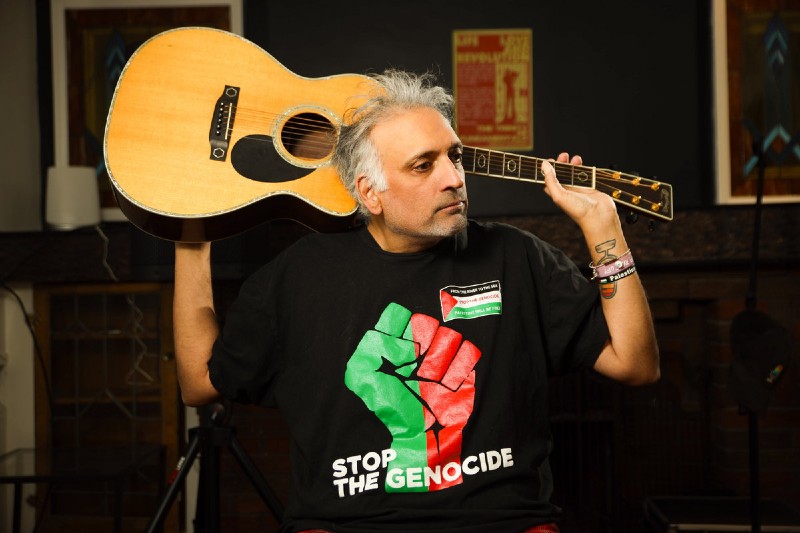
Amrit Kohli confronts sociopolitical issues on “Mama! I Can’t Breathe.” Courtesy photo
One year ago, Amrit Kohli released a sociopolitical album reflecting on resistance and survival.
Known as Mama! I Can’t Breathe, the album’s dozen tracks span almost three decades of songwriting and explore oppression, resilience, Black liberation, and queer identity.
“It’s more than just an album,” said Kohli, a queer folk singer-songwriter and activist from Ferndale, Michigan. “At a time when the world still grapples with the repercussions of George Floyd’s tragic death, I transform pain into art, using music as both a tribute and call-to-action.”
Kohli examines those themes through improvisational lyrics, emotive vocals, and atmospheric instrumentation. On a deeper level, the album helps Kohli confront identity politics and find refuge in authenticity.
“I feel like an imposter in almost every community that I’m in because I’m outside [almost] all of them,” said Kohli, who has Kenyan and Indian heritage.
“I’m either an immigrant or I’m this or that. The queer community is pretty diverse and different, and the queer community I feel like I belong to. I think culturally, ethnically, and all of those things, there’s a lot of fragmentation in my identity that way.”
I recently spoke with Kohli about their latest album ahead of a Stop Starving Gaza benefit show on June 20 at the Ghost Light in Hamtramck, Michigan.
This week’s One Love Symposium includes a series of public conversations, music events and expert panels focused on eliminating discriminatory behavior and racial inequities in the community.
A Washtenaw County symposium aims to forge stronger connections between local communities and public service providers this week.
Known as the One Love Symposium, the three-day event is geared to educate local residents and public service providers who make high-impact decisions for the community, including doctors, teachers and police officers.
Events will occur online and in-person in Ypsilanti and Detroit. They feature police administrators, public school officials, jazz musicians, local business owners, public policy experts and other participants.
Eastern Michigan University researcher Anna Gersh launched a survey and symposium in response to increasing racial, social and political tensions between public service providers and the public after George Floyd’s death in May 2020. She’s enlisted a team of youth data collectors and critical adult thought partners to assist with the survey and symposium.
The symposium also focuses on developing anti-bias training and creating a work certificate for public service providers, or “Human Services Professionals.” The ultimate goal is to create a “Human Services Professional Conference” for “the development of a common scholarship toward improved practices.”
The Stratton Setlist recently chatted with Gersh about the symposium, the work that’s been accomplished, this week’s events and what’s up next.
Dirty Ol’ Men recorded “Six Feet” during the first 100 days of the COVID-19 pandemic. The album’s iconic cover dates back to the Elaine Massacre of 1919 and features seven of 12 men who were wrongly prosecuted and executed for an “attempted insurrection” in Elaine, Arkansas.
The international collective of hip-hop producers, musicians and curators reveal compelling conversations, thought-provoking narratives and tenacious tales about social injustice, systemic racism, internal struggles and personal aspirations on their latest quarantine-fueled album.
“The songs that came out are representative of the discussions and conversations we have as men when we’re not recording. Because as a group, we still get together on a weekly basis or sometimes two to three times a week to just talk. We have members of our collective who may have autoimmune situations, so they haven’t been able to be out and about,” said Rod Wallace, a metro Detroit hip-hop producer.
“We have members of our group who have been through a lot in the last few months. A part of what we do is support them by meeting up and talking regularly; even a song like ‘Piss’ is a song that represents us playfully jiving with each other and talking crazy. It all was just very organic.”
Wallace and his Six Feet collaborators spent the first 100 days of the COVID-19 pandemic writing, recording and producing the project’s seven raw, honest tracks through Songlab TV, an innovative, online one-session approach to songwriting that’s documented by Digital Hustle Films.
“When COVID hit, we decided to build something called Songlab TV where a sample or an idea is given to a producer who makes a beat while a rapper writes and records their verses and an engineer mixes it,” said Wallace about Dirty Ol’ Men’s creative approach for Six Feet.
“Four of the seven songs on the album came from that process; while the other three, they just weren’t recorded, but they went through a similar process. We acknowledge that a lot of music is made that way these days, but a lot of it isn’t made at the time because those four songs were synchronous experiences.”
Executive produced by Wallace and Anthony “Gadget” Mims, Six Feet serves as Dirty Ol’ Men’s second release this year since dropping the Motor City-fueled East Grand in February. Collaborators from Michigan, California, Tennessee, Florida, Illinois and Japan brought initial stems, beats and samples online to share their profound musical conversations with listeners.
Desmond Jones emphatically speaks for countless voices lost to racial injustice.
The Grand Rapids rock-funk-jazz quintet of Isaac Berkowitz (guitar, vocals), John Nowak (drums), Chris Bota (guitars) George Falk (sax) and Taylor Watson (bass) strongly calls for global accountability, peace and unity on their thought-provoking new single and video, “George Floyd.”
Out today, it serves as a growing rally cry from the band and protesters worldwide after the May 25 death of George Floyd in Minneapolis. Desmond Jones has released “George Floyd” exclusively via Bandcamp and will donate half of the proceeds to the NAACP Grand Rapids and the other half to The Bail Project, a national organization that provides free bail assistance to low-income individuals who are legally presumed innocent.
“At the very least, I hope that it acts as a reminder of George Floyd’s story and the countless stories just like it that happen every day in this country without any repercussions. I hope that it makes people say his name and talk about why or how this could have happened,” said Berkowitz, who wrote the track.
Floyd, 46, died after Derek Chauvin, a Minneapolis police offer, kneeled on his neck and back for more than eight minutes during an arrest. Two other officers further restrained Floyd while a third prevented onlookers from intervening. Chauvin has been charged with second-degree murder while Kiernan Lane, Alexander Kueng and Tou Thao have been charged with second-degree aiding and abetting felony murder as well as second-degree aiding and abetting manslaughter.
In response, Desmond Jones’ compelling “George Floyd” single features thoughtful, echoey electric guitars, soft drums and somber sax as Berkowitz seriously reflects, “I can’t breathe he said, the cycle of oppression/Leaves only one direction to be led/I can’t breathe he said, as we heard the pain of generations past and present pled.”
“I hope that it helps people understand that this behavior and complacency of that behavior is unacceptable in this country and on this planet. With the help of the amazing video Nathan Purchase made, I think this song can show how important these issues are to people and what a serious impact our voices can have when we come together to peacefully make the change that needs to happen,” Berkowitz said.
The impactful “George Floyd” video features raw, candid black and white photos of protesters peacefully marching in Grand Rapids, Detroit, Muskegon and Columbus, Ohio. Five local, independent photographers – Nathan Purchase, Nick Small, Adam Berta, James Saville and Ryan Broton – captured and compiled the historical images during last week’s protests.
“They were able to not only capture and convey the tension and the anger of the situation, but also the unifying demand for peace and unity. Each one of these photographers was able to capture a wider image of the state of our country currently. To see how all these different people from all over were coming together in the middle of a pandemic is a powerful thing to see,” Berkowitz said.
“George Floyd” also serves as Desmond Jones’ second new single and video in less than two months. In April, the band released “Major Burbank” as an ode to Jim Carrey’s legendary performance in the 1998 Academy Award-nominated film, “The Truman Show.” While “Major Burbank” celebrates a lighter side of Desmond Jones’ sound, “George Floyd” pushes the band musically and thematically toward a burgeoning political and social conscience.
“I know we are currently working on more songs that approach these political and social issues, which will be a big step forward for us lyrically and content-wise. However, besides more songs, we have been raising and donating money through livestreams and promoting our favorite local and national black artists, musicians and social leaders on social media,” Berkowitz said.
“We also have been directing people toward charities that are helping as well as local black-owned businesses to shop at. In a way, I think we’ve started to find our voice politically and don’t plan on quieting down. We are lucky enough to have a platform and right now we believe it’s right to use that to help fight against social injustice and shine a light on those who are doing all that they can to make a difference.”



 The Stratton Setlist