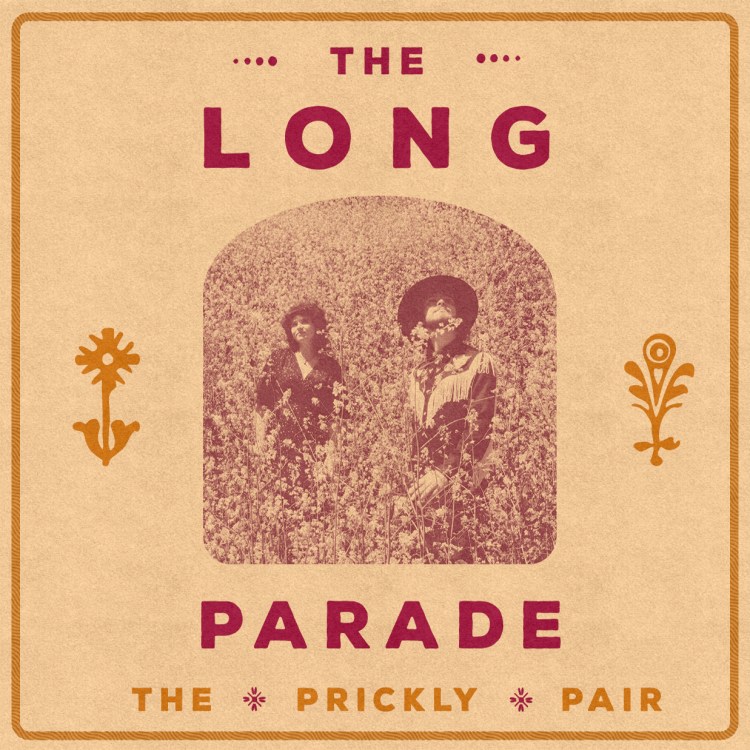
The Prickly Pair channels the heartbreak and betrayal of “A Streetcar Named Desire” on “The Long Parade.” Photo – Caity Krone & Artwork – Spencer Shapeero
For The Prickly Pair, a pandemic-induced film immersion provided an instant gateway to 1950s-era New Orleans.
The Nashville, Tennessee alt-country duo of Mason Summit (vocals, guitars, keys) and Irene Greene (vocals) landed in the throes of “A Streetcar Named Desire” and penned their latest Southern Gothic single, “The Long Parade,” as an ode to Tennessee Williams.
“We actually wrote that song for a Tennessee Williams tribute my mom was putting on as part of her literary series, Library Girl,” said Summit about the 1951 film based on Williams’ 1947 Pulitzer Prize-winning play.
“We often get inspired by dialogue or visuals in movies, and we were taking notes while watching the film adaptation of ‘Streetcar.’”
Throughout “The Long Parade,” The Prickly Pair become entangled in the heartbreak and betrayal of Blanche, Stanley, Stella and Mitch. Twangy lap steel, nonchalant acoustic guitar, strolling bass, somber keys, steady drums and glistening cymbals plead for serenity and closure.
Summit and Greene sing, “Pearls before swine/Pull the wool over my eyes/‘Cause I can’t tell the truth/From my own lies.”
“It’s more of an attempt to capture the overall vibe, but I think people see themselves in these characters,” Summit said. “I hope people can relate to the song in a similar way. I personally find the chorus very cathartic to play.”
The Los Angeles indie folk singer-songwriter quickly attracts the “nano” emotions buried deep within the atomic structure of our subconscious on his latest album.
Out Friday via all streaming platforms, Negative Space reveals a microcosm of inner thoughts and deep revelations about failed relationships, reluctant confidants, unspoken feelings, hidden anxieties, turbulent endings, personal resignations, unexpected transitions and closed chapters.
“The overarching themes include a lot of regret and a lot of trepidation until we get to ‘Round January.’ Some of the songs are more personal in that sense than others, and others were more conceptual like ‘Cause for Concern,’ which I had thought of as an album name initially. I thought, ‘People are going to hear these songs, and they’re going to be concerned about my well-being,’” Summit said.
Summit poignantly addresses that fractured sense of well-being throughout Negative Space’s raw, honest 10 tracks. Despite a barrage of dark emotions and difficult experiences, each track moves Summit and listeners one step closer to stronger, wiser and better versions of themselves. Fittingly, Negative Spaceis akin to chronicling years of internal growth and self-acceptance in a 30-minute span.
“Most of the songs were written in a songwriting class at USC. Some of those came from specific prompts like ‘Round January.’ I probably wouldn’t have written that song had it not been for the prompt,” said Summit, who studied songwriting and graduated from the University of Southern California (USC) in May.
“Obviously, you always want them to sound personal, like on ‘Doomed from the Start.’ For that song, I was thinking about my first serious relationship, which started in high school, and how it didn’t last because it was all about learning how to be in a relationship.”
Mason Summit will release his fifth album, “Negative Space,” on April 3. Photo by Spencer Shapeero
Mason Summit brilliantly shines on the darkest January days.
The Los Angeles indie folk rock singer-songwriter thaws the winter blues with his latest magical single, “‘Round January,” which drops today via all streaming platforms.
Summit’s track fuses sorrowful acoustic guitar strums and delicate drum taps with vibrant electric and slide guitars – “I hope one day I can tell you this won’t last/And be right/Cuz I know how you get when the sun sets early/But there’s a better way/There must be surely/But maybe you’ll make it out alive/Maybe you’ll just survive.” It’s also ideally suited for a fruitful collaboration with Wilco’s Jeff Tweedy and Nels Cline.
“‘Round January” single artwork – Cover by Spencer Shapeero
In a sense, Summit’s exquisite combination of acoustic, electric and slide guitars represent the warring emotional factions within us. Deep inside, there’s a hope that wants burst through, but the darkness fights back with a vengeance.
“It’s specifically the month my dad died, and it’s also when I introduce the song now, and what makes it more broadly applicable to different people’s lives is seasonal depression. I probably experienced that unknowingly since before my dad died, you know the melancholy of those months, especially like the line, ‘when the sun sets early,’” said Summit, who also struggles with the lack of daylight in winter.
“It was just instant depression for me. It made me tired all the time, and I didn’t want to get out of bed. I don’t have it as bad as a lot of people, but it definitely influences my mood in a disproportionate way.”
Two years ago, Summit penned “‘Round January” as a response to a songwriting class prompt at the University of Southern California (USC). The prompt required students to write a song to their eighth-grade selves.
“And that was a week when a lot of people brought in some heavy stuff,” said Summit, a songwriting senior who will graduate in May. “It was just so provocative, and so I was thinking back to eighth grade, and middle school in general is when people tend to be struggling and trying to find out who they are.”
For Summit, the track also advocates the importance of therapy in tackling seasonal depression and other mental health challenges. He came from a family that believed in its long-term healing power.
“When I got to school, I met a lot of people who didn’t come from that and ended up having a lot of undiagnosed issues. They just didn’t know how to deal with it, and it took them so long to have the courage to go to therapy or go to a psychiatrist and start treating their illness with therapy and medication,” Summit said. “Whereas I had already started to sort that out by that time, there were actually specific people in my life I was writing it for as well as myself.”




 The Stratton Setlist