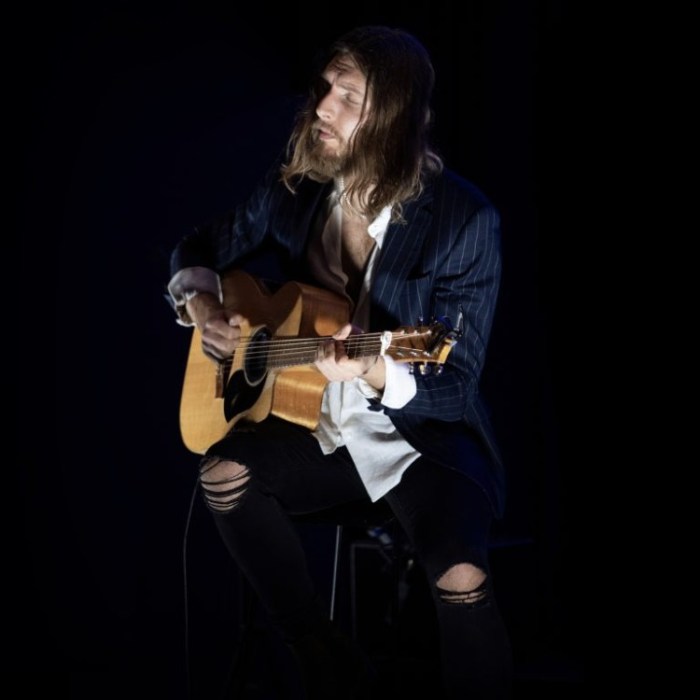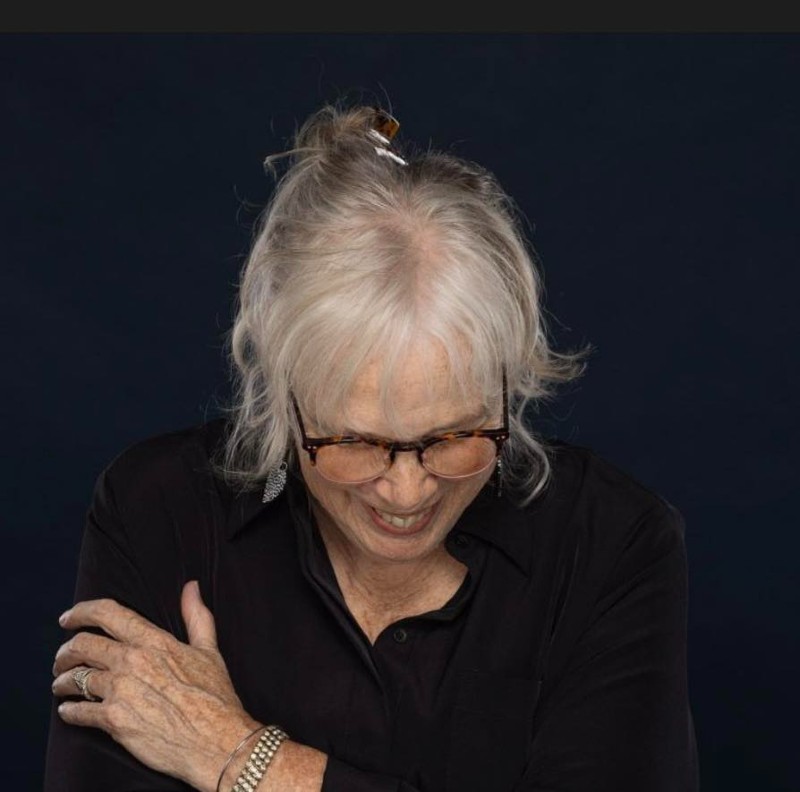
“It was well-received, and we had so much fun performing together that we decided to turn it into something,” Ankley said. “I suggested the name Triana, which means ‘three rivers.’ Since we are three different women with three different styles, it seemed fitting.”
Nearly a year later, Ankley, Chenard, and GlenBrooke are fusing their country, Americana, blues, and rock influences together for Triana’s rich, harmony-driven sound. The trio will share that sound during a September 13 performance at Trinity House Theatre in Livonia.
“We all come from different musical directions, which seem to blend together,” Ankley said.
To learn more, I did an email interview with Ankley about Triana ahead of the show.
Tom Curless and Chip Saam of Crossword Smiles. Photo by Madeline Curless.
Editor’s Note: This article originally appeared on the Ann Arbor District Library’s Pulpblog.
Tom Curless and Chip Saam anticipate life’s twists and turns and adjust their plans and perspectives accordingly on Consequences & Detours, the new album by their band, Crossword Smiles.
“At this point in our lives, we start to have a different perspective on life,” said Curless, who lives south of Flint in the town of Grand Blanc.
“You start to see things a little higher at a 30,000-foot view. I’ve lost people, I’ve lost my parents, and all of a sudden, you say, ‘Wow, life seems a little bit different now.’”
That wise perspective permeates Crossword Smiles’ songwriting on its sophomore release, which features 11 tracks about anticipation, disappointment, and discovery.
“I don’t think you can get away from it,” said Saam, who previously lived in Dexter and now resides in the West Michigan town of Dimondale. “If you’re making music and writing songs, some of your life is going to seep into it. There are some specific references to things like in ‘Typical Waving Goodbye.’ I lost a buddy … and I didn’t know when I was saying goodbye to him that I was saying goodbye for good.”
Those relatable experiences on Consequences & Detours quickly connect with listeners, thanks to the duo’s memorable lyrics, infectious harmonies, vivid electric guitars, and melodic instrumentation.
“We really both contributed a lot of things to each song,” said Saam, also a University of Michigan alumnus and host of the internet show Indie Pop Takeout. “It was very fulfilling for me as a musician.”
The musicianship extends to the arrangements, too, which feature violin, mandolin, trumpet, and accordion to augment the core of guitar, bass, and drums.
“We purposely went after different sonic touches on every song if we could,” Curless said.
I recently spoke with Curless and Sam about the album ahead of a May 31 show at Trinity House Theatre in Livonia.
The Plymouth, Michigan singer-songwriter values the intimate Livonia music venue and its longtime support of independent artists.
“I really appreciate what they do for the music community—for listeners and performers,” said Jewett, who’s performed six times at Trinity House Theatre.
“While locals get to perform there, and a lot of regional and national artists as they’re passing through, they’re quite accommodating, and it operates entirely on a volunteer support basis.”
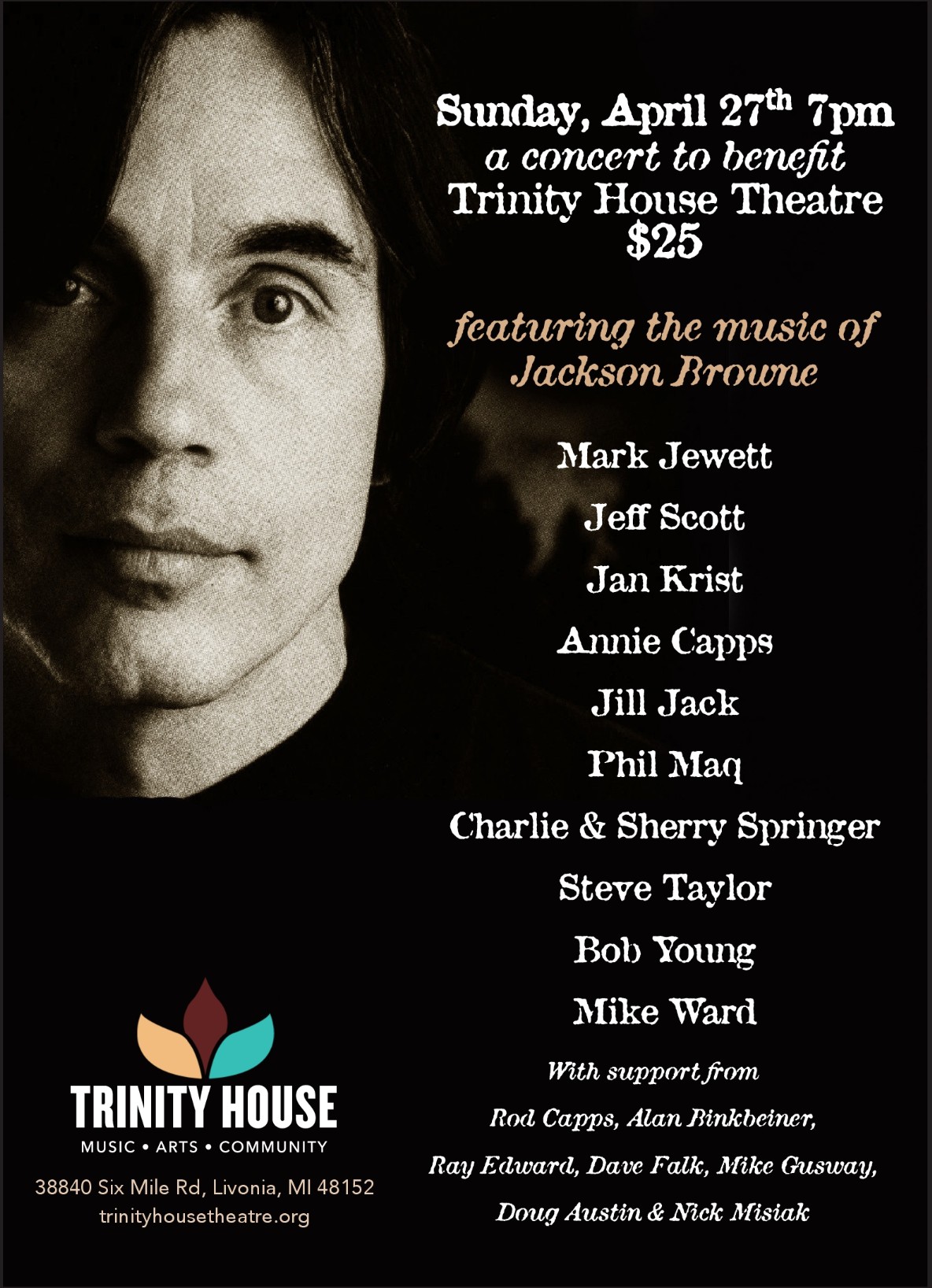
Given that ongoing support, Jewett wanted to give back to the nonprofit theatre and spotlight its 26 years of hosting live music.
He quickly landed on organizing a benefit show, which would donate all ticket proceeds to the theatre and highlight the music of Jackson Browne.
“Over the years, they’ve had at least one annual show to help support the theatre,” he said. “I know there are a lot of people who feel that appreciation and many of them are in the show.”
Billed as Trinity House Benefit: Celebrating the Music of Jackson Browne, the April 27 show will feature an array of Michigan singer-songwriters, including Jeff Scott, Jan Krist, Jill Jack, Annie Capps, Charlie and Sherry Springer, Steve Taylor, Phil Maq, Mike Ward, Bob Sky Young, Jewett, and others, performing songs from Browne’s extensive catalog.
The folk-jazz singer-songwriter and multi-instrumentalist felt inspired to create one after seeing a revue with daughter Grace Hazlett at Meadow Brook Theatre in Rochester, Michigan.
“She was working at the theatre and would get us free tickets sometimes, and we went to a revue of ‘30s and ‘40s songs. There’s no dialogue, no plot—they’re just doing these songs—and I just had a great time,” said Hazlett, who’s from Waterford.
“I was thinking, ‘Wouldn’t it be fun as a songwriter to try and write a revue of songs like this in that style?’ And that’s an oxymoron because it wouldn’t be a revue, but that idea was kicking around in my head.”
What resulted is Calling Winston, an original musical Hazlett co-wrote with Grace Hazlett, a theater professional. It revolves around Winston Coleman, a fictional Tin Pan Alley songwriter and jazz musician who spent most of his career trying to get his songs featured in Hollywood musicals.
At age 85, Coleman reflects on his life and career while spending time with J.P., his great-nephew. During their visits, J.P. learns about Coleman’s past and the nation’s history through several references to famous Hollywood musicals.
While Calling Winston takes place in 1990, the musical’s 20 songs span nearly three decades—from 1929 to 1956—with the final song being Coleman’s latest creation.
“I needed to come up with someone who wrote the songs because it couldn’t be me,” Hazlett said. “I had to come up with a fictional songwriter, and I came up with this guy, Winston Coleman, and started filling in his details.”
The show will feature Hazlett performing the musical’s songs in a concert format with narrator/singer-songwriter Marty Kohn and singer-songwriter Amy Petty.
“Grace is gonna come up here [from Cincinnati], and [she’s] gonna do some costumes and dress us,” Hazlett said. “I’m playing all the instruments and doing the male vocals, and Amy is doing the female vocals. We’re going to have a [visual presentation] by Wolf Tytschkowski and Margaret Hazlett to show credits, photos, and movie posters. It’s going to enhance the experience.”
To learn more, I spoke with Hazlett about Calling Winston ahead of the show.
The show includes a mixture of performance and conversation: Edwards and Green will perform songs from their catalogs, interview each other about songwriting, and take questions from the audience.
“People don’t really talk about the process and talk about the nuts and bolts of how this song came to be or how a song comes to be,” said Edwards about the show’s format at the Livonia, Michigan listening room. “I think this will dig more into that.”
To prepare for the event, the duo sought inspiration from a songwriting group called Song Salon and a past TV show called Inside the Actors Studio.
“We bring in songs in any form and critique them … We just dig in, and we get really deep into the weeds of saying, ‘That word doesn’t work.’ We make suggestions, and my songs are all better as a result of being part of [Song Salon],” said Green, who also works as a booking agent.
“But it came out of that work, and I thought about Inside the Actors Studio and realized people would be interested in this. Trinity House is small enough that we can get a good-sized group of people in there, and it’s a home for many singer-songwriters in Southeastern Michigan.”
During the show, Edwards and Green will each perform 10 to 11 songs, including a mix of new material and past favorites. In 2023, Edwards released his latest album, So Far, and Green released his debut album, Listening for the Bell.
“Mike and I write differently,” Edwards said. “I tend to repeat a lot of the choruses in my songs, and Mike doesn’t so much. I’m interested to hear what influenced him to take that path and why he writes like that.”
The show also serves as a “pilot” for How’d You Write That? and allows the duo to test the waters before launching a regular series in the fall. They would curate the series and include singer-songwriters who are willing to interview each other.
“There’s not that many moving parts to it. It’s just something that we’re both interested in, and we think many people that we know will be interested,” Green said.
“Hopefully, there will be more than the people that we know. Based on the early social media stuff we’ve been doing, many people have said they’re interested.”
“It’s crazy that I’ve taken that long,” said Bizer about his new folk album,About Time. “I’ve done things in between, and the thing I did the most was the duo with Jan, but I wound up in a few different bands and made records with some of them.”
Even as he worked on different projects, Bizer’s songs forAbout Time started brewing in 2005, and they began accumulating.
He eventually landed on 13 tracks for his third solo album and noticed a theme of time had emerged. OnAbout Time, Bizer brings that theme to life through evocative lyrics and soundtracks it with earnest folk instrumentation.
“Not that every single song deals directly with time, but a fair number of them do. I got a kick out of writing ‘Going Nowhere’ about slowing time down and what that could mean and how that would work,” said Bizer, who producedAbout Time and played guitar, bass, and guitjo.
“There’s also the fact that it’s been so long since I put out my last record, and time played a piece of that. And I think of these songs as a time capsule of the last 20 years, so time was so much on my mind as I was putting the record together.”
To learn more, I spoke to Bizer about his latest album ahead of a July 7 show at Livonia’s Trinity House Theatre.
Detroit folk singer-songwriter Mike Ward. Photo by Danny Ward.
Editor’s Note: This article originally appeared on the Ann Arbor District Library’s Pulp blog.
The state of the world weighs heavily on Mike Ward’s mind.
That concern prompted the Detroit singer-songwriter to pen a new folk song called “Why Not,” which sends an encouraging message to help others.
“When I have played it, people get how the song starts out small, gets broader as it goes on, and ends at a point where it’s up to us on a personal level,” said Ward, who’s also a University of Michigan alumnus.
“One of the things I have to work hard at is trying not to be too preachy, especially when I’m writing about things on a political level. It’s one of the areas where I try to find a balance.”
Backed by hopeful acoustic guitar and cello, he sings, “Why not do some good today with the time that we’ve got / Start with something simple / A lesson learned or to be taught / Plant a seed or lend a hand / A little helps a lot.”
“I’ve also been looking at not only how that affects the world in general, but also how it’s affecting people’s relationships,” Ward said. “It goes as broad as the country, but as narrow as some relationships and the struggles that people are having.”
“Why Not” is one of several songs Ward will be performing with Sara Gibson (cello) and Annie Bacon (vocals) at an April 28 show at the Downtown branch of the Ann Arbor District Library.
Ahead of the show, I spoke with Ward about his current state, his career transition from advertising to music, past albums, his latest songwriting efforts, his setlist for the AADL show, and plans for new material.
Carolyn Striho and Scott Dailey focus on the journey ahead on their latest single.
For Carolyn Striho, the road of life is full of unexpected twists and turns.
But those challenges don’t prevent the Detroit singer-songwriter from moving forward.
That perseverance fuels some of the inspiration behind her latest blues-rock single, “14 Miles of Bad Road,” with husband/guitarist Scott Dailey.
“If you say you’ve been on 14 miles of bad road, it sounds far. When I wrote it, I was thinking more of being up north with roads all over the place,” Striho said. “When you think about it, it could be anywhere—a city or a town.”
Determined to reach their next destination, she sings alongside propulsive electric guitar, bass, organ, and drums, “I wish all the world could see you and me again / I wish all the world could feel like a friend again / I wish all the world could be like a kid again / I wish all the world … / I tried, my friend / You lied again / I tried again / You lied …”
“Scott came up with the lyrics, ‘I tried, my friend / You lied again,’ and it makes sense, meaning, ‘You thought there was a rosy picture of life, and when you’re young, everything seems so good,’” said Striho, who shares counterpoint vocals with Dailey on the track’s chorus.
“You also might think someone’s going to swoop in and make everything better if life’s not going well. That doesn’t always happen, though.”
Kyran Daniel headlines several upcoming live shows in partnership with the Michigan Fingerstyle Guitar Society.
As longtime musicians, Ron Stavale and Yeman Al-Rawi strongly advocate for fingerstyle guitarists in Michigan and beyond.
The Michigan Fingerstyle Guitar Society (MFGS) members celebrate the skill and artistry of contemporary acoustic guitarists by showcasing their talent and technique through live shows and workshops.
“When you see an artist, it’s not gimmicky like somebody with a drum and a bell on their head doing all these things,” said Stavale, who’s played fingerstyle guitar since his 20s.
“They’re orchestrating compositions on a guitar by filling in all the things that maybe Yeman and I or another person would try and do. They do it in such a way that really draws me in.”
Mike Ward highlights the fleeting passage of time on “Particles to Pearls.” Photo – Danny Ward
For Mike Ward, a new album chronicles a thoughtful evolution of sound.
The Detroit Americana singer-songwriter carefully transforms a dozen acoustic tracks into an earnest collection of expansive tales on Particles to Pearls.
“I think the first track we added any instruments to was ‘All We Have Are Words.’ David Roof played the electric guitar on it, and I thought, ‘Wow, that’s what this can sound like.’ I’d been playing that by myself for two years,” said Ward about his third Psychosongs album.
“Because it’s been two years since I wrote most of those songs, and that’s right about now, every day on Facebook there’s a memory of the song, and I get to hear how I first wrote it.”
During the 2020 pandemic lockdown, Ward penned 31 new tracks as part of a 30 Songs in 30 Days songwriting challenge with New York City folk-rock singer-songwriter Paul Winfield. The poignant tracks opened his creative floodgates and pushed him deeper into the songwriting trenches.
“They’re all moments in time. The album has a number of those songs,” Ward said. “I’m pretty happy with the end results. David Roof plays bass on everything, but he also plays a 12-string Rickenbacker electric guitar on ‘Back Again.’ We wanted a Byrds/Roger McGuinn-style sound on it.”