Abby Bracken, David Michael, Alan Cook, Jenna Stokes, and Sophie Bracken of OUT Ensemble. Photo – Da Ping Luo.
Editor’s Note: This article originally appeared on the Ann Arbor District Library’s Pulpblog.
Now that she’s finished graduate school, Sophie Bracken finds herself longing for past springs.
The University of Michigan alum and Ann Arbor clarinetist channels that feeling when she performs “I cannot meet the Spring unmoved” with OUT Ensemble, a wind quintet composed of LGBTQ+ musicians performing and commissioning the works of queer classical composers.
“I know that I myself am kind of nostalgic in spring for my high school days and some of the things we would do together in high school band,” said Bracken, who recently graduated with a master’s degree in chamber music. “I think it’s just a really interesting way to reflect on spring.”
Composed by U-M alum Nora Farley, “I cannot meet the Spring unmoved” is titled after and inspired by the Emily Dickinson poem of the same name.
“I really like Nora’s interpretation of spring,” Bracken said. “The Emily Dickinson poem, as well, that she’s drawing from has a lot of nostalgia and longing, which isn’t necessarily what you associate with spring—it’s usually a season of renewal and hope.”
The piece also serves as the opening track from OUT Ensemble’s debut album, Seasons of Change, which comes out May 22.
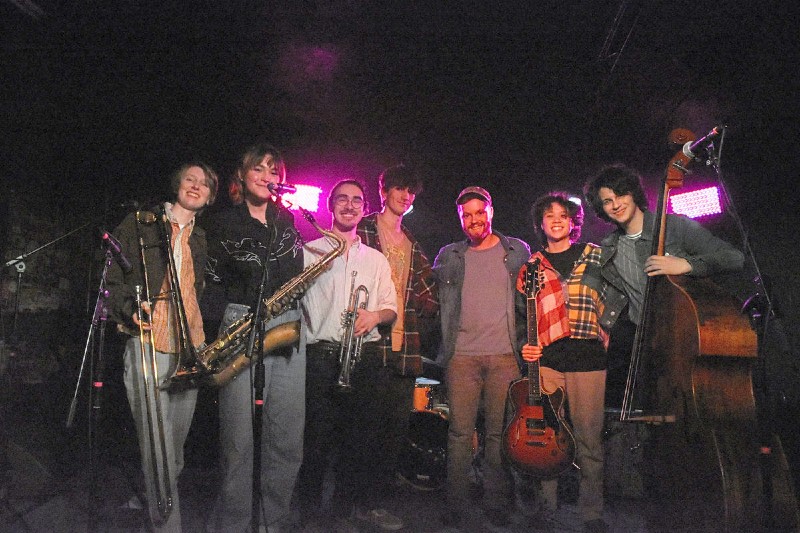
From left: SC Klein, Em Spencer, Elena Bressler, Liam Charron, Jack Harris, Corazon Szell, and Andres Soto of North Ingalls. Photo taken from North Ingalls’ Bandcamp page.
Editor’s Note: This article originally appeared on the Ann Arbor District Library’s Pulpblog.
“One Track Mind” features a Washtenaw County artist or band discussing one song from their latest release.
Standout Track: No. 1, “North Ingalls Street,” from North Ingalls. The seven-piece band’s debut release, To Be Loved Back, is about finding love through different relationships. On “North Ingalls Street,” singer-songwriter Corazon Szell finds refuge and community at a house on 213 North Ingalls Street in Ann Arbor. A U-M alumna and a player for the women’s rugby team, she lived there with the team for two years before graduating in 2025. “Before I even lived there, it was a place that always had its doors open. A place where I could go to escape my dorm and hang out with my friends that I had made on the team. And when I moved in, I wanted to continue the idea that all are welcome. ‘North Ingalls Street’ was inspired by that idea. The idea that no matter what is going on in your life—good, bad, happy, sad—there will always be a place for you to come and share, and to feel safe doing so. The memories that I have in that house with my roommates, my friends, and my family, hosting potlucks, board game nights, movie nights, bonfires, and more, are some I will never forget.” Continue reading “One Track Mind — North Ingalls, “North Ingalls Street””→
Editor’s Note: This article originally appeared on the Ann Arbor District Library’s Pulpblog.
In August 1983, 200 people entered a new dimension above the Heidelberg in Ann Arbor.
The clubgoers stepped into an unfamiliar yet fascinating music realm at the Big Beat Club, now known as Club Above, to dance the night away.
“Want to be on the cutting edge?” wrote Jim Boyd for The Michigan Daily on July 28, 1983. “New York, as usual, is the place to be, but this Friday you can save the plane fare by going to the Big Beat Club. There you will be able to experience the latest music/dance craze that is now surfacing in New York. It’s called ‘hip hop’ and its impact may prove to be culturally vast.”
The show was pushed back to August 5, 1983, but when the concert finally happened, curious viewers arrived to watch Harold “Whiz Kid” McGuire, a New York City DJ, spin and mix records in a “new” musical style known as “hip-hop.”
“There have been articles about ‘hip hop’ – which includes a style of manipulating turntables known as ‘scratching,’ for which the Whiz Kid is known, ‘break’ dancing, and ‘rapping’ – in such prestigious publications as Rolling Stone and the New Musical Express,” wrote Bill Brown in a July 23, 1983 article for The Ann Arbor News.
During Whiz Kid’s mesmerizing set, clubgoers watched his hands move as smoothly as a Kung Fu master while he played, mixed, and scratched records.
“The Whiz Kid’s ‘show’ consisted of a continuous, five-hour stream of heavily synthesized, emphatically rhythmic dance music,” wrote Brown in an August 12, 1983, review for The Ann Arbor News.
“At some points, especially when more people were watching him than dancing, he would play straight, uninterrupted records such as ‘Billie Jean.’ He would gradually throw in rhythmic accents that he either improvised on his electronic drum machine, created by manipulating the turntable’s needle, or snatched directly from other records.”
George Mashour explores the evolution of the self on Eulogy for My Ego Death. Photo courtesy of the artist.
Editor’s Note: This article originally appeared on the Ann Arbor District Library’s Pulpblog.
In 2019, George Mashour aspired to make a psychedelic rock album.
The anesthesiologist and neuroscientist had just turned 50 and wanted to step outside the medical world to pursue a musical project.
“I was reflecting on what I wanted to do in the next phase of my life … and [I’d] been writing all these songs—sometimes just in my head—some of them [were] decades old,” said Mashour, a University of Michigan researcher who studies consciousness and has been dabbling in music over the years.
“For my 50th birthday, my wife got me a gift certificate for studio time at Big Sky [Recording], which was cool, and in retrospect I’m really glad she did that.”
Later that year, he became chair of U-M’s Department of Anesthesiology, and then COVID hit in early 2020.
“I was super busy, and of course, everything was shut down,” Mashour said. “And yet I still had that physical gift certificate for eight hours of studio time … so it was just always on my mind. And then it was 2023 when I said, ‘You know what, I’m going to do this,’ so I got in touch with Geoff [Michael], who’s the owner of Big Sky.”
Michael connected Mashour with Marty Gray, an Ann Arbor producer, engineer, singer-songwriter, and multi-instrumentalist, to help record his debut album.
“I had never been to a studio before, never recorded music before, and had no idea of what was going to happen,” said Mashour, who worked with Gray over several studio sessions. “And I walked out of that first four-hour session with a sense of joy that I can’t even remember the last time I had experienced.”
What resulted is Eulogy for My Ego Death, a ‘60s-inspired psych-rock album filled with existential lyrics, dreamy vocals, fuzzy electric guitars, and groovy instrumentation.
“Generally speaking, in that psychedelic genre, it’s about experience, it’s about great melody, and it’s about the self,” Mashour said. “It’s not what I would call a concept album per se in terms of a narrative thread going from start to finish, but there certainly are conceptual relationships to a lot of the different songs.”
To learn more, I spoke with Mashour about the inspiration behind his album as well as his psychedelic hip-hop project VaporDaze.
The Metro Detroit singer-songwriter follows his instincts and keeps the detractors at bay on “Don’t Let Them In.”
“For me, last year was so nuts with the election and everything. It’s easy to get swept up in all of that. In some ways, it connects back to us,” said Trager about his latest indie-folk single.
“I was thinking about the single and the meaning behind it and staying true to your own beliefs and behaviors. It’s easy to get swept up in the media, and we have so much access to things. You can lose yourself and lose the things that matter to you.”
In response, Trager pledges to keep himself grounded and focused on “Don’t Let Them In.”
Backed by earnest acoustic guitar, cello, and Mellotron, he sings, “They will give you a thousand reasons / And you’ll be tempted to believe them / But all their conviction is just a fiction / Oh please, don’t let them in.”
“I had had enough distance from the song that I needed to hear the message,” said Trager, who recorded the single in 2021. “It’s not letting anything stop you from doing whatever you want to do.”
To learn more, I spoke with Trager ahead of a February 8 show at Trixie’s Bar in Hamtramck, Michigan.
“My daughter Alyson is off to the University of North Carolina School of the Arts next month, and I’ve been weeping big dad tears on and off all summer,” said the Dexter singer-songwriter and multi-instrumentalist.
Alyson is a singer, and she’ll join her dad for a special show at The Ark on August 8 along with bandmates Chris DuPont, Drew De Four, Brennan Andes, Keith Billik, and Mike Shea.
Brad has also been busy as a lecturer at the University of Michigan, a resident artist at The Purple Rose Theatre Company, touring with actress and singer Patti LuPone, and featuring on her new album, A Life in Notes, playing violin, mandolin, guitar, octave mandolin, and U-bass.
“Patti is an icon and it’s no accident. She’s a legend for a reason and to be on stage with her in front of her adoring fans is electric,” Phillips said. “Summer has been both chaotic, emotional, and wonderful all at the same time! It’s been a big year around here.”
To learn more, I spoke with Phillips about his work and tour with Patti LuPone and his family’s artistic accomplishments.
Seeing the breakdancing prowess of Kelly, Ozone, and Turbo in the films instantly captured my attention and spurred nine-year-old me to experiment with some moves of my own.
While I couldn’t quite emulate the popping, up-rocking, down-rocking, or power moves of the films’ heroes, I embraced a love of dancing and developed my own quirky style over the years.
As I grew up, I danced to the music of Run-D.M.C., Beastie Boys, Salt-N-Pepa, LL Cool J, DJ Jazzy Jeff & the Fresh Prince, Rob Base & DJ E-Z Rock, Young MC, MC Hammer, and others.
By high school, I had started learning about three of the five elements of hip-hop—rapping, DJing, and breakdancing—and would encounter the other two—graffiti and historical knowledge—as an adult.
Known asHip Hop @ 50: Defs, Dates, Divas, Detroit & Dilla, the exhibit celebrates the 50th anniversary of the culture and explores its evolution across music, society, fashion, language, entertainment, and politics.
Cece June chronicles loss, acceptance, and growth on “How Did This Get So Heavy?” Photo – Gabby Mack
Editor’s Note: This article originally appeared on the Ann Arbor District Library’s Pulp blog.
For Cece June, life is filled with near-misses and unresolved emotions.
The New York City singer-songwriter processes a gamut of feelings—from heartbreak to frustration to hope—about unclosed chapters on her latest indie-folk EP,How Did This Get So Heavy?
“It’s a feeling that emulates the void when something is no longer in your life. It’s that feeling of trying to grapple with not having people around anymore or accepting that you’re going to have to move on,” said June, a University of Michigan alumna from Barcelona, Spain.
“It’s also feeling displaced or feeling frustrated. For instance, on ‘Things Unsaid,’ you’re [ruminating] on why something could have gone wrong and thinking, ‘I could potentially have an idea of what went wrong, but if I wanted to talk to the person for them to tell me and for me to get closure I can’t because they’re no longer in my life.’ There’s no way to answer those questions to let you move forward and move on easier.”
Despite those challenges, June faces her emotions head-on and looks to the future on her sophomore release. She chronicles loss, acceptance, and growth across eight tracks, which feature cathartic lyrics and wistful stripped-down instrumentation.
“I found solace in seeing the songs evolve as I evolved as a person myself. This EP was written and recorded over two-and-a-half to three years,” June said.
“There were songs that would ebb and flow, and there were times when I was recording them in the thick of the pain or times when I was reminiscing … and no longer being in the depths of that feeling or the grief or the heartbreak.”
To learn more, I spoke with June about her EP and the inspiration behind it.
While the pop-rock singer-songwriter and multi-instrumentalist hails from New York City, she’s ecstatic about attending the University of Michigan this fall as a freshman to study music.
So much in fact that Orensteen has written a song called “Michigan,” which pays homage to the school and serves as the aspirational opener from her debut album, AmericanGirl.
“This song turned into a way that I could express my love for Michigan even though I had never been there [before] or had never seen it,” she said.
“I got in contact with the University of Michigan about using my song for their social media. I also sent in the song with my application, and I didn’t even tell my parents I was applying. And then I got in, and they said, ‘What?’”
Despite that surprise, Orensteen learned of her acceptance to U-M in February and has started planning for the fall.
She shares that sentiment in “Michigan” alongside hopeful acoustic guitar and electric guitar while singing: “I’ve never been to Michigan, but I’ve heard it’s nice / You’re going away, going to college, gonna start a new life / You’ll remember me / When you see my name in lights / And you’ll say, ‘Wow, she was right.’”
“I’ve always loved the University of Michigan, and I wrote this in one of my supplemental essays when I applied there,” said Orensteen, who will graduate from New York City’s Professional Children’s School in June.
“I never told my parents or anybody that I loved the University of Michigan, but I’ve always followed the school and their football team. I never thought I’d go there or get into the school.”
Orensteen’s “Michigan” is one of 13 coming-of-age tracks featured onAmericanGirl, which includes introspective lyrics about life and love and spirited pop-rock and pop-punk instrumentation.
I recently spoke with Orensteen about her background and influences, her latest album and songs, her creative process for the album, her producers and collaborators, and her plans for the summer.
The producer, musician, songwriter, rapper, visual artist, filmmaker, and digital archivist recalled feeling nervous about sharing vulnerable folk songs and playing a nylon-string guitar at the Ann Arbor venue.
“It was such a jarring experience almost to go from performing in sweaty clubs and bars where everybody’s dancing … and having a good time to this very stark, acoustic performance where I’m baring my soul,” said Haywood, a University of Michigan alumnus who had previously performed live with the local hip-hop group Tree City.
“I feel like that performance was some sort of watershed moment for me because I had to prove to myself that I could do it. I had never done a performance like that with just an acoustic guitar and myself.”
Fortunately, Haywood’s intimate performance was recorded on cassette by Fred Thomas and initially released on limited-edition tape through Thomas’ Life Like label in 2015. Today, part of that performance now appears on Haywood’s latest live album, Canterbury Tales.
“I spent the past 10 years or so honing them and working on the mixes and cleaning up some of the noise and things like that to get them to the point they’re at now,” Haywood said.
“When you’re dealing with tape, you have fewer options, so you really have to work in a detailed way to be able to massage those recordings and get the good stuff out and take some of the noise down. That’s something I’ve been tinkering with—those Canterbury House recordings—and I feel like now my tinkering is done.”