
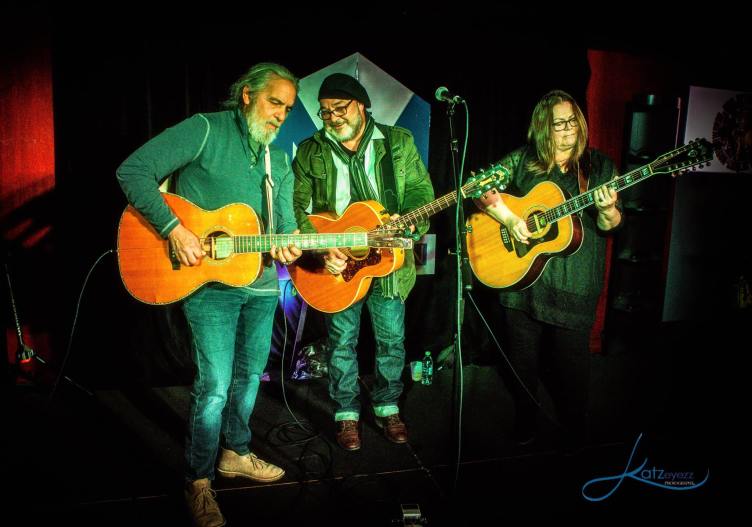
Back in 1986, Billy Brandt and JC Whitelaw placed an ad in the Metro Times looking for a female vocalist and instrumentalist.
The two Metro Detroit singer-songwriters envisioned forming a folk-rock band—now known as Ash Can Van Gogh—that specialized in three-part harmonies.
It wasn’t long until Mary McGuire saw the ad and called Brandt from a payphone at the Inn Season Café in Royal Oak. The Lansing singer-songwriter was working at the vegetarian-vegan restaurant at the time.
“I’m standing there holding the Metro Times, and I put a dime in the phone. Billy answers the phone, and I’m like, ‘Hey, I’m calling about your ad in the Metro Times, and my name is Mary,’ and he’s like, ‘What’s your sign?’” McGuire said.
“That was the first thing he said to me, and I was like, ‘Scorpio,’ and he’s like, ‘Oh, that’s cool; I’m a Capricorn.’ And I’m like, ‘Oh, we’ll get along. I have a moon in Capricorn,’ so then we chatted about our influences and found we were big fans of Crosby, Stills, Nash & Young.”
That first conversation quickly led to Brandt and Whitelaw seeing McGuire perform at Sir Charles Pub in Royal Oak and then singing with her at her house later that night.
“There’s a famous story that I always liken our story to. The story of how Graham Nash joined [Stephen] Stills and [David] Crosby; he came and visited them at Mama Cass’ house. They played through a new song with Stills called ‘You Don’t Have to Cry’ one time, and they said ‘Play it again,’ and then he sang the harmony perfectly,” Brandt said.
“Now, how I remember meeting Mary, we did go to her house above the frame shop in Royal Oak. We sat down, and it was [Crosby, Stills & Nash’s] ‘Helplessly Hoping.’ We sang it one time, and she put in the third part perfectly, and JC and I said, ‘No discussion; this is it!’”
After that impromptu “audition,” the trio started working together and laid the foundation for what would become Ash Can Van Gogh. All three members played guitar while McGuire and Brandt rotated playing bass during acoustic and electric sets.
“It was fabulous being able to interchange like that,” Whitelaw said. “As musicians, it was just great to have the variety, and it kept things interesting for us.”

Despite having an initial lineup intact, the three members didn’t have an official band name, so Brandt turned to childhood friend Robert Ross for inspiration.
“He’s a kid I grew up with in Oak Park; he was my neighbor, and he’s very much an artist. His father owned a big gallery in downtown Birmingham called Ross Gallery. [Robert] knew all the schools of art, and somehow he got the image of our band,” Brandt said.
“He said, ‘You guys remind me of something from the Ashcan School, which was a school of artists in the 1920s,’ and he had a quote about the fusion of this and that. Anyway, it sounded good to us.”
With a band moniker in place, Ash Can Van Gogh added drummer Bill Hosford and played with him briefly. The band later brought Nino Dmytryszyn on as their new drummer.
“I was already playing with Nino, and JC and I didn’t know that we both knew him. I played trombone in the [Oakland Community College] jazz band, and Nino played drums. We needed a different kind of a drummer … and JC was like, ‘Hey, I’ve got this guy that I know really well,’” McGuire said.
“Then Nino shows up, and I’m like, ‘Hey!’ It was weird how we knew each other, and JC and Nino had grown up together and played together since they were kids. It was a really great fit.”
That great fit resulted in Ash Can Van Gogh recording Brandt’s “No More Running” and “Just You Coming Down Again” at Canton’s Pearl Sound Studios with producer-engineer Ben Grosse in 1989.
Featuring driving bass and lush harmonies, “No More Running” explores the thrill of adventure and the excitement of the unknown.
Whitelaw sings, “Sometimes I feel afraid / Sometimes I feel alive / Walking down empty roads, looking for some place to ride / In a heartbeat, for a moment / When I see it in your eyes.”
“I wrote it in Tucson in the mid-‘70s, and my whole trip was a psychedelic adventure thing,” Brandt said. ‘It was just another way of me describing [it] … but that’s all I ever wrote about. I just wrote about us becoming aware, and that’s what that was. I liked it; it had a nice chorus.”
“No More Running” also demonstrated the band’s creative prowess and the potential for future success.
Ash Can Van Gogh released the track in May 1989 and received significant airplay on WRIF-FM 101.1. “No More Running” and “Just You Coming Down Again” entered medium rotation for about two months and caught the attention of record labels.
“Everybody’s calling us because we’re taking slots away from [record labels’] artists they’re trying to get on the [radio]. Now, we’re all thinking we’re something … that we’re rock stars,” Whitelaw said.
“Fast-forward … we organize a tour to go to New York, and we don’t come home with a record deal. We lost a drummer, and Billy’s old boss hooks [Nino] up to be in The Belltower. We come home, Nino splits the band, and that really threw a spanner in the works.”
After Dmytryszyn departed, Ash Can Van Gogh recruited drummer David Jack to join in 1990. (Spencer Hirsch also served as one of the band’s drummers.)
By that time, the band had recorded “Left Out in the Rain” with producers-engineers Gerard Smerek and Dennis Forbes at Farmington Hills’ Ambiance Recordings. Several other tracks were recorded, including “Let It Shine,” “Under the Sun” and “Don’t Wake Me” with Jack on drums, by Whitelaw at his “Barn” studio.
“We were on the cutting edge of what became known as the jam band scene,” Brandt said. “There was no scene, but we were doing it.”
While they were ahead of their time, Ash Can Van Gogh dissolved as members pursued other projects, relocated to different areas, and experienced personal breakups.
“There was a lot of stuff going on; everybody was busy doing different things. We were doing a lot of shows with Red Sea … and then Billy decided to manage Red Sea. We just couldn’t pull it together, and JC found another bass player … but it just didn’t work out,” McGuire said.
“And JC and I had been engaged; we had been involved with one another, but then we broke up. Nothing seemed to be really working out, so we just fizzled it all out, and that was that. We’d get together from time to time over the years.”
Today, Ash Can Van Gogh performs live together with Whitelaw, Brandt, McGuire, Jack and bassist-vocalist Jon Ross. They’re performing Aug. 5 at Detroit’s Cadieux Café and Aug. 26 at Berkley Coffee & Oak Park Dry in Oak Park.
“We never write anything down; we walk up and say, ‘What do you feel like playing?’” Whitelaw said. “It’s more like a round robin … ‘OK Mary, you play your song. What song do you got? Let’s play this one. Billy, it’s your turn. JC, it’s your turn.’”
The band also features several covers in their set, including The Beatles’ “Rain,” Neil Young’s “Down by the River” and The Byrds’ “Eight Miles High.”
“We did a lot of things in those days that you’d see in a Dead cover band or The Dead basically connecting songs or jams seamlessly going from one to another,” Brandt said.
“We’d also do whole new sections, and then we’d come back to the original song. We do a lot of that, and that only happens with musicians that can listen to each other and have a real feel for each other.”
Outside of playing together live, Ash Can Van Gogh has never released an album—despite having recorded enough tracks for one. Some of those tracks appeared on Whitelaw’s first solo album.
“I’ve always had a dream to finish that Ash Can Van Gogh record,” Whitelaw said. “I really think over 30 years we’ve developed to a point where we should/could do that.”
Show details:
Saturday, Aug. 5 | 8 p.m.
Cadieux Café, 4300 Cadieux Road in Detroit
$10 cover
Saturday, Aug. 26 | 7 p.m.
Berkley Coffee & Oak Park Dry, 14661 W. 11 Mile Road in Oak Park
 The Stratton Setlist
One thought on “Then and Now – Metro Detroit’s Ash Can Van Gogh Looks Backward and Forward on the Band’s Evolution”