
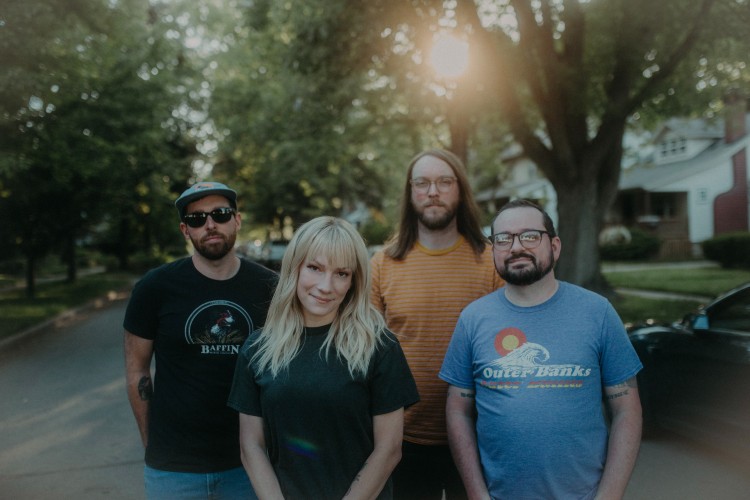
When it comes to loss, Twin Deer deeply understands the grief that remains.
The Detroit quartet of Megan Marcoux (vocals, guitar), Tom Skill (guitar), Bill Kahler (bass, synth), and Rob Duncan (drums) explores that overwhelming emotion and the ongoing struggle to move forward on “Underground.”
“It is a pure description of missing someone immensely,” said Marcoux about the group’s new dream-pop single.
“Sometimes the clarity lies in simplicity, like the line, ‘It’s not right you’re not around.’ And in the second verse, we reference how life is fragile. I find that important to mention—not to cause distress—but to remember to value the time we have.”
Backed by cathartic electric guitar, bass, and drums, she sings, “It would be nice to hear the sound / Of your voice saying you were coming around / It would be nice / If I wasn’t exhaling ice / I’m standing on the frozen ground.”
“I hope others will see that there isn’t always some profound thing that needs to be said,” Marcoux said. “Missing someone is already a lot.”
“Underground” also serves as an introspective B-side to Twin Deer’s “Fever Dream,” which was released in June.
To learn more, I spoke with Marcoux about Twin Deer’s latest singles and past releases ahead of a July 13 set at Alley Fest in Flint, Michigan.
Q: How has your summer been so far? What’s been inspiring you lately as a songwriter?
A: It was great to start it off by releasing a new single! The positive response has been encouraging, and we are so glad people are connecting with our music. I have been seeking out new indie bands to listen to so that I can keep getting inspired to write. I always appreciate when someone shares how the music made them feel or a band that comes to mind when hearing us. It introduces me to something I haven’t heard before.
Q: How did your musical journey start while growing up in Fraser, Michigan? What artists inspired you along the way?
A: I was about five when I started learning about music on the electric organ my mom had. I started playing flute when I was about eight and picked up guitar when I got to high school. I got my first [Fender Stratocaster] and learned all the essential Green Day songs. I quickly realized that being in a band would probably be my favorite thing; it turns out my young instinct was correct. I didn’t write or sing in this capacity until [Twin Deer], and I love it as a creative outlet. My favorite bands include Alvvays and The Strokes. I also love moody new wave like Echo & the Bunnymen and ‘60s pop like The Beatles.
Q: How and when did your musical journey lead you to form Twin Deer? How do members Tom Skill, Bill Kahler, and Rob Duncan each contribute to the band’s sound? How does the band’s name represent your music and creative vision?
A: It was late 2019 when I found myself writing. I dove into it solo first and wasn’t sure where it would go; I just kept writing. I felt strongly about what I had started to create—even when it was just a solo project. I always did want a whole band though. I am grateful that I connected with the people who would round it all out.
Bill’s intriguing and melodic basslines anchor the songs while Rob infuses the drums with feeling and energy. Tom contributes textured layers and complementary guitar parts that enhance our overall sound. Together, the four of us bring a range of influences to Twin Deer, including punk and ‘60s rock bands, that we blend into our own dreamy indie-rock style.
The idea for the [band’s] name came from artwork that resonated with me. It’s been said that deer represent gentleness … and that deer may appear when one’s heart needs nurturing. This aligns well with the emotions and themes in our music.
Q: Your debut album Not Real But True processes the heartbreak, loneliness, and grief you experienced after losing your mother in 2019. How did writing those 10 tracks feel cathartic for you? What was it like to share those songs with your family? How do hearing and performing those songs today continue to comfort you?
A: It was the best and only thing I could do to grapple with it somehow. It was and is necessary for me to do something with purpose. I had so much to say about her and about how this felt. It was only a few weeks after she died when I picked up my guitar and started playing one night and recording ideas. I never had something like that to write about before. Ideas were flowing.
If people can’t meet her, they will know what a radiant person she was. My dad comes to a lot of our shows and likes hearing the dedication to her.
Q: How do you hope Not Real But True helps others who are experiencing and processing grief and loss in their own lives? How did the lyric, “It’s not real, but true,” from “Inebriated” inspire the album’s title?
A: At the beginning, one of the most repeated sentiments my family and I heard was, “I just can’t believe she’s gone.” Despite knowing it’s true, it feels unreal and likely always will. That feeling is constant throughout this entire experience and a solid representation of the whole album.
I hope that others hear this record and feel seen. Grief isn’t always talked about openly and honestly—and because of this—people don’t always know how to be supportive. There is a common misconception that we should try to make people feel better, but that isn’t the answer. Acknowledgment is everything.
My intention with this album was not to dwell on the darkness or heaviness for its own sake, but to offer an honest and authentic depiction of my experiences. And some things, like grief, are inherently heavy. It’s important to approach these things authentically if we want to truly support one another.
Q: “Walking in Fog” explores the shock, fear, and sadness that comes with suddenly losing a loved one. How did writing this track help you face those emotions and find some clarity?
A: This song is very much about the feeling that comes with such an immense loss. It’s one of those things that you can totally relate to if you’ve been there. I knew that if someone had a similar experience and heard this song, they could say, “Yep, that’s exactly what it’s like.” And like the rest of the album, I aimed for a sweet and dreamy sound so that it would have a good vibe to listen to and be relatable.
Q: “The Cemetery” examines feeling overwhelmed with grief while laying someone to rest. How did you find a sense of escape and relief while writing this track?
A: I wanted to be honest about it: While I acknowledge the cemetery as a valid way to honor someone, it doesn’t resonate with me. I like the ways that keep her essence alive. I like rituals with loved ones; I like making a big deal about things because they matter. I like putting up pictures, I like connecting with animals and nature, I like finding celestial wonders in the sky, and I like making music. The cemetery is part of her death; these things were her life.
Q: “Pleasantries” highlights the challenges of keeping your emotions to yourself. How did writing this track provide you with an emotional release? How did it encourage you to be vulnerable with others about your grief and pain?
A: There’s a cathartic element to being immersed in music that reflects our emotions. And this song is a look at being real about our experiences with loss. We don’t have to say things are fine when they aren’t. I think authenticity will always be the best approach to navigating life. We can do this while enjoying things we love. We often juxtapose heavy themes with bright music in Twin Deer songs, and I gravitate toward this approach because it captures the complexity of the human experience.
One of the things I love most about live shows is we can experience the music and good vibes with each other amid some very dark times. We’re acknowledging that life is hard, and we’re enjoying ourselves despite it all.
Q: “The Sky at Night” reflects on missing a loved one and revisiting fond memories of them. How does this track provide you with some hope and solace? What did you and your mother love most about stargazing and exploring the night sky?
A: She found such wonder and beauty in seeing everything that was out there. She would make sure we all went outside to look with her and admire the vastness of it all. This might be my favorite song on the album. I find it important to mention the beautiful things along with the heavy things. Not because it makes anything easier—it doesn’t—but because these stories deserve to be told, too.
Q: How long did you spend recording the 10 tracks for Not Real But True at Cow Haus Recording? How did Tom Skill help you shape the album’s overall sound?
A: It was about three days of tracking for the album. Tom had helped me record earlier demo versions of the songs as well before a band was assembled. A lot of ideas were born then. He would suggest where he thought I should add harmonies or double-track for effect. No one had heard these songs, let alone given me feedback on them, and I really valued those developmental stages.
While recording those demos, he asked me if I ever planned on playing these songs live. I said I would love to and I needed to find band members. Tom expressed interest in playing guitar. With the framework for the songs established, it was a smooth transition to start playing them as a full band. This laid the groundwork for us to come back and record the real album with a band. On the album, we also have the talents of Sungjin Jankowski (drums) and Dan Harness (guitar).
Q: “Fever Dream” explores having a vivid dream about a loved one who’s gone and feeling their presence. How did having this dream about your late mother help provide you with some acceptance and closure?
A: This song is a blend of things I dreamed of and a real-life flashback to the weekend before she died. It evokes strong memories in me, including phrases she would say that are etched in my mind and that are still a constant reminder that she will always be a part of me.
Q: How do “Fever Dream” and “Underground” help set the tone for your new material thematically and sonically? How did they both take shape while recording them at Cow Haus Recording? How did Tom Skill and Brandon Benson help you take both of those tracks to the next level?
A: While the album is raw, honest, and straightforward, we spent a lot more time on songwriting, song structure, and flow this time around. I want to communicate the same emotion in a way that listeners can engage with more deeply.
Last year, I brought initial demos to the band, and we’d practice playing through the songs to see how they felt. It was nice to work more collaboratively this time and explore different directions. Bill and Rob’s interesting ideas for bass and drums enhanced the songs and brought them to life. It was exciting to hear those ideas taking shape.
Tom’s dedication to capturing the best possible sound was great for our recording sessions. He is intentional about how he records and it supports our music.
And this time around, we had Brandon’s feedback on lyrics, vocal melodies, and song structure. He and I spent time workshopping these things, and I appreciate how he invested in us to get these songs to their best possible form.
In those early stages, Brandon and I also had conversations about the feel we were going for. His approach to mixing captured it perfectly, and he played a crucial role in the final sound.
All of their insights are so valuable, and I think the result is evident in these new tracks where every creative contribution shines.
Q: You’re performing July 13 at Alley Fest in Flint and September 13 at The Old Miami in Detroit. What do you have planned for your sets for those shows? Who else will you be sharing the stage with at The Old Miami?
A: We will be playing both new singles and several from the album—and maybe our Kinks cover! We are looking forward to returning to The Old Miami in September and will share the stage with Elspeth Tremblay and The Treatment and Career Funeral.
Q: What’s up next for you this summer? Do you plan to release physical copies of your two latest singles—“Fever Dream” and “Underground?”
A: We will have 7-inch vinyl records this summer!
Show details:
Saturday, July 13 | 2:30 p.m. on the Square Stage
Buckham Alley, 502 S. Saginaw St. in Flint, Michigan
Free event
 The Stratton Setlist