

For Major Murphy, the best life lessons come in retrospect.
The Grand Rapids, Michigan trio of Jacob Bullard (vocals, guitar), Jacki Warren (bass, vocals), and Chad Houseman (guitar, keys, drums, percussion) learns from past struggles and finds a way forward on Fallout.
“I think that was a conscious goal or intention of mine to create something realistic but wasn’t wallowing in despair,” said Bullard about the band’s new indie-rock album released via Winspear.
“There’s a quote in ‘The Water’ from the Tao Te Ching, and it says, ‘Nothing in the world is as soft and yielding as water. Yet for dissolving the hard and inflexible, nothing can surpass it.’ I read that when I couldn’t see a way out, and it was a difficult time and I didn’t know what to do.”
As part of that introspection, Major Murphy discovers a renewed sense of purpose and seeks clarity for the future.
“Thinking about that softness also being something that could dissolve rock was an idea for me that I found incredibly empowering in the sense that you don’t always need to meet resistance with more resistance,” Bullard said. “Sometimes you have to soften and flow.”
On Fallout, Bullard and his bandmates process change, uncertainty, and growth across eight reflective tracks. The album’s philosophical lyrics, soaring harmonies, and emotive instrumentation provide a cathartic and impactful listening experience.
“The album came together organically from a writing perspective, but at a certain point, those themes became evident to me as well. There are more songs than what ended up on this album, and I curated the selection to be super cohesive,” Bullard said.
“It’s a bit more stylized from a lyrical perspective, and it’s less prose and more poetry from my vantage point. I thought of the music, too, as being more contemporary compared to stuff we’ve done in the past. I wanted the lyrics to be more minimal.”
To learn more about Fallout, I spoke to Bullard about the album’s thematic elements and creative process.
Q: Some of the tracks on Fallout include references to water and the passage of time. How did water and time come to play such important thematic roles on the album?
A: Part of that recurring lyrical [notion] is speaking to the cycles of life and death and renewal and destruction. There’s also the idea that memory transcends time and space. With that in mind, you can think about a ripple effect, and clearly, that’s a water image.
On a spiritual level, I was reflecting on and exploring the idea of a ripple effect through time. Something that I’ve been hearing people talk about is generational traumas and the way that things get passed on for good and bad on a subconscious level. That’s part of my headspace when I’m thinking about water. The album title Fallout is [examining] at what point are you experiencing stuff from an “explosion” that happened a year ago, two years ago, or 20 years ago. You might not even be aware that what you’re dealing with is a result of something that you didn’t even do or that you did do X amount of time ago.
Something that I’ve learned about water on a more scientific level is that water has its own memory. This idea that it carries a memory or a vibrational imprint … that’s insane when you think about the ramifications of that and when you reckon that with the fact that our bodies are made up of so much water and that we consume so much water. The vibrational imprint on water has a huge effect on us as a physical body and a spiritual body, so stuff like that is incredible to me and a part of where my head’s at.
Q: The album title Fallout is referenced as a lyric in three of the album’s tracks—“First Thought (Best Thought),” “Time Out,” and “Breakdown.” How did that lyric inspire the album’s title and lead to the release becoming an album instead of an EP?
A: It wasn’t like I started with the word “fallout” and then wrote everything. There was a body of work in front of me and then I sculpted it into this form. Initially, this was going to be an EP, and I only had “First Thought (Best Thought),” “Time Out,” and “Daylight.”
I thought, “Let’s put together an EP with three songs and a few extra things to bulk it up, but it’s not a full album.” There’s the intro to “First Thought (Best Thought)” with the “plinkies” [sound], and we hadn’t done anything quite like that before. Then I wrote “Breakdown” and thought it could be four songs and there’s a little intro that didn’t get included. There were going to be these instrumental passages and then “The Water” became a song, too, and “Raincloud (Under My Skin)” has its own little intro.
I thought there could be a few songs with these little things that tie it together. In the end, I wrote “Breakdown” and that got added on, and I did “Puzzle” acoustically. It started to become an album and I still kept calling it an EP. Mike [Bridavsky], who helped me with the mixing and we recorded [Fallout] at his studio, said, “Why are you calling it an EP? This is an album.” A few other people kept calling it an album and I thought, “Well, maybe it is an album.” It felt like we were selling it a little short to call it an EP.
Q: “First Thought (Best Thought)” explores a trail of memories and experiences from a situation and serves as an ode to creative immediacy. How did exploring an initial thought process inspire this track for you?
A: It’s definitely from a creative standpoint and that phraseology came out of a writing class I took in college. It’s a don’t self-edit kind of thing … and it’s about cycles [of life]. On a sonic level, those “plinkies” symbolize the thought of “Here we go again” and the waves that come over you.
Q: “Time Out” reflects on moving past a difficult situation and anticipating a new start. How did writing this track help you process all of that and move forward? How did the kaleidoscopic video for “Time Out” come together, too?
A: I love that it can be read at that level. Where I was coming from when I wrote it was more like the lyrics say, “I filled the time out.” I was aware of the double potential for [interpretation] there, but I thought about it more like working a shift at a job. You’ve blocked the time and filled it out and there’s the repetition of that, too. It’s a grind, and with a grind, you can almost rest in that. It can be oppressive at times, but it’s also something that you can be carried in and something where you don’t have to think too hard. Sometimes that’s great and you have to go through those times.
Regarding the video, I filmed it with my phone in my living room. I used an app to create that effect. I just wanted it to be fun and not too crazy; it’s just crazy enough and not too serious.
Q: “The Water” is an atmospheric and peaceful instrumental filled with strings and synths. How does this track help convey the album’s themes of relief and renewal sonically? What was it like to collaborate with Jeffrey Neimeier (violin, mandolin) on it and include the voices of several family members and friends on the track as well?
A: This is the first time we’ve had strings on a Major Murphy record. It’s something I’ve wanted to do forever and it surprised me that it was with this. I pictured it being grander when we would actually go for it.
Jeffrey Neimeier is a friend I’ve collaborated with over the years, and we’ve played in live bands and recorded together. Our drummer Chad [Houseman] has a project called Tom Hymn, and I’ve worked with [Jeffrey Neimeier] on stuff with Tom Hymn. Jeffrey has also recorded material I’ve done that’s never been released. We’ve worked together a whole bunch, but never on Major Murphy records. He’s a virtuosic kind of improviser, and I had him over and recorded him at home. That’s who’s playing violin on “The Water.” For the bigger sounding stuff, that was a synth pad that I had and I included a lot of different layers of synths on [“The Water.”].
As for the voices, I sent an email to 15 people, and it was an idea that I had. I thought, “Oh, that’s a great idea; I should do that.” When it came time to send that email it was a little intimidating because it was putting myself out there. People know that I’m making music and it wasn’t that wild, but it was a little bit of an experiment and I had to close my eyes and hit send. I got so many great responses: my mom’s on there, my uncle’s on there, my sister’s on there, a lot of friends are on there, and so is my brother-in-law. The main voice … is a co-worker of mine and he’s the one who talks about “nothing in the world.” I love how it came together because now I can’t imagine if it wasn’t there.
Q: “Raincloud (Under My Skin)” acknowledges having heavy things on your mind and deciding whether to share those thoughts with others. How does this track encourage you to be honest with yourself and others about your struggles?
A: Unfortunately, you take a risk, and it’s almost like I was saying about inviting people to collaborate on “The Water.” It’s a slight risk, and that wasn’t a huge risk, but when you do choose to share something I think the reason it’s hard is because it is a risk. You don’t know how people will respond, so unfortunately it was more of a reflection on choosing to take that risk and feeling misunderstood. I think it’s universal, and it’s only a matter of time because if you’re alive long enough you’re going to deal with a lot of stuff.
Q: The title track is an anxious and attentive instrumental that functions as a future warning. How does this track serve as a sonic response to the emotions that arise while experiencing a “fallout” in life?
A: For me, this one is catastrophic, and it’s a fiery song. It’s this burning sensation and it represents a feeling when you’re passing through these moments in life. It’s incendiary and you’re lit up inside, whether you have righteous anger, you’re feeling a ton of pressure, or you’re feeling judgment from other people on you. You have to be able to get right deep down in that and power through that, so that’s what that track is trying to describe.
At the very end of it … there’s a spoken track, which quotes a verse from the Bible that talks about the branch that doesn’t bear fruit will be cut off and thrown into the fire. To me, that’s exactly that experience, and it describes how you’re in these tumultuous times, and you feel like you’re being burned alive.
The quote actually says that and it closes with “Be glad,” so be glad that has happened because the true light will shine from that. Pruning is an essential part of life and growth: If you think about plants, and if they don’t get pruned, they don’t grow. You’re going through these passages feeling like you’re getting burned up, but be glad that you’ve been given this opportunity to grow. Because if you weren’t going through that, you wouldn’t be expanding and growing.
Q: You recorded Fallout at Russian Recording in Bloomington, Indiana, and at your home studio in Grand Rapids. How did the eight tracks for the album come together during those sessions? How did engineers Mike Bridavsky, Kyle Houpt, and Dan Ahrendt help you fine-tune the album’s sound?
A: We did a three-day session at Russian Recording and tracked drums, bass, and some of the rhythm guitar. There are a few places where I did the vocals live, but for the most part, when I got home, I redid the vocals and then added guitars and synths here and there.
Mike is someone that we’ve worked with on nearly every release that we’ve done. His studio is an asset and we’re just used to working there. It’s important to have a place where we can go that’s away from distractions and daily life stuff. Mike has amassed this incredible collection of analog recording equipment and vintage microphones … and especially with the drums, that’s something that I like to have a lot of detail and presence in our music. Mike is good at capturing the drums and his space is conducive to that.
Q: The album also includes collaborations with Agnes Weiss (violin) and Grant Floering (additional synths, programming) on several tracks. How did they help take those tracks to the next level?
A: Agnes [Weiss] is a friend of mine … and she’s only 14. It’s one of those things where I’m supposed to teach her about music, and I’m trying to introduce her to how the recording process works and how to write a song. I have done that, but I’ve also learned [from her]. It’s also like how the apprentice teaches the master and humbles the master all the time—there’s that dynamic with us. She’s taught me so much, too, about guitar and approaches it from a new vantage point. It’s been a [friendship] that’s been cool for me over the past couple of years, and I wanted to include her [on the album].
And then for Grant [Floering], he’s an old buddy of mine and we were in a band together in high school. He now does more commercial music and scoring work. When it came time to do something with strings, I was working with this string sound that’s on an electric keyboard that KORG makes. I started with that in my house, and I thought, “What if we did this synth thing?” and the sound is kind of corny. We needed to do something so that it didn’t have a fake string sound, so I hit up Grant to help me broaden that sonically. He did very well.
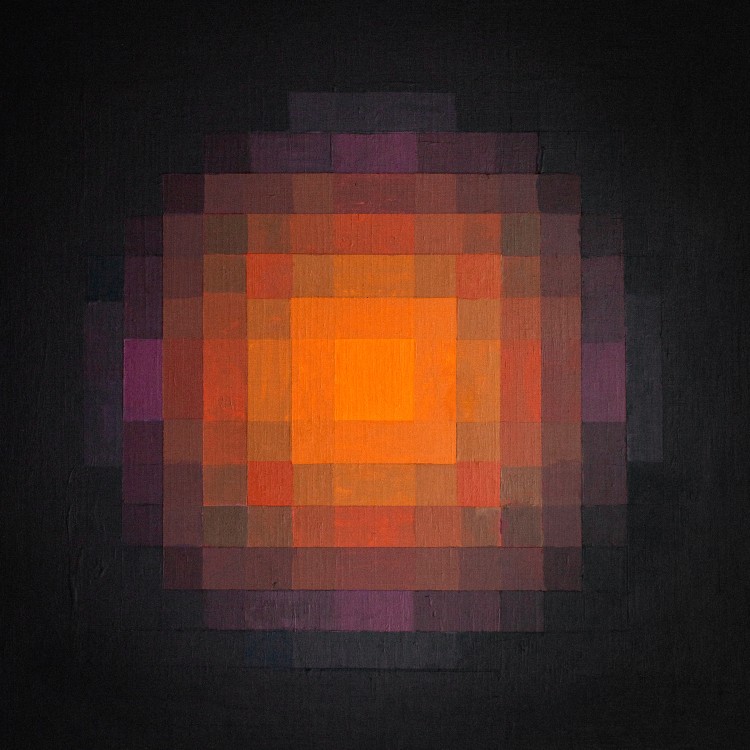
Q: The vibrant album cover for Fallout features an Americana quilt motif by artist Blake Rhein. What inspired Blake to take that creative approach with the album artwork?
A: Blake plays in a band that we’ve played with called Durand Jones and the Indications. Somewhat recently, Blake got into painting and started sharing his paintings on Instagram. He’s into repurposing these quilt patterns into paintings, and I reached out to him about a painting that he had done already and shared. I said, “Hey, can we use this for our [album] artwork?”
That one wasn’t quite as much of a quilt motif or whatnot; it was a square within a square like five times and the different squares were different colors. I felt like it spoke to the layers or the ripple effect [theme] of the album. He said, “I would rather make something for you,” and I said, “Even better.” He developed the artwork, which was overtly more of a quilt [motif]. I loved how it turned out, and it’s a perfect fit.
Q: Fallout is dedicated to the memory of Steve Black. How does this album serve as a tribute to Steve and his family?
A: Steve was my neighbor, and he and I kicked off a friendship over the past couple of years. He died in 2022, so it’s coming up on two years [since he’s been gone]. Before he died, we kindled this somewhat unlikely friendship because we’re different people, but very similar in some ways. My son and his son are best buddies. He was somebody that I got to know and love, and he just passed away extremely unexpectedly.
It was a tough moment for his family and my family, and surrounding his death, that’s when “The Water” took place. I remember “Time Out” had already been made, and I was mourning and playing those chords with the strings, reflecting on his passing, and thinking about water not running to an end. He was a great guy, and I felt like he was part of the story.
Q: What plans do you have for new material?
A: We have a couple of tracks that we did this spring that we’re sitting on, and they’re more one-off kind of things. Beyond that, I’ve got a stack of songs I’d like to do another proper album with, so I’m trying to figure out how to get that together.
 The Stratton Setlist