
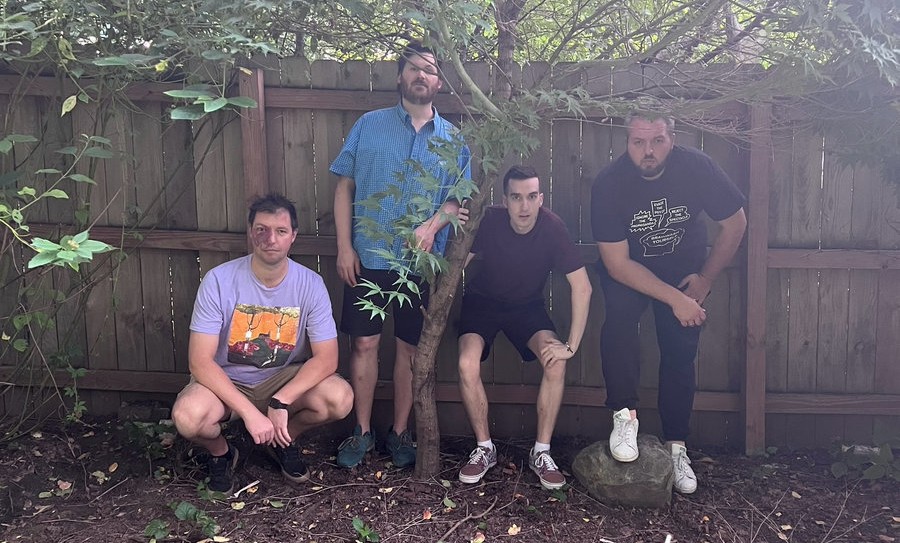
Steven Meltzer takes a more personalized approach to songwriting on And The Elderly Midnight.
The Elroy Meltzer frontman examines internal struggles with death and grief on the indie-rock collective’s latest album via Midwest Gold Records.
“I wanted to go down that [path] and be more relatable. Not to say I’m a dark person by any means, but sadness and death are something that everyone has experienced and dealt with,” said Meltzer, the vocalist-guitarist of the Grand Rapids, Michigan collective.
“In our music scene, we’ve lost great people due to suicide or drug use. I’ve also had friends who have recently lost parents to cancer or are dealing with that currently. It’s heartbreaking, and it’s hard to maneuver through, but it’s happening.”
The album’s seven tracks uncover the emotional toll those experiences take on Meltzer, the people he knows, and the world around him. His perceptive lyrics and the collective’s earnest instrumentation invite listeners to explore their challenges alongside them.
“It’s the feeling of getting older and the idea that I’m getting close to death even though I’m not. It’s also that feeling of thinking, ‘Am I at a point where it’s too late? Have I missed any opportunities? Am I too old now?’” said Meltzer, who founded the collective in 2010 and performs with The Soods.
“It seems like everyone is married, everyone has kids, and everyone is happy. I’m wondering if I’m missing out on those things. It’s also the helpful acceptance of making this life work because you only get one.”
To learn more, I spoke with Meltzer about the inspiration behind And The Elderly Midnight.
Q: And The Elderly Midnight is a thoughtful examination of death, grief, acceptance, and closure. How did you find catharsis while writing the album’s seven tracks?
A: With me, it was related to animal loss and I had lost my first pet, my first cat. It was a tough one. And my wife lost one of her first cats during that time. It was a bummer … and [the album] was done in a therapeutic sense. I thought, “I should sing about this and try to be more personal, but I wanted to do some metaphors so it’s open to interpretation.” I don’t think I’m a morbid individual per se; I like to make people laugh more than anything. It’s [having] a dark sense of humor and not avoiding the topic because it happens, so let’s get over it and [know that] people are still here for you.
Q: How did watching episodes of Jon Taffer’s Bar Rescue help you escape from everyday life and find comfort while writing the tracks for the album?
A: I am a hermit in a way and I am a TV baby from the ‘80s. I do love television shows … and I find inspiration off of that. It gets me in a good mood and [this] album was [inspired somewhat by] Bar Rescue. I had that show on mute while I was trying to write songs, and then when I took a break, I would unmute it and listen to [Jon Taffer] rave like a lunatic at bartenders on how to fix up spots.
It’s that comfort food—not to say that it was always on in front of me—and some of those shows … there is a pace, cycle, and rhythm to them. There’s a humorous aspect to it … because some of the episodes are so outlandish. It’s like, “What is happening? Who would ever give this person a job? How do they not know how to run a bar?” Some of those things and when you break them down … can relate to the ideas of death or the realization of “What am I doing? I don’t know. What happens next? I need help. What should I do?” That was the whole basis of the show: being vulnerable, asking for help, and then accepting it.
[The show] was funny to me, and it was there. In hindsight, I was able to relate serious topics to this silly show more or less. These people on the show are real and they’re struggling through something even though it’s broken down to be entertainment.
Q: “Inextrovert” explores the challenge of balancing the introverted and extroverted sides of your personality. How was this track inspired by that struggle?
A: I wanted to be humorous and make weird names or words that don’t necessarily exist. I’ve always been labeled as an extroverted person because I’m loud and outgoing. I like to meet new people, but … I like to label myself the opposite of that because I do like to stay home. I don’t like to go outside the boundary that I’m not comfortable with. It’s dealing with that spotlight where people think you should be the clown or the entertainer.
I like to be in the background a bit, so it’s dealing with that acceptance. Everyone’s introverted to some [degree], and maybe I’m not frozen by it or it doesn’t take me over. The older I get I want to be home with my cats and I want to spend time with the people who I feel are important because we only have so long. I don’t need to be on this pageant tour and say, “Hey everybody, look at me. I’m happy all the time.”
Q: “Inextrovert” also examines starting over and feeling uncertain about what’s next. How did writing this track help you move forward?
A: And with the whole COVID thing … I thought, “What am I doing? Should I start again?” Because I got into a dark place with myself and I didn’t know if I wanted Elroy Meltzer to continue and I thought maybe I just wanted to do something new. I also thought, “Why do I feel so defeated right now? And I don’t need to be—people can take breaks.”
You forget you’re in a hole, and you think, “I need to put something out,” but bands I look up to will take five or six years off. It’s not even a hiatus; they are able to get people to [accept] their silence and they say, “We don’t need new music.” No one needs it, but you also don’t need to have that feeling … and that doesn’t mean you’re not important and what you’re doing isn’t fun and can’t inspire someone.
Q: “Fibtion” highlights feeling trapped and lost in your grief while searching for answers internally. How did writing this track help you face those emotions and find clarity?
A: The title is a combination of “fiction” and “fib.” I didn’t know if I wanted to write music, and I was burned out on it, but I got that little gust again and thought, “Let me try to do this.” I wanted to do a concept album where I could be more relatable and write about more personal topics.
When I was done writing “Inextrovert,” I went into [“Fibtion”] and I had that eerie, dark feeling. I knew I needed to keep with those emotions … and the spooky thing with bones and stuff popped into my head. I came up with a phrase and tried to go off of that and it was “bare bones” and [the idea of] being reminded that we are just skin and bones. It’s also about dealing with that and being trapped in our bodies.
Q: “Nancy Don’t Kerrigan” examines the dark side of the Olympics and the strange steps hosting cities take to make themselves look good. How does this track serve as a wake-up call about the future of the Olympics? How did Olympic figure skater Nancy Kerrigan inspire the track’s title as well?
A: I tried to weave those themes in, but I also wanted to sing about the Olympics. It’s about how everything else is brought in [for the Olympics]. The Olympics also give police this military power … and they can control the city they’re having the Olympics in. The police force gets to keep those laws that are put in place, so they’re more militarized and they’re pushing out homeless people and everything else to make these places look good.
There’s always been this huge controversy with the Olympics, and before that, it was world wars. We had World War I and then the Olympics followed. It was like, “We just [demolished] these countries, and we’re expecting them to compete in the Olympics.” It’s also about the horrible time we’re having right now in Gaza and Palestine and that it’s going on constantly. And I was thinking about all the hurricanes and tsunamis and how they were disruptive during the Olympics.
The name was funny for me and “Kerrigan” popped into my head. The choruses are pretty and the imagery there for ice skating is the only connection. Writing an album about death and grieving, it seemed like those themes were happening there and Olympians had to deal with them.
Q: “APR We’re Gonna Buy This House” delves into survivor’s guilt and mortality. It also spotlights how buying a home is a metaphor for what a “normal” life looks and feels like. How did writing this track help you explore those concepts?
A: We were buying a home, and I thought, “I’m a boring person and a sheep who’s working a nine-to-five [job].” I shouldn’t feel like I’m bad, and that I’m a cardboard cutout suburb liver. It’s about dealing with your happiness and realizing things aren’t over.
Buying a home, settling down, and getting married isn’t the end—it can be a new chapter. You can still be creative and hang out with people and those things don’t need to be put off. The verses say, “Who out of us is gonna live the longest” and “Have a guilty conscience bout still being here.” We’re here to have fun, but we’re going to question all of these things and ideologies. It’s also asking, “When should I stop drinking? Should I still smoke? What am I doing? Just counting down the days? Or am I being active and trying to pursue something?”
Q: Tell me about your writing process for the seven tracks on And The Elderly Midnight?
A: They were all written back-to-back … and I started toward the end of the pandemic from 2021 to 2022. It was those seven right away and I didn’t have anything else. I continued from there and I have nine more songs now.
Q: What was it like to record the album with Matt Noordhoff (guitar), Drake Fierge (bass), Pat Kargl (drums), Joe Schimmelmann (sax, keys), Megan Meadows (vocals, violin), and Ryne Clarke (sax, keys, violin, harmonica, steel guitar, vocals), at Farm Haus Studios and Upstairs, Man Studios?
A: Matt’s always been my go-to guitarist; he has a great spacey indie tone, and he has his band Nordy. He records at home and he went to Hope College for sound. He has that whole background … and I’m able to take my time and it feels like I don’t have to rush anything.
I’m not wasting his time if I don’t have something the next day. It’s recording with your best friend and hammering out ideas. I put the stuff down and he put on guitars and I knew I wanted bass and drums—it was filling it out from there. Drake [Fierge] also recorded bass at Matt’s studio.
And with Ryne, he had started Vernon Potts and then there was the band Short Panic that I was introduced to and met Joe [Schimmelmann], who’s the saxophonist and keyboardist. I said, “I need some sax,” and I know that instrument can do a lot, so I wanted that.
And then Megan Meadows, who’s in Short Panic, has a great voice and I love vocal harmonies, especially a female voice that’s softer and higher compared to mine. She was able to sing on two songs, [“Nancy Don’t Kerrigan” and “APR We’re Gonna Buy This House.”]
With Joe and Megan being friends with Ryne and Ryne having his whole studio, it was easier to record over there. And since Pat [Kargl] plays with Ryne [in Vernon Potts], he had his drum set over there, so we recorded drums, sax, and Megan’s vocals.
Q: What plans do you have for new material?
A: I have nine more songs that we’re working on and the album name is pending. The new Elroy Meltzer album will come out next year.
I’m also thinking of releasing some B-sides with me on acoustic that sound real lo-fi. They’re tracks from my past that I never got to record … and [some] stuff is with Jason [Roy]. Some of it is when we went by Lake Timber … and we later changed it to Sun Circles. They’re old tracks that would be fun to re-record.
Recently, Jason [Roy] and I have been working on four or five songs [for The Soods]. We went to Amber Lit Audio and recorded those, and we’re trying to make rough drafts and go from there.
 The Stratton Setlist
One thought on “Getting Personal — Elroy Meltzer Examines Death and Grief on “And The Elderly Midnight” Album”