

Widetrack explores the emotional limits of an evil man and his heroine redeemer on Galatea.
The father-son duo combines elements of horror movies, psychological thrillers, and Greek mythology to create a compelling narrative for its latest concept album.
“We love all the classic books and movies, like Red Dragon, Psycho, and The Silence of the Lambs,” said Ron Tippin, Widetrack’s vocalist and drummer. “It’s not so much about the shock and gore, but more about the psychological aspect of it.”
On Galatea, a man is caught in a destructive cycle while searching for the perfect woman to love and possess.
“What I started seeing with a lot of these books and movies that I was reading and watching is this person who overcompensates for feeling uncomfortable in his own skin,” Tippin said. “He desires these women, but he knows he doesn’t stand a chance with them.”
After dating and discarding many women, the man finally meets his match in Galatea. Inspired by Pygmalion’s ivory statue and Madeline Miller’s short story, Galatea sees beyond the man’s controlling nature and falls in love with him.
“The actual album is about this woman who doesn’t give into his control and ends up making him see himself for who he really is,” said Tippin, who’s based in Waterford, Michigan.
“It’s a composite of all these movies [and books] we’ve liked and talked about. It’s a tribute to horror movies, a tribute to strong women, a tribute to the power of redemption, or the question, ‘If you can’t be redeemed, then what’s the next best thing?’”
Tippin and his son, Zach Tippin (guitar, bass, keys), examine that question across eight tracks on Galatea, which features suspenseful lyrics and haunting alt-rock/prog-rock instrumentation.
I spoke with Widetrack about Galatea ahead of a May 23 show at Detroit’s Outer Limits Lounge.
Q: The album’s opener, “Saturnine,” examines struggling with a secret, pushing another away, and knowing your fate is sealed. How does this track set the tone for the album thematically?
Ron Tippin (RT): It’s a brutal self-awareness for the man, and the woman is caught in this loop of knowing she should walk away because she sees this monster. But she’s still haunted by the version of him she fell in love with when he was at his best. It’s this tension, and it sets a tone of foreshadowing.
We also were going back and forth for a minute about [whether] we [should] open the album with a mellower-type [song] because every Widetrack album [starts] out like gangbusters. It was different to break out of that rule, and it’s just one of those things that felt right to do. It worked out well because the rest of the album until the last song is pretty heavy. For the most part, it’s a heavy album all the way through, and it certainly has some of the heaviest music we’ve ever done.
Zach Tippin (ZT): This was the first one my dad showed me from his proto-Galatea album. This one stood out to me; it’s still one of my favorite Widetrack songs. The mood and the darkness, I really dug it. It’s all in seven and it’s got a little bit of prog. It checks all the bases; it’s everything we love in Widetrack. I think that song has a lot to do with how the rest of the album was written. Trying to match that energy with the heaviness and the melancholy, it was a lot more to live up to than some of the vibes of the previous albums.
Q: “Lycanthropic” explores the power of transformation and the primal urges that accompany it. How did the concept of someone turning into a werewolf inspire this track?
RT: We always joke around about progressive rock, and we poke fun at it. We thought, “What would be the most prog name for a song?” and that title came up. It fits the lunar [theme] of going out at night, howling at the moon, and hitting the nightlife … when your dark [side] starts to rear its head a little bit. When I hear the main guitar riff, I can see this wolf popping through the streets. It was kinda playful, but the actual song is aggressive and dark. We think a little levity helps out with how dark and heavy this stuff gets sometimes.
Q: “Ivory” acknowledges being threatened by others, overcoming obstacles, and taking control. How were you inspired by the Greek myth of Pygmalion and his ivory statue of a woman while writing this song?
RT: We thought that was the perfect title because it represents the [woman’s] strength, but ivory also [symbolizes] a man’s version of a woman’s purity. And the statue that Pygmalion carved was out of ivory, so it seemed like a good title for the song about the woman. It’s the central piece of the album with that confrontation, and this song is one of the longest [on Galatea].
Zach has this guitar and bass instrumental passage that gives it an epic feel, so that was the heroine taking her stand. It comes to all these women breaking under the sway of this guy and then one woman doesn’t break. She says, “This was going great until you thought you could control me.” That’s a common theme with the man’s fear … we’re just trying to shed a little light on that. It’s the turning point, and it’s done with a very balanced strength.
Q: “Demons” is about finding clarity, feeling relieved, and letting someone go. How does this track explore expelling evil forces and putting someone’s needs before your own?
RT: This was a song that Zach had played for me. There was another outro that went with this [song]. I said, “I think with the outro, maybe we could try a different approach,” and the next day he came back with the outro that’s on the song. It’s one of those songs that has all of this contrast, and the music is bludgeoning you, but the lyrics are romantic. They’re saying, “Oh wow, I’ve been seen by this person. My demons are being cast out.” And then it comes to a screeching halt and goes into this spooky, haunting-type guitar outro that comes out of nowhere. It tapers it off so nicely.
ZT: I had written this one as part of my personal, fun, over-the-top metal collection. I thought, “This is not a Widetrack song; there’s too much going on. How would you write a vocal part over this? This has to be something else—maybe an instrumental.” And I showed my dad and he said, “Are you kidding? This needs to be on the album.” And I said, “If you say so,” and it turned into something cool.
Q: The title track addresses needing closure, leaving the past behind, and starting a new chapter. Why did you end the album on such a hopeful note?
RT: The album resolves with the preceding song, “Wretch,” so the last two songs are about each of the two characters. This one is about the heroine emerging from the wreckage of a toxic relationship reclaiming herself and her strength. I had this vision of this luminous force rising into the cosmos. It’s a real symbol of all the strong women I’ve known.
One of the themes of this album is the guy becoming callous, and [he] uses the excuse, “Well, I’ve had a hard life.” The guy learns that true strength comes from that vulnerability and being seen and understood. It was also a word of encouragement to people in my life who are tired. They’ve been the strong ones, and we want to give them words of encouragement about their power and idealization of rising to a place where they feel alive.
ZT: It was tricky figuring out what exactly to do next after some of those parts. It all came back to listening to the song up to a certain point and then hitting pause and letting your brain do the rest. We’re thinking, “What are [we] imagining that comes after this? What feels the most natural?” It doesn’t have to be anything super clever or surprising. Sometimes it’s the thing that’s right in front of you.
Sonically, this one was done on an eight-string guitar. I wondered if I could write something that couldn’t be played on a six-string guitar, but would need all eight strings to play different sections of the song. I tried exploring the whole range of the instrument, going from the low notes to super high notes. I thought that [would] make the song more dynamic and was able to build more because there’s more of a range on the instrument.
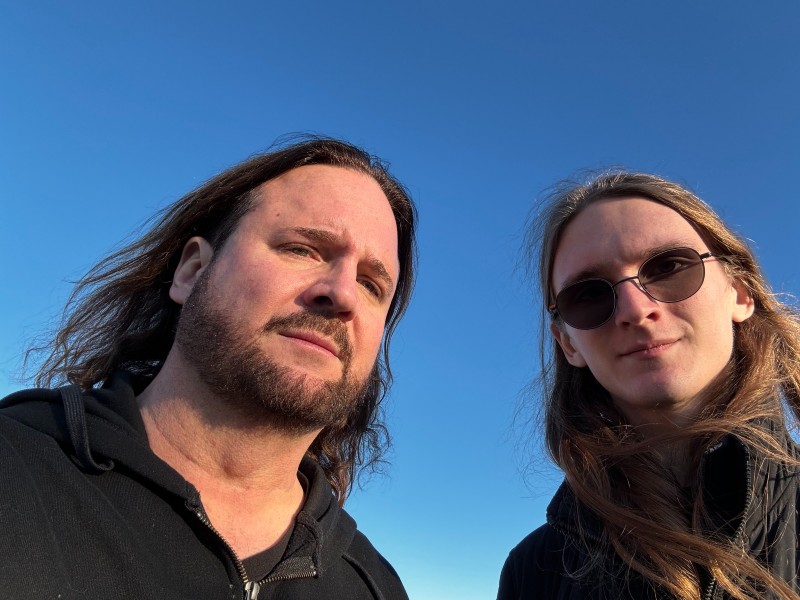
Q: Part of the inspiration for Galatea came from Zach deciding to attend Berklee College of Music in Boston earlier this year. How did that impact the album’s creative process?
RT: Musically, a lot of this is when Zach had told me he was going to school. He said, “Let’s write a great album before I go,” and it was a “who-knows-what-the-future-holds” album. Every album we do … you never know how long any good thing will last. You hope it will last forever, but life changes, and you don’t always see the direction in which life goes. That makes us dig into every album that we do, and every album that we do at the time we make it, it just means so much.
Q: The writing for Galatea morphed during the creative process. What was it like to see the songs transform for the album?
RT: I got into this creative groove a couple of years back, and I ended up coming up with 12 or 13 songs that were like an original version of Galatea. They had a little bit of a different storyline, and I played it for Zach and he liked the first two songs. I thought, “Oh, that’s all you like?” I was a little bummed about it, but then he started giving me stuff he wrote.
I had the ideas for the first two songs, and then where the narrative went from there was all based on how I reacted to the stuff that he sent over. It ended up being much better done that way. Once he started writing, he was writing on the drums, and I was throwing vocal stuff at him. He was coming back and saying, “Look, you can do better than this.”
ZT: I remember the first two tracks on the album were written, and I had been talking with my dad about our live set. Especially the song, “Red,” we had been playing for a year and a half before we even recorded it. Part of it was coming from that lens of what song would follow it in a live set. [It’s also] trying to write stuff that’s not seven minutes long, stuff that has a little bit of musical continuity, [and] stuff that I could play without having to change guitars. Those sorts of limitations ended up bringing a little bit of creativity and were inspiring for me to write the rest of the instrumentals [for] the album.
Q: Galatea took six months to write and record. How did it evolve in your home studio during that time?
RT: Once we knew that he was gonna go to school, we got into it. He said, “Well, we’ll at least have these songs written by the time I go.” He started getting fired up for writing. He wrote a lot of stuff, and said, “I think I want to finish this thing before I go to school.” I said, “Really? Do you think that’s possible?” Because Monoliths took a couple of years, but we did it. I’m glad we did because, by the time he went to school, we didn’t want to hear these songs.
By the time we’re done with one of these, we’re so sick of listening to it that we [need to] put it away for a little while. But then you go back … and listen to it and you have a whole new perspective on things. I always feel immensely appreciative … that I get to be part of this with him because I think he keeps getting better and better throughout the making of these albums. He just turned 21, so he’s coming into that age when his playing with all the experience that he’s had is starting to fire on all cylinders. And I think this album benefited from that more than anything.
ZT: It was more about communicating the whole of the music. When playing the guitar, [I’m] leaving room for the bass, drums, and vocals. When playing bass, [I’m] trying not to overdo it because my ideas are still there on the guitar and that doesn’t need to be all in one spot. I don’t have to prove myself on any of these things.
And hearing not just my instrument, but [hearing] every other instrument was inspiring throughout this album. It gave me the courage to speak up about these drum ideas … and the ones we used. Whenever I give my dad a song with or without a drum idea, what he always ends up coming up with is perfect and better than what I had in mind. I’ll look back and say, “Oh my gosh, I’m so glad I didn’t say that was [how] it had to be,” because then we wouldn’t have this much better drum part that needs to be there.
Q: Galatea is one of your shorter albums—it’s 42 minutes long and has eight tracks. How were you able to pare things down for this release?
RT: We had written about four other songs in addition to the other 10 songs I had written for this album. There was a lot of stuff that didn’t make the cut. We almost had two more songs on this album; it was gonna be a 10-song album. Those other two songs, we might still do something with [them], but when we took them off, we thought, “Oh my god, this is so powerful—just these songs.”
We’re always trying to trim the fat, but sometimes you want to squeeze on a song because you like a song. But when it’s put with this other collection of songs, it doesn’t always work. And you get better at discerning those things as you go along. I thought this album was the best one we had in terms of all the songs flowing together, but it did require that a couple of songs get cut. Now, when I go back and listen, it’s obvious they don’t belong. But when you’re in the thick of it, it’s hard to make those calls [because] you’re still too close to it.
ZT: When I was listening to bands like Covet, Polyphia, and these other technical bands, they’ll have pretty short albums, but also pretty short songs. They’ll have nine or 10 songs on an album, but the album will only be 35-40 minutes [long]. You can listen to the whole album in a single car ride and then you can do it again. When you have a shorter album like that or a shorter song, you hear it, and then you’re ready to hear it again. As much as I love writing seven-minute, eight-minute, and 10-minute songs, I don’t listen to very many. Proportional to what I am interested in listening to is how I like to approach writing.
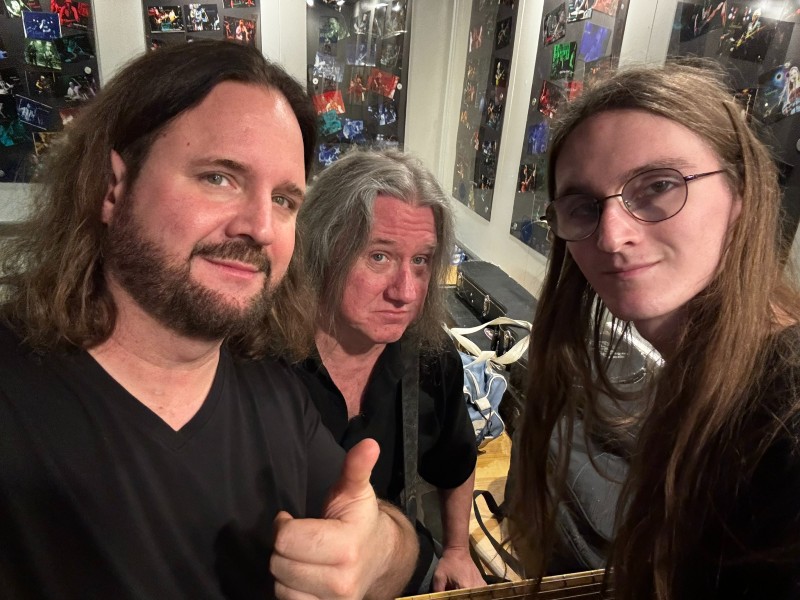
Q: You’re performing May 23 with Troy Gregory & The Mercury Gauntlett and Angel of Mars at Detroit’s Outer Limits Lounge. What plans do you have for your set?
RT: We’ve been rehearsing for this show that we have this Friday. It’s like, “Oh, wow!” These songs have benefited from us putting them aside for a while. It’s a 40-minute set, so we’ll play most of the album and maybe a little surprise here and there. We’ll be playing as a three-piece with Dave Humphreys, and he’ll be playing bass.
Q: You’re working on new material with Dave Humphreys. Do you plan to release it as the next Widetrack project?
RT: We haven’t talked about making another Widetrack album yet. We’re gonna do some writing with our buddy, Dave [Humphreys], and we’re gonna see if that ends up being a Widetrack album or if it just ends up being its own thing. But that’s the project that we have in front of us. It’s such a special thing.
This will be the first time we have collaborated with anybody. Dave is one of the only people alive—if not the only person—that we know that we are that close with. Dave’s been my best friend since I was 13 years old, and [we] have been in many bands and written many songs together. Dave and I have always had a musical chemistry like Zach and I have. Zach and Dave also have a great musical chemistry together, and it’s gonna be exciting watching those guys write together and be a part of that. We don’t want to put any restrictions on it and want to see what it’s gonna be. It could just be something that we do for fun. But I suspect it will be cool, and we’ll want to release it. I’m sure it’ll get out there somehow or another.
Widetrack performs May 23 with Troy Gregory & the Mercury Gauntlett and Angel of Mars at Outer Limits Lounge, 5507 Caniff Street, Detroit. For details, visit the venue’s website.
 The Stratton Setlist