Lighten the Load — J. Michael & The Heavy Burden Provides a Cathartic and Emotional Outlet on “Where We Belong” Album

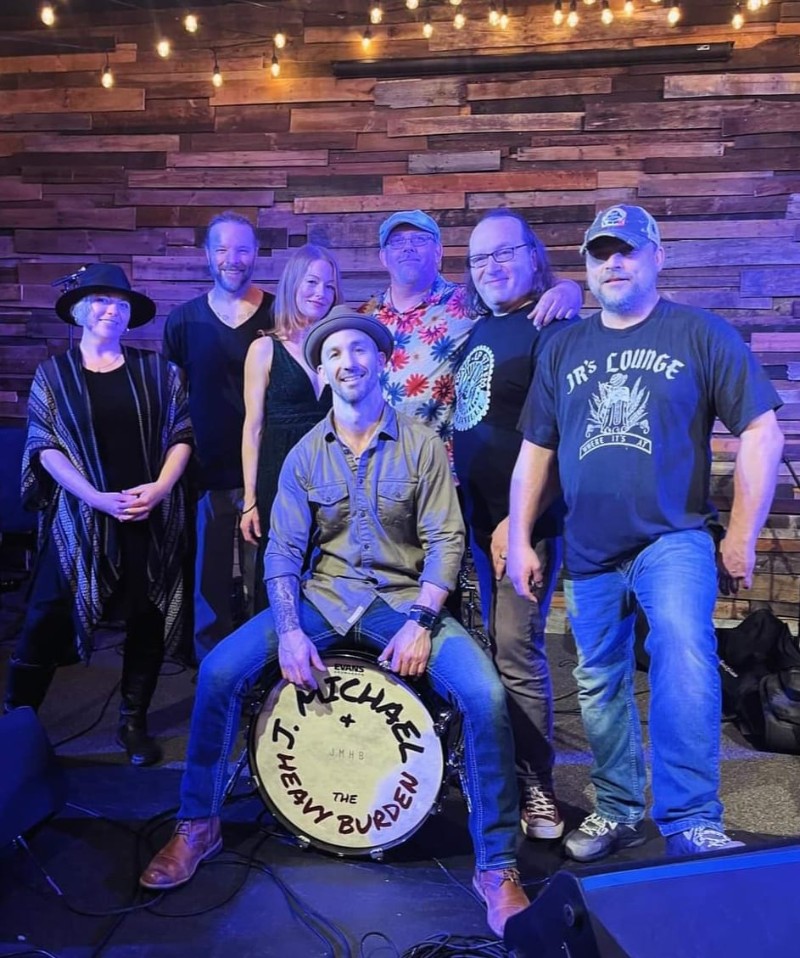
Shannon Lee, Andrew Pfeiffer, Hillary Finchum-Sung, Jeff Brach, Christopher Georges, David Roof, and former bassist Jamie Sass. Not pictured: current bassist Kevin Howard. Courtesy photo.

Editor’s Note: This article originally appeared on the Ann Arbor District Library’s Pulp blog.

Despite the band’s name, J. Michael & The Heavy Burden wants to lighten the emotional load for people.

The Ann Arbor-Metro Detroit band provides a cathartic outlet for processing feelings—ranging from hope to heartbreak to euphoria—on its latest album.

“A lot of the music that I write, it all comes from a very emotional place,” said Jeff “J. Michael” Brach, frontman for the Americana-jam rock band, about Where We Belong.

“When I’m at my peak creatively and writing a lot of music, which I’m actually doing more of right now, it’s when I’m going through difficult things.”

Brach examines a spectrum of emotions while rediscovering his purpose—both personally and vicariously—across eight tracks.

“Universally, the music that I love, you can identify with it, even if you’re interpreting it differently,” he said. “We all come from our perspectives, but you can universally tap into certain things that are being said.”

Brach’s relatable songwriting comes to life alongside the spirited instrumentation of The Heavy Burden, which includes lead guitarist Andrew Pfeiffer, drummer Christopher Georges, vocalist Shannon Lee, keyboardist David Roof, vocalist-violinist Hillary Finchum-Sung, and bassist Kevin Howard.

“Once I started listening and focusing on the lyrics, I [don’t] think of us as the heavy burden, but that’s the funny joke part of it,” Georges said.

“A lot of the songs have heavy, emotional tones sometimes, even though they’re light in their presentation and fun and groovy. There’s also this behind-the-scenes bit of toil and heartbreak, and that story-work in there. It’s delivered nicely and sweetly almost to the ear.”

I recently spoke to the band about its album ahead of an August 1 headlining set at the River Rhythm Music & Arts Festival in Manchester.

Continue reading “Lighten the Load — J. Michael & The Heavy Burden Provides a Cathartic and Emotional Outlet on “Where We Belong” Album”

Music Mavens — Katherine Yeske Taylor’s “She’s a Badass” Book Features Conversations with 20 Women Rockers About Feminism and the Music Industry

Katherine Yeske Taylor. Photo – Karen Stackpole

When I was a kid, I used to watch Happy Days.

I remember coming home from elementary school and watching reruns of the show, which featured several episodes of Suzi Quatro playing a musician named Leather Tuscadero.

There was something cool about Leather and the way she carried herself. I liked the idea of a woman fronting her own band, and in this case, it was Leather and the Suedes.

By the time I was nine, I started fronting my own imaginary band called Lori and The Red Hearts. It was inspired by women rockers like Suzi Quatro and Joan Jett.

While Lori and The Red Hearts never came to fruition, I learned later on that Quatro grew up in Detroit and is proud to be from there.

“It’s just a special city. You’ve got your Black and white completely coming together. Musically, it’s joined somehow. You’ve got your energy level. You’ve got your edge. You’ve got this almost desperation. It’s one of the best music cities, if not the best music city, in the world,” said Quatro in an interview with author-music journalist Katherine Yeske Taylor for the book, She’s a Badass: Women in Rock Shaping Feminism.

While she appreciates her hometown, Quatro also said she’s always been a square peg in a round hole and has forged her own musical path in life.

“From the time I started to play bass in a band, I was aware that I didn’t have my own niche in which to fit. It did not exist, so I created my own,” she said.

Quatro is one of 20 women rockers featured in Yeske Taylor’s book, which takes an in-depth look at the talent, determination, and humor they needed to succeed in their music careers. She’s a Badass also profiles Heart’s Ann Wilson, X’s Exene Cervenka, The Go-Go’s Gina Shock, Suzanne Vega, L7’s Donita Sparks, Indigo Girls’ Amy Ray, Paula Cole, and more.

“As I interviewed the women for this book, many of them proudly proclaimed themselves to be feminists—but several others had various reasons to reject that label. In either case, the way these artists have led their lives has turned them into role models (whether they actually intended to be or not), thereby promoting gender equality in the music business—and, arguably, in society overall,” writes Yeske Taylor in the book’s introduction.

To learn more, I spoke to Yeske Taylor about her background, music journalism career, and latest book.

Continue reading “Music Mavens — Katherine Yeske Taylor’s “She’s a Badass” Book Features Conversations with 20 Women Rockers About Feminism and the Music Industry”

From Lyric to Lore — Metro Detroit’s Nick Juno Finds His Folk Through Timeless Stories and Songs

Nick Juno stands in front of a Wayne Kramer mural at Detroit’s Lager House. Mural by Eric Patrick Kelly. 

Nick Juno knows how to tell a powerful story.

The folk singer-songwriter, historian, and storyteller is driven by curiosity and a desire to understand, express, and connect with listeners.

“I want to know something,” said Juno, who lives in Metro Detroit. “I want to say something; I want to feel something. And I want the listener to feel something, too.”

Whether he’s writing and singing about women working in cigar factories or calling for the release of a wrongly imprisoned activist, Juno’s songs hit an emotional and thoughtful mark.

“I’m a topical folk singer with songs often inspired by front-page headlines, historical events, museums, or personal stories shared by everyday people,” he said.

“My music, whether personal or historical, aims to honor the power of storytelling and connect people to both the past and present.”

His engaging stories and songs are best heard in intimate settings, like coffeehouses, taverns, small theaters, and house concerts.

“House concerts are a favorite setting at this stage of my career,” said Juno, who hails from Flint and has been writing and performing since the early ‘80s.

“Intimate and conversational spaces allow me to set up songs, tell their stories, and create memorable, meaningful events with listeners up close.”

I recently spoke with Juno about select songs from his catalog and his upcoming plans.

Continue reading “From Lyric to Lore — Metro Detroit’s Nick Juno Finds His Folk Through Timeless Stories and Songs”

Period Piece — Kelsey Detering Looks to New Wave and a New Artist Name on Her “Kelsey.” EP

Kelsey Detering plays her Dream Rio bass. Courtesy photo.

Editor’s Note: This article originally appeared on the Ann Arbor District Library’s Pulp blog.

Kelsey Detering has found her groove.

The Ann Arbor indie-rocker recently started playing bass and features new wave-inspired basslines on her four latest singles.

“Musically, I feel like I found myself starting at the end of 2023,” said Detering, who’s traded her previous Ceolsige (pronounced see-ole-sidge) artist moniker for Kelsey. (pronounced Kelsey period).

“I found myself as an artist and as a person, and everything locked in. That’s what happened to me, and I thought, ‘This is so different than Ceolsige, and it feels different.’ I’m hearing music differently since I started playing bass, and I’m writing and approaching it differently.”

Initially a pianist, Detering credits Duran Duran bassist John Taylor with inspiring her to pick up the bass—a Rio Dream bass.

“I learned all the [Duran Duran] basslines and started to branch out to other basslines and players, too,” she said. “That’s really the foundation of my playing. The first [bassline] I wrote was for ‘Throw the Stone,’ and you can hear [John Taylor’s influence] all over that. He was inspired by [Blondie], it’s a thread that goes through it.”

Detering’s including “Throw the Stone” and three other songs on a new Kelsey. EP, which will be released during her July 17 show at Lo-Fi Bar in Ann Arbor.

It features collaborations with singer-songwriter/guitarist Chris DuPont and guitarist/pedal steel guitar player Michael Harrington and drummer Billy Harrington of The Brothers Harrington.

“If you come to the show, you can get this packaged EP of all the singles I’ve released so far,” she said. “‘Wasted’ is the bridge song because half of it was tracked with these singles and the other half was finished in the album sessions.”

In addition to releasing a new self-titled EP, Detering has been working on her full-length debut album for Kelsey. at Ann Arbor’s Solid Sound Recording Company.

“In the fall of 2023, I had a lot happen in my personal life, and it inspired this whole album,” Detering said. “It was a lot of feelings that I had and a lot of new things I had never felt before.”

I recently spoke with Detering about her latest projects ahead of her show.

Continue reading “Period Piece — Kelsey Detering Looks to New Wave and a New Artist Name on Her “Kelsey.” EP”

Higher Love — Low Phase Explores the Evolution of a Relationship on “So Pretty It’s Perfect” EP

Low Phase’s Miles Ferguson, John Bomer, and Caleb Waldvogel. Courtesy photo

Low Phase understands the evolution of a relationship.

The Grand Rapids, Michigan band chronicles a budding romance and its growth over time on So Pretty It’s Perfect.

“I’m getting married in September,” said Caleb Waldvogel, the band’s lead vocalist-guitarist. “The whole EP is covering the beginning parts of our relationship and then falling into that decision. It’s been really inspirational. When you plan a wedding, you go through a lot of the relationship and a lot of the timeline.”

That timeline stretches across the EP’s six tracks, which include vulnerable lyrics, heartfelt vocals, and hopeful instrumentation. Waldvogel and his bandmates, drummer Miles Ferguson and bassist John Bomer, soar thematically and sonically on their indie-rock release.

“The three of us have been best friends for over a decade, and we’ve been playing music together for that long,” Bomer said. “We’ve known [Caleb’s fiancé] Jenna for as long as they’ve been together, so seeing that relationship come to a full bloom has been inspiring. We wrote a lot of these songs on the EP in the winter, but I think they’re turning out to be summer jams.”

As newly minted summer jams, the songs on So Pretty It’s Perfect will stand the test of time.

“The EP’s title is supposed to reflect the end of our story,” said Waldvogel, who met his fiancé in high school. “Everything you’ve been through, everything you’ve said, everything you’ve done has all been perfect. You created it with this other person and it’s all been worth it. Take a second to look at that timeline—it’s so pretty and it’s so perfect.”

To learn more, I spoke with the band about the EP ahead of a July 12 show at The Pyramid Scheme.

Continue reading “Higher Love — Low Phase Explores the Evolution of a Relationship on “So Pretty It’s Perfect” EP”

A Decade Later — Chris DuPont Celebrates 10th Anniversary of “Outlier” Album With Willis Sound Show

Chris DuPont. Photo – Misty Lyn Bergeron

After more than a decade of releasing music, Chris DuPont wants to revisit one of his earliest albums.

The Ypsilanti, Michigan singer-songwriter is paying tribute to his second album, Outlier, for its 10th anniversary with a show at Willis Sound.

“For many Ann Arbor listeners, Outlier was an introduction to my songwriting,” said DuPont, who’s performing songs from the indie-folk album with a full band on July 10.

“The longer I make music, the more important it feels to pause and celebrate milestones and to look at how I’ve changed and grown since then. The season of creating and releasing that album holds a great deal of memory, and I want to honor it before I dive fully into my next body of work.”

In 2015, he penned Outlier’s 10 tracks after confronting personal challenges related to his mental health and faith.

“In terms of what it means to me now, I think Outlier contains the opening statements of a discussion I’m still having with myself and the world around me,” DuPont said. “It’s the writings of a young man who’s coming to terms with his own mental health challenges, but still in the earliest stages of owning his problems and being good to those around them.”

Looking back, DuPont sees the emotional and spiritual growth that’s come from that creative experience.

“It’s the serpentine spiritual musings of someone who is enamored with the faith tradition he came from, yet deeply saddened and enraged by the abuses it inflicts,” he said. “These songs took some big swings to talk about relatively tough things, but looking back I think I may have pulled my punches in ways I wouldn’t now.”

I recently did an email interview with DuPont about Outlier ahead of his celebratory show.

Continue reading “A Decade Later — Chris DuPont Celebrates 10th Anniversary of “Outlier” Album With Willis Sound Show”

From Now On — Detroit’s Mike Ward Looks to the Future on “The Time That Remains” Album

Mike Ward embraces the future on “The Time That Remains” album. Photo – Steven Glynn

Mike Ward lives each day to the fullest.

The Detroit singer-songwriter and guitarist reconciles the past and embraces the future on The Time That Remains.

“I feel like I know these songs the best,” said Ward about his new folk album. “When I released The Darkness and The Light, most of those songs I knew as well as these. I feel like these songs are a lot closer to me than anything I’ve done.”

For his seventh release, Ward gets up close and personal about love, loss, and wisdom across the album’s dozen tracks. He spent considerable time fine-tuning the album’s evocative lyrics, heartfelt vocals, and earnest instrumentation before going into the studio last fall.

“This is unlike any album I’ve done because the songs have been performed out more than any of my other albums,” Ward said.

“When we recorded it, we produced 15 songs, but we trimmed it back because we felt these were the songs that hung together [the best]. At one point, we had a working title called Prayers, Parables, and Pet Peeves, and those are the buckets [the songs] fell into.”

I recently spoke with Ward about The Time That Remains ahead of an August 3 album release show in Ferndale, Michigan.

Continue reading “From Now On — Detroit’s Mike Ward Looks to the Future on “The Time That Remains” Album”

The Message — 1980s Hip-Hop Through The Eyes of Local Media

Graphic by Nate Pocsi-Morrison.

Editor’s Note: This article originally appeared on the Ann Arbor District Library’s Pulp blog.

In August 1983, 200 people entered a new dimension above the Heidelberg in Ann Arbor.

The clubgoers stepped into an unfamiliar yet fascinating music realm at the Big Beat Club, now known as Club Above, to dance the night away.

“Want to be on the cutting edge?” wrote Jim Boyd for The Michigan Daily on July 28, 1983. “New York, as usual, is the place to be, but this Friday you can save the plane fare by going to the Big Beat Club. There you will be able to experience the latest music/dance craze that is now surfacing in New York. It’s called ‘hip hop’ and its impact may prove to be culturally vast.”

The show was pushed back to August 5, 1983, but when the concert finally happened, curious viewers arrived to watch Harold “Whiz Kid” McGuire, a New York City DJ, spin and mix records in a “new” musical style known as “hip-hop.”

“There have been articles about ‘hip hop’ – which includes a style of manipulating turntables known as ‘scratching,’ for which the Whiz Kid is known, ‘break’ dancing, and ‘rapping’ – in such prestigious publications as Rolling Stone and the New Musical Express,” wrote Bill Brown in a July 23, 1983 article for The Ann Arbor News.

During Whiz Kid’s mesmerizing set, clubgoers watched his hands move as smoothly as a Kung Fu master while he played, mixed, and scratched records.

“The Whiz Kid’s ‘show’ consisted of a continuous, five-hour stream of heavily synthesized, emphatically rhythmic dance music,” wrote Brown in an August 12, 1983, review for The Ann Arbor News.

“At some points, especially when more people were watching him than dancing, he would play straight, uninterrupted records such as ‘Billie Jean.’ He would gradually throw in rhythmic accents that he either improvised on his electronic drum machine, created by manipulating the turntable’s needle, or snatched directly from other records.”

Continue reading “The Message — 1980s Hip-Hop Through The Eyes of Local Media”