

After more than a decade of releasing music, Chris DuPont wants to revisit one of his earliest albums.
The Ypsilanti, Michigan singer-songwriter is paying tribute to his second album, Outlier, for its 10th anniversary with a show at Willis Sound.
“For many Ann Arbor listeners, Outlier was an introduction to my songwriting,” said DuPont, who’s performing songs from the indie-folk album with a full band on July 10.
“The longer I make music, the more important it feels to pause and celebrate milestones and to look at how I’ve changed and grown since then. The season of creating and releasing that album holds a great deal of memory, and I want to honor it before I dive fully into my next body of work.”
In 2015, he penned Outlier’s 10 tracks after confronting personal challenges related to his mental health and faith.
“In terms of what it means to me now, I think Outlier contains the opening statements of a discussion I’m still having with myself and the world around me,” DuPont said. “It’s the writings of a young man who’s coming to terms with his own mental health challenges, but still in the earliest stages of owning his problems and being good to those around them.”
Looking back, DuPont sees the emotional and spiritual growth that’s come from that creative experience.
“It’s the serpentine spiritual musings of someone who is enamored with the faith tradition he came from, yet deeply saddened and enraged by the abuses it inflicts,” he said. “These songs took some big swings to talk about relatively tough things, but looking back I think I may have pulled my punches in ways I wouldn’t now.”
I recently did an email interview with DuPont about Outlier ahead of his celebratory show.
Q: What have you been up to lately?
A: I’m logistically busier than I think I have been in years, but very happy overall. My partner Kylee [Phillips] and I just bought a house in Milan at the top of 2025. This winter and spring I was hard at work converting a pre-fab 10-foot-by-16-foot shed into a finished backyard studio building, and I got it up and running in May. I’ve been busy recording clients, writing new work, and gigging like crazy.
Q: Outlier is an introspective look at feeling out of your element. What was it like to explore this theme across the album’s 10 tracks?
A: At the time, this album felt like it was taking a lot out of me. Which is weird, because it seems like a lighthearted walk in the park when I play it back-to-back with Floodplains. But Outlier was definitely about estrangement. Feeling like a misfit in my own skin, in the faith I was raised in, and in the relationship I was trying to keep alive.
The process of what it was—in retrospect—was one of my more disciplined seasons of writing practice. I had set up a little writing room with a desk, string lights, and a couple of guitars. No computer, just paper. I remember “Walk Next to Me,” “Forgiveness,” and “Ease the Blow” all came out in the solitude of that room. I also had a really reverberant church stairwell I had access to, and I wrote a bunch of songs there, too.
Lots of the songs gave me a space to deal with my growing doubts and critique of the faith I was raised and steeped in. At the time I thought I could be this winsome and reasonable voice dissenting in church settings, both in conversation and in my songwriting. It was an interesting time to be a musician working on staff in a church. The weird intermingling of Christianity with right-wing American politics was by no means new at this point, but I think that’s when I started to see it and become increasingly troubled. Much of Outlier was written and sung by an outsider in a camp that felt more foreign by the day.
I felt weird internal pressure to make the art equally palatable for families, people of faith, and nonreligious listeners. I wonder how it would have turned out if I had let myself off the hook. Maybe we can find out on the next album.
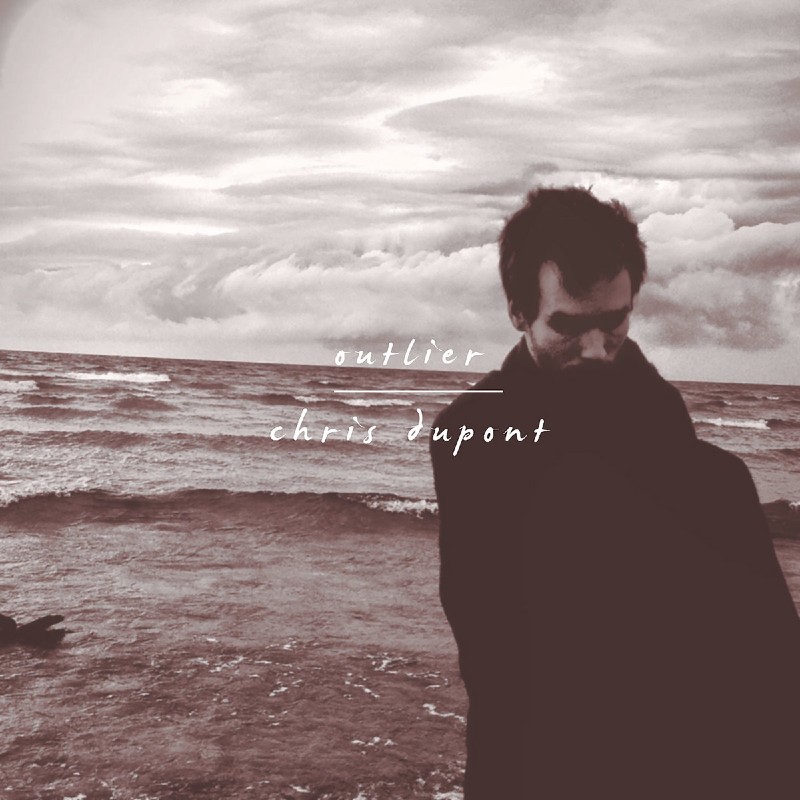
Q: The lyrics for Outlier’s songs include a lot of seasonal and nature imagery, especially related to fall. How did autumn inspire you while writing the songs for the album?
A: One thing I love about this album is that the cover photo looks like how the album felt to me. I’m standing out there under a foreboding Michigan cloud canopy, bracing myself for the coming cold. I used to struggle a great deal more with the lack of sunlight we Michiganians experience for over half the year here. That sorrow and foreboding definitely inspired the weightiness of songs like “Walk Next to Me” and “Evergreen Waltz.”
Q: “Forgiveness” explores being upset with someone and the negative emotions that linger after having a difficult conversation with them. How did writing this song help you ease that burden and find closure from that situation?
A: The main insight behind “Forgiveness” is that forgiving is not a two-person affair. In most cases, we have to forgive even if we never get an apology. In fact, I think waiting for an apology is immature and insane. I’ve sung this song thousands of times, and it still serves as a good reminder that my grudges hurt me and [not] the offender.
Q: “Cut the Tie” confronts a family member about choosing religious principles over relationships. How did writing this track help bring you clarity and catharsis?
A: I’m so glad the meaning of this song is so clear to you because it’s been interpreted in numerous ways. The song was written around 2014, when the debate over legal gay marriage was at a fever pitch. The fear and vitriol directed at queer people was becoming even more loud and frequent than it already was, and my disillusion with Christians was growing. I kept thinking, “Is this the hill you guys want to die on? How is this loving your neighbor?” I found myself thinking, “If there is a way of life that brings grace and wholeness to people’s lives, this sure as hell isn’t it.”
I was often surrounded by people who would rather estrange a loved one than accept them as they are. And “Cut the Tie” was my way of saying, “I’m not a part of this.” Strangely enough, the song didn’t give me much catharsis at the time. I wondered if the lyrics were too “inside baseball” to get the point across. But in brushing up on it for this reunion show, I relate to it now more than ever and think it could be a very meaningful and rewarding addition to future sets. I also honestly enjoy the experience of playing it now more than I did then.
Q: “Evergreen Waltz” asks someone to stick with you through good and bad times. How did this track become a hopeful anthem about overcoming obstacles and looking to the future?
A: I actually wrote this song for a children’s Christmas benefit concert. It was supposed to be this cute winter waltz, and I didn’t take it super seriously. The more I played it, the more I realized it had a great deal of musical and lyrical depth I hadn’t planned on. I think it wouldn’t have become anthemic if it hadn’t been for a last-minute whim we ran with the full-band live video shoot. The song was brand new, but I felt strong about getting it out there. I told Katie [Van Dusen] and the band, “Why don’t we do a fake ending, then kick back in with a loud drop, and Katie rips a solo?” Then that became the song as it still is today.
Lyrically, I now see it as an anthem for hope in general. When I sang it for the album, Eric Wojahn actually said, “Sing this again, and instead of walking next to a partner or something, imagine holding your toddler’s hand and telling him the cold world is worth seeing, and it will all be warm again soon.” The song’s meaning widened for me after that.
Q: “Bedside” is about becoming a father and pledging to love and protect your child. How did the birth of your first son inspire this song?
A: It was intended as a lullaby, but in retrospect, I think I was trying to assure myself more than him. I love that you called it a pledge because that’s definitely how I see it. I felt entirely unprepared to guide another human being when I felt pretty lost. It felt good to acknowledge how unruly and scary the world felt while also reminding myself that I intended to show up to the best of my ability.
Q: Outlier was recorded at several places, including Backseat Productions, Solid Sound, Big Sky Recording, Backseat Driverside and the Wolfhaus, and in a “little room” in Chicago with Nicholas Gunty. How did the 10 tracks for the album come together across all of those studios?
A: We definitely did the rounds of Southeast Michigan studios. We’d book a room that served a specific purpose, based on what we wanted the session to feel like, or what sound we were chasing. Solid Sound has a great mic selection for getting killer vocal sounds. Big Sky has an amazing drum room. Backseat—may it rest in peace—had limited equipment but unlimited vibe. The footage was carted around on a hard drive, and after I cleaned everything up, it was handed over to Nick Nagurka (Vulfpeck, May Erlewine) for mixing. Looking back, I don’t think this is the best or most efficient way to do things, but it certainly loaded the album with a wide palette of memories.
Q: How did co-producers Billy Harrington and Eric Wojahn help shape the album’s overall sound?
A: Billy was the guiding light on this album. He put in so many extra hours. He helped direct pre-production demos of many of the songs. We were very intentional about human grooves and patient tempos. Billy really internalized the songs and helped carve them in a way that felt intuitive.
Eric Wojahn guided the bulk of the vocal performances. I had typically always tracked my own vocals, largely out of self-consciousness. It’s a vulnerable thing for sure. But I knew I wanted the experience of being guided and challenged. Eric gave great feedback and made me feel right at home. It helped me grow a great deal as a performer and studio vocalist.
Q: Outlier features collaborations with Billy Harrington (drums), Luke Jackson (bass), Tony Pace (dobro, lap steel), Katie Van Dusen (violin, orchestration, cello), Christina Furtado (cello), Betsy King (vocals), Christina Thomashefski (vocals), Jacquie Jones (vocals), Brian Powers (vocals) and Nicholas Gunty (vocals). How did they create such an intimate sound on the album?
A: Each player came at these songs like a band member. There is certainly plenty of layering and multi-tracked overdubbing on this record, but every player was careful to craft a part for each song that stood on its own.
Billy and Luke’s rhythm section is restrained but confident. There isn’t a single note that doesn’t need to be there. Tony’s lap steel and dobro parts are all single instrument recordings usually done in a rehearsed single pass. And I’ve gotta say Katie really shone as an important voice on the album. In many cases, her violin is almost a vocal duet with my voice. She didn’t just play, she composed melodies, and they make many of the songs what they are. And everyone else on that list just truly showed up. They let the songs be the restrained, distilled pieces that they were, and they added exactly what they felt needed to be there.
Q: You first performed songs from Outlier during an album release show in October 2015 at Washtenaw Community College’s Towsley Auditorium. What was that show like?
A: The release show was this big DIY accomplishment that I’ve never quite matched. I rented a college auditorium, hired light and sound [support], ticketed the event myself, and got hundreds of people to see the full-band show I wanted to put on—big stage, big drama. Then I hit the road and began my most substantial touring with my buddies, Frances Luke Accord.
Q: What plans do you have for the Outlier decade show on July 10 at Willis Sound?
A: We are going to play the album top to bottom for sure. We are pulling in one of my favorite Noah Gunderson songs later in the set and a handful of tunes from the Floodplains and Fragile Things records. I’m super excited about it. Willis is a great place to see and play a show, and I loved being a part of Kylee [Phillips’] EP release show there a couple of years ago. I hope the listeners love it as much as I do.
Q: What will it be like to revisit Outlier’s songs on stage with this lineup: Kylee Phillips (vocals, keys), Katie Van Dusen (violin), Brad Phillips (mandolin, guitar), Mike Harrington (guitar, pedal steel), Nate Veldhoff (bass, backing vocals), and Billy Harrington (drums)?
A: It feels great to have this crew, Kylee is such an integral part of what I do and knows this album super well, so it will be a real gift to have her lend her voice to this show. She is such a powerful lead, but also a remarkably skilled guest vocalist because she makes everyone’s songs easier to sing somehow.
Having Katie Van Dusen home will be a joyful reunion. She moved to Ohio shortly after our last tour together and playing together has been more of a rare treat since then. I’m so excited to hear her shred on these songs, as her voice is a big part of their lifeblood.
Brad Phillips is a secret weapon and no one deserves him. That dude learned a bunch of my tricky second guitar parts and came up with some amazing mandolin work to enliven the songs.
Mike played the Outlier release show 10 years ago! He’s a beast, and I love getting chances to play with him. Billy was a big part of Outlier coming into existence, and the songs are always easy and just right when he’s at the drum kit. Nate Veldhoff is a treasure and an integral part of most of our sows. He internalizes songs like no one’s business and having him live on shows like “Forgiveness” and “Holding It Together” actually helped inspire this reunion anniversary show. He breathes a lot of new energy into the tunes.
Q: What plans do you have for new material?
A: There is so much on the docket! In addition to the anniversary show, I am really deep into production on some new revisited recordings of a couple of my favorite Outlier songs. I hope those will be as exciting for listeners as they are for me. Look for those in the fall, I think.
There is a new DuPont Phillips EP being dreamed up, and I hope to crank that out before the end of the year. Kylee Phillips is sitting on a pile of great songs that will be her first full-length, and I look forward to assisting in any way I can. I’m producing recordings for a lot of other artists, including Spencer LaJoye, Kyle Joe, Sammie Hershock, and Teghan Devon. It’s a full docket but I think it will be exciting.
In terms of the CDP world, I am sitting on a pile of new songs I hope to turn into my next LP. You heard a bunch of these at my “Scary Night of New Songs” show at the Rumpus Room back in March. I’m really taking my time with this collection and think it’s some of my strongest work yet.
Chris DuPont performs the “Outlier Decade Show” on July 10 at Willis Sound, 8906 Meridian Street, Willis, Michigan. The show starts at 7 pm. For tickets, visit Chris DuPont’s website.


One thought on “A Decade Later — Chris DuPont Celebrates 10th Anniversary of “Outlier” Album With Willis Sound Show”