
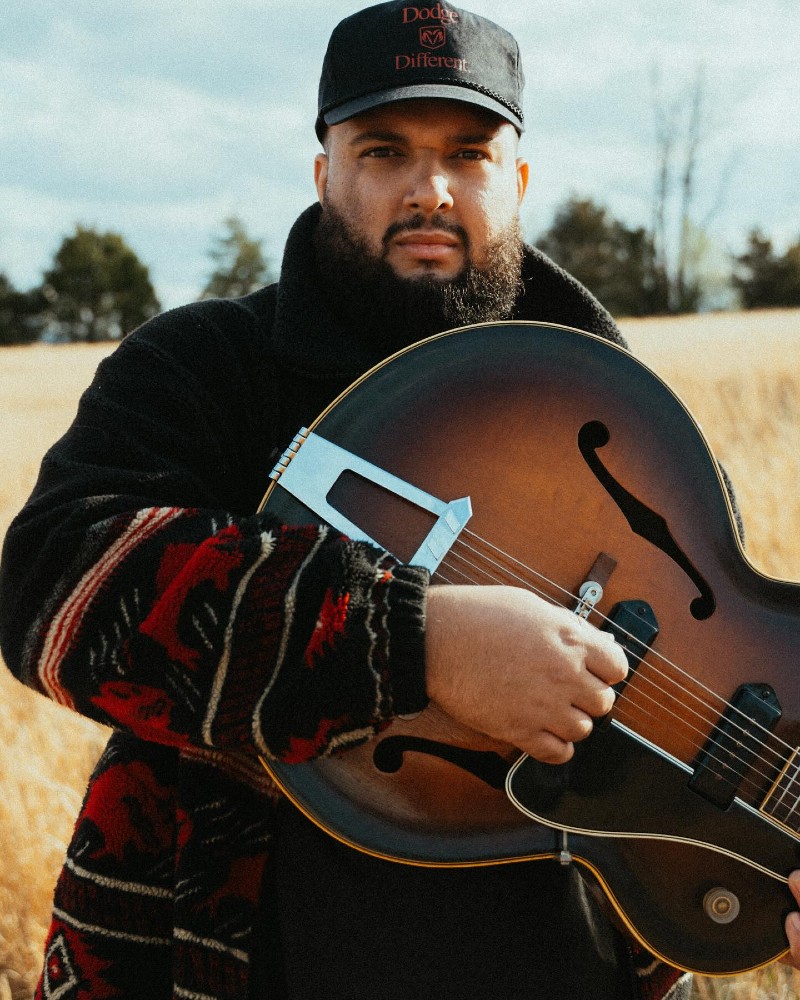
Trey Simon understands the grief that comes from a miscarriage.
The Rochester Hills, Michigan, singer-songwriter and guitarist processes that emotion and mourns that loss as a father on “Jesus Hold My Baby.”
“Ignorantly, you think you’re invincible,” said Simon about his latest Christian Americana single. “Everything with [our first son] Wisdom went so smoothly and perfectly, so we said, ‘Let’s do it again.’ We were expecting the same thing, and then seeing my wife go through that was one of the hardest things I’ve ever walked through.”
Two months into their second pregnancy, Simon and his wife, Lindsey, lost the baby and struggled with how to move forward.
On “Jesus Hold My Baby,” Simon sings, “I don’t know how we can move on / How do we ever try again? / I never wanna relive the heartbreak / Can there be a second chance?”
“When you love somebody and something’s wrong, you want to fix it with everything,” he said. “This is one of those things that I felt like I had to endure with her, and it was something I couldn’t fix. The thing that amazed me was that [roughly] one in [four] pregnancies, a miscarriage happens. I never knew that, I never dreamed of this happening—I never thought it would ever happen to me.”
Fortunately, Simon and Lindsey worked through their heartbreak and were able to conceive again. Their second son, Canaan, was born in July.
“We decided to go for it, and we had a healthy pregnancy,” Simon said. “It’s been beautiful, but it gave me a whole new perspective and a real heart for people who experience child loss and experience miscarriage. I really want to be a champion of those things and a supporter. Hopefully, this song can be a source of healing for many.”
I recently spoke with Simon about his latest single ahead of a September 19 show at The Apostolic Church of Auburn Hills in Auburn Hills, Michigan.
Q: What’s been inspiring you lately?
A: It’s really been my family. All my music leading up to this point—a lot of it was pretty self-centered in a sense—it was just talking about my journey, my experiences, and my desires. When you get married, you learn that it’s not about you anymore, and then when you have kids, you learn that it will never be about you ever again. I think that’s very much shifted my songwriting and my creative process.
I almost want to be careful when I say this, but music isn’t the thing that fulfills me anymore. It’s a vehicle to give to people, it’s a vehicle to express, but I’m not looking for something from music anymore. It’s purely just a one-way giving thing now. I think it’s also helped bring honesty to my songwriting and added purpose in many ways. Now that I’ve found fulfillment in my faith, and with my wife and sons, I feel a greater sense of purpose. They fulfill me, and that’s where I get everything I need out of this life.
Q: You released the Crosses EP in 2024. How was making that EP an eye-opening experience for you?
A: I learned a whole lot about myself with the Crosses EP. It opened a lot of doors for me. “Crosses” was the first song I ever had that got like real radio play. We had 12 networks add it to rotation on Christian radio, and we got national radio play on Air1. I got to work with Bryan Todd, and he’s an amazing pop producer. It was my first time … and I had labels taking me out to dinner, and I was sitting in boardrooms and all that kind of stuff.
In all honesty, it also kind of showed me a lot of things behind the curtain in the music industry—and even more specifically, the Christian music industry—that I wasn’t a huge fan of. You see a lot of people who wear the banner of one thing and then maybe live the other way. Now, will I say the Crosses EP, do I think that really represents my artistry? No, but I do think it was a huge step in finally giving myself permission to embrace the artistry that God’s given me, to write the songs I want to write, to play the music that I want to play, [and] to fully embrace all the things that I love.
You get around really big, successful people in the music industry, and they’re speaking into your life. You’re thinking, “OK, these guys are super successful and live in these mega mansions.” I need to listen to everything they tell me to.” And then you can very quickly kind of lose yourself. I’m grateful for what Crosses did, and I still receive emails. I still get people reaching out about how it’s helped them, and I believe it’s still playing on the radio throughout the South, which is really cool.
Q: You’re currently working on a new album. How is that coming along?
A: I’m more excited about the stuff we’re about to release because I think it’s a true reflection of who I am as an artist. Ever since I started writing songs as a 12-year-old, and now I’m 32, I’m actually making the music that I’ve always dreamed of making, and it sounds right, and I’m proud of it. And it’s something I really want to sit behind 20, 30, 50 years from now, and that’s what I’m most excited about.
I’m working with a producer, Gabriel Wilson, and he’s got a 40-acre farm in the mountains [in Tennessee]. It’s very much out of the Nashville bubble, which I think has been really good for this project just in general. This album is coming out in three parts: the first part is Exodus, the second is Wilderness, the third is Promise, and then there will be a full-length album, actually titled Canaan.
There’s no Auto-Tune on this album. It’s all recorded analog, it’s all real instruments, it’s all me playing all this stuff. When you come to see this live, it’s gonna sound just like the record because there’s no smoke and mirrors—it’s as raw and gritty as it gets.
Q: What was it like to write “Jesus Hold My Baby” from the perspective of a father experiencing a miscarriage?
A: It’s a weird, complicated feeling of guilt. You also feel like, “What did I do wrong for this to happen?” It’s this feeling of guilt and shame, but you’re not guilty—you didn’t do anything wrong. That’s a weird thing to toggle with, but I just want to put that out there so we can start the conversation because people need to know they’re not alone.
I feel like men, too, we feel like we have to be strong because we can’t fix it. We feel like we have to be stoic, and we have to put on this face, so our loved ones feel a sense of security and that we got it all locked down for them. The best form of strength through this is really to be vulnerable. I know for my wife, it was just to communicate and say, “I feel this, too. I feel the pain. I feel the hurt. I’ve had my tears. I’ve had my moments. Let’s just feel this together, but just know that you’re not alone.”
I do feel like men are left out because we put this standard on ourselves that we have to be invincible to be this protector, when I think sometimes the greatest display of security and love is really just being willing to be broken in front of them. This song is saying, “I’d love to be this child’s father, but [Jesus], you’re going to be so much of a greater dad than I can be.”
Q: Now that your second son, Canaan, has arrived, what does this song mean to you now?
A: It was [Lindsey] who gave me the courage to try again. And I gotta speak to a conversation I had with Gabriel [Wilson] when I was down south recording with him. I was sharing the fear of: “I want to be able to provide. I don’t want to go through this pain again.” Then he said, “This isn’t your decision because you were made here to have a family and do all these things. It’s not up to you to make all the ends meet, but you gotta have faith.”
There’s a verse in Matthew 6:33 that says, “Seek first the kingdom of God above all else and His righteousness and everything else will be added among you.” If I’m going to call myself a follower of Jesus and actually live this thing out, I can’t let fear stop me from moving forward. It’s not up to me. He gave me a perspective of: “I’m going to dive into this thing as ugly as it gets. We’re gonna go after it, and I try to hold that in every aspect of my life.”
Q: You initially struggled with writing “Jesus Hold My Baby.” How did producer Gabriel Wilson encourage you to finish it?
A: I was in midst of writing an album, I was dealing with [a miscarriage], and then Gabriel [Wilson] asked me about it. He said, “Have you been writing?”, and I said, “I kinda wrote this song … and it’s not even worth really showing you.” He said, “Well, no, show it to me.” I started to write, and I was hiding from my emotions. I was hiding from truly confronting what I was feeling. I started writing this song, and I sent it to him, and he said, “Trey, we gotta record this right away,” and I said, “No, man.”
And then he said, “Trey, when you’re running from something, it’s a clear sign that it’s exactly what needs to be put down on paper. We need to put this into something tangible.” To be honest with you, it’s still hard for me to listen to and hard for me to play, but I believe the responsibility of being an artist or being a singer-songwriter is you gotta be brave enough to put your healing process on display for others.
That’s our responsibility: to give other people the bravery, first of all to feel, but to feel the emotions, feel the hurt, feel the disappointment, feel the anger, and to dive into all of that and [not] run from it. It’s also knowing on the other side of that dissonance and that pain, there’s going to be purpose and there’s going to be healing.
Q: “Canaan” is an empowering anthem about finding comfort in your faith and feeling hopeful about the future. How did your personal experiences inspire this song?
A: On a personal note, just like everybody else, I’ve experienced my traumas, my hurts, and my pains in life. You will literally spend your whole life trying to find ways to heal from all of that. [It’s] also becoming a person that isn’t a victim of those things, but rather a product of the process of healing and the metamorphosis of walking into the fullness of who I truly believe God made us to be, walking through those difficult things.
“Canaan” is saying, “I’m not going to be a victim, but I’m truly going to be [my authentic self]. God, you trusted me with the difficult things and the traumatic experiences of my life.” My parents got divorced, and I was homeless for four years with my dad. I struggled with substances for a time in my life. Before I met my wife, I was always looking for love and looking in the wrong places. I’d wake up in the morning, and I’d look at myself in the mirror, and it wasn’t really somebody I was proud of.
This song came in, and this whole project is [a blessing]. I’m [32] now, I’m married, and I have two sons. [Now], I’m proud to say that I look in the mirror and I’m proud of who I see. I’m proud of this life that I’ve built, and I’m proud of everything that’s around me.
“Canaan” is [also] saying: “I’m leaving the past behind. I’m leaving the hurt, I’m leaving the trauma, and I’m accepting the person that it’s made me to be. And I recognize what it is, but I’m freeing myself from those things, and I’m embarking on this journey of I’m going to be the artist that God made me to be. I’m going to write the songs that I was always meant to write. I’m going to reach people in a way that I’ve never reached them before. I’m going to take as many people as I possibly can on this journey with me of freedom, fulfillment, and fullness, and truly finding what real faith looks like.”
Q: How did listening to Bruce Springsteen and other artists influence “Canaan’s” subject matter and sound?
A: Sonically, it’s all the stuff that I’ve loved forever. It’s super Springsteen, and I think that was the influence, like Born in the U.S.A. In the past, I always wore the mask of showing, “I’m going to wear these fancy clothes. I want to make sure I’m perfectly manicured at all times,” because I wanted to be this stud muffin troubadour dude that was too cool for school.
As you grow up, you say, “I don’t care about that stuff. I just want to be my true, authentic self—unfiltered—for people.” That’s showing the ugly, that’s showing the scars, but that’s also showing the things I’m excited about.
Musically, I wanted to represent that, and Bruce Springsteen is a blue-collar hero. With this music, I grew up with B.B. King, Albert King, Freddie King, Buddy Guy, and these great singer-songwriters like Bruce Springsteen, Tom Petty, James Taylor, and Ray LaMontagne. I’ve listened to outside voices telling me the kind of music I had to make. [Now], I’m gonna make the stuff that I love, and these guys are my heroes. This is the music that I listen to 24/7.
Q: How long did you spend writing “Canaan?”
A: “Canaan” kinda hit me out of nowhere, and I was just writing it. But I gotta say, it was a labor of love in the sense that I would get there and then I would think, “It’s not quite there yet.” And I would show it to people I trust, and I just kept digging until I said, “I think I nailed it. What do you think?” And then my trusted voices would say, “Yeah, I think you hit it, too.” [In the song], when I say, “I’ll set foot on the promised land / I’m on my way to Canaan,” I want people to believe me because I’m expressing just the rawest and most authentic truth of myself.
Q: What inspired the raw and honest sound featured on “Jesus Hold My Baby” and “Canaan?”
A: [With these songs], I’m going to absolutely not follow any of the rules, and I’m just going to make something that I really love and that I’m really proud of. It’s going to reach the people it needs to reach, but I’m going to be brave enough, and I’m going to honor and respect what God’s put in me enough to let that come through.
Gabriel [Wilson] was a big instrument in finding that and the courage of that, and he allowed me to be myself. He’s really hands-on without being hands-on. He said, “I’m not gonna write the song for you. I’m just going to keep telling you until I believe you.” And then he said, “Ah, I believe you.” Sonically, he said, “I have no idea what we’re supposed to make. Let’s just start making stuff until we find it,” and so it was just him and me with guitars and him sitting at the drums and us finding the sound.
We said, “You know what, we’re just making a classic American album.” We’re using all vintage gear, and it’s all analog. Let’s just make this thing classic. There’s no 808s and Heartbreaks, and there’s no processed whatever. It’s just guys in a room jamming. For lack of better words, I almost want to be like the Chris Stapleton of Christian music. Chris Stapleton is just Chris Stapleton. He goes into a room, and he has his band, and they just record them playing. That’s our approach for this—take it or leave it—it is what it is, and we’re not going to make it anything else.
Q: What exciting things are on the horizon for you?
A: I’ll be opening for Tauren Wells, who’s a big Christian pop artist, on September 19 at The Apostolic Church of Auburn Hills for the Concert for a Cause. All ticket proceeds will benefit the children and families served by the nonprofit House of Providence. I also signed my first record deal with Maranatha! Music and will have my music distributed through Capitol Christian Music Group.
Q: What plans do you have for releasing additional new music?
A: Our plan for Exodus, which is gonna be the first part of this album, is “Canaan” was released in July, and then “Jesus Hold My Baby” was released in August. We just [released] music videos for both of those as well. We’re gonna have a third single … and then we’ll release those three singles as part of a body of five songs, which will be the EP Exodus. That will be released in October.
We’ll do the same exact thing going in throughout the rest of the album. The second EP is Wilderness: it will be three singles that lead into a body of five songs. And then we’ll match that until we have a full body of work, but the full body will be at least 15 songs. The whole album we’re looking at coming out in 2026.
Trey Simon performs September 19 for the Concert for a Cause at The Apostolic Church of Auburn Hills, 3655 North Squirrel Road, Auburn Hills, Michigan. All ticket proceeds will benefit the children and families served by House of Providence. Doors open at 6 pm and the show starts at 7 pm. For tickets, visit TicketSpice.
 The Stratton Setlist