
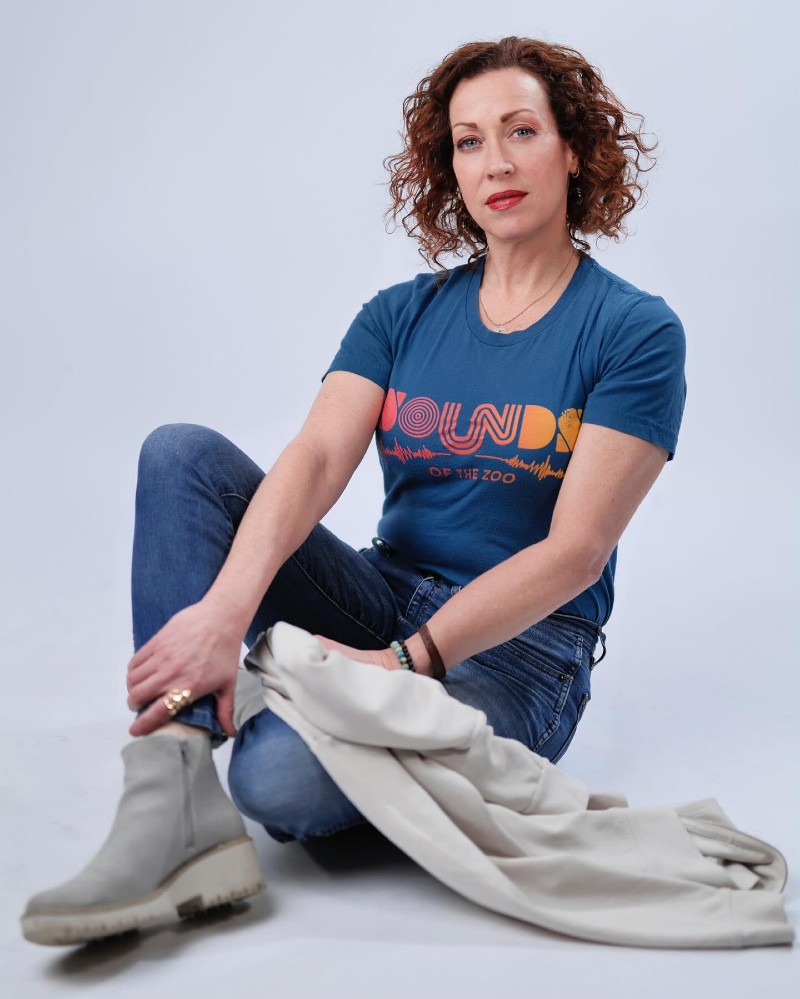
When it comes to curating a music festival, Jennifer Hudson-Prenkert looks to Willie Nelson.
She remembers watching Nelson and other artists perform during Farm Aid when it aired on TV while she was growing up.
“I never went to it, but somehow, through the TV, it made me feel like there were legitimate people running it,” said Hudson-Prenkert, who’s based in Kalamazoo and is the founder, curator, and director of the Sounds of the Zoo music festival.
“There was something different about Farm Aid from a regular trying-to-make-money music festival. Obviously, we know it’s for farming, but it’s about quality. You get good artists to come in, and the artists want to be there.”
She took that inspiration and ran with it for planning, organizing, and spearheading the inaugural Sounds of the Zoo festival in 2022. The festival was the perfect antidote for reinvigorating local live music coming out of the pandemic.
“I feel like the Farm Aid mentality, to me, was given a mission and had the right people in play. It was the curated invite and not the mentality of saying, ‘You’re not worthy,’” Hudson-Prenkert said.
What resulted is a free-admission festival filled with 50-plus acts performing at eight locations over a week. It also includes music industry workshops and documentary screenings.
“I have different genres of music, and this is a community,” Hudson-Prenkert said. “It’s a mission-driven music festival, so it means all things.”
Hudson-Prenkert is gearing up for the fourth Sounds of the Zoo festival, which runs September 22-28, and features performances from Hannah Laine, Super Dre, Jordan Hamilton, Luke Winslow-King, Louie Lee, Jennifer Westwood and The Handsome Devils, Yolonda Lavender, The Go Rounds, and others.
There’s also a “Push the City Cypher” competition, the premiere of the Kalamazoo Gals documentary, busking stations, and workshops by Maggie Heeren and Chris Simpson.
To learn more, I recently spoke with Hudson-Prenkert about her background and the festival.
Q: You come from a family of creatives. How did they inspire you to pursue the arts?
A: Most of my family is involved in the arts in some capacity. They’re artists themselves, and they have talents that they didn’t pursue professionally, or they just have a love of the arts. I grew up in an art family and all things art, like movies, writing, theater, dance, and music. We just enjoyed it and we just lived it.
I was born in Manistee, Michigan, and I grew up in Ludington. I was a child running around the Ramsdell Theatre, which is their community theater. My grandparents retired up in Manistee, and my grandfather was a music major in violin at Wayne State University. My whole family is from Detroit, and I’m an east-sider at heart, too. A lot of our family migrated up to the Manistee-Ludington area for various reasons.
Q: How did your early childhood days in Manistee and Ludington help lay that creative foundation for you?
A: Once my grandparents retired up there, my grandfather pursued music 100 percent. He was heavily involved at the Ramsdell as an actor, director, and singer. He actually made violins; he was a carpenter and one of those right-and-left-brain people. And my grandmother was an artist; she pursued art a little later in life. She was a beautiful artist and painter of all media. She would actually create the programs and then sometimes do the set design.
And then my dad was in a play once and he was more of a guitar player and singer. My mom got involved in theater, and my uncle was a DJ at WKLA-FM in Ludington, and he was an actor. He got my mom into theater, and at one point, there was a really fun article about the Hudson family dominating the Ramsdell and the West Shore Community College theater. It comes really natural to me, and I really think this is my destiny.
Q: How did your creative journey start as a dancer?
A: I started when I was seven in Ludington at Calista Marie School of Dance. Tap dancing was my first introduction, and I think that set a tone for jazz dance. I found ballet a little bit later, and it was always a little bit of a struggle for me. Ballet is the foundation of dance in terms of athleticism and training … but it felt a little bit closed culturally. I just dabbled in it.
We moved from Ludington to the Detroit area when I was going into seventh grade. I moved to Oxford, and our high school really wasn’t into the arts as much, but I started in choir. I was scared about dancing, and I didn’t know where to go. I took a couple of years off, and then I got back into it. I ended up taking master classes and auditioning at Stagecrafters in Royal Oak.
I had learned all of the choreography of West Side Story without even realizing it. I showed up to audition, and in my senior year of high school, I got into West Side Story. I was driving to rehearsal every night and staying there until 11 at night the whole year.
Q: How did that lead to studying dance at Western Michigan University?
A: I finally decided to major in dance, and I got into Western Michigan University’s dance program. It has a really good arts program, but it’s not a conservatory. One thing about going to Western for dance is that you get live music performers during your classes. In ballet class, I had a live pianist, and we had a drummer in our modern dance class. On Fridays, we would have live music in my jazz dance class, and we would have a drummer and a bass player. Two of those guys were in a band, and they played at The Club Soda in Kalamazoo. That birthed the connection for me in music in Kalamazoo because dance and music go hand-in-hand.
Q: What was it like to join a modern dance company in Kalamazoo?
A: We were so blessed to have a modern dance company in Kalamazoo called Wellspring Cori Terry & Dancers. She was a direct descendant of a famous dancer named Erick Hawkins, who was married to Martha Graham. I was super-honored to have been introduced to dance, and Erick was known more for his technique than his choreography. Cori moved here from New York and was in a renaissance period at that point in the ‘80s, and that was huge.
I danced professionally for 12 years, and I had danced my whole life up to that point. I’ve been involved in theater since I left the dance company, and once I transitioned into the music world, I’ve been doing a little bit of everything.
Q: You sing in the cover band Groove Tonic. What types of songs do you perform?
A: We try to do a little bit of everything, and I look at ourselves as picking good music and playing it well. We put our spin on it, but not in a kitschy way. We play songs that have a groove to them, and it’s music for me that’s almost like a hug. One song we perform is Deee-Lite’s “Groove is in the Heart,” and we perform songs by The Doobie Brothers, Hall & Oates, Kings of Leon, and Lake Street Dive.
I also get inspiration from May Erlewine and Kait Rose, and they seem to have a good time. It has to be fun to diverge from their own songwriting that they do. I’m also enamored by Greensky Bluegrass doing their covers. They’ve done such a good job of taking different songs you would never think they would play into this jamgrass.
Q: How did you get involved in curating and booking live music?
A: I’ve always been into event planning, and I worked at restaurants for years. When I was at Western Michigan University, I ran for president of the student body. I’ve always had a leadership event jam, and I think restaurants really solidified that with banquets and even shows and theater. I’ve always loved all different kinds of art, and I’ve never felt like I fit in anywhere. Leaving the dance company was the hardest thing I’ve ever had to do. It was about finding my own voice in a way that was so different that I didn’t even know what it was.
I started booking music at Arcadia Brewing Company in Kalamazoo, and my husband helped build and design a beer garden. I found out that was happening, so I got him involved, and I snuck my way in. I knew it wasn’t going to be a music venue, but I used it as a catalyst to try … and there was a beauty that came out of it.
The Arcadia situation created a lot of relationships for me in music in Kalamazoo and with other people. The owner wanted a summer concert series, and he was building a stage outside. I was given a budget, and he said, “We want one concert a month, and here’s the money you have.”
Q: Who were some of the artists that you booked for that concert series?
A: The Go Rounds was one of my first acts, and I also had Last Gasp Collective, Yolonda Lavender, and After Ours. There are a lot of people I’ve worked with from that moment on who came from that period. I actually booked The War and Treaty, and then I was working with Max Brown, who was in several bands in Kalamazoo. We also had a symphony on stage.
Q: How did that experience prompt you to start Sounds of the Zoo in 2021?
A: Once that happened, I knew that Arcadia wasn’t going to continue. That seed was sitting there waiting to be planted. I met a production company through there, and I said, “What if we just did one festival for one day?” And then the city actually got involved because I’m a hair stylist, and I know a lot of people, and I get to meet a lot of people.
The city said, “Instead of doing it at the Kalamazoo Growlers baseball stadium, why don’t you do it at Bronson Park in the middle of the city?” And I said, “That seems like a lot, and I don’t know how to think about that … and now I have to figure this out.” And then out of COVID, I thought, “We can do something seven days a week,” and I was determined [to do it].
Q: How did the first Sounds of the Zoo go in 2022?
A: The first Sounds of the Zoo in 2022 went really well. The template that exists right now has been there from day one. I’ve always had 50 performances over seven days at eight locations—give or take. Sometimes I use a location more than once. I think the biggest challenge is that I decided to make it free. I think that came out of my passion for humanity, but I also didn’t want to get into nonprofits either. I was looking for a hybrid that I didn’t know existed, and that’s been the most bizarre thing that I’ve been doing. There is a force that’s guiding me into something that I think I’ve been just put on the planet to do.
The weeklong [aspect] came out of The Club Soda days in Kalamazoo. They always put out a calendar each month, and every day of the week had great bands. I went into Sounds of the Zoo with that mentality, whether it’s during the festival or during the entire year. I do things all year because I’m mission-based, and I try to average one to three events a month.
Q: Why did you name the festival Sounds of the Zoo?
A: There was an event going on in Kalamazoo that had a Sounds name, and somebody put that on my radar. We had this [ad campaign] called “Yes, there really is a Kalamazoo,” and I think it’s more [known] in Kalamazoo. And I’m also from [the] Detroit [area], and we call Detroit “The D.” In Kalamazoo, we call it the “Zoo” or “K-Zoo,” and it’s paying homage to Detroit—in my head—even though it’s “Zoo.”
Once I got the name, everything that I’ve done has been very curated. Everything I do is very specific, and I could tell you every single thing. That’s the artist in me, that’s the theater person in me, and that’s the detail person in me, but it’s hand-picked—like farm-to-table. It’s that same mentality, and I’m farm-to-tabling this festival.
And I have to plug Bell’s Brewery because I grew up there, and Larry Bell did a great job with what he birthed. He had a good strategy, and marketing was a big part of that. Being near colleges and having stickers, hats, and T-shirts, he knew people would take that to other places. I’m not there yet at all, but I do recognize that mentality, and I respect that very much. I think that was part of my inspiration, too, and for being here for so long.
Q: How did you land on a festival lineup that features a variety of acts representing different genres?
A: I work local, regional, national, and international in terms of booking music. It’s all genres, but the focus clearly is on local and regional [artists]. The national and international focus is like a hybrid, and it’s punched in. I’m not closed off to anything; I think of everything like a revolving door. But that being said, I feel very adamant about putting Michigan artists out there.
And so the other goal is that I want Sounds of the Zoo to be known as a place where other festival owners and venue owners can say, “Oh my gosh, that’s a cool band!” Because I have the advantage of curating, doing it free, and having other people coming since it’s accessible to all.
I also want to put the emphasis on local, but it’s fun to watch people grow in the ways that they want to grow. We don’t want to just have a ceiling in Michigan, but for those who decide to plant roots here, I think it’s really important to celebrate that, talk about that, and make everyone feel good about themselves, whether they decide to go travel and tour and change the world on that bigger level or do it like a local community.
Q: The festival is screening the Kalamazoo Gals documentary, which pays tribute to the women who built Gibson guitars during World War II. What do you hope people take away from it?
A: When I went to Western Michigan University, I did not know that Gibson was founded here in 1894. And then I found out four years ago about all the women who had worked there during World War II from 1942 to 1945. Think of all the places that can rediscover that, and I hope that we can be a catalyst for that. It’s been a long time coming, and I’m so honored.
I literally wanted to [help] birth this documentary [with] John Thomas, the author of the book Kalamazoo Gals: A Story of Extraordinary Women & Gibson’s “Banner” Guitars of WWII, and he was about to do it four years ago. I was so excited, and we were almost going to do it at the Kalamazoo State Theatre my very first year of the festival. There are a lot of reasons why that didn’t happen—some are good, some are bad—but I think it’s the right place right now. John has become a really good friend and is so supportive of music on every level. John is not from Kalamazoo, he’s from Connecticut, and he wrote this book in 2013.
Q: What does the future look like for Sounds of the Zoo?
A: I have to start turning this barge and turning it in the right direction to be more sustainable from an operations management component. I’m building my team a little more and finding better ways to make the money side of it work a little easier. I’m really working with the municipality of Kalamazoo, and creating change through music is like the phoenix rising from the ashes. One of my pillars is mental health, and this came out of nothing. When there was nothing in Kalamazoo, I birthed Sounds of the Zoo with a lot of different people and thoughts. It’s very interesting to see the evolution four years later.
Sounds of the Zoo runs September 22-28 in Kalamazoo at eight different locations, including the Clover Room, Bell’s Back Room, Green Door Distillery, and Bronson Park. The festival is free. For festival schedule, lineup, and locations, visit soundsofthezoo.com.
 The Stratton Setlist