
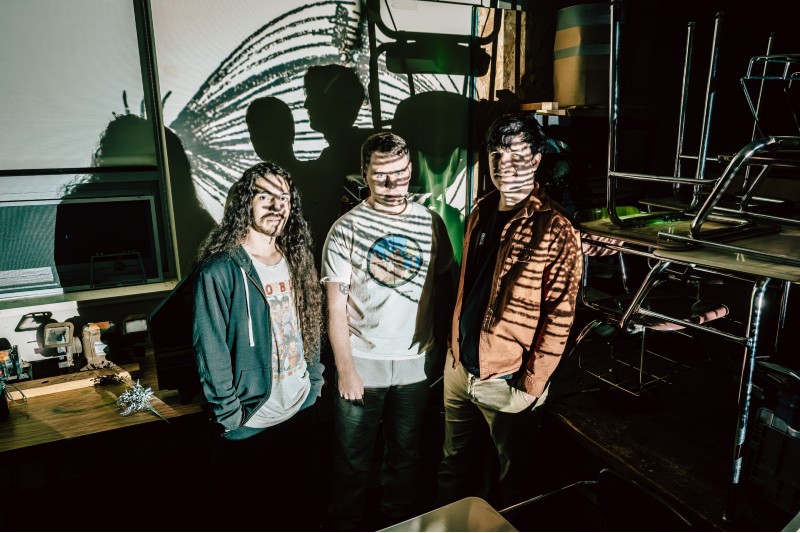
Chandler Lach needs a change of pace.
The Ypsilanti musician spent six years working on Ness Lake’s latest album and reflecting on several life changes.
“I was facing a lot of weird inner turmoil and changes,” said Lach, the band’s frontman, about Normal Speed.
“And now, looking back on it, I wrote all those songs about needing to get better before realizing that I really needed to. I think it’s a pretty constant experience of an artist to look back on former work and think, ‘Oh, you were so cute six years ago. I can’t believe that experience was so intense for you. I can’t believe that was what was consuming me at that time.’”
Lach chronicles his evolution across nine tracks, which explore relationships, mental health, and sobriety.
“There’s a lot of hope on the album, too. It’s cool to see that hope has been realized,” he said.
“Thematically, it’s knowing that things need to improve and not knowing exactly the steps to get there, but seeing that there is some light there. It’s strange writing songs now. I have different problems and anxieties, but also different joys and pleasures.”
On Normal Speed, Lach excels alongside bassist/multi-instrumentalist/producer Marco Aziel and former drummer/percussionist Brandon McDole. Ness Lake’s contemplative lyrics and experimental instrumentation instantly resonate with fans of emo, shoegaze, and indie rock.
“I walk away from the whole experience [being] so grateful to Marco and Brandon for pushing [us]. This is the product … because of that hard work,” said Lach, whose band name takes inspiration from Loch Ness. “I’m really interested, excited, and curious to see how it’s received and what happens next. I think no matter what, we have a cool roster of new songs.”
I recently spoke with the band about the album ahead of a January 30 album release show at Ziggy’s.
Q: How did you form this lineup of the band?
Chandler Lach (CL): I’ve been working as an English teacher at [Ypsilanti’s] Arbor Preparatory High School. I’m in my ninth year right now. Several years in, I found out that our chemistry teacher was leaving the school, and I knew Brandon because [he] and I had performed together with his project, Great Expectations. And I knew that he was a chemistry teacher because we had that in common when we talked at a show. I thought, “He’s a cool guy. I should let him know there’s a job opening,” and so Brandon applied for the job.
At the time [with] Ness Lake, I had gone from performing with some other members, and I had been a solo [project] for a period of time. Brandon came to the school, and he had drums in the lab.
Marco and I had been friends, and we were briefly roommates. Marco and I met when my former band, Swordfish, was playing shows at the American Legion hall in Plymouth back in 2016 or 2017. We were acquaintances, then roommates, then acquaintances, and then friends. We brought Marco in as a bass player, and I didn’t think that they would want to do it initially. It felt like a half-court shot asking them, and then they were down. I’ve been so grateful for their involvement.
Brandon McDole (BM): I think it was COVID, and we weren’t actually using the chemistry lab. We were teaching hybrid. I had turned it into a practice space and had my drums there. I had recorded an album of my own at the same time, too, but even before that, we had started demoing stuff. It was just [Chandler] and me first.
Marco Aziel (MA): Our individual projects had been around each other at shows for years. And Ness Lake, being the amorphous blob that it is, eventually Chandler said, “I need new bandmates,” and then it fell together. In 2020, during COVID, Chandler and I started hanging out in a non-musical context. We would hang out, goof around, and make music with no particular [goal]. I don’t remember if that was before or after he had asked me to be a part of Ness Lake, officially, but that was part of the process.
Q: On Normal Speed, “Fish Tank” addresses the struggle of imposter syndrome as an artist. How did an actual fish tank inspire it?
CL: There was a real fish tank. It was my COVID hobby; I had gotten into bioactive fish tanks. It was all natural and had crayfish, shrimp, and guppies. It was the perfect size for me if I chose to drop my OP-1 synthesizer into it. You have the archetype of the rock star smashing their instrument.
There isn’t a clear analog for that for bedroom-pop musicians. There’s a feeling of frustration or feeling like you’re not actualizing your talents. I’ve experienced that and thought, “Let’s sell the guitars, let’s get rid of everything, and let’s move to the mountains and forget that art was even a thing.” It’s saying, “Let’s be done with this.”
MA: This is a notion that I project onto that song, especially the line about “Gonna put my synth in the fish tank.” As an artist, you can get really self-critical about the fact that you feel like what you have to say is important enough to put on an album and promote it by saying, “Look at the art that I made. This thing that I’m gonna say is so important.” That voice is telling you to shut up, and that’s what that line invokes in my mind.
BM: I always thought it was much more playful. We never talked about it. As a teacher, Chandler is always [joking] with his students, and he plays little jokes and pranks. He’s a little goofy and likes making everybody laugh. I took it as emblematic of him being a little cheeky.
Q: “You Get It All” acknowledges feeling doubtful about a relationship. What was it like to explore this perspective in the song?
CL: It’s being in a relationship with somebody who seems like they’re giving their all, and you feel like they deserve it all, but they’re not getting that. That’s all I have to say about that.
Q: “Thrift Store Knife Set” has an infectious bounce and momentum to it. How did Marco help craft that song?
CL: For that song, Marco had such a specific idea for the drums. Marco pulled Brandon out of the driver’s seat. I think Marco saw a vision for the song, and all of a sudden, my guitar part changed. I was being encouraged to play it a certain way. It took me quite some time to figure out what I was actually doing.
The song has a bounce and momentum to it that it otherwise wouldn’t have had. It was like a slow fingerpicking song, and it just went from there. It’s also my first ever recorded guitar solo. I’m not a guitar solo [person], but I’ve got this one under my belt. But I see why people do it, it’s really fun. I have the [knife set] still. It’s a wooden one with a sticker on it.
Q: “Clear” examines forgiving yourself and confronting depression. How was writing this track an eye-opening experience for you?
CL: That one is the theme of self-forgiveness, and it’s about the relation I have with improving my life and then getting better. I’m really proud of the image that comes [from the lyric], “The rainbows in the oil disappear.” When your life sucks, and you’re really trudging through it, you have that oil, and you’ve got all these positive byproducts through your art and through your suffering.
The shift of that song is talking about taking medication to address your depression and letting the oil get cleared up a little bit, and not feeling like you’re missing something. There’s so much pain in the world. I think a lot of artists—myself included—when you’re young, you want to suffer because you have this perception that suffering makes good art. You shouldn’t avoid suffering and neglect it.
You think, “Life sucks, and I’m gonna write a beautiful album about it.” That song, to me, is saying, “OK, we don’t have to feel bad about taking steps to improve this situation.”
Q: “Underneath” explores feeling overwhelmed, lost, and alone. What did you learn about yourself while writing this song?
CL: In my mind, this one is the odd song out on the album. It has a very different texture and sound. This one is saying, “OK, guys, sorry, I messed up.” That song feels like you’ve been messing up, and you’re checking your pockets to leave the bar. You’re making sure you have all of your shit, and you’re maybe having one more [drink] and paying for it out of an apology.
You’re saying, “This last one is on me.” That’s what this song has felt like to me. It’s not about anything too specific. One of the lines I’m proud of in that song is: “The corner house can take two names, but where’s the mailbox?” It’s looking at your relationships and taking ownership of your role in [those] relationships—romantic or otherwise.
MA: That song is also one of my favorite ones to play live off this batch. It has a really unique bounce and groove to it.
Q: How did Normal Speed evolve while recording it from 2019 to 2025?
CL: A lot of those songs were solo songs, and seeing how a band sounds just backing that. For Normal Speed, over the six years, Brandon was there for the first year and a half or so before moving to Malaysia. It’s been Marco and me sometimes dragging our feet and sometimes working really hard on the album.
For the collaboration, it wasn’t us saying, “Let’s take these solo songs and make them into a full band.” All the songs start with me and an acoustic guitar. Marco will challenge my final product status quo, and they’ll say, “That’s good, but let’s do this. Or that’s good, but it feels undercooked. What can we do to this part?” I feel like I was constantly being challenged to bring out all the good out of these songs that we possibly could, and I think that’s part of why it took so long.
Q: Marco and Brandon, how did you help shape those songs with Chandler?
MA: As soon as the songs had a shape, it was a week of recording Brandon on the drums. We had drum tracks early on, and then Brandon moved to Malaysia. That part got done quickly, and everything else, I feel partly responsible for how long it took because my creative energy comes in irregular bursts. I was thinking, “We have these drum tracks, but we still have a lot of room to explore what to fill everything in with.” We’ll go have a studio day, and I’ll say, “OK, but what if you sang it this way, or what if these notes were more staccato?”
It’s trying to get every little detail to do its job as well as possible. A lot of Chandler’s natural workflow [includes] being at home recording a ton of ideas. He would record a bunch of ideas in between us working together, and then we would go and listen to [them]. We’d have to carve out more of the marble again and figure out what stays and what goes. It’s a lot of iterative stuff over these drum tracks that were immediately there. It just took us forever to finish everything out on top of that.
BM: I remember Chandler being a little new to sitting with a song and exploring where you could take it, especially when you’re making stuff on your own. I got the impression [Chandler] would sit down at night, crank out a couple of songs, hit record, and then send them. From day one, I think [Chandler] had this idea of taking some songs, building them out, and refining them. There are probably a few songs that we scrapped along the way. I remember having a lot of fun with the three of us, saying, “Why don’t you try this? Why don’t you try that?” We were working together as a group on where we could take the songs [during] the initial stage of writing them.
Q: How did Arbor Preparatory High School serve as an ideal recording space for Normal Speed?
CL: I’m so grateful for that space … and it’s just a safe place to go. When we’re there, we work on music, and we’re typically able to leave everything set up. [We’re] able to show up to the space energized and ready to go. It’s really cool because we still practice there, and we’ve been in a few different rooms. Right now, we’re in the book room. It’s a classroom where the members of the English department have all of their books on shelves. We work really hard to keep it clean and neat, so that other teachers who use it aren’t disturbed by all the cable spaghetti everywhere.
The chemistry lab is where we first started, and all of the drums were recorded there. I like the splashiness that the drums have [due to] the linoleum. As an English teacher who recorded the album at the school where I work, it feels like part of the fingerprint at this phase of my life.
MA: It goes a long way having a space where you’re not constrained on time, per se. You haven’t booked this eight-hour session at a studio and have to get everything done in that period of time. It lends itself to the looser, more iterative process that we were going through—cooking up the album into its final product. Having the spare room at the time, we were thinking, “Let’s have a studio day for five or six hours.” It wasn’t the end of the world if we didn’t get anything or weren’t happy with what had happened in that particular session. It was still worth trying all the ideas we [had], and if we didn’t like them, then we still had all the time in the world to go back and try something.
For Ness Lake, if things sounded too shiny and pristine, it wouldn’t feel right. I tend not to like albums from DIY artists that sound too good. It needs to have a little bit of grit and [something] that’s not like every other studio album to give it an identity.
BM: I wasn’t there for the mixing or the recording of the later stuff. I recorded my album there for [another] project and liked getting all that reverb. It sounds a little more natural than all of the digital reverb.
Q: Racing Mount Pleasant’s Samuel Uribe Botero mixed the album. How did he help elevate the album’s sound?
MA: In our first meetings with Sam, he had us make a playlist of songs to use as references, and we talked about other albums and bands that were sonic inspirations. Immediately, we were speaking the same language. It helped a lot to have somebody who knew some of the albums we were talking about and some of the vibes we were chasing after. He already knew what we were going for. I think that helped a lot to boost our confidence at the beginning. With the synths and some of the more abstract moments in the songs and textures, he really brought the magic out of those in a huge way.
Q: How did you come to work with Tyler Floyd on the mastering?
CL: Tyler has established himself as a reputable mastering engineer for bands in our area. I’ve worked with Tyler on a few other Ness Lake projects, and he’s always done a fantastic job. For our mastering, we got the first round back, and we just suggested a couple of tweaks. Mastering is an arcane art to me. I don’t know how you get from A to B in the mastering process, but I can tell you that whenever I give songs to Tyler, they come back sounding better than they did before. For that, I’m always grateful.
Q: Guitarist-vocalist Tanner Ellis is featured on “Thrift Store Knife Set” and “Clear.” What was it like to work with Tanner?
CL: Tanner was playing in Ness Lake for about a year, and then he recently moved to Chicago this past summer to support his partner, Kaysen [Chown], who’s in Racing Mount Pleasant with Sam [Uribe Botero]. Tanner has a really cool solo project called Young Adult Fiction. It was cool to have him in the fold for a little while.
Q: What plans do you have for 2026?
CL: An album release show is in the works, and the date is set for January 30 at Ziggy’s. It’s my favorite venue that Ness Lake can play at. I think it would be fun to play the album in its entirety straight through. I think it will be a goal, and we have practiced all of the songs with Matt Mitchell, our current drummer.
There are also whispers of traveling with the band. One of my friends. who’s in another band, floated an idea by me. I would love to do something like that. Ness Lake did a weekender once.
[We’ll] continue to play locally and work on figuring out [some] new songs. I don’t want them to take six years. We’ve been [doing] a good weekly rehearsal practice and songwriting routine, so I’m hoping that we can keep that up. We talked to Sam about potentially doing some recording with him in the future. I think that would be really cool for us to [work] with this person who sank a lot of time [into] mixing our [latest] album.
Ness Lake performs January 30 with Tanner Ellis, Great Expectations, and Kissyourfriends at Ziggy’s, 206 West Michigan Avenue, Ypsilanti, Michigan. Doors are at 7 pm and include a $10 cover.
 The Stratton Setlist