
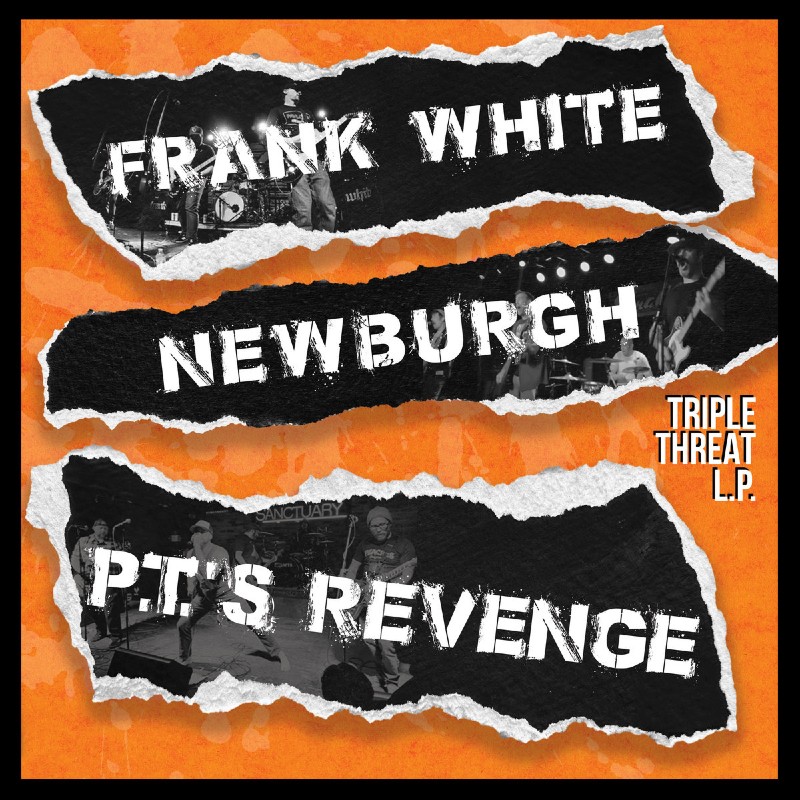
Ben Wixson is a longtime fan of split albums.
The vocalist-bassist remembers listening to classic splits by bands like Bottomed Out/Before I Go, Wafflehouse/Foredirelifesake, and Rancid/NOFX.
“I’ve always loved split releases,” said Wixson, who performs in Frank White, a punk-rock band from Detroit. “When I was younger, bands put them out all the time, both locally and nationally.”
It wasn’t a big surprise when Wixson pitched the idea of a split album to three other local punk-rock bands: P.T.’s Revenge, Newburgh, and Middle-Out.
“The idea for the Triple Threat LP came from P.T.’s [Revenge] booking their holiday show far in advance,” Wixson said.
A few months before the holiday show, three of the four bands recorded 12 songs for Triple Threat with drummer-engineer-producer John Kowaleski at Stu Stu Studio in Livonia.
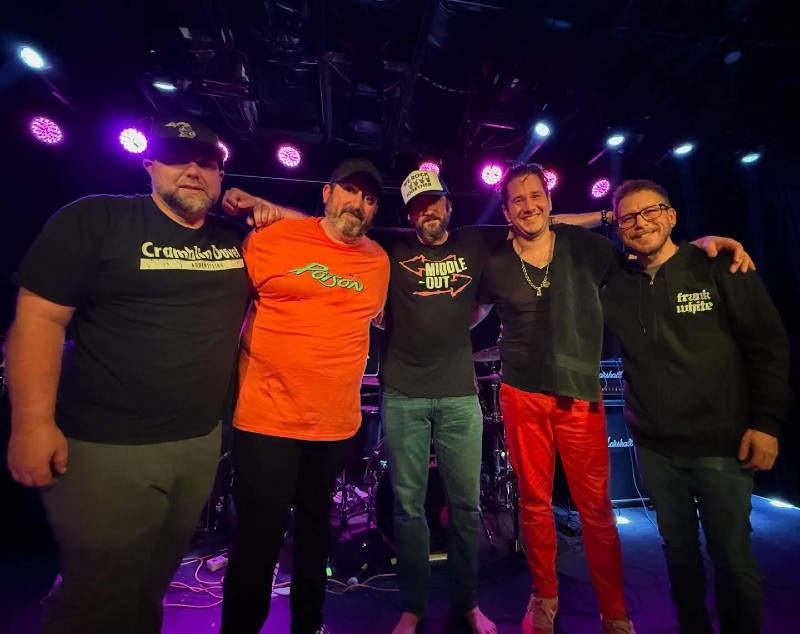
“It felt like a great way to revive that tradition,” Wixson said. “Originally, it may have even been a ‘quadruple threat,’ since Middle-Out was invited, but their schedule didn’t allow it this time. Hopefully, that’s something we can revisit in the future.”
On Triple Threat, P.T.’s Revenge, Frank White, and Newburgh each contributed three original tracks and one cover.
“We said, ‘We’re going to produce it, and we’re going to put it on vinyl,’ and it’s a lot easier when you have three bands splitting the bill,” said Kowaleski, who’s also the drummer for Frank White and P.T.’s Revenge.
All three bands appreciated the guidance and expertise Kowaleski provided during the recording process for Triple Threat.
“He played to our strengths as musicians, boosted our confidence in ourselves, and with his years of experience as a songwriter, he really helped us dial in our sound,” said Nic Engler, a vocalist-guitarist with Newburgh.
I recently spoke to Wixson, Kowaleski, and Engler about the album.
Q: How did all three bands first meet each other?
John Kowaleski (JK): A lot of the relationships that I’ve had through my musical endeavors have come via my relationship with Nic Engler, who is the founder of Newburgh. Nic used to come to our shows when we played at Pharaoh’s [Golden Cup in Westland], and he was a fan of P.T.’s Revenge and Churchill, which was the band I was in back in the day.
When I started producing and recording out of my home in Garden City back in 2005, he had a band that he was in, and he hit me up to record them. In the last couple of years, Nic formed Newburgh. He had come over here and assisted me with some recording stuff. In March of last year, he said, “Frank White’s looking for a new drummer,” and I said, “Who’s Frank White?”
I didn’t know them at all, but I messaged them on Instagram. I said, “Hey, I hear you guys are looking for a new drummer. I drum for P.T.’s Revenge, and we don’t do a whole lot. I’m looking to play drums.” I went in and did two rehearsals and jams on a couple of songs with them. After the second rehearsal, they said, “Do you want to do this?”, and I said, “Yeah.”
Ben Wixson (BW): P.T.’s Revenge is a band I remember hearing about when I was much younger. A friend of mine who grew up on the west side of Detroit turned me on to them in the early 2000s, so that was my first exposure.
We met Newburgh in 2024 when Frank White played a show with them, which I believe was their first show. We stayed in touch after that. In early 2025, when we were searching for a new drummer, the guys in Newburgh suggested we reach out to John [Kowaleski] from P.T.’s Revenge. We hit it off immediately and started working on new material.
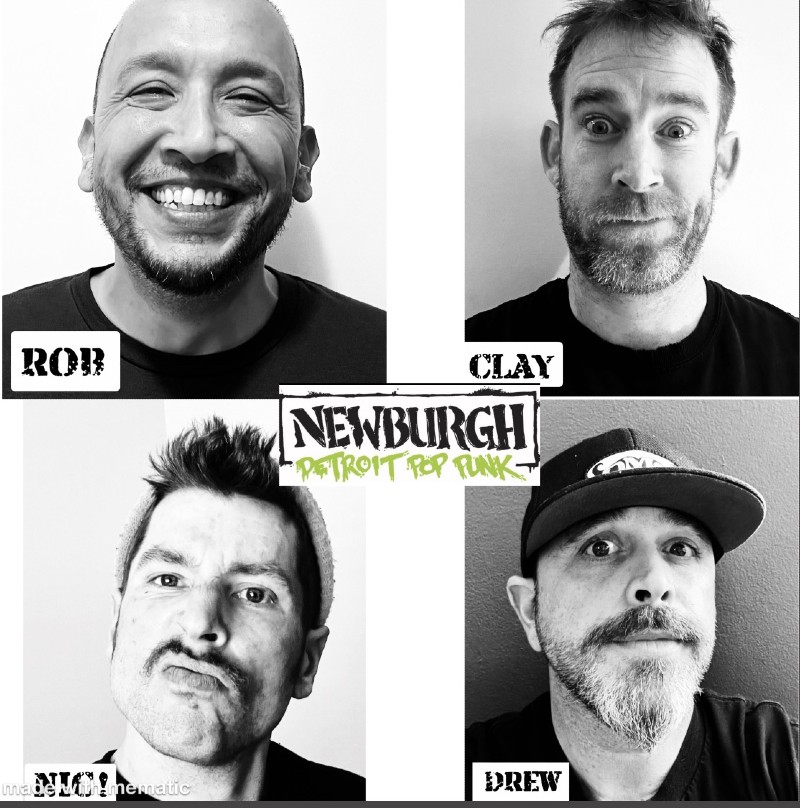
Nic Engler (NE): Rob [Barck], Drew [Smith], and I—three of the four members of Newburgh—have known of and been fans of P.T.’s Revenge since we were young kids. Rob, our drummer, played in a short-lived project with Kevin [Sierzega] from P.T.’s Revenge a few years back. [As Newburgh’s vocalist and guitarist], I’ve had a personal relationship with John [Kowaleski] since I was 20—I am currently 40.
As far as meeting Frank White, Drew (guitar, vocals) and I first learned of Frank White at a local record release show. We heard their opening song while standing in the merch area, and immediately started running to the stage to see who was playing. We have been fans ever since.
When it came to recording our first EP, Gratuitous Vulgarity, we reached out to Frank White via Instagram to inquire where they recently recorded. It was called IO Studio. We went to the same studio, hoping to tap into some of the same magic that they have. Patrick [Sheufelt], who runs I/O Detroit Recording Studio, is close friends with Frank White, and he put our name into conversations with them.
Ultimately, our relationship with Frank White was solidified the day they posted a need for a new drummer on their Instagram page. When I saw this, I immediately contacted John [Kowaleski], who I knew would be a shoo-in for the job, and let him know about the opportunity. He contacted them, tried out for the band, and the rest is history.
Q: Triple Threat explores a variety of themes, including questioning your purpose, overcoming adversity, and being authentic. What inspired these themes on the album?
JK: When people think of a punk rocker, they think of a certain aesthetic or a certain style of music. I subscribe to the punk-rock ideologies of questioning authority, challenging convention, carving your own path, championing the individual, and coming together for the community.
I’m all about all that stuff, and that thread winds itself through all the music that I’ve written, whether it sounds like punk rock, or it sounds like country, or sounds like electronic. There isn’t an intentional theme that the split album is trying to deliver at all—it was nascent.
Q: Frank White contributed four songs to Triple Threat: “Guild,” “Adrenaline,” “Shunner,” and a cover of Newburgh’s “Wondering.” Why did you select those songs?
BW: This is an interesting question because we didn’t have a huge backlog of finished material at the time. We had started demoing with our previous drummer, but when John joined, his playing naturally pushed the songs in different directions. In many ways, we stepped back and rewrote from scratch.
Committing to the split, especially with a fixed timeline tied to a booked show, meant we had to write and record within a defined window. So the selection was less about choosing from a large catalog and more about shaping the best material we were actively creating. We were intentional about including some faster songs. That energy is a core part of what we do.
When we decided to cover one of the other bands, we were immediately drawn to Newburgh’s “Wondering.” It has a raw emotional quality, and it gave us the opportunity to highlight different vocal textures.
In recent years, Frank White has incorporated more ska-punk influence into what was once a more straightforward punk-rock sound, and “Wondering” gave us space to experiment with that while still honoring the intensity of the original.
Overall, the four tracks are representative of Frank White because they showcase what we’ve always done well. We’re a three-vocalist band, and everyone is well represented here. There’s speed, melody, and the layered vocal interplay people expect from us. At the same time, the songs reflect how our sound has evolved.
Q: Newburgh contributed “The Days,” “For What It’s Worth,” “This One’s for You,” and a cover of P.T. Revenge’s “Danny” to the album. How do they provide listeners with a representative sample of the band’s catalog and sound?
NE: We chose those songs because they seemed to sum up our sound the best. “This One’s for You” is on the harder side of our music, while “The Days” and “For What It’s Worth” are two of our most anthemic songs. Collectively, “Danny” is one of our favorite songs off of P.T. Revenge’s [self-titled] full-length—that was an easy choice for the cover.
Q: P.T.’s Revenge contributed “SEX,” “Dead to Me,” “Hopeless Day,” and a cover of Frank White’s “Live Forever” to Triple Threat. What can you tell us about those songs?
JK: With P.T.’s Revenge, there are two originals that the band had originally recorded back in 1997 or 1998. They were released on an album, but I wasn’t on that because I didn’t join the band until 2000. They wanted to redo them because they’re two songs—“SEX” and “Hopeless Day”—that we still play live. Especially with the song “SEX,” I play that completely differently on drums than the original recording. “Dead to Me” is brand new.
If you listen to the original version of Frank White’s “Live Forever,” the tempo and arrangement sound like it could have been a P.T.’s Revenge song. It just lent itself very naturally to us doing that, and we brought it down a whole step in key.
Q: Each band covers another band’s song on the album. How did those covers come together?
JK: I had the idea that each band should cover one of the other bands’ songs. For the cover of Frank White’s “Live Forever,” [the members of P.T.’s Revenge] were discussing on Zoom what we wanted to do for the arrangement for it, and Kevin and I said, “Let’s make it almost like an Irish pub sing-along style.”
And that’s one of three songs on the album where the first mix I did was the one that ended up on the album. We had a lot of fun putting that together, and it was also a complete departure from anything P.T.’s Revenge has ever done. We’ve never done an acoustic release or without drums. I did bongos instead of drums, and I recorded the bass for that and “Dead to Me.”
Frank White picked “Wondering” [by Newburgh]. Each band picked a song from the other band that they were covering that [reflected] their sensibilities and style. It all worked out. With “Wondering,” we had a lot of fun with that because we thought, “Hey, we’re covering it; we can do whatever we want.”
We completely flexed and massaged the arrangement, so it starts out with Jesse on ukulele. I sampled some beach sounds. The arrangement is sort of all over the place, but it’s completely coherent, and it makes sense for the tune. We had a lot of fun with that.
Newburgh is a new and emerging band, so they’re finding their lane right now. With them doing “Danny” by P.T.’s Revenge, they were essentially trying to do as faithful a rendition of it as the original.
None of the bands knew what the other bands were doing cover-wise. Until we got the vinyl [back], we didn’t get to hear it, but I had heard all of them. Everyone was very happy with how each group did their cover.
Q: What was the recording process like for you?
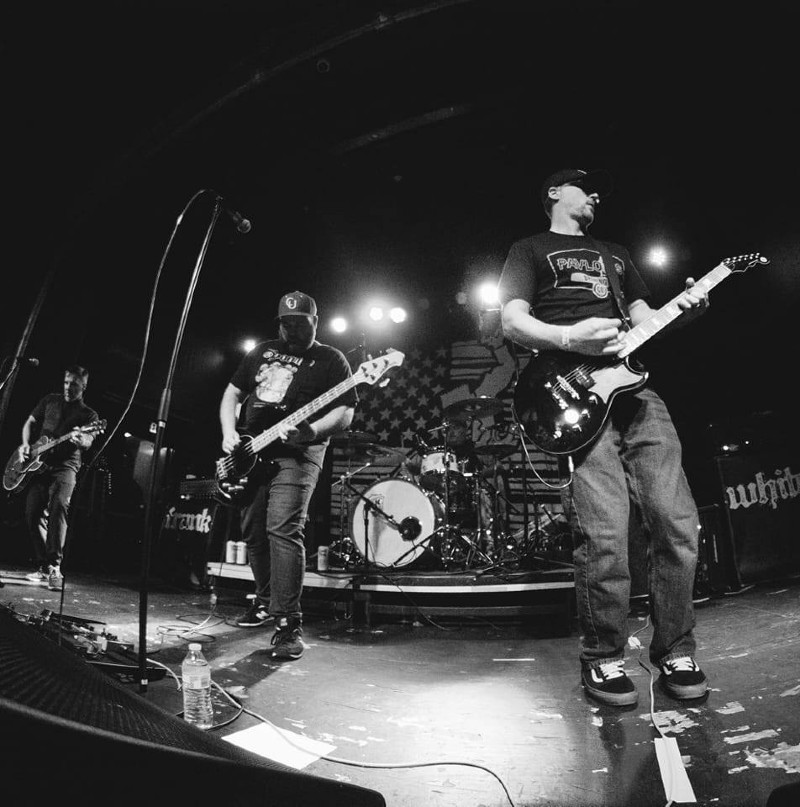
BW: The recording process was surprisingly smooth. Since this was our first time recording with John [Kowaleski] as our drummer, there was more for him to learn about how we capture performances than the other way around. That said, he’s incredibly efficient behind the kit. Watching him track drums so quickly definitely raised the bar for the rest of us.
Doing four songs was a perfect way to get comfortable with each other’s recording styles and workflow. It helped us dial in communication and expectations without overcomplicating things.
John didn’t just play drums. He also recorded and produced the tracks. Having him at the helm gave the entire project a cohesive sound and a consistent quality across all the bands on the release. It felt unified without losing each band’s identity. Overall, it was a great experience and a strong starting point for what we can build together going forward.
NE: John is a true master of his craft. Not only did he do a fantastic job tracking, mixing, and producing these songs, but he handled us as a band perfectly. That was the key: he knew exactly how to pull the best out of us. He kept the vibe in the studio exciting and fun.
Q: John, how do you approach recording a split album as a producer?
JK: When I’m producing an artist or a band, I do my best to get out of their way, listen to what they’re doing, and try to capture it in the best way possible to show it in its best light.
For me, if I know the songs, I understand the arrangement and what the different instrumentation is, I’ll say, “OK, we’ve got to get this recorded,” and let them do their thing. I’m a big fan of not taking more than three takes to do a specific part.
We might be working on the guitar part in a verse or a chorus. I only want to do up to three takes for that, because after three takes, the artist or the musician starts overthinking, they start thinking about the technical aspects of their performance, and I just want [it to be] natural—I want [it to be] authentic.
If there’s something that sticks out that doesn’t sound good or makes us grit our teeth or wince, then we’re going to fix that, we’re going to redo that.
Q: John, how did you help shape the sound of Triple Threat?
JK: In “SEX,” for instance, when I’m recording Chris [Doerr’s] guitar part, and we’re coming out of the bridge and the drum break, there’s a big shout before the chorus comes in. Chris just randomly hit a weird note on his guitar, and I captured it. We both laughed at it because it was just so ridiculous and dumb.
I said, “I’m leaving that in,” and it wasn’t intentional at all. I try to leave myself open with a childlike, playful mentality even while saying, “This is going to go on the record; we have to get it right, quote-unquote.” Once the record is put out, everyone is going to assume it was intentional.
With this album, I was focused on producing and thinking, “All three of these bands are of a similar vein, but they have different sonic fingerprints.” They have different qualities that make each band sound like that band, but they’re all coming in and recording on my drums.
Maybe Rob from Newburgh uses his cymbals and his snare drum, but they’re recording on my drums in the same spot in the same room. They’re recording on my amps, and for Newburgh, we used a Kemper modeling unit to do their guitars, so there’s that, but they’re recording. They’re going through all the same gear for the most part.
My focus was thinking, “Are these all going to sound the same?” As you said, it’s three bands, and each band has a [distinct] quality to them, and they sound like themselves throughout. No two bands sound the same, which to me is remarkable because it all happened here, and it happened with one person at the helm.
A lot of times, when you hear a split album, those two bands usually record in completely different rooms. And there’s a very distinct difference between the sound of one band versus the other.
On this one, each band sounds like themselves, but it all sounds like it belongs on the same album. I was very pleased with how that turned out because I was worried that it would sound stale and sound like they all went through the same factory process.
Q: Frank White is playing Prove It Fest at Sanctuary Detroit on February 28. What can people expect from the show?
JK: We are one of eight groups that are playing. It’s in honor of Bob Gibson, who was a member of Aggro or Die!. He was in The HandMe Downs and other punk-rock bands. He was involved in the punk-rock music community, and he passed away almost two years ago, unexpectedly. They did this once before, and it’s a benefit show with all the proceeds going to Pound Pals Downriver, an animal rescue. It’s Aggro or Die!, St. Thomas Boys Academy, Frank White, Superdot, No Vision, Captain Geech and the Shrimp Shack Shooters, and two bands from New York, Sketchy and The Jukebox Romantics.
BW: We’re really looking forward to Prove It Fest for a few reasons. First, it honors a longtime member of the Detroit punk scene, which makes it meaningful beyond just another show. Second, the lineup is stacked. Mark from St. Thomas Boys Academy used to play in The Red Shift, and in the early days of Frank White, we played a lot of shows with them. We’ve been trying to line something up with STBA for a while, so this feels like the right time. As for what to expect, your guess is as good as mine. We might debut a new song, but that could be a game-time decision.
Q: What’s up next for Frank White and Newburgh?
BW: Looking ahead, 2026 will hopefully bring the recording of our next full-length and some out-of-town shows for the first time in years. We’ve been productive in writing and recording lately. Now, it’s about translating that same energy into [going] outside of Detroit and playing for new audiences.
NE: We plan to continue playing shows and establishing ourselves in the local market. Our goals are to go on a regional tour, [including places like] Grand Rapids, Chicago, Indianapolis, and Toledo. We are currently writing new material and discussing a plan for a full-length album at the end of the year.
Frank White performs February 28 for Prove It Fest at Sanctuary Detroit, 2932 Caniff Avenue, Hamtramck, Michigan. The show starts at 5 pm. For tickets, visit TicketWeb. All proceeds from the show will go to Pound Pals Downriver.
 The Stratton Setlist