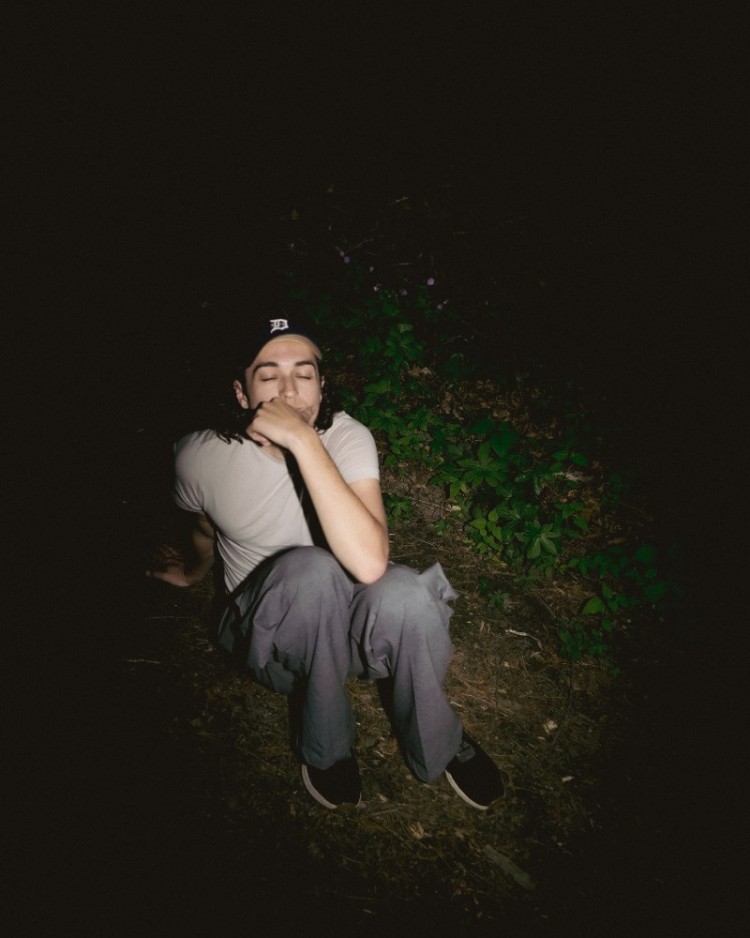
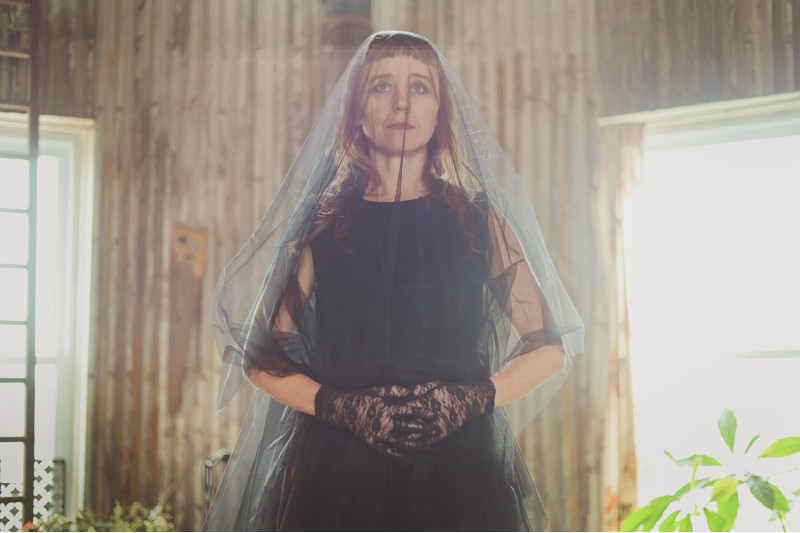
The cast of The Rocky Horror Show during rehearsals at EMU’s Legacy Theatre. Photo courtesy of EMU Theatre.
Editor’s Note: This article originally appeared on the Ann Arbor District Library’s Pulpblog.
In April 1993, I took my first step into the world of Rocky Horror.
I went with three high school friends to see a midnight screening and shadow cast of The Rocky Horror Picture Show at the State Theatre in Ann Arbor, Michigan.
Upon arrival at the theatre, I was greeted by one of the shadow-cast actors fully dressed in her costume. She walked over to me and asked, “Are you a virgin?”
Somewhat taken aback, I asked, “Who wants to know?”
The actor just laughed and said, “You’re my very special virgin.”
Being a naïve, clueless teen and new to Rocky Horror, I didn’t get the reference at first. I thought the actor was nosy and wondered why she asked me such a personal question.
Her question didn’t click with me, though, until the start of the show. As the emcee, she made some announcements and invited me to join her on stage as the “Very Special Virgin.”
Tree City’s Kyle “Silas Green” Hunter, Jacoby “DJ Cataclysmic” Simmons, and Evan “Clavius Crates” Haywood in 2013. Photo by Cy Abdelnour
Editor’s Note: This article originally appeared on the Ann Arbor District Library’s Pulpblog.
A mature tree blooms every year. Fruit trees can take two to five years to produce. It took Tree City 13 years for Pure Levels to flower.
The Ann Arbor hip-hop group spent that time shaping and defining the album’s tracks before releasing it late last year.
“It’s a time capsule, and it’s a good chunk of our personal evolution as artists and as a group,” said Evan “Clavius Crates” Haywood, a Tree City MC and producer, about the group’s first collection of new songs since 2010’s Thus Far.
“It’s exciting that it’s finally at the point where we’re happy with it and we felt like it was ready. We did not want to release it when it was just good enough. We wanted to release it when we felt it was something really timeless, something that would hold up to repeated listens, and something that would hold people’s interest.”
Pure Levels features Tree City’s four MCs—Clavius Crates, Silas Green, DJ Cataclysmic, and Cheeks—rapping candid rhymes about broken relationships, aging family members, systemic issues, and capitalism alongside fantastical space-themed wordplay over sci-fi-sounding beats by producer Michael Dykehouse and several others.
“Over the years, I feel like we’ve always believed in ourselves as rappers, but working on these songs, we came to the realization that we’re good at what we do,” said Jacoby Simmons, who performs as DJ Cataclysmic. “And who doesn’t want to feel the feeling of accomplishment when you work on something for a long time, and you garner that success?”
And with that success comes a 15-track album that explores living life in another dimension while facing real-world challenges and everyday struggles.
“The theme of the album is—on one level—about space, and it has these space travel themes,” said Kyle Hunter, who performs as Silas Green, and is now based in Houston. “But on the other side of it, space represents growth and expansion and challenging yourself.”
To learn more, I spoke with Tree City’s MCs about the inspiration behind the album.
The Ypsilanti, Michigan indie-rocker embraces that mindset while exploring the need for connection and community on their debut album.
“That has been the journey of my life because I’ve always been a very independent person and a person who’s not good at asking for help,” said Mer Rey, who performs as Premium Rat, about Stranded on Land.
“This album tells the story of me learning that lesson—that no person is an island—and I can’t do it all myself.”
Premium Rat follows that story arc throughout Stranded on Land’s 12 tracks, which were curated against a backdrop of multi-genre sounds.
“The idea of Stranded on Land is starting the album feeling very disconnected from the world and people around me, feeling like I didn’t understand or belong in the world, and feeling very isolated and alone with that feeling,” said Rey, who features elements of pop punk, indie rock, dance-pop, indie folk, and Broadway music on the album.
“As the album goes on, it tells the story of me finding community, finding other people who also felt that way, and realizing, ‘Oh, I’m stranded on land, but so are a bunch of other people, and we’re actually stranded together.’ And that is how we [find] our way out and claim our freedom—by doing that together.”
Marty Gray features a guitar-driven rock and shoegaze sound on “Disassemble.” Photo courtesy of Marty Gray.
Editor’s Note: This article originally appeared on the Ann Arbor District Library’s Pulpblog.
Marty Gray empathizes with loved ones battling dementia, depression, and other personal challenges on his latest album, Disassemble.
“The whole album is autobiographical, it’s just about the people around me,” said the Ann Arbor singer-songwriter, multi-instrumentalist, and producer. “It’s rare that there is a song about me, but I’m telling you how I feel about these people throughout the whole record.”
Gray explores that fragility and the observations of a concerned bystander on Disassemble. The album’s poetic lyrics, ethereal vocals, and cinematic instrumentation convey the emotions he encounters while witnessing family and friends decline.
“There are some songs about my friends and the things that they’re going through,” said Gray, who studied opera at the University of Michigan. “There are friends in my life that are losing the battle with depression. I have a couple of songs about my grandparents; I have one about my opa and one about my [late] oma … and my oma’s dementia and seeing what happened with her brain, her mind, and her life.”
Gray ventures into new sonic territory on his fourth album, too, trading his previous pop sound for guitar-driven rock and shoegaze.
“Part of this story is me falling in love with guitar,” Gray said. “And I’ve never been a fabulously talented guitar player. With shoegaze, you don’t have to be a ripper. If the story calls for it and if the story wants it to be big shoegaze with lots of reverb, lots of distortion, lots of everything … [then] let’s go for it.”
To learn more, I spoke with Gray about Disassemble ahead of a January 8 show at The Blind Pig.
Zach Pliska and Emily Sturm of VAZUM. Photo courtesy of VAZUM
Editor’s Note: This article originally appeared on the Ann Arbor District Library’s Pulpblog.
VAZUM didn’t expect a Western film to inspire the title of its latest album.
The Jackson duo of Zach Pliska (vocals, guitars, drums) and Emily Sturm (vocals, bass) stumbled upon the phrase “Western violence” while watchingThe Quick and the Dead.
“We had some of the songs fleshed out and usually we go with a ‘V’ in the name for our albums. We were watching [the 1995 film] by Sam Raimi and the rating was ‘R,’ and it said two words: ‘Western violence,’” said Sturm about the duo’s doomgaze album,Western Violence.
“We said, ‘Oh my god, that’s what we’re writing about,’ and it just summed it up. And then we said, ‘That’s what we’re living in … This is how our society expresses itself now.’”
OnWestern Violence, VAZUM reflects on the disintegration and disillusionment of our country and provides a social commentary on the personal, cultural, and political events that impact it.
The album’s dozen tracks explore topics ranging from the opioid epidemic to gun violence to a dystopian future to toxic relationships. It also takes inspiration from VAZUM’s past tours through the southern U.S., the U.K., and France.
“We were driving through Georgia and we went through some areas with houses falling apart,” said Pliska, who’s a University of Michigan alum.
“To see the extent of the poverty and those places you’re driving through, it’s still shocking. Our tours in the U.K. and France were eye-opening with just seeing how different the countries are.”
As part of that perspective, VAZUM bringsWestern Violence’sthemes to life through vigilant lyrics, ethereal vocals, and spellbinding instrumentation filled with goth-rock, post-punk, and shoegaze elements.
To learn more, I spoke with the duo about the album ahead of an August 10 set at Ogma Brewing Co.’s Art Pop ‘24 festival in Jackson.
“My daughter Alyson is off to the University of North Carolina School of the Arts next month, and I’ve been weeping big dad tears on and off all summer,” said the Dexter singer-songwriter and multi-instrumentalist.
Alyson is a singer, and she’ll join her dad for a special show at The Ark on August 8 along with bandmates Chris DuPont, Drew De Four, Brennan Andes, Keith Billik, and Mike Shea.
Brad has also been busy as a lecturer at the University of Michigan, a resident artist at The Purple Rose Theatre Company, touring with actress and singer Patti LuPone, and featuring on her new album, A Life in Notes, playing violin, mandolin, guitar, octave mandolin, and U-bass.
“Patti is an icon and it’s no accident. She’s a legend for a reason and to be on stage with her in front of her adoring fans is electric,” Phillips said. “Summer has been both chaotic, emotional, and wonderful all at the same time! It’s been a big year around here.”
To learn more, I spoke with Phillips about his work and tour with Patti LuPone and his family’s artistic accomplishments.
Seeing the breakdancing prowess of Kelly, Ozone, and Turbo in the films instantly captured my attention and spurred nine-year-old me to experiment with some moves of my own.
While I couldn’t quite emulate the popping, up-rocking, down-rocking, or power moves of the films’ heroes, I embraced a love of dancing and developed my own quirky style over the years.
As I grew up, I danced to the music of Run-D.M.C., Beastie Boys, Salt-N-Pepa, LL Cool J, DJ Jazzy Jeff & the Fresh Prince, Rob Base & DJ E-Z Rock, Young MC, MC Hammer, and others.
By high school, I had started learning about three of the five elements of hip-hop—rapping, DJing, and breakdancing—and would encounter the other two—graffiti and historical knowledge—as an adult.
Known asHip Hop @ 50: Defs, Dates, Divas, Detroit & Dilla, the exhibit celebrates the 50th anniversary of the culture and explores its evolution across music, society, fashion, language, entertainment, and politics.
“It’s crazy that I’ve taken that long,” said Bizer about his new folk album,About Time. “I’ve done things in between, and the thing I did the most was the duo with Jan, but I wound up in a few different bands and made records with some of them.”
Even as he worked on different projects, Bizer’s songs forAbout Time started brewing in 2005, and they began accumulating.
He eventually landed on 13 tracks for his third solo album and noticed a theme of time had emerged. OnAbout Time, Bizer brings that theme to life through evocative lyrics and soundtracks it with earnest folk instrumentation.
“Not that every single song deals directly with time, but a fair number of them do. I got a kick out of writing ‘Going Nowhere’ about slowing time down and what that could mean and how that would work,” said Bizer, who producedAbout Time and played guitar, bass, and guitjo.
“There’s also the fact that it’s been so long since I put out my last record, and time played a piece of that. And I think of these songs as a time capsule of the last 20 years, so time was so much on my mind as I was putting the record together.”
To learn more, I spoke to Bizer about his latest album ahead of a July 7 show at Livonia’s Trinity House Theatre.
The Ann Arbor, Michigan singer-songwriter, pianist, and producer chronicles a personal transformation while encountering unrequited love on her latest album.
“The album shows that certain people come into our lives to be catalysts and light us up. Sometimes, our imagination is a huge part of the creative process and gets the best of us,” said Baiardi about her sophisti-pop release.
“It’s a beautiful thing to catalyze for music, albums, and songs, but when you come back to reality and the present moment, it doesn’t often translate.”
In her musical realm, Baiardi easily converts that inspiration into a mesmerizing concept album filled with intimate lyrics, cathartic instrumentation, and soulful vocals.
The dozen tracks featured onPhoenix explore the cycle of a potential relationship and the powerful emotions that accompany it.
“It almost felt like this was a fantastical world I had entered, or I had found this portal—like a rabbit hole. While I was making sense of it, the album was coming together,” said Baiardi, who wrote, recorded, and produced the album. “I started to see the early days of it as I was healing and getting into this surrender mode and soothing the heartbreak.”
I recently spoke to Baiardi about the album’s storyline and creative process.
Annie Bacon explores grief in all its forms on Storm. Photo – Cybelle Codish
Editor’s Note: This article originally appeared on the Ann Arbor District Library’s Pulp blog.
When it comes to grief, Annie Bacon doesn’t want people to feel alone.
The Ann Arbor, Michigan singer-songwriter and guitarist views it as a shared emotion that fosters connection and growth with others.
“Something that I’ve done with my art and that I feel like is important is to take on this role and say, ‘I don’t know if anybody understands me, but I’m going to explain what I’m going through in a way that hopefully other people can feel seen and understood,’” said Bacon, who performs under the moniker Annie Bacon & Her Oshen.
“I try to find the places where my experience might be universal and create these little bridges into my experience. That’s one of my philosophical approaches to songwriting: I want to as accurately as possible describe the experience I’m going through in the hopes that it creates a witness for somebody else.”
Bacon masters that honest songwriting approach and explores grief in all its forms on her new folk-rock album,Storm. The record’s 14 poignant tracks take listeners on an emotional odyssey through death, divorce, job changes, the pandemic, and a loss of identity.