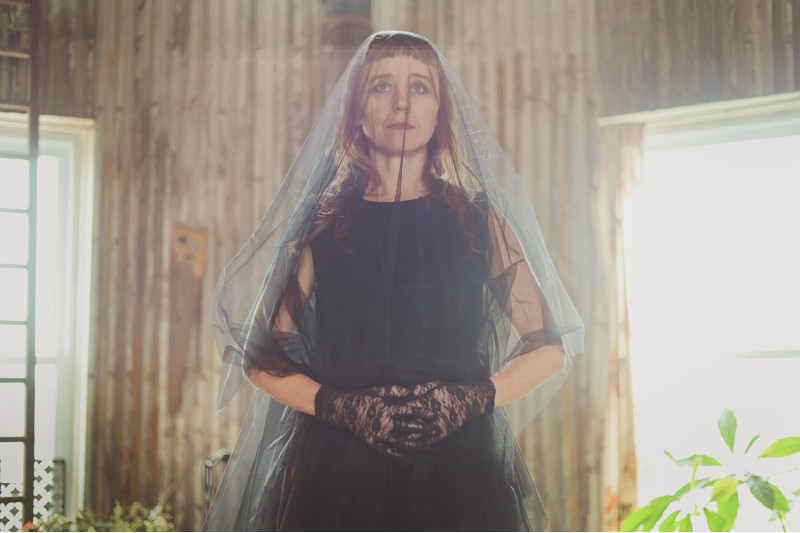
Annie Bacon explores grief in all its forms on Storm. Photo – Cybelle Codish
Editor’s Note: This article originally appeared on the Ann Arbor District Library’s Pulp blog.
When it comes to grief, Annie Bacon doesn’t want people to feel alone.
The Ann Arbor, Michigan singer-songwriter and guitarist views it as a shared emotion that fosters connection and growth with others.
“Something that I’ve done with my art and that I feel like is important is to take on this role and say, ‘I don’t know if anybody understands me, but I’m going to explain what I’m going through in a way that hopefully other people can feel seen and understood,’” said Bacon, who performs under the moniker Annie Bacon & Her Oshen.
“I try to find the places where my experience might be universal and create these little bridges into my experience. That’s one of my philosophical approaches to songwriting: I want to as accurately as possible describe the experience I’m going through in the hopes that it creates a witness for somebody else.”
Bacon masters that honest songwriting approach and explores grief in all its forms on her new folk-rock album,Storm. The record’s 14 poignant tracks take listeners on an emotional odyssey through death, divorce, job changes, the pandemic, and a loss of identity.
Carolyn Striho performs at Scuderie Aldobrandini in Frascati, Italy. Photo courtesy of Carolyn Striho
For Carolyn Striho, a clear, wintry night sky evokes feelings of enchantment.
The Detroit singer-songwriter captures that spellbinding sensation on her latest instrumental single, “Piano Moon.”
“There’s something about playing in A minor on the piano; it’s just one of my favorite ways to write songs. It’s what I was doing with a 3/4 time signature, and I was starting to write that as I heard the melody line,” said Striho, who penned her single in Detroit and Fiuggi, Italy.
“I liked it so much as an instrumental. I had it written out, and it needed something, so this winter I came up with that dramatic middle part. It was also during the holiday season, and I was thinking of Trans-Siberian Orchestra and that dramatic, dark classical feel.”
On “Piano Moon,” she brings that symphonic piano to life alongside wistful cello, haunting electric guitar, and glistening percussion. Part of the song’s inspiration also comes from “Bear Dance” by Béla Bartók.
“I used to play it, and it’s amazing and super avant-garde. It’s a difficult piece, and my mom loved it, too,” Striho said. “She would hear me play it, and I worked hard on that.”
Striho wanted to recapture that magical feeling while recording “Piano Moon” at Inner Door Music with Jason Charboneau (cello), husband Scott Dailey (electric guitar), and Ron Wolf (percussion).
“We had talked about putting violin on it, but when Jason came over and was doing the cello, it was just this moment of inspiration,” she said.
“‘Piano Moon’ is a fierce, yet soft song with a melody line that is memorable, and it unfolds with desire and raw strength,” said Striho, who’s shared a new video for the single. “It will be released later in a second version with vocals.”
Striho is also performing her new music at several live shows with Dailey, including June 8 at the Nor-East’r Music & Art Festival in Mio, Michigan, June 23 with The Orbitsuns at Cadieux Café in Detroit, and July 21 with the Don Was Detroit All Star Revue for the Concert of Colors at the Detroit Institute of Arts.
“We have some great summer shows bringing our eclectic blend of new music,” she said. “We’re excited for Nor-East’r this weekend; for our full-band matinee show with Jason, John Barron, and Todd Glass and The Orbitsuns; and at the amazing Concert of Colors with the wonderful Don Was Detroit All Star Revue.”
Bart Moore features storied lyrics and charged folk instrumentation on “Wild Flora.” Photo – Jena McShane of McShane Photography
When it comes to music, Bart Moore possesses a lively, adventurous spirit.
The Grand Ledge, Michigan singer-songwriter and guitarist infectiously captures that essence and beckons listeners to come along for a rollicking-filled quest on Wild Flora.
“In the vast majority of the songs, there is something happening, a story of sorts,” said Moore about his latest alt-folk album. “My previous album, Graveyards Wind & War, was unconsciously dark. I wanted Wild Florato be different— funnier with more movement and more adventures.”
OnWild Flora, Moore features storied lyrics and charged folk instrumentation across nine insightful tracks. Each song explores compelling characters at various points in time and captures the excitement, fear, and disappointment they encounter along the way.
“I like that the more I think about it,” Moore said. “There’s certainly more color than Graveyards—hence the title, Wild Flora, with the cover shot of the woman in my wildflower meadow.”
To learn more, I spoke with Moore ahead of a June 2 album release show at EagleMonk Pub and Brewery in Lansing, Michigan.
That turn starts a new chapter for the Royal Oak, Michigan singer-songwriter and guitarist, who’s embracing a different sound and releasing her debut EP, Full Circle.
“I’ve taken the approach these days that if I’m not making music that I love and it isn’t just 100 percent me, then I don’t want to bother,” Burns said.
“I don’t want to make music that sounds like somebody else, and I don’t want to make music that’s trying to sound like somebody else. I feel like this is the first time I’ve made something of that nature where it says, ‘This is me.’”
Burns’ authenticity permeates all four tracks on Full Circle, which features a turbocharged indie-pop-rock sound in place of the previous folk, bluegrass, and Americana territory she explored as half of the former duo Escaping Pavement.
“This time, it’s all about finding the sound, making the introduction, and putting it out there in the world as a starting point,” she said. “It’s the start of something new.”
While the pop-rock singer-songwriter and multi-instrumentalist hails from New York City, she’s ecstatic about attending the University of Michigan this fall as a freshman to study music.
So much in fact that Orensteen has written a song called “Michigan,” which pays homage to the school and serves as the aspirational opener from her debut album, AmericanGirl.
“This song turned into a way that I could express my love for Michigan even though I had never been there [before] or had never seen it,” she said.
“I got in contact with the University of Michigan about using my song for their social media. I also sent in the song with my application, and I didn’t even tell my parents I was applying. And then I got in, and they said, ‘What?’”
Despite that surprise, Orensteen learned of her acceptance to U-M in February and has started planning for the fall.
She shares that sentiment in “Michigan” alongside hopeful acoustic guitar and electric guitar while singing: “I’ve never been to Michigan, but I’ve heard it’s nice / You’re going away, going to college, gonna start a new life / You’ll remember me / When you see my name in lights / And you’ll say, ‘Wow, she was right.’”
“I’ve always loved the University of Michigan, and I wrote this in one of my supplemental essays when I applied there,” said Orensteen, who will graduate from New York City’s Professional Children’s School in June.
“I never told my parents or anybody that I loved the University of Michigan, but I’ve always followed the school and their football team. I never thought I’d go there or get into the school.”
Orensteen’s “Michigan” is one of 13 coming-of-age tracks featured onAmericanGirl, which includes introspective lyrics about life and love and spirited pop-rock and pop-punk instrumentation.
I recently spoke with Orensteen about her background and influences, her latest album and songs, her creative process for the album, her producers and collaborators, and her plans for the summer.
Nick Behnan reconciles his expectations of fantasy with reality on “What You Got.”
As a longtime musician, Nick Behnan searches for the right balance between fantasy and reality.
The Detroit singer-songwriter, multi-instrumentalist, and producer straddles those two worlds on his latest pop-soul single, “What You Got.”
“I think the nature of what I do for a living creates pretty drastic swings of highs and lows,” Behnan said. “I feel fortunate to not have to have a 9-5, but the ups and downs and expectations can sometimes be difficult to navigate. It’s the nature of the beast though.”
Surrounded by hypnotic electric guitar, bass, electric piano, and drums, he sings, “It’s a whole new paradigm / Livin’ what I had in mind / So I keep it movin’ all the time / Until I find / Just what I’m tryin’ to do.”
“The new thing everyone in my business is freaking out about is AI, which could threaten the music business as a whole and especially sync licensing for TV, film, and commercials,” Behnan said.
“Hopefully, the right regulations get put in place before it goes bonkers, but it’s like the Wild West right now. I find it’s the most important to stay creative and productive—it’s also a mindset thing.”
To learn more, I spoke to Behnan about his past releases, latest singles, creative process, summer plans, and sync licensing opportunities.
In those fleeting moments, the Detroit singer-songwriter feels grateful and inspired while spending time with others.
However, that magic often dissipates as people move on or pass away, but the love and appreciation from those interactions remain with Striho.
She beautifully shares that sentiment and a longing to recapture it in her new single, “Blue Ridiculous Love,” which features poetic lyrics and heartfelt rock instrumentation.
“I saw this song more as a painting, and with a painting, you’re interpreting it your way,” said Striho, who co-wrote the track with husband-guitarist Scott Dailey. “I’m talking about the ‘green grass of gold dirt,’ and it reminds me of one of the Beatnik poets, and you get these images.”
Surrounded by eager acoustic guitar, electric guitar, and drums, Striho sings, “I had this magic / It’s right on my side / Then everybody took a ride / The evening shadows / The tiny voice in my head / Starts talking louder / It’s an evil eye.”
“It’s a romantic song with an angst about the future and missing people, but it’s also about how falling in love can feel ridiculous,” she said.
”The lyric, ‘Everybody took a ride,’ could mean different things: They just left your life or they could have died. I had this magic, and I thought, ‘Wait, where did everybody go?’ It prompts you to look back and say, ‘Wait a minute, those people are gone.’”
Detroit folk singer-songwriter Mike Ward. Photo by Danny Ward.
Editor’s Note: This article originally appeared on the Ann Arbor District Library’s Pulp blog.
The state of the world weighs heavily on Mike Ward’s mind.
That concern prompted the Detroit singer-songwriter to pen a new folk song called “Why Not,” which sends an encouraging message to help others.
“When I have played it, people get how the song starts out small, gets broader as it goes on, and ends at a point where it’s up to us on a personal level,” said Ward, who’s also a University of Michigan alumnus.
“One of the things I have to work hard at is trying not to be too preachy, especially when I’m writing about things on a political level. It’s one of the areas where I try to find a balance.”
Backed by hopeful acoustic guitar and cello, he sings, “Why not do some good today with the time that we’ve got / Start with something simple / A lesson learned or to be taught / Plant a seed or lend a hand / A little helps a lot.”
“I’ve also been looking at not only how that affects the world in general, but also how it’s affecting people’s relationships,” Ward said. “It goes as broad as the country, but as narrow as some relationships and the struggles that people are having.”
“Why Not” is one of several songs Ward will be performing with Sara Gibson (cello) and Annie Bacon (vocals) at an April 28 show at the Downtown branch of the Ann Arbor District Library.
Ahead of the show, I spoke with Ward about his current state, his career transition from advertising to music, past albums, his latest songwriting efforts, his setlist for the AADL show, and plans for new material.
Michael Skib features the hypnotic sounds of progressive rock, heavy metal, and shoegaze on “This Bewitching Season.” Photo – Alex Hancock
Editor’s Note: This article originally appeared on the Ann Arbor District Library’s Pulp blog.
For Michael Skib, winter brings a sense of enchantment.
The Ann Arbor singer-songwriter, multi-instrumentalist, and producer feels most creative during the darkest and quietest time of the year.
“It’s the best time for reflection, introspection, and creation because I’m not going to be out and about,” said Skib, who’s also half of the electronic-experimental duo Mirror Monster.
“I do find myself wanting to try and capture the melancholy that I feel because snow and darkness are beautiful. Those are the reasons why I’m drawn toward this type of music.”
That beautiful melancholy is woven throughout Skib’s latest album, This Bewitching Season, which features the hypnotic sounds of progressive rock, heavy metal, and shoegaze.
“I’m a seasonal person in the sense that there are different types of music that I listen to in different types of seasons,” he said. “I’m very sensitive to the way my environment impacts [my writing].”
Alongside those seasonal influences, Skib chronicles a spiritual quest for truth, peace, redemption, and salvation across the album’s nine tracks. His candid lyrics, ethereal vocals, and fearless instrumentation entice listeners to vicariously accompany him on his journey.
“One of my goals with this album was to reconnect with myself … and honor the experiences and where I came from and how I became the person that I am today,” said Skib, who’s inspired by Opeth and Devin Townsend.
“I’ve done a lot of therapy, and one of the therapeutic practices that I found to be very helpful is to go back to your younger years and see situations you were put in.”
I recently spoke to Skib about his background, previous projects, the album’s religious themes, select tracks, his creative process for the album, and upcoming plans for new material.
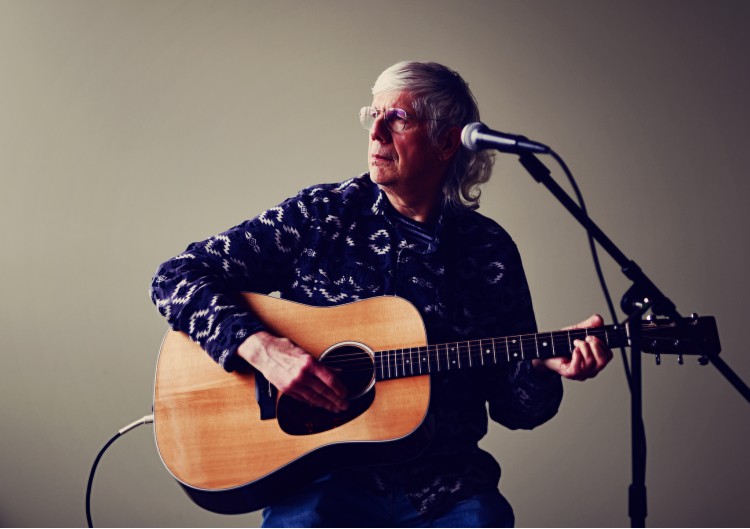
Tom Alter tackles a variety struggles on “Dispatch From the Lesser Middle.” Photo – Jay Jylkka
For Tom Alter, life has become quite the head-scratcher.
The current social and political state of the nation and the world leaves him questioning the present, yet remaining hopeful for the future.
“I turned 65 this year, and there’s so much in this world that leaves me shaking my head,” said Alter, a Fraser, Michigan singer-songwriter and guitarist. “I really never thought things would be like this … and as I was writing, somewhere in the middle of the process, I wrote the song, ‘A Wilderness.’”
The insightful opener from Alter’s latest indie-folk album, Dispatch From the Lesser Middle, features a dream in which he speaks to his younger self about being resilient in life.
Backed by wise acoustic guitar, electric guitar, and bass, he sings, “Young man buckle up / Living takes a lot of trust / If this sounds cliché / Don’t know another way I can instruct you / If I only had / A wise old man / Tell me what he’d come to know when I was young.”
“It’s saying, ‘Well, what did you expect?’ It’s kind of always been like this.’ Some of it is just trying to understand some of these changes that are going on in the world, but also realizing that they may not be permanent,” Alter said.
“When we’re young, we think everything’s gonna go along swimmingly, and we can set goals, and they’ll be achieved. The line I like in this song is, ‘You better buckle up,’ and I was setting myself straight.”




 The Stratton Setlist