

For Tom Curless & The 46%, actions speak louder than words.
The Detroit power-pop quartet of Tom Curless (vocals, guitar, keys), Chip Saam (bass), Ron Vensko (drums, percussion) and Lenny Grassa (guitar), extracts the hidden meaning from everyday interactions with people on Speaking in Code.
“There’s a lot of that theme going through the record; some songs aren’t based on personal relationships and some are,” said Curless about the band’s latest album.
“The first single, ‘Sorry for You,’ is when you’re trying to comfort someone and they’re laying down a lot of issues and problems. You’re happy to do it … but nobody has it all figured out. Everybody has their own problems, too, and it’s the theme of ‘I’m sorry for you, but I’m sorry for me, too.’”
On Speaking in Code, the band explores and deciphers different situations across 11 tracks that range from revelation to confrontation to determination. Those emotive stories resonate with listeners against a backdrop of spirited pop-rock instrumentation, vivid lyrics, melodic vocals and lush harmonies.
Breaking Silence to Here Tomorrow
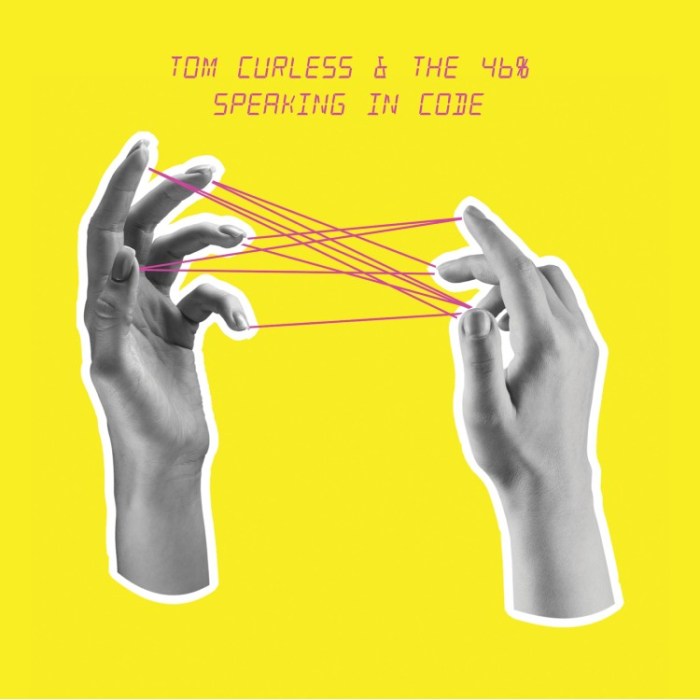
The album’s bold opener, “Breaking Silence,” instantly sets that tone and encourages revealing your authentic self and being honest with others.
Determined electric guitar, bass and drums instill courage as Curless sings, “Brilliant diamonds catch the waning sunlight / Running trance-like in a dream / Tip-toe secrets hide the real connection / Alone and crying in your room.”
“It has to do a lot with being vulnerable … people are scared to be vulnerable, but that’s the only way you get to know somebody well,” Curless said. “In any kind of relationship, whether it’s romantic, a friendship or whatever, you have to let your guard down.”
Once Tom Curless & The 46% let their guard down on “Breaking Silence,” they prompt a loved one to face the truth, take accountability for their actions and move forward on “Sorry for You.”
Glistening electric guitar, buzzing bass and pounding drums provide a wake-up call as Curless sings, “What’s the use to try … just walk and say goodbye / I’ll make it on my own / My future seeds are sown / Fortunes lost and sold.”
“For me, it was about a family member. The theme is ‘I feel empathy for you; I’m sorry you’re going through this,’” he said. “You can give them advice, but you can’t do it for them; they have to do it themselves.”
After addressing accountability on “Sorry for You,” the band confronts the challenge of delivering difficult news on “Don’t Shoot the Messenger.”
Disappointed electric guitar and synth echo Curless’ sentiment as he sings, “You’ll know when your life is right / When your mind stays calm / All through the night / You’ll know when you’ve seen light / When your heart beats hard / And when to fight.”
“Sometimes, I’ll scour my notebooks of lyrics to find something. I found the couplets about ‘Don’t Shoot the Messenger,’ and it was from years ago. It was a situation where I felt like, ‘Hey, I’m just relaying something, don’t get angry at me about it,’” said Curless, who formed the band in 2019 and named it after a joke Vensko made about the band’s “46%” completion rate of a song.
“It may have been a personal or work situation where I felt like I was getting crucified for something that was just being relayed. I feel like the music is upbeat, so I wanted to put some sweet and sour in [the song] at the same time because my favorite songs do that.”
The band also examines the “sweet and sour” of reconciling the past on “Silver Shine,” a new wave-inspired ode to dispelling old ghosts and focusing on the future.
Surrounded by radiant electric guitar, humming bass and thumping drums, Curless sings, “So afraid of ghosts you can’t see / Just an apparition / So afraid of words you can’t be / Just a superstition.”
“There’s the whole thing about the ghosts you can’t see, being haunted by that and walking up to the house and there’s nobody home,” he said.
“I tried to make a positive conclusion about how it seems like the house is haunted and its ghosts are haunting you, but eventually you’re going to be able to figure this out and move beyond this.”
Finally, Tom Curless & The 46% show their determination on “Here Tomorrow,” a hopeful tale about breaking free from a stifling environment.
Alongside optimistic acoustic and electric guitar, he sings, “You got me packing all my things / You got me hanging by a string / There might be something we forgot / But I know we’ll get out of here someday.”
“That’s a fictional song, and it’s a jailbreak song. It’s based on a dramatization of a real jailbreak; two guys escaped from jail, and it captivated me,” Curless said. “I just thought, ‘What would people be thinking if they finally got out of there? What direction would they run? Where would they go?’”
Speaking in Code
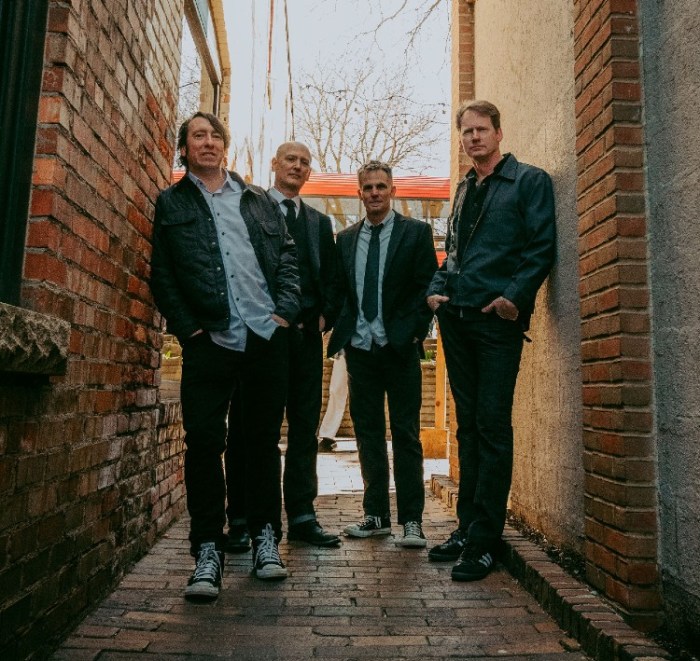
Curless started plotting the band’s sophomore album after releasing Almost Ready for the Future in 2020. Most of the tracks for Speaking in Code were written over two years and recorded at Ann Arbor’s Big Sky Recording.
“The song, ‘Never Ending,’ is older, and it’s from the first record sessions with Dave Feeny at Tempermill,” said Curless, who’s inspired by The Beatles, The Who and Led Zeppelin. “I did a couple more overdubs on that and then put it [on this album].”
With the album’s songs written and ready to go, the band recorded the basic tracks live at Big Sky with owner/engineer Geoff Michael.
“At Big Sky, we did about six or seven studio sessions that were spread out. Geoff is like a Zen master; he doesn’t say that much, but when he does, it’s really profound,” said Curless, who added vocals and some overdubs to the album’s tracks at home.
“He’ll jump in if he feels strongly about something and say, ‘Maybe you should change that,’ or ‘How about this? Why don’t we change it to this?’ He’ll have little suggestions that will make the song better.”
Tom Curless & The 46% also worked with several collaborators to help shape the album’s tracks, including Roger Manning Jr. (keys, vocals), Alyssa Smith (piano), Ron McPherson (guitar), Garret Bielaniec (lead guitar) and Nick Bertling (drums, keys, guitar).
“Roger Manning Jr. from Jellyfish is on ‘Don’t Shoot the Messenger,’ so he did vocals, keyboards and synths on it. It was really fun to collaborate with him; he’s such a cool guy. Alyssa is more of a jazz pianist, and I met her at our rehearsal space. I heard her play and knew she was good,” Curless said.
“Garret is an amazing guitar player … he came in and did it in two takes. Ron McPherson was in the band previously, and he did a fantastic job on ‘Never Ending.’ I worked with Nick on ‘Calling After You’ and that was a pure collaboration with him where we shared files.”
Since releasing Speaking in Code in July, the band has been sharing the album’s tracks with local and regional live audiences. They’re performing Oct. 6 at Detroit’s Lagerhaus No. 5 with Elspeth Tremblay and The Treatment and Oct. 21 at Chicago’s Montrose Saloon with Brick Briscoe & the Skinny, John Boyle and whitewolfsonicprincess.
“We’ve been playing a lot of live shows, and we’re juggling a lot. [Bassist] Chip [Saam] really brings the organizational point, and he’s always prepared. Once you get an arrangement, he’s the guy,” Curless said.
“And our drummer Ron [Vensko], I’ve never had someone play for the song more than him, and he’s really solid. Lenny [Grassa] is just an amazing guitar player, and he’s so fluid and comes up with these parts that are very complementary to what I’m playing.”
Looking ahead, the band will continue playing live shows, and Curless and Saam will resume working on new material for the next Crossword Smiles record.
“We’re gonna play a couple of more shows in the Detroit area and Chicago, and we’re going to keep promoting the record,” Curless said.
“Then, I’m going to shift a little bit at that point into writing for Crossword Smiles. Chip and I have four songs that are almost complete … and we’re thinking about heading back into the studio for the first round of recording of the next Crossword Smiles album.”
Show details:
Elspeth Tremblay and The Treatment with Tom Curless & The 46%
Friday, Oct. 6 | 8 p.m.
Lagerhaus No. 5, 1529 Adelaide St. in Detroit
 The Stratton Setlist