

Rob Zinck & The Collaborators boldly channel the past while navigating the future on Swim or Sink.
That refreshing mindset flows through the Detroit power trio’s new album, which features 11 tracks that aim to wipe the slate clean and search for internal peace in an iron-fisted world.
“The first nine songs loosely tell the story of finding myself in a particular place, examining how I got here and then fixing my eyes on the path I want to take in the future,” said Zinck, the band’s vocalist, guitarist and songwriter.
“It travels through different times and places in my life trying to figure out how I can be the best version of myself possible and a positive force in the lives of people I care about. The last two tracks deal with the fact that finding yourself doesn’t change the world, which is uncertain and oppressive and doesn’t afford all people the same privileges.”
Alongside bandmates Dan Radlick (bass) and Phil Giannotta (drums), Zinck embarks on an introspective journey that runs from childhood in Alaska to fatherhood in Michigan to thirtysomething life in the future.
“I think most of us experience a similar sense of uncertainty when our 20s start to wane and our 30s approach. We start to feel like we’re supposed to be whatever our vision of an adult is, but we’re afraid we’ll lose the passion that defines our youth,” said Zinck, who shares those thoughts against a backdrop of punk, alt-rock and indie-rock instrumentation.
“Reconciling that feeling is definitely a theme of this record. We’re all searching for ourselves in an uncertain world, and I don’t think that searching should ever fully end. By the time track nine [‘You Then Me’] fades out, I’ve found enough of the person I want to be that can move on with a life that feels meaningful rather than stagnant.”
I recently spoke with Zinck about growing up in Alaska, moving to Michigan, meeting his bandmates, dissecting songs from Swim or Sink, using field recordings, writing and recording the album, preparing for a Nov. 18 album release show and winding down this winter.
Q: How are you doing? What’s been inspiring you lately?
A: It’s been crazy! We’ve had a revolving door of family from out of state visiting my house and my son turned three years old on Oct. 31, so double the excitement for our Halloween. Lately, I’ve been inspired by my memories of past releases. I’d put all of my focus into getting through the release date and then realize that I had virtually no new songs on deck to keep the momentum going.
That was part of the reason The Means ended up dissolving not long after our second EP. We had nothing left in the tank and just couldn’t get things moving again. This time around I’ve been trying to spend a little bit of time each day working on new ideas and not just hyper-fixating on the current crop of songs. Plus, I’m always afraid the last good song I wrote is going to be the last good song I ever write. That’s certainly an inspiration, especially right now.
Q: How did you get involved in music while growing up in Nikiski, Alaska? At what age did you start playing guitar and writing songs? How did the Pixies, Fugazi, Sparklehorse, Interpol and early grunge artists inspire you?
A: My dad is a musician and music lover. He had a beat-up 12-string acoustic he’d pack around with us camping and let me slaughter songs on the harmonica while he played and sang his favorites. When I was about five, my Uncle Gary gifted our family a drum set. On Friday nights, my mom would play drums, and my dad would play guitar and sing while my sister and I tried to beat Punch-Out!! on a secondhand Nintendo.
About this time, my dad started giving me pretty open access to his guitars, but I was mostly just screwing around with them playing pretend. When I was 11, he decided it was time I learned to play for real. He gave me some rudimentary lessons, like teaching me the power chords to Black Sabbath’s “Iron Man.” Then, he showed me how I could teach myself to play songs I liked by looking them up on this new thing we’d recently gotten called “The Internet.”
We’d play together, and he’d take me along to sit in with his cover band. At one of those gigs when I was 15, another teenager who happened to be there told me that his band needed a guitar player and invited me to try out. I had kind of started dabbling in songwriting by that point but joining my own band with people my age that wanted to play originals was how it took off.
We started as a Killswitch Engage-type metalcore band, and by the end, we’d evolved into a blackened death metal band in the style of Behemoth. That band had a fair amount of success in Anchorage, but we were pretty limited by location, and we were unfocused young guys. By the time we were in our early 20s, it just fell apart. That was when I turned to indie/punk/alt-rock-type stuff, and the bands that you asked about came into play.
I love the Pixies because they make interesting choices with their songwriting and because Frank Black showed me that you didn’t have to be a male model to be a frontman. You could just be a regular-looking dude without all the primping and preening as long as your music was earnest and had passion. Early grunge like Mudhoney and Melvins made me love those huge fuzzed-out, sludgy guitars, and their approach was so unpretentious it appealed to me. Playing in the Anchorage metal/hardcore scene meant some of my peers were more into punk and hardcore than metal, and we’d hang out and share stuff we liked. I came to Fugazi by learning about the DC hardcore scene from my friends.
They showed me that “punk rock” meant so much more than just four chords and an attitude. It could also be thoughtful, insightful, introspective, passionate, emotional and sensitive. Interpol was a band I turned my nose up at initially and then came to love when I became more open-minded. They made me go back and discover all of their influences like Joy Division and Depeche Mode, which opened up a whole new world of music to me … and a new branch of punk in post-punk. Sparklehorse was the kind of music I thought I was going to be making with this project before it evolved into a full live band. Quiet, vulnerable songs that pack a wallop without going overboard on decibels.
Q: How and when did your musical journey lead you to St. Claire Shores, Michigan? What was it like to relocate to Michigan after having lived in Alaska?
A: I moved from Nikiski to Anchorage to attend college in 2006, and by 2010, my life felt stagnant and was kind of falling apart. The metal band I’d played with since I was 15 had broken up, so I put together that James Stuart Abbott EP alone as a proof-of-concept—like, “Can I sing? Can I do more than just shred?”—and ended up being very proud of the result.
Moving to Michigan was a bit of a culture shock, but by then, I was ready for it, and I’d been living in Alaska’s big-ish city, Anchorage, for four years while I went to college. The actual move to the Detroit area came because my sister had moved here to go to college in 2002, and in 2010, I visited for her wedding. The kicker is the night before I left for that trip I’d been evicted from my apartment, lost my job, gotten dumped and alienated a huge segment of my friends in the process. I ended up in Detroit for my sister’s wedding feeling like I had nothing to go back to and decided to take the gamble and move to what I knew was a city that was a lot more geographically advantageous than Anchorage and had a reputation as a music city. I had just finished the James Stuart Abbott EP and figured I could use that as a way to show people I was serious and that they should give me a shot playing music with them.
Q: How did releasing EPs with The Means and Lagerheads and as James Stuart Abbott help shape you as an artist, songwriter and musician?
A: I connected with the band that became The Means via craigslist first as a rhythm guitarist/singer and then as the singer/songwriter and bandleader of a trio after the other guitarist left. That was how I learned to be a bandleader and discovered that my ideal configuration is a power trio.
Lagerheads was my first time being a lead singer without playing guitar. Honestly, it’s not the role I’m best suited for in a band, but I’m proud of the work I did with Lagerheads. It pushed me way, way outside my comfort zone and helped me gain a new perspective on songwriting by forcing me to write lyrics and vocal melodies to other people’s songs. But in the end, it also taught me that I need a songwriting outlet of my own or I’m not fully satisfied as a musician.
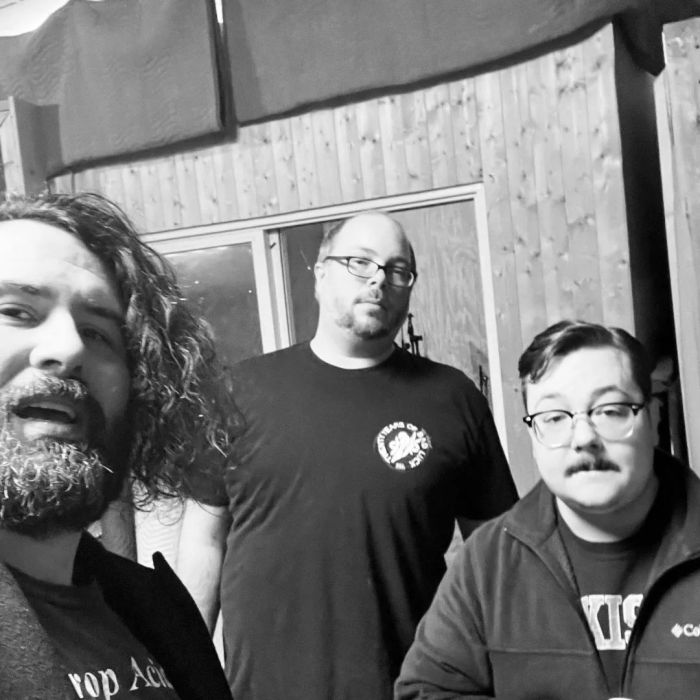
Q: How and when did you come to meet Dan Radlick and Phil Giannotta? How did that lead to the formation of Rob Zinck & The Collaborators? How do Dan and Phil both contribute to the band’s sound?
A: Dan played bass in The Means, and Phil was the drummer in Lagerheads. Phil and I both love punk, and Lagerheads was more of a bluesy garage-rock band, so he and I bonded over fantasies of starting a punk band together on the side. When I realized my solo project was evolving to the point where I’d need a live band, I took that as an opportunity for Phil and me to make those fantasies a reality.
Phil’s not just a drummer either; he’s also a guitarist with an ear for melody and arrangement, so he’s a two-fer. And as a drummer, I could literally set my clock to Phil. We didn’t use a click track in the studio—just a starting tempo for reference. When we’d listen back, the tempo would vary by maybe 2 or 3 bpm max, which was unbelievable to me.
I brought Dan in because he’s got this knack for writing basslines that don’t necessarily follow what I’m doing, but serve as this perfectly woven complement. He knows how to find the spaces in between and fill everything out—which is critical in a trio—but without overthinking and while still locking in with the drums. He’s got a style that’s all his own and somehow it just fits with my writing. When he was tracking his parts, Phil and I were getting to hear these details in his basslines that we hadn’t noticed before and were blown away by how creative they were.
Both Phil and Dan possess my favorite quality in bandmates and musicians … they make interesting choices with their parts. The flashiest player in the world can easily be the most boring if they’re doing something I’ve heard a million times before. Speed and technical skill mean nothing without a unique perspective that allows a player to write parts that only they would think of.
Q: How does Swim or Sink serve as an extension of your previous solo work as James Stuart Abbott? How did writing the album’s 11 tracks help serve as an important step to preserving your work as a songwriter?
A: Figuratively, it serves as an extension of the James Stuart Abbott EP in that it’s my first solo release since then, but it also literally picks up where that EP left off. The water sounds that open Swim or Sink come from that same field recording that closed the James Stuart Abbott Out West EP. There are also a couple of songs that I wrote alongside the ones on Out West that didn’t fit the EP, or I felt like I couldn’t pull off without an actual band. [One was] “Before I Was But Now I Am” … and so parts of the record came from the same set and setting as my work under James Stuart Abbott.
As for preserving my work as a songwriter, I spent years putting my whole heart into writing songs for bands that no longer exist. I feel that some of those songs have to stay in that time and place because they don’t fully belong to me. This record—and Rob Zinck & The Collaborators more broadly—is my way of saying that from now on everything I write stays a part of me forever.
Q: “Behave” examines facing yourself after a night of drinking and vowing to change that behavior going forward. How did past experiences bring this track about? How did it make the protagonist think twice about the erratic behavior that comes with drinking?
A: It’s written both from the perspective of the person behaving in a way that’s unacceptable and the person begging them to behave. Past a certain point, it’s just not fun to be a maniac anymore because if you have anyone in your life that you care about you become a problem for them. To me, that is the worst feeling in the world. Being on the other side of that is awful, too. Having someone you care about who means well and yet can’t help but do poorly starts to drain you of your compassion for them, and that in itself hurts like hell.
The most difficult part is that many people never get to the point where they do face themselves and honestly self-reflect because it’s painful. The kind of person who’s drinking to excess is usually avoiding a pain that already exists. It becomes this self-reinforcing feedback cycle where they drink because they feel bad and they feel bad because they drink. “Behave” is about the external forces that help a person break the cycle in the form of family and friends willing to hold them accountable and the internal monologue that tells them, “They’re right. You’ve got to behave.”
Q: “Orange Juice” explores the promise of making a new start and seeing each day as a new opportunity. How did a beautiful day in southeast Michigan inspire this track?
A: This was a beautiful day that I spent with my girlfriend at the time doing nothing except sitting outside all day watching the clouds go by and the wind move through the trees. It was Memorial Day weekend and we had decided—rather than go out and party with friends—we were going to have a low-key weekend being homebodies, but we were recovering from a trip we’d just taken. We didn’t really have the energy to be social with anyone except each other.
As the weekend went on, I came to realize that being together without any social distractions allowed us to see each other and our life together as the most important thing either of us had going on. Even so, the whole time I had this nagging feeling that something wasn’t quite right, and I couldn’t shake it. I wrote this song so I could revisit the moment as the clouds turned the color of orange juice and cotton candy at sunset when I finally realized what was wrong. I didn’t want her to be my girlfriend anymore. Three months later, I told her so by giving her my great-grandmother’s engagement ring and asking her to become my wife. We’ll celebrate our 10th wedding anniversary in 2024.
Q: The title track questions a person’s current actions with drinking at a lake and how those actions will impact their future. How did writing this track help you think about that situation and the impact that it would have on you? How did it serve as a pivotal moment to determine whether you would “swim or sink” from there on out?
A: The title track is really the moment where the record starts to turn and becomes about moving on from a lifestyle that lots of musicians, artists and creative types live … there are very few moments of pure sobriety. When you’re experiencing your world with even just a little bit of a buzz pretty much all the time, you’re putting a barrier between yourself and your experiences. Often, it’s a way to dull the hypersensitivity that lies at the heart of creative expression.
Popular culture likes to conflate things and tends to tie substance abuse to the creative process as though it’s a source of creativity rather than a symptom of it. “Swim or Sink” is coming to terms with the fact that substance abuse is not a means for creativity and becomes a detriment to the process after a certain point. I came to a point where it was either “swim” and learn to uncouple those two things, or “sink” and let their entanglement get in the way of my ability to be creative.
I don’t necessarily think that has to mean total abstinence, but I don’t pour myself a drink or four every time I sit down to write anymore. My days of letting wild nights turn into hellish mornings are over.
Q: “Manley” revisits growing up in Alaska and reflecting on the memories that are associated with it. How did writing this track help you relive those childhood memories and experiences? How did they help shape you into the person you are today?
A: Writing “Manley” was an attempt at processing the first big move I had made in my life and the impact that it had on me as a child. Until I was seven, we lived in a very isolated town called Manley Hot Springs in Interior Alaska. It had a population of about 60-100 people depending on the time of year and was a four-hour drive to the nearest city, which was Fairbanks.
In some ways, it was a pretty idyllic existence, but it was also arduous. Most of the food was hunted or grown since groceries were four hours away. We had indoor plumbing but no heater, so for things like baths, we’d heat water on a wood stove. As a child, it was the only life or home I’d ever known so I had no idea there was anything out of the ordinary about it.
When we moved from Manley to Nikiski, I was going into third grade, and while I was excited about having a bigger, more modern house in a much less isolated town, it was also a big culture shock for me. That school year was difficult, and it was the first time that I had ever felt the deep melancholy that I now understand is depression. But at that time, all I knew was that I felt sad and I couldn’t understand why. My parents loved me (still do), and I had a great home life, so I felt very guilty about my sadness because I didn’t see why I would feel that way when I had such a good life.
I now realize that moment in my life was the breaking of the childhood innocence that kept me from understanding that the world was so much bigger than the one I knew. It felt overwhelming and scary. I think everyone has a moment in their childhood when they experience that feeling. “Manley” tries to capture that and also explores the way those experiences made it difficult for me to relate to other people in life. Most people’s childhood was not like mine, and it can be hard to connect with my peers because we can’t bond over the same things that most people can bond over.
Q: “You Then Me” highlights being on a thrilling adventure with loved ones and feeling excited about the future. How did writing this track help you capture that sense of adventure and optimism for the future?
A: “You Then Me” is a fairly linear retelling of the day my son was born—from the moment we awoke at 3:30 a.m. because she was going into labor to the moment we saw him open his eyes. I wrote it while I was home on paternity leave with my wife and newborn son ruminating on how that day was the most emotionally charged thing I’ve ever experienced. We spent months planning, preparing and anticipating this moment, and then suddenly we were off like a shot, driving down a complexly empty 696 to the hospital where our lives changed forever. We became more than just the two of us.
We decided to start a family in January 2020 and found out we were pregnant in February 2020 and then COVID hit. Something that was already the most anxiety-ridden experience of our lives so far became even more terrifying. I still feel like we got so lucky with the way everything worked out, and “You Then Me” was written while I was home on paternity leave in between diaper changes and midnight feedings. I was still high on this feeling of relief and joy, like “Can you believe how well this worked out?”
You mention a sense of optimism, and that’s pervasive in the song because I felt like we had such a narrow target to hit. So many things had to go perfectly right, and somehow mercifully they did. Nothing in my life will ever top that sense of accomplishment.
Q: Swim or Sink includes field recordings of water on “Behave,” coyotes on “Invocation” and “Orange Juice,” and loons on “Before I Was But Now I Am” and “Manley.” Why did you decide to include those compelling field recordings on those specific tracks? How did those field recordings from Alaska and Tennessee help add a whole new dimension to those songs?
A: I’ve always appreciated when records have connective tissue between the tracks that help the individual tracks form a more cohesive whole. I’m always trying to capture interesting sounds out in the wild, and I knew that if I pored through my collection of field recordings I’d find things that heighten the atmosphere and turn an already good song into something more.
The water in the beginning of “Behave” comes from the same recording as the end of the James Stuart Abbott EP, so it marks a continuation of that creative project. “Invocation” is about trying to commune with the unseen world to call forth a desired outcome. I thought the coyote sounds fit perfectly because it’s like a sign from nature that your call has been heard and returned. Those loons are there to bookend “Manley” because they are something that I associate with my memories of growing up in Alaska. Plus, because loons have such a mournful call I felt it added to the melancholic, bittersweet vibe of the song.
I like using field recordings in general because it’s such a perfect little imprint of a moment in time that you can carry with you forever. The moment that you hear it, you’re back there in that place and in that time.
Q: How long did you spend writing the 11 tracks for Swim or Sink? What was it like to record the album this past winter at Oak Park’s Woodshed Studios with Ed Sertage? How did Ed help shape the album’s overall sound?
A few of the songs, like “Manley,” “Orange Juice,” and “Before I Was But Now I Am,” were pulled from my past catalog of ideas I’ve had kicking around for a while. But for the most part, these songs were written between 2019 and 2022. Between 2016 and 2019, I wasn’t writing very much. I was honestly concerned that maybe my best work was behind me, but when I put The Collaborators together and had a reason to write, I suddenly had all of these ideas come pouring out and that felt great.
Recording with Ed at Woodshed was the best studio experience I’ve ever had. His level of “give a damn” was incredibly high, and we just clicked right off the bat. We have similar influences, he speaks my language and he seems genuinely excited to be working with us. His whole approach was, “Let’s just make it sound like you guys are in the room playing music,” meaning keep it earnest, don’t over-produce it and let the performance speak for itself. He gave us plenty of guidance, but never pushed us into anything we didn’t want.
I think if you asked him he’d tell you that he shaped the sound of the record by not shaping it. Instead, he faithfully captured the sound of us playing music transparently. I think that’s a much bigger challenge as a recording engineer than doing a ton of layering or crazy production stuff. For that, I’ll sing Ed’s praises forever.
Q: You’re hosting an album release show on Nov. 18 at Detroit’s Lager House. What do you have planned for your set? Will you and the band be playing Swim or Sink in its entirety? Any plans to play past favorites or unreleased material? Who are some of the guest musicians that will be joining you on stage that night?
A: Yes, I’m excited about the record release party. Everyone who pays the $15 cover will get a voucher they can exchange for a copy of Swim or Sink that’s good for one night only. We’ll have hors d’oeuvres during what we’re calling our “cocktail hour” while Jon-Mikal Bartee of The Idiot Kids performs a solo acoustic set.
Our set includes every song on Swim or Sink and a few songs that didn’t make the record, plus a cover or two. We do have plans to play some past favorites and that’s where the guest musicians come into play. I don’t want to give too much away here, so I’ll all say is that we’re planning a special three-song encore that includes a heartfelt thank you to some very special people to me and a reunion of a group of people who will help me close a chapter in my musical journey and start a new one.
What I’d like most to say is that I’m very grateful to have such talented friends and ones who are willing to come onstage with me to celebrate not just the release, but everything that we’ve all accomplished together.

Q: You’ll also be sharing the stage at your album release show with Danny Van Zandt, The Hourlies and Jon-Mikal Bartee. What will they each help bring to the show that night?
A: I really love this lineup. I told these guys last night they were all picked because I’m a genuine “listen to it in the car for fun” fan of their music.
I’ve been a fan of The Idiot Kids for years and a few months ago was able to book them for a show, but their drummer injured his hand and Jon-Mikal had to play a solo set. At first, I was disappointed, but what I saw from Jon-Mikal was such an earnest, passionate performance. I knew I had to try and get him to open the night for us, and I was thrilled that he agreed.
The Hourlies bring that party, that’s just a fact. They’re one of my favorite bands to go see in the Detroit area, and they happen to be dear friends. They’ve been so encouraging since I put this project together. There were times I felt like maybe I should just give up, but one of them would always give me a pep talk and put the wind back in my sails.
Danny VanZandt is another of my favorites because he writes these great indie-rock songs with pop hooks that are precision-engineered to be my kind of tunes. He’s got a great persona and sense of humor that is refreshing in a musician. So many musicians don’t understand that you can be serious without taking yourself too seriously, but Danny gets that. He blends well-crafted songs with what seems like a deep appreciation of pop art and irony.
Q: What’s up next for you later this year and early next year? Any plans for additional live shows with The Collaborators? What about writing and recording new material in 2024?
A: We’re booked on 11 Mile Sessions Live with Scott Boatright for a livestream performance on Nov. 30. Then, we’re throwing sort of an “office Christmas party” type-thing for our friends in the scene by doing a show with The Hourlies at Bowlero on Dec. 15.
After that, I’m going into hibernation until probably the end of January 2024 before we start booking shows again. It’s been a crazy year, and I’ve put so much energy into this release, which has meant I’ve spent a lot of time out of the house and away from family. I need like a month or two during the winter to sit at home, recover and focus on being a husband and father without having this huge project hanging over me.
I think in the spring we’re going to look at putting together an EP with the songs that didn’t make the record. We were also talking about doing a split 7” with another band in the area. Past that, it’ll be time to start turning the ideas I’ve been kicking around into full-fledged songs and find out what the next record will sound like.
Show details:
Rob Zinck & The Collaborators Record Release With Jon-Mikal Bartee, The Hourlies and Danny VanZandt
Saturday, Nov. 18 | 7 p.m.
Lager House, 1256 Michigan Ave. in Detroit
Tickets: $15
 The Stratton Setlist