

The passage of time weighs heavily on Steve Taylor’s mind.
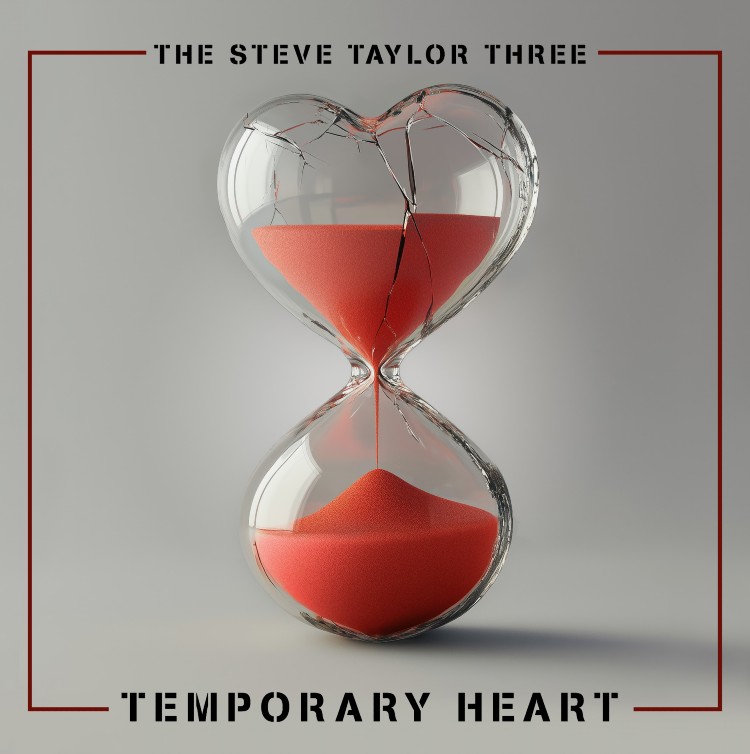
The Metro Detroit singer-songwriter and multi-instrumentalist ponders new beginnings and closed chapters on The Steve Taylor Three’s new album, Temporary Heart.
“The songs were all written in the same period, so there were certain themes that were on my mind—certainly aging,” Taylor said. “I’m 51 now, so turning 50 was a big deal from an age standpoint.”
Alongside bandmates Bryan Frink (bass, guitars, keys, vocals) and Carey Weaver (drums, percussion, vocals), Taylor explores changing family dynamics, fluctuating relationships, and childhood memories on the trio’s fifth release.
“A good friend of mine that I grew up with got married very young and then got divorced,” Taylor said. “That’s what the song, ‘Anymore,’ is about and love comes with age. I keep saying that the topics that are most on my mind right now are aging and the weather.”
On Temporary Heart, The Steve Taylor Three features a dozen heartfelt tracks bursting with rich harmonies, ruminative lyrics, and vibrant Midwest Americana instrumentation.
While the songs reflect on the fleeting nature of change, the album’s universal themes and infectious soundscapes remain deeply embedded in our hearts and minds.
To learn more, I spoke with Taylor about Temporary Heart ahead of the band’s November 29 album release show.
Q: The album’s title comes from a lyric in “The Best of Me.” How did the lyric, “You may have won my heart but only temporarily,” inspire the title?
A: I sat there and went through every lyric on every song on the album. I made a huge list and I passed the list out to Bryan and Carey. Then Bryan said, “Everyone just star four of them and we’ll see if we have any overlap.” And we did and then we whittled it down and it ended up being that one. It was not only a cool-sounding title, but it was indicative of the themes of the songs. That lyric was a paraphrase from “The Best of Me.”
Q: The opener, “Family,” highlights the importance of spending time with loved ones, regardless of how busy life gets. How did your experiences with family inspire this track?
A: It’s an amalgam of a lot of family members who I’ve known over the years. It’s a third-person song whereas most of the songs that I write are personal. It’s a song about characters and Billy Joel does that a lot. He invents characters and then writes about them. As a songwriter, I’m always looking for new angles and things to write about that aren’t all about me. My concept was that I would write these verses about these people and then you would realize in the last verse that they were all related.
Q: “Climbing Up Your Walls” examines a relationship that’s falling apart and a partner’s need for closure. What was it like to work with Bryan on this track and reflect on a past relationship?
A: This is one of Bryan’s songs and one of his contributions we co-wrote. Whenever you hear big, crunchy guitars like that, it’s Bryan. I always tend to go more for the acoustic stuff.
We had a good time recording that one and Bryan wrote some great lyrics for the song, like “Common sense is a consequence.” There are a bunch of nice couplets he wrote in there. The overall theme is about waiting to hear back from somebody and you’re climbing up the walls. That’s definitely about a relationship.
Q: “Good Enough” acknowledges a struggle with self-worth and weighs whether a relationship should continue. How did hearing about a friend’s troublesome marriage lead to writing this track?
A: This is another one that Bryan brought in … and it was based on a real relationship. It was a girl that Bryan knew that was in a bad marriage. Sometimes at the end of the day, the best thing you can do—as it says in the song—is convince yourself not to give up. And sometimes that’s as good as you’re gonna do … since getting through the day is [often] an accomplishment. This is reflective of people that are our age and they’re all issues that we deal with.
Q: “Love The Way (You’re Loving Me)” celebrates finding true love and being with your soulmate. What was it like to co-write this upbeat track with Nashville songwriter J.T. Harding during the pandemic?
A: We were looking for new avenues to write. J.T. and I have been friends for years, but we had never written together. He said, “Hey, I’ve got this idea,” and sent it to me. I worked on it and sent it back to him. We went back and forth recording voice memos and trying to work out the details of the song. He’s so good with lyrics and he’s such a great songwriter. He’s got so many hits and he knows what he’s doing.
It’s a very up-tempo, infectious song … and it’s almost like a big pop song. We loved the song, we rehearsed it, and we recorded it, but there was something missing. We couldn’t quite wrap our brains around it, and then Bryan and our co-producer Andy Reed dove into this keyboard thing. They invented all these synthesizer sounds and combined them with guitar pedals. Everybody loved it … and we sent it to J.T., and he thought it was great. It’s very poppy with all the keyboards, but it still sounds like us.
Q: “Almost Home” reminisces about the carefree days of being age 11 in the summer. How did writing this nostalgic track take you back to your childhood?
A: This is autobiographical … and I was writing it in the summer and nostalgic for those days when you didn’t know what day of the week it was. The summer seemed like it was endless. There were no cellphones and our parents had no idea where we were. We took off on our bikes, we were gone all day, and we would come home for dinner.
In the neighborhood I grew up in, there was a fence that bordered a school and it had basketball courts. We always wanted to go there and play, but we had to jump over this fence. No matter what time of day it was, Jasper Moore, or Old Man Moore, would come out and start yelling at us for jumping over his fence.
Shortly after I’d written the song, I did a songwriter show with Bill Arnold and he played the dobro—he’s so good. I had just written “Almost Home,” and I said to myself, “When we record this song, I want Bill to come in the studio and play dobro all over this.” It was probably a couple of years later when we got it down and Bill was totally game for it. It added so much to it and it’s almost like a bluegrass [sound].
Q: The closer, “I Don’t Want to Die in Winter,” reflects on a life well-lived and wishes for a peaceful passing in the summer. How did your past experiences with winter and death inspire this song?
A: I played that at a show and I had a friend who came up to me and said, “You know, they’re gonna play that song at your funeral.” And I said, “Good as long as it’s in July.” I was trying to use simple language and write it almost like a timeless folk song.
It’s the last song on the record, and it was the last song we worked on. I kept saying, “Well, I want to end the record with a song, but it’s an acoustic song.” We kept not wanting to rehearse it and we said, “When we go to record it, let’s just see what happens.” It gave us a chance to bring in a bunch of different elements and there’s a lot of weird ear candy on that song as well.
When I did a demo of “I Don’t Want to Die in Winter,” I played a little cello, but I’m not very good at cello. I said, “We need to get somebody in here who’s good at this,” so we brought in Jason Charboneau.
Q: Temporary Heart features a variety of genres, including pop rock, power pop, blues rock, folk, bluegrass, and country. What inspired such a bevy of sounds on the album?
A: The other thing I like about this album is there’s so much diversity as far as styles go. We all grew up listening to different music and all of that seeps in at some point. We have Motown influences and rock influences. I always want everything that we do to sound like us regardless of genre.
Q: What was your writing process like for the album?
A: I wanted to write shorter songs. I usually write songs that have long titles and they’re long songs. But this time it was “Family,” it was “Enemy.” It was short titles and concise songwriting. Plus, I knew Bryan wanted to do vinyl and there is a time limit to that.
And Bryan’s a great songwriter as well. In everything that we do, we share songwriting credits equally because it’s a collaborative process. I don’t think of them as my songs or Bryan’s songs—they’re our songs. They wouldn’t exist outside of the band.
Q: You and the band spent two years recording the 12 tracks for Temporary Heart. How did they come together at Frink Studios and Reed Recording Company during that time?
A: When we start an album cycle, we’ll get together once a week, and we’ll take things in three-song chunks. We’ll play them every week, work on them, come up with parts, and arrange and edit them. When we feel like we’ve got a collection and we’re ready to start recording, that’s when we’ll bring in Andy [Reed] and start the sessions.
Bryan [Frink’s] got a studio at his house and most of the album was recorded there. We went up to Bay City and did some overdubs at Andy’s studio. Usually, Andy will come down and we’ll do two or three days at Bryan’s [studio] with him.
Q: How did co-producer Andy Reed help you shape the album’s overall sound?
A: This is the third record we’ve done with Andy. It started with Earn Every Scar, then Travel Light, and now Temporary Heart. The first two records, Check Your Baggage and The Tennessee Sessions, we produced ourselves. Andy is like the fourth member of the band because he’s contributing arrangement ideas and coming up with great things sonically as well.
He makes great records and he has great ears. He’s picking up guitars, he’s got ideas, he plays parts, and he sings harmonies. He sang on “Climbing Up Your Walls” and some of those backing vocal parts are Andy.
And Bryan is right there with him; they’re both cut from the same cloth as far as producing and engineering. It’s easy to work with Andy, and Bryan is so skilled and has a great studio that we can access anytime we want.
Q: You also co-wrote and collaborated with J. Chris Newberg on “Next to You” and feature a duet with Renee Paquette on “Slip Away.” How did they help elevate those two tracks?
A: I played in Vudu Hippies with Chris and we were in that band together for 10 years. He left the band to do comedy and moved to Los Angeles. He makes his living as a standup comedian now.
He sent me a video sometime during the pandemic back when we were all holed up at home. He said, “I’ve got this idea for this song,” and sent me the verse and the chorus. And then I finished the chorus and I wrote a second verse. I sent it back to him and we went back and forth. It was super fun because we used to write songs together with Vudu Hippies and we hadn’t done that in many years.
We finished that song and I told Chris, “I love this song, and I think it’s super catchy. I’m going to put it on our next record.” He was in town later for some comedy shows and I said, “We’re gonna get you over to the studio and we’re going to get you to sing on this.” Chris was excited because he used the song to propose to his fiancée.
Renee Paquette was the lead singer of Vudu Hippies, and we have two former Vudu Hippies members on this record. “Slip Away” was interesting because I dreamt about that song. I woke up one morning and it was there.
I remember texting Renee and I said, “I just dreamt we were singing a duet.” I wanted a chance to do an honest duet when we were both singing the entire time and she has some solo lines in there.
There was a real Indigo Girls influence on that song because Renee and I used to sing Indigo Girls songs together. We still love to do two-part harmonies.
Q: You’re hosting an album release show November 29 at the Blind Owl in Royal Oak, Michigan. What plans do you and the band have for the show?
A: We’re gonna play the entire album live, and at the end of the set, we’ll throw in some songs from our previous albums. We’re using a keyboard player—Marc Dorian—for the first time. We’ve always had lots of organ and piano on our albums, but it’s usually played by Bryan. He can’t play bass and keys at the same time.
We’re going to have another special guest, Carey’s wife Sarah, who sang with us for our Travel Light album release party. She’s going to sing on “Slip Away” with us.
We’re also coordinating this album release party with a book event for Gary Graff’s new book, 501 Essential Albums of the ‘90s: The Music Fan’s Definitive Guide. Bryan, Marc, and I all wrote for the book as well. We’re doing a whole set of ‘90s material to tie in with it.
Q: What’s up next for you and the band?
A: I wrote a Christmas song called “Three Little Snowmen” and it’s a rumination on mortality. It’s the first time I’ve written a song, and in less than a week, we had a finished recording. We’re going to release it during the first or second week of December.
I also have eight songs written for the next record that I’m excited about. At a certain point, I keep pushing for a Bryan Frink album. He has a lot of songs that might not be right for this band, but they’re still good songs. He always demures, but I hope to talk him into it. Why not put that out into the world?
The Steve Taylor Three performs November 29 at the Blind Owl, 511 S. Main St. in Royal Oak. Attendees can reserve a table in advance. For details, contact the Blind Owl at (248) 216-1112 or visit their website.
 The Stratton Setlist