
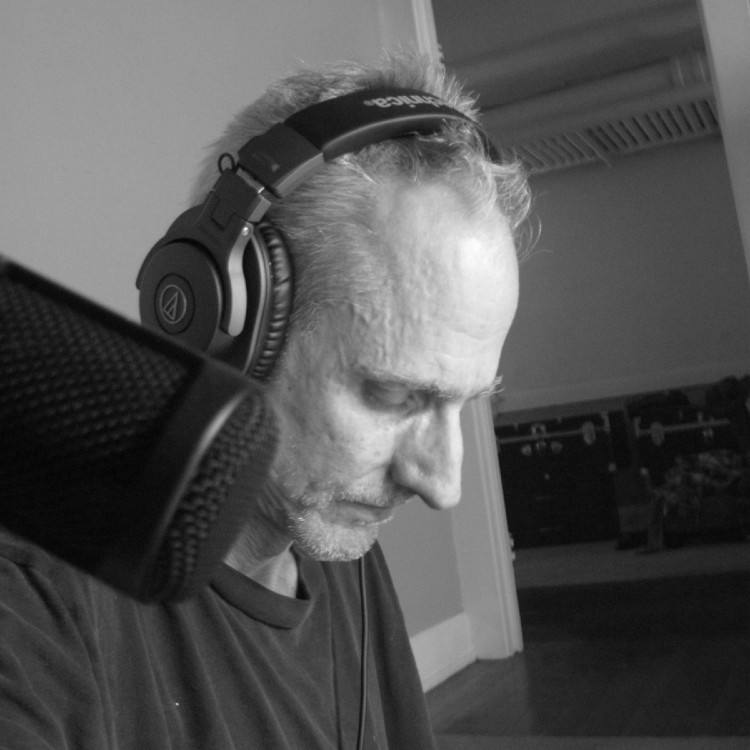
John Eagan creates an immersive sonic experience for listeners on Signal.
The Toledo, Ohio multi-instrumentalist and producer invites listeners to slip on a pair of headphones and absorb a spectrum of electronic sounds on his latest album.
“Everything I ever make is intended as headphone music,” Eagan said. “It’s not something to put on while doing the dishes. Some things are ambient—and in that sense—there are some things that people would label with the ambient term.”
As part of that electronic music exploration, listeners encounter six instrumental tracks that range from atmospheric to contemplative to chaotic to cinematic.
“I make music for people who are paying attention. It doesn’t even matter if it’s exactly matching whatever idea I might have. For that matter, sometimes the idea in my head is vague or nebulous,” said Eagan, who plays keyboards and percussion on Signal.
“I like a bit of ambiguity in music—it doesn’t have to be all spelled out. You might come up with something different than I had in my head and I’ll think that’s cool. It’s food for your imagination.”
To learn more, I recently spoke with Eagan about his background and the creative process for Signal.
Q: How did your musical journey start while growing up in Toledo?
A: I started playing guitar when I was 16 and mainly focused on rock music. As a teenager, I also started getting interested in electronics … and went through a two-year vocational education program in high school. And then I had a one-year stint in college in electronics engineering technology. I was interested in music, but I thought, “Well, I’m a beginner guitar player at this point, so I’ll become a recording engineer.”
I never went that route, but I learned the craft of recording engineering. I have actually been the engineer on every solo recording I have made. It’s been useful because I can work on my recordings alone, and … I’m not tripped up by the technology because I know what I’m doing.
I played [guitar] for fun, and I was serious about it; I wanted to become a good player. I never had any thoughts about doing something serious until I was in my early 20s. I thought, “I’m actually doing some things where I could develop something,” but I never dove into being a serious working musician. A few years into playing guitar, I started playing electric bass guitar too. I was inspired by people like Chris Squire, Jack Bruce, Paul McCartney, and John Entwistle. I spent a little bit of time … playing bass in some rock bands.
Q: How did your musical journey progress and lead to releasing your first two albums?
A: In the late ‘80s, I was [hanging] around the Collingwood Arts Center and I met some people there, including my friend Ken Knab and songwriter Steve Miller. There was a shared rehearsal space and I got to be friends with Ken in particular. And we put together a label for releasing things on cassette only … and [we] could crank out low-run reproductions of cassettes. There were a few things that were put out under the name Covert Music.
We would put things out and send copies to Option magazine, which was a big thing at the time, and other underground music zines. I borrowed a cassette four-track machine and recorded the first album, which was called Nostalgia for Atlantis, and the second one a year or so later, which was called Industry. They were pretty raw and ragged, but those were the first things where I was trying to seriously do something. There was a mix of songs and instrumentals [on those two albums].
Q: What prompted you to shift from writing songs to doing instrumental music?
A: Over time, I was working on things throughout the ‘90s, but I was not in a position where I could release anything. There was a whole album I recorded and shelved. I made a conscious decision back at that time to do instrumental music. In a song form, the focus is on the singer and the lead vocal and the words and everything else is a framework and foundation for that. And I thought, “I want to remove that … and [have it be] just about the music.”
Q: How did that creative shift lead to writing and recording Distant Cities in 2002?
A: It was at least a seven or eight-year period and eventually I finished it up in the spring of 2002. I released it in some form of mail order through the web in 2002 and I would do CD-Rs as orders came in. It didn’t do much—and finally in 2018—I was looking at Bandcamp and thinking about it.
I arrived at the idea of doing things as digital downloads because it was the first time I saw something that looked good for the musicians themselves. We were now in a period where it was common for people to have computer systems with lots of storage space and also high-bandwidth internet connections. I could release high-quality audio through Bandcamp that’s better than CD quality. I thought, “OK, I’m going to do this,” and I put up Distant Cities.
And then the next album that followed that, which is called Cinema, was finished by 2007. It sat on the shelf for years because I thought, “Well, what am I going to do with this?” And it wasn’t until I set up shop on Bandcamp that I thought, “Well, it’s time for the release of Cinema.”
Q: How has Brian Eno influenced your electronic sound?
A: If you listen to what I do, you’ll say, “This guy likes Brian Eno.” Even if you get into specific technical details about some things I’ve done, there are conceptual ideas that are borrowed from things he does. There’s a particular overall technique where you have individual musical ideas, like several different melodic themes. But the trick is you’ll have different melodic themes and they repeat.
It’s an ostinato pattern in music, and an ostinato is a repeating figure, it cycles around over and over. If you’ve ever listened to Phillip Glass, you’ve heard a lot of ostinato. You take these different length melodic cycles … so when you listen to it and you’re not paying attention to it, you might think, “Well, it’s the same thing over and over.”
But if you start listening more closely and paying attention, you’ll realize it’s constantly changing. And every now and then, depending on the number of beats for each cycle, they’ll all arrive on the one at the same time and then they’ll start shifting again.
Q: “And Then That” and “Signals in the Noise” are companion tracks in a sense. They both reflect the current chaos of the outside world and the struggle to process it. What was it like to channel that perspective in both tracks?
A: If you listen to the opening track, “And Then That,” and then in a different way, “Signals in the Noise,” those are things where something is going on … and I’m in sheer chaos here. It’s hyper and frantic, and there’s noise in the world around us—just a barrage of insanity. There’s a lot of this insane chaos, and the idea of having a simple, meaningful, and honest conversation with someone is lost in this barrage of screaming lunacy.
When I talk about composition, structure, and arrangement, there are some things if you listen to the broader view of all the work as a whole … there’s no standard template for a piece of music. Some things will have a long-term gradual flow … and then other things are almost cinematic in terms of abrupt scene changes.
I will have a piece of music where it’s divided up into sections and there are points in the music where it will go from one section to the next section where everything is different. It’s not just a different musical idea, but all the instrumentation and sounds are completely different from one section to the next.
Q: Tell me about your creative process for Signal. How did the six tracks come together for it?
A: I’ll work on things until I’m sitting back and thinking, “This is good; I should release this.” And then I’ll put it together into an album … [until] I’m happy with the sequence. In terms of individual pieces of music, I’ll have an idea and I’ll pile it away. I have to memorize it … [since] I don’t work in written notation.
I’ll accumulate ideas and then they’ll start to coagulate until there’s some weird magnetic attraction. Gradually, things will start coming together and I’ll start to get a sense of what something is at some point. I’ll be composing, recording, and arranging [things] as this intermixed, interwoven process.
I don’t sit down and write a whole piece of music and then say, “I’m going to start recording.” I spend a lot of time sitting and reviewing … and listening to what I have so far to the work in progress. I’ll make myself a list of chores … and I keep doing that until eventually I get to the point where I’ll sit and listen to something and my chores list is blank. And then I’ll say, “Oh, I guess it’s done.”
Q: How do you keep the creative process fresh from one album to the next?
A: If I step back and try to get some perspective, I can see where I have some things in common as you go from one album to the next. But I’m trying not to make the same album over and over … It’s an important thing—you don’t want to keep repeating yourself.
I won’t release something until I’ve sat and listened to it in review a whole bunch of times. My criteria for deciding if something is done and ready to release to the world—or to whoever wants to listen—is if I sit and listen to it and think, “I would buy this and want to listen to it all the time if I hadn’t made it myself.”
When I’m doing this stuff, I’ve put hundreds of hours of work into the album. I’m not someone who cranks out an album in a week. By the time I get to the end review stage, I’ve heard this stuff a lot. If I’m still listening to it and I’m not completely sick of it and bored with it, then I’ll say, “OK, it must be pretty good, so maybe other people will think so, too.”
Q: What plans do you have for new material?
A: Right now, I’m in a period where I’ve been working on some things, but there’s nothing that has my fire lit. I’m just working toward the next album. I have one thing that’s just about finished that I’m still thinking about, and it’s 13 minutes long.
 The Stratton Setlist
One thought on “Total Immersion — Toledo’s John Eagan Offers a Spectrum of Electronic Sounds on “Signal” Instrumental Album”