
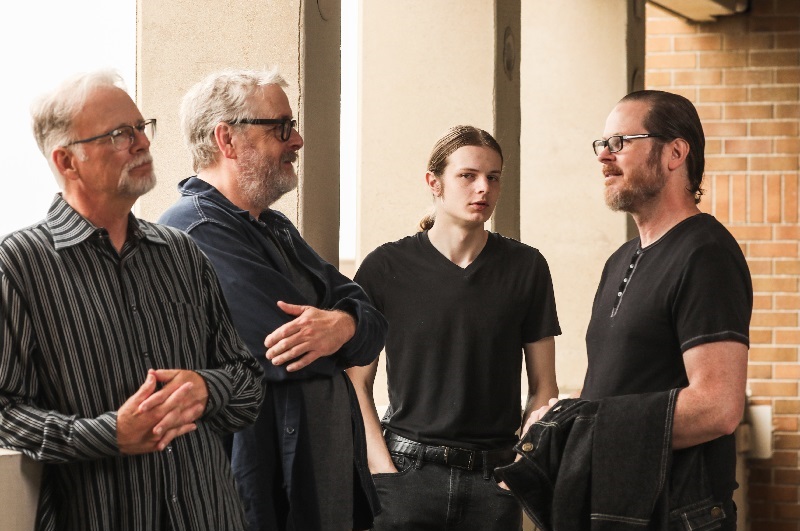
Discipline understands the struggles of navigating the online world.
The prog-rock band weighs the permanency of having a digital footprint with the instant gratification of using new technology on “Breadcrumbs.”
“In my mind, the origin of it was also this notion that when we look at ourselves, we change during our lifetimes,” said Matthew Parmenter, Discipline’s frontman and multi-instrumentalist, about the title track from Breadcrumbs.
“And here we are in this age where so much of what we do is captured, and now, how do we each get to have that luxury that I had as a person growing up, which is to make mistakes and to learn a little from them and to change as we grow. How do we do that when everything we do or utter is recorded forever online?”
Discipline explores that thought as Parmenter sings, “Should we have known / Might we have chosen for ourselves / Now it’s the platform decides / What survives archives our lives.”
“I fear that it leads us to having to become like extreme versions of ourselves, because once you say it, you gotta live up to it,” said Parmenter, who’s based in Metro Detroit. “You can’t let it go. You can’t wake up the next day and say, ‘I probably shouldn’t have said that.’ It’s gone, it’s there. So these were some of the thoughts that generated that particular song.”
In addition to the title track, Parmenter and his Discipline bandmates—guitarist Chris Herin, bassist Mathew Kennedy, and drummer Henry Parmenter—shine on their latest album, Breadcrumbs.
Parmenter’s haunting vocals and philosophical lyrics, along with the band’s spellbinding instrumentation, take listeners on a contemplative journey across five tracks.
To learn more, I spoke with Parmenter about his background, the band, and the album.
Q: How did your musical journey start in Royal Oak, Michigan?
A: I’ve played the piano since I was a baby. We had a piano in the house, and my mother used to put me in the highchair up to the piano so that she could do housework. And I would be entertained on it because you press it and it makes noise. Gradually, I started to find patterns; my mother taught me about fifths. She just showed me fifths; I couldn’t reach octaves, so I was playing by ear that way, and I was playing by ear my whole life. When I was 10 years old, she decided to get me piano lessons, but of course, I played all the time. I didn’t do sports per se; I just played the piano and was pretty much by myself most of the time.
Q: How did that lead to playing violin and guitar?
A: I took the lessons [with] my piano teacher, and I played for probably a year and a half. I was playing Mozart, and then one day at a lesson, he put music up and said, “Let’s work on this piece together,” and I couldn’t read it. I think he knew that I couldn’t read it because he said I had unusual fingering. I couldn’t read it, and apparently, he took my mother aside and said, “You need to get him off of the piano because he’s never going to learn to read the music.”
And I hated reading, so my parents got me a violin. They gave me the gift of a violin, and then after I opened it and said “Oh my gosh!”, I started squeaking on it and trying to make noise. They said, “But in order to keep that violin, you’re going to have to take lessons, so you’re going to have to learn to read.” I did eventually learn to read. I picked up the guitar on my own; my sister played the guitar and taught me [some chords]. She basically taught me how to play [John Denver’s] “Leaving on a Jet Plane,” which is a beautiful song.
Q: When did your older brother and friends introduce you to rock music?
A: My first exposures to rock music were through Gentle Giant and Yes. I had an older brother who was some 12 years my senior, and he was into that stuff back in the ‘70s. I was five years old and eight years old, and he was giving me albums. My parents listened to classical music—my mother in particular—and I thought that was what rock ‘n’ roll was. When I was a child, I would play these albums for my friends growing up, and they thought they were odd. I didn’t realize they were odd, but they were normal to me.
I had a longtime friend in grade school named Bill, and he introduced me in junior high to the new wave stuff. I took off on all that, and I was listening to Oingo Boingo and A Flock of Seagulls. In 1982 or 1983, we were at a record store, and I saw a Gentle Giant album, picked it up, and all of a sudden, it went right back. Over the course of the next five years, I pivoted back to the music that I had heard as a kid … and other albums that I had forgotten about.
Q: How did you meet Discipline bandmate Mathew Kennedy?
A: My good friend Mathew Kennedy, who is in Discipline, he’s the bass player; he and I were friends at three years old. We were forced together by our parents because his mom was a single mom, and my mom would watch him. We were put together at a very young age to play, and he and I remember the first day he came over. I said, “Do you want to watch me play the piano?” I dragged him into the music room and played the piano because that’s all I did. I watched scary movies and I played the piano.
In high school, [Mathew] was hanging around with me and the guys in the then band. He would just come to rehearsal and hang out, and then eventually I said, “Hey, would you be interested in playing bass?” And he picked up the guitar, and he’s been doing it ever since for like 40 years.
Q: How did Discipline form in high school?
A: I went to a school called Kimball, which is now called Royal Oak High School. My Discipline friends— with the exception of Mathew, who later joined because we were playmates as children—I met those other cats in high school. That was probably in ’83, ’84, or ’85, and then I graduated in 1986, but by then, I was already working with Jon Bouda, who was our guitarist.
He’s a really fine blues guitarist, whom I actually met in the jazz program at Kimball High School. I would go in the early mornings and play the piano for the jazz band, and he was there, and I watched him play. I went up to him afterward and said, “Hey, would you like to come to my house sometime and play the guitar?” And he said, “OK,” and then we sat at my piano with him learning melodies, and that was it. We played together for 10 years or something.
We decided we would adopt the name Discipline in 1987. Prior to that, we were just gigging. We stole [the name] from King Crimson’s album of the same name, which was—in my mind—the album that helped me transition [to prog rock].
Q: Why did you stop playing the violin at one point?
A: I auditioned for the violin to go to college because I was a fairly advanced student. I auditioned at Oberlin College in Ohio. They have a really fine music program there—a music conservatory—and I botched my audition. I didn’t get in, but I was also a side writer. I wrote a lot of short fiction because I liked the horror movies and whatnot. I ended up getting into that same school as a creative writing student, so I put my violin away, and I didn’t play it for 10 years. I recorded on Discipline albums a little bit of violin here and there, but I never played it because I was always so embarrassed about how I botched that audition. You were supposed to play the song from memory, and I blanked, so I put it away. I did encourage my children to play the violin.
Q: How did joining the Kate Hinote Trio reignite your interest in playing violin?
A: Eight or 10 years ago, I saw my friend David Johnson, and he was in a trio called Kate Hinote & The Disasters. He kept sending me invitations saying, “Hey, you’ve got to come see this band,” through Facebook. And I thought, “Oh, they’re playing. I missed it.” I finally came, and I saw Kate singing, and I was pretty dumbstruck. She sings in tune like nobody I’ve ever heard.
I was seeing The Musical Box at a show, and I went out to the lobby, and of course, David Johnson was there. But we bumped into each other at this show, and I said, “Hey, how’s that group that you’re in?” He said one of the members had left, and I said, “Oh well, if you’re looking for a third instrument, I’d be happy to try. I used to play the violin a lot; I’m trying to play a little bit more.” And then I didn’t hear from them for like six months. And then [Kate] contacted me some six months later and said, “Would [you] be willing to come to a rehearsal?” And that was it—it was really fun to play with them. So now I play the violin like I used to play the piano.
Q: Did you ever expect Discipline to be a long-term project?
A: No, I didn’t expect it would be around so long. We put out a record on cassette. Our first show … was in 1988 under the name Discipline at the Baldwin Theatre, [now known as Stagecrafters], which is the community theater in Royal Oak. We rented the theater and had a lot of friends from high school come, and we premiered our new album. It was called Chaos Out of Order … and it was ambitious.
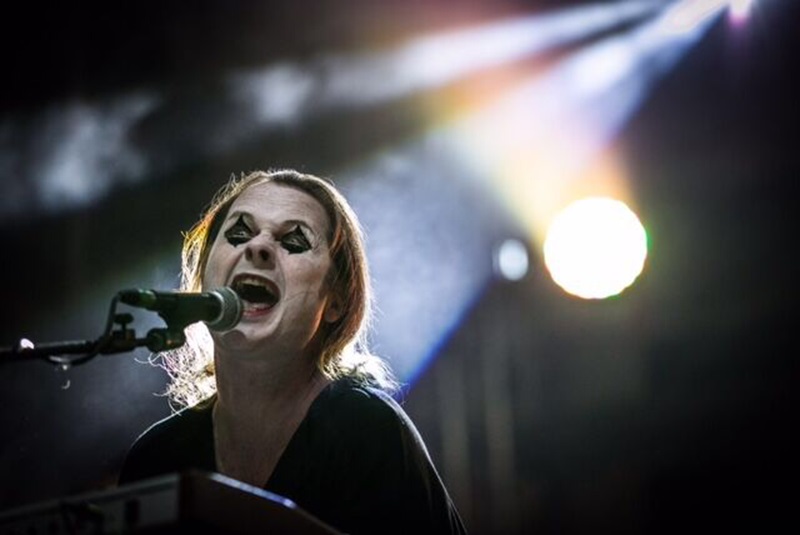
And then we played that show, and we started to get a little bit more interesting after that. And I started to do the makeup thing, and I would put on some costumes. I didn’t play the piano back then … it was David Krofchof, who also went to Kimball High School. He was doing sound for us, and then one day, he was playing Scott Joplin ragtime on the piano, and I said, “Oh, why don’t you play piano for Discipline?” And then I started just singing, but now I’m back on the piano.
Q: On Breadcrumbs, the song, “When the Night Calls to Day,” explores the heartbreak and loneliness a woman feels when her partner leaves her. What prompted you to develop the character of Marcie for this song?
A: The coda groove, which is “Aloft,” is a separate track. That I remember hearing in the cafeteria at college, and I wrote it on a napkin, and then I walked around humming it. The rest of the song I wrote later. I had the groove for a long time, but then, probably 10 years ago, I actually sat down and wrote all the lyrics. The lyrics tell their own little story, but there is a playfulness in this song that has sort of a Horace Silver groove, but it’s in seven.
I felt bad for [Marcie], but hopefully there’s a hopefulness in the refrain. And it’s a narrative song and it’s poetic, but it’s definitely flexing the storytelling [muscle]. I remember thinking something about it temporally, like the fact that it starts now, then it flashes back, and then it flashes into the fall, and then at the end it talks about the winter. You realize, “OK, she knows he’s not going to call,” and then there’s a flashback to this romantic time they had in the fall, and now it’s the brittle, cold winter.
Q: The video for “When the Night Calls to Day” features the band and a dancer dressed as a crow. How did you develop the concept for it?
A: I have to give credit to Mathew Kennedy for pulling that all together. That’s his gig; he does that. There’s a little bit of instrumentation, so maybe it draws attention to some detail. We just filmed, and then he calls it chroma key. He said he takes the background out so he can put us where he wants us, but it was fun. In the video, we had the drummer Henry [Parmenter] play his passage, which was cool. Mathew’s [also] going to put together a teaser, which is like a 60-second [album promo], but we don’t plan to make another video.
Q: How did a Marc Chagall painting and a Charles Darwin book inspire the song, “Aria?”
A: When I was writing that song, at the time behind the piano I was writing on was a painting by Marc Chagall. It’s an image that’s the ceiling of the Paris Opera. He was commissioned to paint [it]. In it, you see angels in flight and different images. As I was composing that song, there were some references to: “We raise our eyes / divine divine.” And then it says, “Amidst the clouds / birdlike gods / in ballet / defying man,” that was a reference right out of that painting.
Aside from the painting, I was reading [Charles] Darwin book [about the origin of man], which is a really entertaining book. One of the things he talked about was like females having downy hair, and I use the phrase, “hair and down,” in the [song]. To me, it’s really about the animal coupling act, but also recognizing that there’s something divine in it and something animal in it. And hopefully, honoring the two and recognizing the divinity in the animal part, which we tend not to do. It is our connection with the infinite, and we should recognize that there’s something amazing and divine in this. The speaker is illustrating the courtship, and then it’s just a dramatic story.
Q: How long did you spend writing the songs for Breadcrumbs?
A: “Breadcrumbs” and “Aria” are among the newest songs. “Keep the Change” is the oldest song, which was actually written back in the 1990s. [In the song], he talks about “pay phone calls,” and then later I added the term “cell phone calls” in the follow-up chorus, which was not in the original lyrics because it was written like 30 years ago.
Q: Tell me about the recording process for Breadcrumbs. How did everything come together at Swindlehurst in Metro Detroit and Windfall Recording with Ben Ridley in New York?
A: Swindlehurst is my home studio. Windfall Recording is near where [bassist] Mathew Kennedy lives, and so we had to travel there to record the bass. We spent a weekend [there], and we got all the bass tracks down with Ben in his studio.
We recorded the drums with scratch guitar and piano, so we were all playing together. But the guitar and electric piano were all going into headphones, so that you couldn’t hear them; you could only hear the drums on the mic. And so that was how we got the feel of the drums, and then I overdubbed the real piano. Chris [Herin] overdubbed his guitars. We traveled to a cottage on the lake and recorded the guitars there. We did Mathew Kennedy’s bass, and then I did my vocals at Swindlehurst.
Q: How did Terry Brown help shape the album’s overall sound?
A: Terry Brown mixed it. He’s beloved in the world for [producing] some of Rush’s best-known albums. He is a gift; he’s so fast at his craft. He sent me back the [album], and it was 90 percent done. Then, I had little tweaks, and he was very kind to me. He came back and he said, “I think your observations were very good.”
He has a way of situating the instruments in a way that’s not piercing; there’s never an irritating frequency. Most of the time, he’s able to take my irritating frequencies out, and he somehow gets it to sit in a sonic space that makes sense. It’s not just somebody tweaking my work; it’s somebody who really takes it to another level. He seems to really care about making it sound like a band. … He made it sit very nicely.

Q: The album artwork includes a quote from Hansel and Gretel. How did that quote inspire Hugh Syme‘s artwork for the album cover?
A: It turned out that Hugh Syme took an interest. He really enjoyed the Hansel and Gretel theme. When we were talking about Breadcrumbs and what does it mean, I always start with the Hansel and Gretel story, and it was intended. For the image, it originally was a breadcrumb in the bird’s beak, but then we went for an eyeball, because what is it that all of the advertisers want online, and what do they say they want? They want eyeballs! Now, you see this bird is plucking out the eyeball from the corpse.
Q: What plans do you have for your August 16 show at The Loving Touch in Ferndale?
A: We are playing from the album, and we are going to play some of the songs that people know better. People who know us will appreciate this show. It’s not strictly the new album, but it is going to feature the new album—because damnit, it’s a new album! The reason we booked this show was to play one local, and I’m really grateful that we did. It’s forced us to get this train moving in time for that show, and then we’ll probably be at a fair pace when we get to the U.K. [festival] and the New Jersey show.
Q: You’re playing ProgStock with Discipline on October 11 and the Kate Hinote Trio on October 12. How did both groups become part of the festival’s lineup?
A: Discipline played at ProgStock six years ago, and then the pandemic came and shut everybody down. ProgStock, like everyone else, had to shut down. During the downtime, they did virtual Friday nights for ProgStock Presents, and they invited Discipline to do one. And I said, “Well, how about if I do Matthew Parmenter and Friends or Discipline and Friends?”
On our ProgStock Presents virtual [show], I did a solo set to commence, then the Kate Hinote Trio played for 30 minutes, and then Discipline played for an hour. That’s how Tom Palmieri and Ann Rinaldi, who run ProgStock, heard Kate, and they really adored her voice. When Discipline was invited to this year’s [festival], they invited [Kate] to play.
Q: What other festivals are you playing this fall?
A: Prior to ProgStock, we’re going to be in Wales, and they were the ones that invited us [to perform on October 4]. It’s called Summer’s End, and it’s a small festival. They had us there in 2016, and this is their 20th reunion. Normally, they don’t allow bands to come back, but for their 20th reunion, they’re inviting bands that were requested, and apparently, we were requested.
Q: What’s up next for you and the band?
A: I’m working on some material with Discipline. I also would like to do a project where it’s a little bit more freeform and not as through-composed. I’ve been doing some jazz work over the past five or six years, and I’m playing in a small jazz combo here in Ferndale. I’ve been trying to learn a little bit more of the jazz language on piano.
Discipline performs August 16 at The Loving Touch, 22634 Woodward Avenue, Ferndale, Michigan. Doors at 7 pm. For tickets, visit TicketWeb.
 The Stratton Setlist