

Anne Domini embraces a growth mindset on Summer Snows.
The Metro Detroit singer-songwriter and multi-instrumentalist confronts past struggles and rediscovers a sense of purpose on her latest folk album.
“Summer Snows is the story of me growing up,” Domini said. “The first song, ‘Jello,’ starts with how the world feels like Jello, how everything is terrible, and I’m scared. It’s [about] that first year of growing up and what does that look like and me processing that.”
On her second full-length album, Domini processes the growth that comes from tackling mental health challenges and gaining independence.
“There was a lot that happened that was big and heavy, and I couldn’t process it on my own,” she said. “My goal is to write [music] in a way that other people can listen to the songs and see themselves in it. They can see it address their situation, they can gain comfort, and they can gain wisdom through the songs and interpret them in their own way.”
Domini’s poetic lyrics, warm vocals, and emotive instrumentation quickly invite listeners into Summer Snows. The album’s 11 tracks elicit a wealth of emotions while exploring existential and spiritual themes.
“I do think God gave me the love of music, or he just made me in a way that I loved music,” she said. “That is definitely an outlet that I have found.”
I recently spoke with Domini about the inspiration behind her album.
Q: How did your musical journey start in Lexington, Kentucky?
A: When I was four years old, my dad had a dream of singing with his family. I was singing with them … and I was six years old when I started to harmonize and [could] hold my own part. I was about four to six years old, too, when I started some piano courses on a DOS computer. It had a fat monitor, and there was a plastic keyboard we would hook up. My sister and I would do piano practice on that.
I think that was also around the time I wrote my first poem called “Rise Up Sunset.” It was four lines, and my sister helped me with that. When I was around four or five, I was plagiarizing my sister’s songs. She would write these little songs, and I thought, “I want to write, too.” And so I would take her songs and adjust the lyrics a little bit. Once I was about ages seven to nine, I started writing more of my own songs.
Q: How did songwriting lead to a love of poetry?
A: When I was 13 years old, I fell in love with poetry and started seriously leaning into [it]. Most of my life, as much as I kept writing songs, I was way more focused on poetry and lyrics. I wondered, “What can I do with just words?” It wasn’t until a few years ago that I released my first album, and I was having a conversation with another poet. I made a joke saying, “Oh yeah, I just [write songs] because nobody likes poetry anymore.” I tried to play up my poems in a format so that people would listen to them.
She said, “I know all these poetry circles. You should get involved more in poetry if you love poetry so much.” And that got me thinking, and I realized, “Actually, I really like songwriting, and I think I do want to stick with songwriting.” Once I came to realize that, I thought, “What can I do with songwriting? What boundaries can I push? What experiments can I run?”
Q: How did hymns inspire you as a poet and songwriter?
A: I was very sheltered, and I wasn’t exposed to hardly anything. I didn’t have the opportunity to be exposed to the inspirations that I have now. I did hear some Christian artists, and that was good, but what made me dive head-first and become really serious with it … were the hymns.
As much as I wish I had been able to have more exposure early on to a variety of music, and as much as I can make jokes about liking contemporary music maybe more than hymns, the poet in me does have to give the hymns some credit. Those lyrics can be stunning, and I think that was because some of my earliest songs were very much in the style of hymns. The archaic language—how it would just be so flowery and so descriptive—I just really fell in love with it. And certain words, too, would just hit me differently.
Q: What brought you to Metro Detroit six years ago?
A: Necessity is the short answer. My family situation was not ideal. It became unsafe for me. My uncle, aunt, and cousins live in Michigan, and they were able to get in contact with me once I had left home. They found out I was couch surfing, so they went down and essentially rescued me and brought me up to Michigan. I’ve been living up here ever since, and they’ve been such a huge support. I am able to have some relationship with my parents now, as well as my sister, so I am thankful for that. The distance has now made it so I can have some relationship with them while still feeling safe.
Q: How did you meet and start working with producer Bobby Guskovict?
A: I found Northville Christian Church at the same time I found a church called Roots Church [in Canton Township]. I did an event with Roots Church, and someone was a youth leader at Northville Christian Church. He said, “You should become a youth leader at Northville Christian Church.” So I ended up doing that, and I met Bobby’s son and Bobby there. But my same friend said, “You should be a janitor at Northville Christian Church,” and Bobby was my boss whenever I accepted that position.
Back then, I had pink and aqua hair, and I looked a lot different from what I do right now. Bobby always tells the story and says [laughingly], “My life could have been so much different if I had just said ‘no’ to the girl by the trash cans with pink and blue hair that asked if I knew anyone who recorded music.” But that’s how it happened because that same guy who told me I should be a youth leader, that told me I should be a janitor, then found out I did music, said, “Well, you should talk to your boss Bobby because he records.” I’m so thankful to him because he really paved that path.
Q: What was it like to write and record your first album, Autumn Rains, in 2023?
A: The main thing that inspired that was—in large part—just the number of songs that I was writing. I felt like I was writing too many songs, especially at that time. That album spans four years of writing, whereas Summer Snows spans about a year. And my third album is going to span only two-thirds of a year.
I said to [my producer] Bobby [Guskovict], “Listen, we need to make a full album because I have to write, and I have so many [songs].” We went through the different songs, we collected the best 11 at that time, and we recorded them. I didn’t have a lot of money, and I was very impatient. I said, “Bobby, I’m sorry, but we have to do this now. I have $500—can we record and release this in a month?”
And he said, “Yeah, sure.” I went into the studio, I did all of the guitar work … and I did all the vocals, and I did all the instruments. We just recorded it, and I thought, “It’s good enough; I have to get it out.” It’s definitely my most efficient album. Once that got out of me, I thought, “There’s a lot of relief,” and I felt like I could take a little more time on my next album.
Q: How was writing and recording Autumn Rains cathartic for you?
A: Theme-wise, it goes over four years. I mentioned how my family up here helped me out of what I had been through. My cousin Kyle had driven down to [Kentucky to] bring me up here, and I had lived with him for four years. He helped me a lot, and he re-raised me. His parents and his [younger] brother [Evan] helped in re-raising me as well. Kyle and Evan were like siblings to me, and their parents were like parental figures to me.
The end of Autumn Rains was right around the time Kyle was about to get married, and so that’s what “Addington” is about. It’s realizing, “That he’s leaving, and I get that I’m 23, but in some ways I’m just four years old, but I suppose it’s time to grow up.” His parents and younger brother Evan helped a lot with that process, too.
Q: Summer Snows is an introspective journey about growth, purpose, and wisdom. What did you learn about yourself while writing this album?
A: In [writing] and recording Summer Snows, I got to the same place I got to at the end of Autumn Rains. You might discover as a bit of a theme in my life that I have these waves of depression, and I’m [wondering], “How much longer am I gonna exist?” I got to that point at the end of Summer Snows, and with my aunt, who was going through everything she was going through, there were a lot of hard emotions going on.
Q: “Jello” is about going through the motions and feeling out of sync with life. How did writing this song help you face your mental health struggles?
A: It’s the sequel to the song “Addington,” and it’s asking, “What does life look like now growing up?” I wrote it when I was at work [and] when there was some downtime. I stepped away, and I was trying to process this depression, whether it was disassociation I was dealing with, and everything was muddy.
Nothing felt real, and it was me processing some of the self-harm things I had struggled with [at the time]. “Jello” is a pretty dark song … and even in the darkest times, and even when I’m pouring out my heart in what I consider some of my darkest songs, you can still see the hope. My ultimate goal is to aim upwards, do the next right thing, and seek light and seek God.
Q: “Starlings” examines being inspired by nature from a visual artist’s perspective. What was it like to explore this theme in the song?
A: I was driving at night, and it was rainy, so all the streetlights and their reflections were on the road. I’ve always found that beautiful, but it got to a point where I had to capture this and process this. I wanted to somehow explain to people how beautiful this was because I didn’t think anyone else was appreciating it at the time.
I had seen some artwork on Instagram of people doing bokeh effects with paint around lights, and some of it was rainy driving scenes. I think that was part of the inspiration, too, because I thought, “Oh, I’m actually not alone. People are attempting to express this beauty.” That’s what started it, and the chorus specifically, which says, “And my windshield makes the headlights look like baby starlings.” The inside of my windshield was greasy and dirty, and it was almost like my windshield had an astigmatism.
The windshield flared the lights as a car was coming. The little flared lights sticking up on both sides of the car reminded me of the baby starling I had seen back home in Kentucky. There was a baby starling that had these two white feather tufts on either side of its head. And I thought, “The car looks like a baby starling,” and I liked that and thought it could work.
Q: “Surprise, You Love It” celebrates being alive and living in the moment. How did this song become an anthem for gratitude and connection?
A: I had a full 180, and it was like God speaking to me [and saying], “Surprise, you’re still here, you love it.” It literally goes from me being mad in “The Fork Song” and [thinking], “God, why aren’t you letting me kill myself?” to God saying, “Ha-ha, this is why. You actually like being alive.” “Surprise, You Love It” was my aunt’s favorite song besides the “Sophia” song, and she told me, “I love how confident it is.” And that really warmed my heart and obviously shows her character: how much she loved me and had accepted me as her family, and really wanted me to succeed.
Q: “Beautiful Earth” acknowledges the beauty of nature and shares an appreciation for it. How did your love of nature inspire this track?
A: That song mainly was me trying to process how beautiful the earth [is] and how I can express this to people. I obviously love nature and get overwhelmed by beauty. I thought, “How can I capture this accurately [and] sufficiently?”, and I realized that I can’t. It’s so beautiful that it’s impossible for me to sufficiently describe what I’m trying to say. I was at Kroger in my car, and I was looking up at the sunset, and I got pissed off.
I asked myself, “Why am I getting pissed off looking at a sunset?” This is getting ridiculous because the reason I was pissed off was that I felt like I couldn’t adequately describe it, and so it frustrated me. This was messing with me, and I had to figure out how I could handle this and somehow get this in a song. I didn’t feel like I could sufficiently describe it, so instead I gave a proposal and asked in the song, “Will you watch with me? Because I can’t describe it to you, you have to see it yourself to understand it.”
Q: “Yellow Shadows” reflects on your aunt’s cancer diagnosis. How did it help you process that news at the time?
A: My aunt recently passed from cancer. She was diagnosed in July of last year. My song “Yellow Shadows” is where I say, “How is it dark in September / When it was dark in July?”, and that’s referring to that. “Yellow Shadows” is a song I wrote to process her diagnosis.
The chorus is my takeaway, and I’m personally referring to Jesus in this context. I’m saying, “God, will you just sit with me because I can’t?” That’s what I came to at the end of Summer Snows. It’s saying, “Life is too painful; I can’t do this without you.” I felt like God absolutely accepted an invitation, and obviously, he had been doing that with me before.
I then came to a deeper realization of [understanding], “I really need this right now. I can’t fully pray. I don’t have any requests. I just need you to be next to me. We don’t have to talk. Can you just be by me and support me just by being there as we’re watching time progress?”
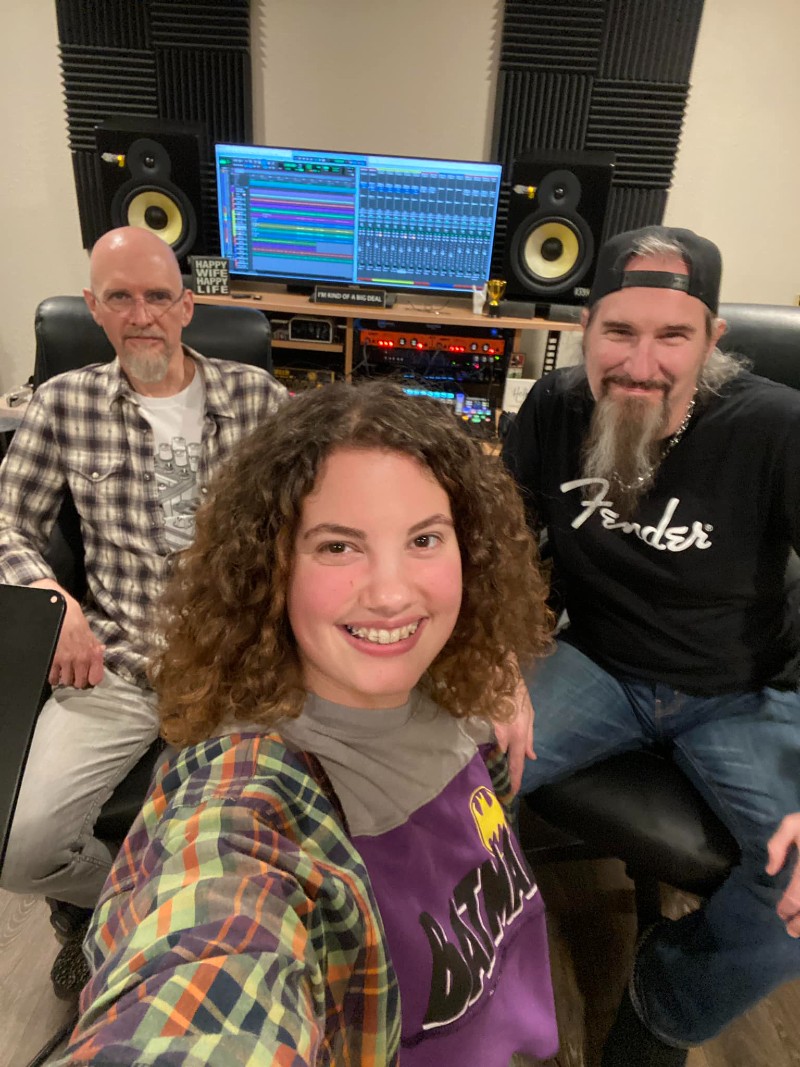
Q: How did the songs for Summer Snows come together in Bobby Guskovict’s home studio?
A: We started in September [2024], so I had just written “Yellow Shadows.” We did a few recording sessions in September and October, and then we didn’t meet again until January. I wanted it out by March [2025] because I was starting up the next session of a kids’ choir that I teach at one of my jobs in April.
Bobby had a friend actually lend us a very nice microphone for the vocals for Summer Snows. All the instruments he either had or I had, and it was all live instruments. For “Beautiful Earth,” though, one of my friends I had met at United Adoration … loaned me their Celtic harp, so I was able to play that on “Beautiful Earth.” But other than that instrument, all the other ones were just things that Bobby and I already had that we just implemented. I should add kalimba because that’s one of the instruments I put on the album. [Bobby] did all of the guitar work.
Also on this album, I started being more experimental and pushing more boundaries on recording, including utilizing motifs and trying out a self-created method of melody encoding. I wrote a lot of the songs at or above my skill level, so I would teach Bobby the song I was trying to do, and then he would take it and actually be able to play it.
Q: What live shows do you have coming up this month?
A: I will be singing every Wednesday in August from 6 pm to 7 pm in Northville Town Square before their “Dancin’ in the Ville” community event. I will be doing some songs from Summer Snows, some unreleased [songs], and some covers that people will know!
Q: You’re currently writing songs for two new albums. How are those songs coming along?
A: My third album is actually finished being written. The [newest] song I’ve written is going to be the first song of my fourth album. I’m starting to write my fourth album now.
I wrote a very raw poem, and I believe it was around the time that I had left home. It was pretty soon after I had come up to Michigan. There was a portion of my life where I was using “fates” instead of “God” [when describing] my journey. The poem [I wrote] ends [with the lines], “And as the fates would have it be / Joy never is eternity / And autumn rains like summer snows / The water flows and so it goes.”
It’s gonna be a four-album set. The next album is gonna be The Water Flows, and the one after that is gonna be And So It Goes. All the songs are in chronological order. I plan to have [The Water Flows] come out next year.
Anne Domini performs August 20 and August 27 at 6 pm in Northville Town Square, 215 West Main Street, Northville, Michigan.
 The Stratton Setlist
Really good article. I’ve had the privilege of getting to know Anne