
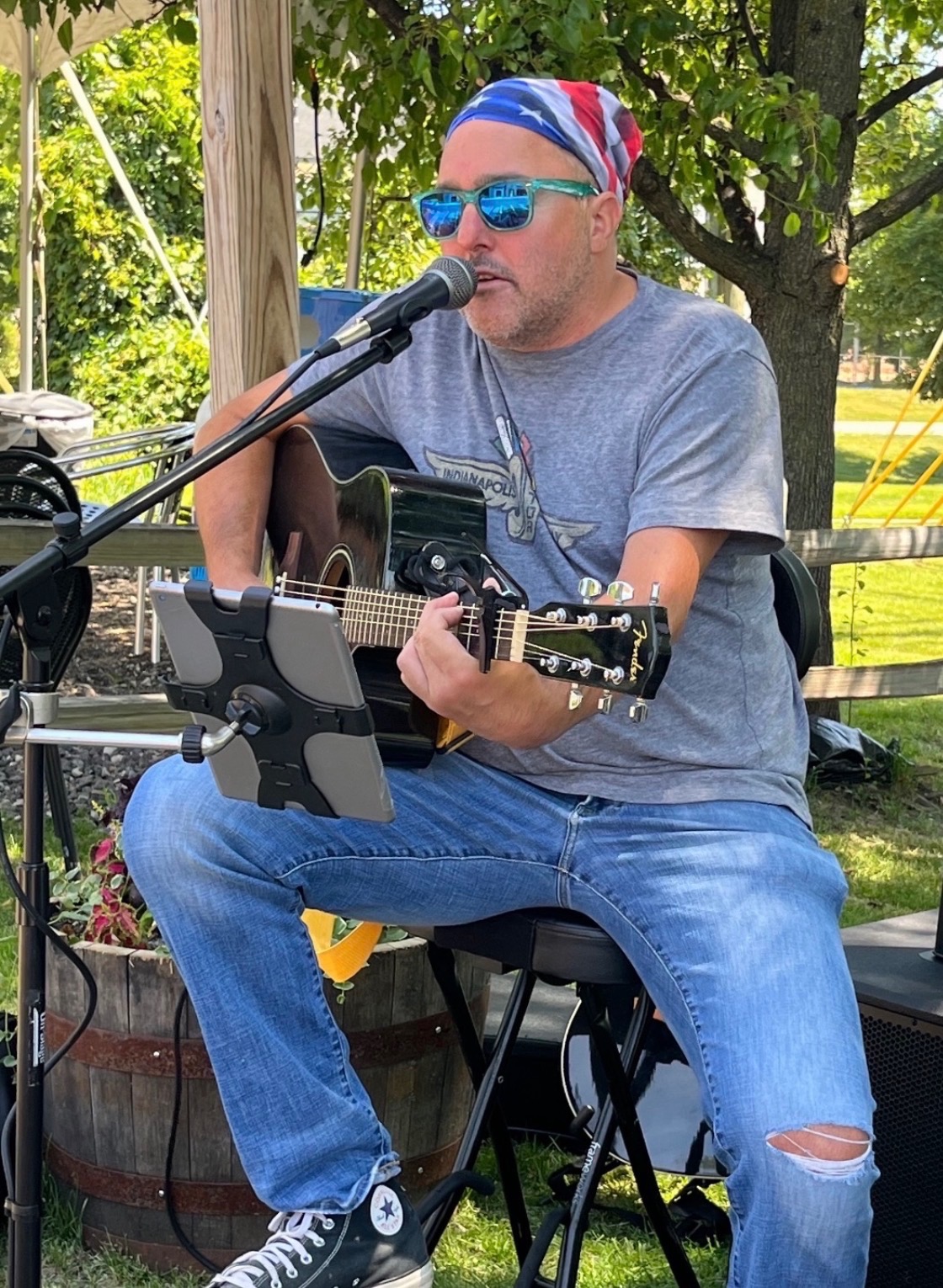
In 2003, Jarrett Cogswell took a DIY approach to releasing his album, Back Home.
The Pinckney singer-songwriter burned CDs to sell at shows in Livingston County and the Metro Detroit area.
“Back then, they had those CD burners and CD labelers,” said Cogswell, who’s also a teacher and coach for Pinckney Community Schools. “I would print the paper out and then stick it on every single CD. That’s how it started, and I probably sold 1,000 overall.”
Two decades later, he’s decided to revisit the album and put it on streaming.
“The last couple of years, students of mine and my own kids said, ‘You should get this online,’” Cogswell said. “I emailed Darryl [Schmitz], the guy who recorded my album, and said, ‘Hey, do you still have the files for this?’” And he shared them with me. I got it on my Chromebook and then went on DistroKid. I sent them the files, signed the waivers—and then boom!—it was on [streaming] platforms.”
Putting Back Home on streaming has given the country-pop album a new lease on life. Now, his family, students, and fans don’t need a CD player to hear it.
“If anybody can do that, I should start doing that,” Cogswell said. “That’s why I went back and got the old album and put it out there.”
Featuring heartfelt lyrics and earnest acoustic instrumentation, Back Home is a snapshot of Cogswell’s life and relationships in the early 2000s across 16 tracks. It also reflects on the time he spent in Nashville.
“Back Home is a mix of autobiographical experiences and stories,” Cogswell said. “I would take a story that actually happened and create that. Being back home was a big part because I had moved back from Nashville. The song, ‘Your Favorite Song,’ the last one, that’s about being there.”
To learn more, I spoke with Cogswell about his background and the album.
Q: How did your musical journey start in Pinckney?
A: When I was four or five, I remember my mom watching General Hospital. There was a character named Frisco Jones, who was played by Jack Wagner. I thought, “Wow! That guy’s cool,” and I got his single “All I Need” on record. It came in a sleeve, and I just thought that was a cool thing to do. I think my babysitter listened to Wham!, and I became a fan of them. Once I got a little bit older, maybe third grade or so, the Faith album came out.
I did the third-grade talent show, and I wanted to do “Faith.” I never had the fear of being in front of people; I just wanted to do it. My mom got me some glasses—I still wear aviators when I play gigs—and I had a black jacket and jeans. I had one of those plastic rakes that kids play with, but my mom cut out some construction [paper] and put an acoustic guitar on the front of it. She also burned a cork and then colored it on my face so I had a beard. And I did “Faith” in front of the school.
The next year, this group of girls said, “Hey, we wanna do a dance. Will you be George Michael again for ‘Hard Day’?” and I said, “Sure, I’ll do that.”
Q: How did it evolve from there?
A: I just started having concerts on my front porch. I was lip-syncing all of the Wham! albums and George Michael. My parents were also big fans of The Beach Boys. My dad used to host staff get-togethers, and K-12 teachers would show up at my house in Pinckney. Two Greyhound buses would show up in our neighborhood, and that was unreal in Pinckney at the time. They would all hang out and party and then go to Pine Knob. I thought, “Music is a big thing,” and I used to charge kids a nickel to come to my concerts.
I would say, “Bring me a nickel, and I’ll do a concert.” There were three or four girls who would show up, and some other buddies of mine said, “Can we be in the band?” And I’d say, “Sure! Here’s a broom.” But I wanted to be the one singing, and I would gather the money. Back then, the ice cream man would drive through, and I never had to ask my parents for money because I had it.
Q: What else influenced your love of music?
A: That was right with MTV coming out, and I was just hooked on watching that stuff. My mom had a guitar that was at my grandmother’s house in Wyandotte, and I had asked about it. I said, “Hey, where’s that guitar?” No one ever really knew, but I had been asking about it since age six.
I was in choir in middle school, and then by high school, I went into sports. I was a three-sport athlete, but I still loved music and listening to it. I had part-time jobs, and every time I got money, I would buy CDs. I didn’t save my money; I bought CDs. I bought thousands of CDs and liked all types of music.
Q: What inspired you to play guitar in college?
A: I got accepted to [Michigan] State, and I wanted to be a teacher. I got a guitar that Christmas, and it was a Fender guitar. I took my guitar to State and just started practicing in my dorm. I bought one of those posters at Spencer’s that had guitar chords on it and put it on the wall. I learned it by looking at the poster and practicing every day. I always had two hours of practice time for sports, so I decided to put that into the guitar.
Q: How did going to MSU help shape your musical journey?
A: During sophomore year, things started opening up in the kiva. We had open mic nights, and I started going to them. I had a job at the front desk at Wonders Hall and became the front desk supervisor. During that time, I would bring my guitar down there … and I sat there and played it. People started stopping by and hanging out, and they’d gather in the lobby by the elevator. Someone said, “Hey, you should do open mic night,” and I said, “Oh, OK.”
I used to do concerts on my front porch, but I wasn’t playing. I was pretending, and then I was playing [in college], and that was real. Then, I got a volunteer job at IMPACT 89FM (WDBM-FM). I was asked to be on the air, so they must have liked my voice or something about the way I talked.
I was on the 2 am to 6 am underground shift on Friday mornings after Thee Hourz O’ Power. That’s part of the music, too, listening to all kinds of music. I learned a lot about different genres, and I was playing off-the-wall stuff I had never heard of.
Q: You won at talent show at MSU. How did you become part of that?
A: During my junior year, they had a talent show at the MSU Student Union in 2000. There was an RA on the first floor of Wonders Hall, and we started hanging out and singing together. We learned together Tim McGraw and Faith Hill’s song, “It’s Your Love.” We said, “Let’s do this talent show,” but I had only performed at some open mics.
We went to audition, and the judges said, “We like what we hear. Can you play tomorrow night? We want to have you in the show and put you second to last.” We won the whole thing. We got $200 and an encore performance at the next year’s talent show.
I went home that night thinking, “I haven’t even played this guitar very long. I’ve only been playing it for maybe two years.” I had just won that talent show, which had stand-up comedians, full bands, and then there was me with a guitar and a girl singing harmony. I said, “I think I should focus on this a little bit,” so I got started playing gigs.
Q: You started to play gigs at bars and coffeehouses. How did that lead to recording your first demo?
A: I was a bartender at the Pinckney Pub and Grill, and this guy came in once and said, “Hey, I have a studio. Do you think you’d ever want to record any of those songs you’ve written?” I had started writing in the dorms, and most of my original stuff at the beginning was all about relationships.
He had me at his studio, and I recorded an eight-song demo in one night. It was called Midnight Memories. It was named after one of the songs I had written, and then I had this demo. I would burn CDs and sell them for $5 each when I was playing gigs. I did my student teaching at Mt. Hope Elementary School [in Lansing], and then I moved to Nashville.
Q: What did you learn during your time in Nashville?
A: When I was there in 2002, I got a job as a host at LongHorn Steakhouse, but it’s not LongHorn Steakhouse anymore. And it’s before LongHorn Steakhouse became a chain. It was this small tin-roof steakhouse between the Holiday Inn, the Howard Johnson, and Ruth’s Chris Steak House across the street. It was within walking distance of Music Row, and producers and songwriters would come in every day.
I met [Earl] Bud Lee multiple times; he was always there. He wrote “Friends in Low Places,” and that was his big one. I saw everybody; I met Toby Keith and Montgomery Gentry. I also learned about the business and how hard it is. I researched and gathered data, and learned you have to be there for at least seven years to have average success. I wasn’t sure if I could be there that long because I had a teaching degree and I missed home.
Q: What happened once you moved back to Michigan?
A: I was back at the end of 2002, but I had been in Nashville for a year. I wanted to give myself a year to learn the music business. If I hadn’t gone, I knew I’d regret it. It was almost like an experiment to see what I could do in a year. But then I learned I had to be there longer than that. I’ve always said, “I’m going to keep this music thing alive.”
Q: Back Home’s opening track, “Roll With Me,” is about meeting new people and taking chances. How did your time in Nashville spark this song?
A: It was the first one I wrote, and it’s a fun one. I actually wrote and played that for Eddie [Montgomery] and Troy [Gentry] in Nashville. It’s funny because they came out with a song called “Roll With Me” a year later.
I was a little suspicious at first, but it has a completely different sound. I took it as an honor if they did that, and that would have been great because I gave them an idea. To this day, I don’t think that’s a coincidence. It came out after I played it and told them about it, but that’s the art of music because everybody is influenced by someone, somehow.
Q: “Michigan” longs for someone back home while living in Nashville. How did a past girlfriend inspire this song?
A: That’s long gone, but at the time, absolutely. I don’t tell stories too much, specifically because I want people to have their own thoughts about the song. I don’t always say everything.
Q: “When She Asks” comes from conversations with an old friend. How did those conversations prompt you to write this track?
A: That came from one line because she used to ask me, “Do you remember when? Do you remember when we went to this and saw this?” She would always ask that, and that’s why “Do you remember?” is repeated.
I actually had met her through a friend who needed help moving his TV. She was a sister of my next-door neighbor on Evergreen [Avenue] in [East Lansing] at Michigan State. In the summer of 2001, there were five girls [in one house] and five of us [next door], so we were like friends.
Q: “Little Rock” pays tribute to a former teacher who passed away. How does the song honor David Little’s legacy?
A: He was a legendary swim coach in Pinckney, and he was my dad’s age. Back in the day, he had practice for swimming early in the morning. Everybody knew who he was, and he was a PE teacher during the late ‘90s and early 2000s. When I moved back from Nashville, he got sick, and I was asked to substitute teach at Navigator Elementary School.
It’s the school where I’m currently teaching, and it was said that he had pneumonia. The school needed me for two weeks, so I said, “Sure.” This was around February [2004], and the next Monday, I got a phone call that he had passed away. He was an advocate for getting rock [climbing] walls built, and every [elementary] school gym has them now.
Pinckney got one at Navigator upstairs in the mezzanine, and the principal at the time wanted to name the wall. They had the kids vote on the name for the wall. There were all sorts of different names, but it ended up being “Little Rock” because of Mr. Little. They had an opening ceremony with a ribbon-cutting, and the entire school was at it. The principal at the time asked me if I could play a Bob Dylan song at the ceremony because she knew of my background in music.
Mr. Little really liked Bob Dylan, but I said, “How about if I write a song about him?” I went home and wrote it in 20 minutes. The way I tied the wall to him, I don’t know how I did that. I knew it was gonna be one of those where people were gonna cry.
Q: “Turn It Down” hints at volume and temptation. How did you explore those ideas in the song?
A: “Turn It Down” could be either, so I had a little bit of a twist there with that. I wanted to use a shaker on that song. It’s got a little darkness, but it’s got that motivational beat to it. It’s a fun one to play.
Q: “The Chance” is about taking risks and following your heart. How did this song become an anthem for facing uncertainty?
A: This is my mom’s favorite song. When I first recorded the album and had a copy, I came home, and I played the album for her. When my parents are in the audience, I always introduce it and dedicate it to them. It’s about taking a chance and putting yourself in my shoes. It was inspired by a girl, and we went on a couple of dates. It didn’t work out, and that’s how I got through it—I wrote about it.
Q: “Your Favorite Song” acknowledges being excited about the future and taking a chance in Nashville. What does that song mean to you now?
A: There aren’t a whole lot of specifics in that song. It just repeats, “It’s your favorite song,” so I guess it’s timeless, as to when it could be used.
Q: Tell me about the recording process for Back Home.
A: I recorded it once I was back from Nashville, and I wanted to get my master’s in teaching. I was substitute teaching back in Pinckney and taking [classes] for my master’s at Michigan State. After my class, I would drive to St. Johns. Darryl Schmitz has a studio there called 33 1/3 Street Sound and Video.
Over the course of that year, I was working on chiseling a little bit at a time. One night, we would do just the acoustic guitar for two songs, and then the next time we would work on vocals. I just kept building this album, and I brought my keyboard; I did all the instruments. I’d sing harmony on my own voice, and that’s how that was made.
Q: How often do you play shows?
A: I’m playing gigs here and there, and I’ve played some private parties during the school year. It doesn’t really get heavy until May. I love teaching and coaching, and the way I’m able to still be a rock star is during the summer. I book summers, and I’m busy in the summer. And once school gets going again, I put it away for a little while and then come back to it.
Q: What’s up next for you?
A: I haven’t sat down and written in a very long time. A lot has happened, especially since the last time I wrote an album that’s focused on relationships. I have kids now, and to this day, I’ve thought, “I should write a song about every kid.” The next time I write, I’m going to just do something like that.
 The Stratton Setlist