

Dan Hazlett never intended to write a musical.
The folk-jazz singer-songwriter and multi-instrumentalist felt inspired to create one after seeing a revue with daughter Grace Hazlett at Meadow Brook Theatre in Rochester, Michigan.
“She was working at the theatre and would get us free tickets sometimes, and we went to a revue of ‘30s and ‘40s songs. There’s no dialogue, no plot—they’re just doing these songs—and I just had a great time,” said Hazlett, who’s from Waterford.
“I was thinking, ‘Wouldn’t it be fun as a songwriter to try and write a revue of songs like this in that style?’ And that’s an oxymoron because it wouldn’t be a revue, but that idea was kicking around in my head.”
What resulted is Calling Winston, an original musical Hazlett co-wrote with Grace Hazlett, a theater professional. It revolves around Winston Coleman, a fictional Tin Pan Alley songwriter and jazz musician who spent most of his career trying to get his songs featured in Hollywood musicals.
At age 85, Coleman reflects on his life and career while spending time with J.P., his great-nephew. During their visits, J.P. learns about Coleman’s past and the nation’s history through several references to famous Hollywood musicals.
While Calling Winston takes place in 1990, the musical’s 20 songs span nearly three decades—from 1929 to 1956—with the final song being Coleman’s latest creation.
“I needed to come up with someone who wrote the songs because it couldn’t be me,” Hazlett said. “I had to come up with a fictional songwriter, and I came up with this guy, Winston Coleman, and started filling in his details.”
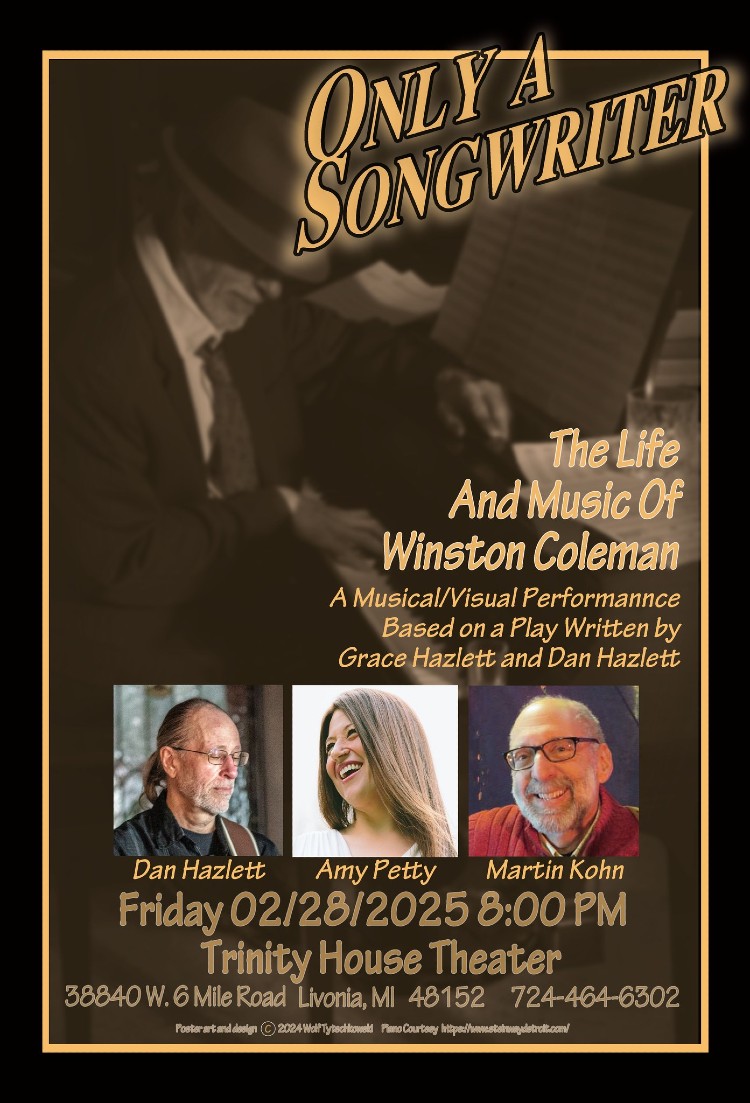
To bring the musical to life, Hazlett will perform songs from Calling Winston during a February 28 show called “Only a Songwriter: The Life and Music of Winston Coleman” at Livonia’s Trinity House Theatre.
The show will feature Hazlett performing the musical’s songs in a concert format with narrator/singer-songwriter Marty Kohn and singer-songwriter Amy Petty.
“Grace is gonna come up here [from Cincinnati], and [she’s] gonna do some costumes and dress us,” Hazlett said. “I’m playing all the instruments and doing the male vocals, and Amy is doing the female vocals. We’re going to have a [visual presentation] by Wolf Tytschkowski and Margaret Hazlett to show credits, photos, and movie posters. It’s going to enhance the experience.”
To learn more, I spoke with Hazlett about Calling Winston ahead of the show.
Q: As a longtime songwriter, performer, and producer, what inspired you to write a musical?
A: I do like musicals, but I’m not an actor … and it’s not in my wheelhouse at all. I don’t know what got me going on [2010’s] Tumbledown Town; it seemed like a thing to do.
The other theater I’ve done, I got hired to be in the band of a production, and the band was on stage because we were supposed to look like a band. We would sit on stage and pretend we were musicians and then play the songs. It wasn’t much of a stretch, but I watched how the actors evolved the play as they moved through time.
And working on Tumbledown Town, I was working with some good actors, and I got to see how everything changes when you’re rehearsing and putting it together. I started writing it and thought, “I don’t know theater. What am I doing?” I kept making it smaller until it became a concert format, so there were three other actors. There were four of us and 10 roles and there were four microphones and four stools. We would walk up to the microphones for conversation, but it was a concert with dialogue more than a play. And we did it at music venues because I thought, “Well, I can do that.” But [Calling Winston] is meant to be a full-on production by a theater company that knows what they’re doing.
Q: How did that initial inspiration lead to creating the character of Winston Coleman and writing an early draft of the musical, Calling Winston?
A: At some point, I was watching an old movie, and the next day, I got an idea for a song. I wrote this song in the voice of one of the characters in the movie, and I thought, “I could do this project and write all these songs spoken in the voice of the character from a movie.” And that was interesting, and then I thought, “But you can’t just have people break into a song in the middle of the movie, so I better pick musicals.”
And that’s when I [realized], “Oh, it’s gonna be a play.” It didn’t start out to be a play; it just started out to be a fun thing. I had to think about “Who’s this guy? What’s his life? What’s his story?” and come up with a backstory for [Winston Coleman].
And I had some of the songs done, and I sat down and wrote this whole script out. I thought, “Well, this is kinda cool, this should work.” I got the two smartest people I know—my wife Margaret and my daughter Grace—to read through it with me. I had rough recordings, and we’d play the song when it came up in the play. We read through the whole script, and they got quiet, and they looked at me and said, “We’re not going to tell you what we think. Give us a couple of days, and then we’ll give you our feedback.”
Q: Once you received their feedback, how did Calling Winston evolve while working with your daughter, Grace Hazlett?
A: After a couple of days, they gave me their feedback, which was carefully thought out and gently given with lots of suggestions. Their feedback was, “This will never work, and here’s why, and here’s what we think you could do instead.” And I started thinking, “Oh no, I have to start all over again,” and I said, “OK, then you’re going to do it with me.”
And that’s when Grace got involved. She’s smart, creative, talented, and a good writer, and she’s working in theater. She could picture how the sets would work, and she’s involved in wardrobe and costuming. We went back to the drawing board, started over, and hashed out every scene. We rewrote it and went through several revisions and different versions. It took a long time, and altogether we must have spent two years on it.
It was a lot of fun, but it was also stressful. We would hash things out and say, “Well, that’s not going to work. How about if we try this?” She was good at conceptualizing everything. We went through at least four drafts—and not counting my original one—because we started over and changed the whole approach to it.
Q: Calling Winston allowed you to step outside your comfort zone as a songwriter. What did you learn while writing for it?
A: Some songs got cut and some songs got added. That’s how the play came to be, and it was an interesting experience and a great learning experience for me. For one thing, I am running through a lot of different layers. I have this songwriter who was born in 1905; he’s a different kind of songwriter than I am. I’m writing from his point of view for a character in the movie who is played by someone—most of them are famous—and then that person is portraying a character in a film who is sometimes also portraying a character.
Sometimes I’m writing for an actor portraying an actor. I know the plot of the movie and I know this scene we’ve chosen and I know the tone. I had this advantage, too, knowing that I’m not really the songwriter, so I am not responsible for anything that guy does. It’s liberating, and it’s a great experiment as a songwriter because I would never do anything that cornball that’s required for this scene. I had permission because I didn’t write it—that guy wrote it. One of the things I learned was I indeed have more boundaries that I was unaware of. That’s how it developed and that’s the story.
Q: How did you develop the character of Winston Coleman for Calling Winston?
A: He’s not modeled [after] anyone else. The name seemed like a cool name that would be appropriate for a songwriter. I’ve been interested in those songwriters from that era, so I know who they are and how they wrote. Teaching songwriting, I had to understand different approaches from that era because it’s [much] different than [how] people [write] now. Some of that now is filtered in there, but … we let the character decide who he wanted to be. He’s a zany guy, and we wanted it to be fun.
We’re also hoping there’s some real relevance with our current culture because history has a way of repeating itself as we are currently seeing. A lot of those issues pointed at what was going on at the time, so we got to look at a bunch of things in both popular and political culture of the day. Hopefully, that will translate and people will see the relevance.
Q: What inspired the musical’s title and overall storyline?
A: We called it Calling Winston because all these old memories come up that you see through phone calls. In a sense, he’s got this old phone, and it’s like a time machine. As soon as the phone rings and he picks it up, we begin to see the past, and we don’t know if it’s his memory of the past or if we’re seeing the actual event. You see the people as they would have performed it, rehearsed it, or auditioned it.
I wanted to have him never stop working. When you’re a songwriter and probably when you’re a musician, too, you don’t get to retire. I can’t imagine myself ever stopping unless I can’t physically do it anymore. Most people I know don’t say, “Well, it’s time to stop being a musician now.”
Q: The opening song, “Keep Your Sunny Side Up,” focuses on having a positive attitude regardless of what you encounter in life. How does this upbeat anthem help set the tone for Calling Winston?
A: I wasn’t thinking about the play when I wrote the song. I was sitting at a restaurant having breakfast with my wife and the idea popped into my head because I had some eggs. I started writing the song and thought, “Oh, is there a movie?” It happened to be a very early musical [1929’s Sunny Side Up] that is kind of lost in time, but there was a song and some little footage that was close enough to include it. If there were such a thing as a theme song for the play, then that would be it.
Q: “Only a Songwriter” acknowledges the financial struggles and professional uncertainties of being a songwriter. How did the musical, Gold Diggers of 1933, inspire this song?
A: That title was Marty [Kohn’s] contribution. I showed him the narration I had written and he punched it up. Before I had even thought of doing this play, I had wanted to write that song because I watched the movie. I couldn’t believe this scene was in there because these young showgirls are all living together and they’re roommates.
It’s the [Great] Depression and they’re thinking, “Oh no! How are we going to pay our rent?” And Ruby Keeler’s character has this romance going with Dick Powell’s [character], who’s this young songwriter she hears singing from next door. And there’s this scene where her roommate says, “He’s a songwriter!”
In Calling Winston, [Winston Coleman] never actually succeeded in getting any of his songs in any of those movies. Part of the joke of the play, for one reason or another, is he kept just missing [out on potential success]. Everybody knew who he was and respected him.
Q: “I Will Be Coming Home” explores how Winston Coleman misses his late father, who died in World War I. How does this song help express his lingering grief?
A: We hope that’s a special moment because it’s the end of the first act. It’s not the end of the first act in the play, but we decided to cut [a song] for this performance. I didn’t want it to go too long and that seemed like a poignant moment to end that first act.
Q: “The Mind of Lina” exposes women’s professional limitations in Hollywood. How did the character of Lina Lamont from Singin’ in the Rain inspire this empowering song?
A: That song came along pretty late, and I had a different song that Gene Kelly would’ve been singing. It was an OK song, but I felt like we’ve got enough of that. And then I realized this was an opportunity to talk about that issue.
[Lina Lamont] is portrayed as this dumb blonde egotistical person, and I thought, “But there is this scene where she outsmarts everybody, and she says, ‘I already have my contact. I went over it with my lawyer, and you have to do this.’” She has them all over a barrel, and I thought, “Let’s empower her … let’s hear from her.” She had a lot to say, and that was fun to write. And you have to imagine Amy Petty singing that.
Q: “When Winter Comes” conveys Winston Coleman’s ongoing desire to keep writing songs, regardless of his age and the passage of time. How does this track represent the final chapter of his life?
A: That’s the intent of the song and the idea that so many people when they begin to age, they complain about it. They’re upset about aging, and he has a gentler experience.
Q: Let’s talk about the writing process for Calling Winston. How did the songs come together for you?
A: They were all pretty darn challenging. There were so many layers I was writing through that I had to be conscious of. It’s not common for me to write in these musical styles, and there are some things that those songwriters did musically. I’m talking about songwriters like Cole Porter, Jerome Kern, Irving Berlin, and The Gershwins.
That was a real learning experience for me and trying to do something worthy of those guys because they’re [Winston Coleman’s] competitors and peers. If he’s not writing songs on the same level as those guys, then the play isn’t going to work. A lot of the songs, but not all of them, were a journey and a musical discovery. Jerome Kern puts a radical key change in every B part of everything he wrote. If you’re a jazz musician, and you’re improvising over his stuff, you’re cursing him.
Q: Your upcoming show of “Only a Songwriter: The Life and Music of Winston Coleman” features narration from Marty Kohn and vocal performances from Amy Petty. How did you bring everyone into the show?
A: Marty was the theater critic for the Detroit Free Press and he’s retired. He supports the whole idea because he’s helping me with the narration. He had some suggestions, which we incorporated because they were good suggestions—things to change or revise. He reviewed it with a pretty glowing review, and he privately reviewed it.
I hired [Amy] to come and do some background vocals on one of my records. It hasn’t been released yet, and she did a wonderful job, of course. I was hesitant to ask this of her, but I just presented her with the idea, and she was immediately interested. She read through it and said, “I can just see it—it’s gonna be great!” She’s been enthusiastic about being in the production, so that’s exciting. She can do all the styles and her part will be great.
Q: What can attendees expect from the February 28 performance at Trinity House Theatre?
A: I think anyone in an audience who enjoys old musicals and has watched them will find a lot more stuff they understand—like how it relates to a particular musical. I wrote [the songs] with that scene or those people in mind so that if you’ve seen the movie, you’ll have that moment of recognition. I’m just hoping we have a good crowd and that they enjoy it, and they leave with their full hearts and are happy about the experience.
Q: You’re recording your performance of “Only a Songwriter: The Life and Music of Winston Coleman.” How will that recording be used to help promote the musical, Calling Winston?
A: We want to get it out in front of people—one way, shape, or form—because it was a lot of work, and I’m proud of it. But the other reason is we’re making a video, so I’ll have a tool. I’ll be able to say: “Here’s a live performance of the songs with narration in front of an audience. Here’s how the audience reacts and here’s the script.” And that might help me to get some interest from a theatrical group.
Q: Are there any plans to do studio recordings of these songs?
A: Well, it’s been suggested, and it could happen. I’m not a piano player and they’re all meant to be done on a piano. This version we’re doing—I’m just playing guitar—but in the play, there’s supposed to be a little jazz band. In the most stripped-down possibility, it could just be a guy on piano, but it would have to be piano.
To make a record, it would require finding the right pianist and then [determining] who’s going to sing all of these parts. We realize that we’re asking a lot of the actors, and theoretically, you could have a great big cast. The vision was to have six players, and for the most part, four of them are doing all of those roles. They don’t have to [completely] imitate [them], but they do have to give the sense that they’re the person they’re portraying because everybody knows who they are. They have to sing somewhat like Frank Sinatra, Louis Armstrong, or Doris Day. That’s asking a lot; they don’t have a lot of lines, but they have to inhabit those characters. To do a cast album would be cool if there were a cast.
Q: What plans do you have for the musical after the show?
A: I’m just dying to see it performed well by a theater company. If I could turn it over to a good theater company and get out of the way, [then] it would evolve even more and they [could] smooth out the things that need smoothing out. I remember doing Tumbledown Town and somebody would come up with something that was hilarious and that went right into the play. I want to step back and watch them do whatever they’re going to do with [it] and give up ownership of the product.
Q: What’s up next for the live show later this year?
A: When I first came up with this idea, [the plan] was to stage it once like this and make a video so I can have a tool. But since then, there has been some discussion amongst the cast looking elsewhere to take it some other places.
Dan Hazlett, Amy Petty, and Marty Kohn perform “Only a Songwriter: The Life and Music of Winston Coleman” on February 28 at Trinity House Theatre, 38840 West Six Mile Road, Livonia, Michigan. For tickets, visit Trinity House Theatre’s website.
 The Stratton Setlist