
Editor’s Note: This article originally appeared on the Ann Arbor District Library’s Pulp blog.
Dave & Kristi feel a special connection to the chickadee.
The Dexter duo embraces the songbird as a symbol of joy and hope on their new folk album, The Chickadees.
“The chickadee reference is about the spiritual part of you that lives on,” said Kristi Davis about her latest release with husband and musical partner Dave Boutette.
“That’s the hopeful part, and they represent good luck, happiness, knowledge, truth, and adaptability. That’s exactly the stuff that we need right now.”
Davis and Boutette channel the chickadee’s positive spirit as they reflect on love, loss, and aging across the album’s 13 tracks.
“As far as things that are on the record, we’ve experienced a lot of loss in the last two or three years,” Boutette said. “And also this summer we’re both turning 60. It’s everything from family members and friends passing.”
The duo unexpectedly lost three family members and a pet during the last few years.
“Our dog passed very unexpectedly and a week later my dad passed,” said Davis, who sings and plays percussion on the album. “Dave lost his mom and his brother. There’s a little memorial to them on [the album], but it’s been an inspiration for the music.”
Some songs from The Chickadees also reference Dave & Kristi’s growing concerns about the nation’s changing political climate and its impact on our future.
“There are different parts of our foundation that we’ve been walking on for a long time and counting on for a long time that have shifted and are slipping,” said Boutette, the duo’s co-lead vocalist and guitarist.
“We’re OK, we have a roof over our head, and there’s food in the cupboard. It’s just that we’re older now—things are different underneath us now. We’re in uncharted territory, and we’re just trying to make our way through it.”
Dave & Kristi explore those themes and reflections through singable lyrics, rich harmonies, and emotive instrumentation.
To learn more, I spoke with the duo ahead of their June 1 album release show at Ann Arbor’s Old Town Tavern.
Q: “All Are Welcome Here” highlights appreciating and accepting people from all walks of life. How did this song become an uplifting anthem about unity and inclusion?
Dave Boutette (DB): I’m in one of those songwriter groups with Andy Baker, Annie Bacon, and Annie Capps. I think the prompt that month was “welcome.” All of the [album’s] songs are from prompts.
On that song, and on a lot of the other songs on the record, I didn’t get too matter-of-fact with things. I appreciate songs that let you think about stuff and figure stuff out rather than just saying, “I’m gonna tell you that this is bad so that you have to think it’s bad, and I’m gonna just put it down in writing so there’s no doubt I don’t like this particular corporation.” If your message is like an island, get the people to the dock of your island and let them explore the island.
Q: The title track examines feeling stuck and frustrated, yet longs for peace and freedom in the future. How does this song represent the spirit of Dave’s late brother and the chickadee?
DB: There are a couple of lines that quote him directly. One of the things he would say all the time is “It’s no big deal,” but that was an indication to you that “yes, it’s a big deal.” If he said it wasn’t a big deal, then you knew to pay special attention to that.
The thing about the chickadee that struck me when I did a bit of research is the now or never portion of it. Because they only live two or two and a half years. It’s like, “I gotta get born, I gotta grow up, I gotta find a mate, I gotta have the babies, I gotta raise the babies, and I gotta do it all in two years.” Making the most of your time on earth is a great [mantra].
Kristi Davis (KD): Dave wrote this song … that was influenced by his brother. And when you lose people, you realize your mortality. We [also] lost John Latini—we weren’t expecting that. You even treasure more of your time with these people in your community and don’t waste time on stuff that doesn’t matter or be grumpy about stuff that doesn’t matter.
Q: “Soapbox Soliloquy,” “Who You Are,” “Winter Embers,” and “Pledging My Love” celebrate growing older with another person and thriving during a lifetime of love. How did your relationship and the relationships of others inspire these songs?
KD: We knew each other in middle school, but we didn’t start dating until later in life. It’s a lot about adult development, [and] you shouldn’t stop developing. We always talk about childhood development—that’s what they teach in school. But there’s this whole element of adult development, and I think it all ends up leading you toward the spiritual end of things.
The development of love [also] starts out like Hollywood [movie] love with sparks and fireworks. The hormonal love that you see in Hollywood movies—everyone wants that—but there’s such a deeper development of love that happens over the lifetime that is so precious and gets you through the hard times. [Songs like] “Winter Embers” and “Soapbox Soliloquy” speak to that and “Who You Are” too. We’re both second marriages, and we’re going on 12 years.
DB: We put the instrumental triggers in there, too, like with Drew Howard and his pedal steel. We were pretty specific with Drew and said, “You’re not here to play a country song. You’re here to add atmospherics, and like Kristi said, ‘The feels.’” People don’t necessarily even need to know it’s pedal steel as long as they hear something that’s gonna move them.
Q: “Truth or Consequences” is about seeing the country change and anticipating trouble in the future. How did the changing state of our nation and spending time in Truth or Consequences, New Mexico, lead to writing this song?
DB: We always talk about perspective, like getting above the fray, the muck, and the rhetoric, and taking a real look at stuff. And that’s why on that one we don’t get into specifics, we want people to get above the fray, understand what’s happening, and then try to correct it. We just want to get above [everything] and get a lay of the land and then work from there.
I spent a week in Truth or Consequences when I graduated from college. Nobody ever thinks of the Rio Grande going up into New Mexico, but the Rio Grande flows right alongside. Then people think, “Oh, that’s about immigration,” and then I say, “It’s about everything—it’s about the whole thing.”
Q: “Roll” advocates seeking adventure and following your dreams. How does the song’s story of Frank and Connie encourage people to feel alive at any age?
DB: In earlier drafts of the song, Frank was angrier. Frank was frustrated and angry that he wasn’t finding what he was looking for, but we just mellowed it out. Frank and Connie are based on a couple here in Ann Arbor.
KD: The songwriting prompt was “ham.” The couple that we know bought a little camper and they said it’s shaped like a can of ham. It was inspired by their camper.
Q: “Outlaw Polka” is a metaphor for living authentically and fighting the power. How does this track serve as a rallying call for change?
KD: Hopefully, the humor helps you accept it more—the idea. When we’d sing it live, I used to say, “From the brain of Dave Boutette, the ‘Outlaw Polka.’” I like his unique way of thinking about things. I [also] sing one line as Betsy Ross, but I didn’t study her voice or anything.
DB: Kristi does the best Betsy Ross impersonation I’ve ever heard.
Q: “You Chase Too Many Things” cautions about being too distracted and losing sight of your main goal. What inspired this song about re-evaluating your priorities at any age?
KD: It’s like a motivational speech in two and a half minutes.
DB: I think it’s a little less motivating, and it’s a little bit more just expressing the frustration. There’s also the notion of the American checklist, like I gotta have the house, I gotta have the car, I gotta have the cottage up north, and sometimes there’s not enough hours in the day. We buy that there’s this checklist when maybe two of them will make you happy. And then you lose track of what you actually have. You’re so upset that you don’t have item No. 5 that you forget that you have item No. 1.
Q: The album’s 13 tracks were written from song prompts shared in a songwriting group. Why did you select these specific songs for it?
DB: This is over the last two and a half years. There are probably 12 other songs that didn’t make the cut. There are songs that we have played at conferences that we didn’t include here, but we thought this is a nice family of songs. These are really nice siblings that represent a varied, but cohesive family.
Q: Some of the songs’ lyrics reference spending time in nature and having a spiritual connection to it. How does nature inspire you as songwriters?
KD: Beaver Island inspired “We Swam in Rivers,” and the music was written [there]. And “Pulling From the Shore” is how we feel when we’re leaving on the ferry boat. We had just finished the music festival and were pulling away. We had that bittersweet sadness of leaving, and then he used it as a metaphor for John [Latini] leaving.
DB: “We Swam in Rivers” was written on somebody’s porch. If I were to sing a song at an Irish wake, “Pulling From the Shore” would be the song.
Q: Sonically, The Chickadees is influenced by different genres, ranging from folk to jazz to country to polka. Why did you explore such a variety of genres on the album?
KD: I always say his songs are like being at a party with different people: “If this is a party and these are all individuals at a party, they’ve all got distinct personalities.”
DB: But they can all be at the same party. The two tracks with the bands, when we started that session, we were well aware that we had to create a family of songs. We said, “Fellas, we’re gonna keep it at this lower level, like drums and electric guitar. In the way you approach your attack of playing your instrument, we’re going to keep it down here so that we can keep an even flow through the course of the record.” And they totally did what we asked them to.
We also had Geoff [Michael’s] expertise in mixing the record to keep everything like a family and the mastering expertise of Jim Kissling. Between Geoff and Jim, they guaranteed this was a family of songs and that there were no real outliers.
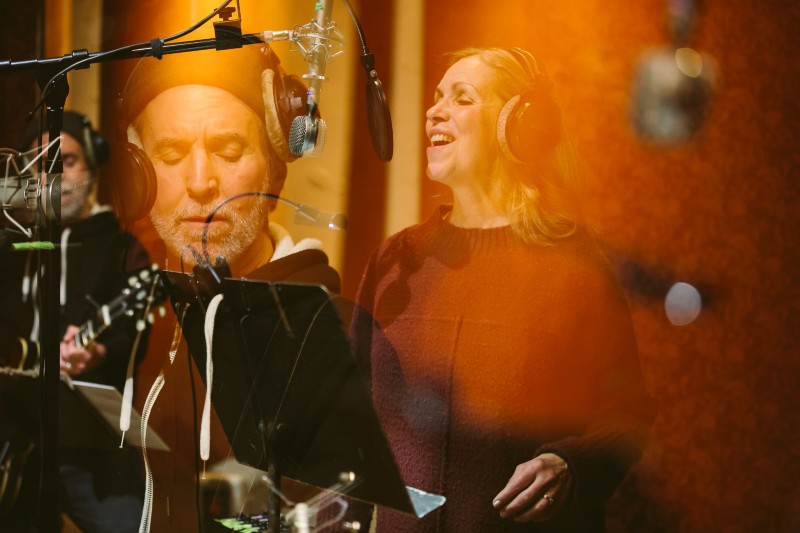
Q: Tell me about the recording process. How did the album come together at Ann Arbor’s Big Sky Recording with co-producer/engineer Geoff Michael?
KD: We started working on the tracks in January. We did five days of really intense recording. And then we had to bring in a few more people and do a few more things after that. Geoff Michael is a good collaborator, and he’s very helpful. He would suggest that I add harmonies in certain places that I hadn’t originally thought of adding.
DB: We did a 40-hour work week at Big Sky. It was like going to work, but it was great. Geoff’s not heavy-handed, but he will also gently correct you if you’re going in the wrong direction. If the mood of a song was very smooth and there was a choppy vocal passage, he would say, “Try singing that just with more sustained notes.” He would suggest instruments and say, “Don’t play that guitar, play this guitar, and we’ll see how it sounds.”
Q: What was it like to collaborate with Rod Capps (guitar), Jason Dennie (mandolin), Neil Donato (piano, organ), Jim Latini (drums), Peter Madcat Ruth (harmonica), Brad Phillips (violin), and other musicians on The Chickadees?
DB: Most of them are like family—the rest are like cousins. We’re super comfortable and we know how they work. Brad did all of his parts in [about] 45 minutes.
KD: Except for Steve Scott (djembe), we worked with everyone, and Matt Martinez who did trombone, Ross Huff (trumpet) brought him in. But otherwise, everyone else we’ve worked with before. They’re all amazing professional musicians that you can count on to bring their magic to the studio and be prepared. They make our job easy to have them come into the studio.
Q: What can people expect from your June 1 album release show at Ann Arbor’s Old Town Tavern?
DB: We’ll have our core [band] of John Sperendi (bass), Neil Donato (keys), and Jason Dennie (mandolin), and folks will drift in and out. We have to play two 45-minute sets. The first set will be the [album], potentially in order, and that would easily eat up an hour. Then it’s 45 minutes of just letting our ponies ride.
Q: You’re performing at some festivals this summer, including the Nor-East’r Music & Art Festival on June 14 and the Beaver Island Music Festival on July 17-19. What brings you back to these festivals each year?
DB: I’ve played Nor-East’r more than I can count. The Beaver Island Music Festival is an adventure, and it’s one of the highlights of the year for us.
KD: [Dave] was already playing Nor-East’r before we got together, and we’ve been together 12 years. He’s been playing there that whole time, and I jumped in later. This year, we’re playing twice at [Nor-East’r], but it’s all on the same day. We play on the main stage and in the schoolhouse.
He’s been hosting the Beaver Island Music Festival for at least 15 years, and I think this might be my 10th year. The festival starts on a Thursday … but the Wednesday before the Beaver Island Community Center is going to show Jay Stielstra’s North Country Opera. Jay’s wife, Barb Schmid, is gonna come, and Chris McMullen, who was in the show with me, is gonna be there. We’ll do a little intro and maybe some Q&A. It’s gonna be a fundraiser for the festival and the community center.
Q: You’re currently working on new material. What can people expect to hear from you next?
DB: We have songs we promised people we would record that we have not [yet]. We like to keep our promises.
KD: But we also have, for years, been talking about doing a little Christmas album because we do a lot of Christmas shows. We have four [songs] already that we do, but you [often] have to prioritize an album that people will listen to year-round versus seasonal. But we’ve started getting known for our Christmas shows, so I would love to do a little Christmas album—even if we just recorded the four songs that [Dave’s] written.
Dave & Kristi perform on June 1 at Old Town Tavern, 122 West Liberty Street, Ann Arbor. The show runs from 7 pm to 9 pm. For details, visit Dave & Kristi’s website.
 The Stratton Setlist