
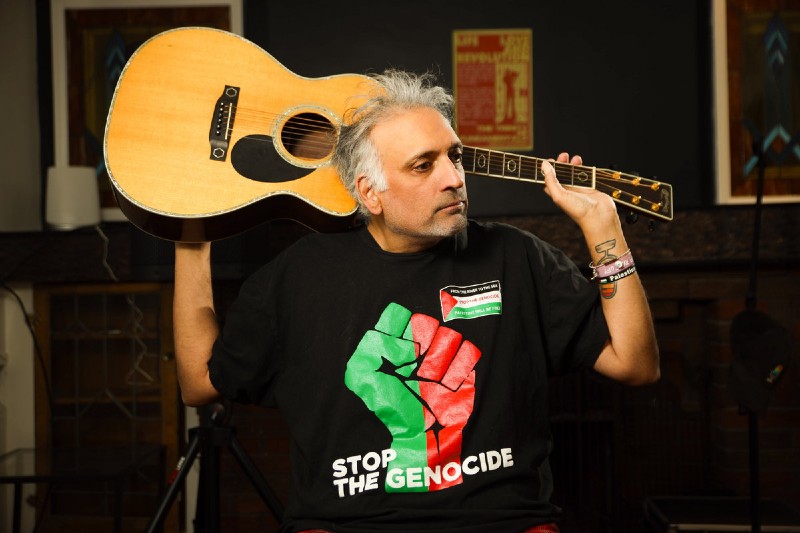
One year ago, Amrit Kohli released a sociopolitical album reflecting on resistance and survival.
Known as Mama! I Can’t Breathe, the album’s dozen tracks span almost three decades of songwriting and explore oppression, resilience, Black liberation, and queer identity.
“It’s more than just an album,” said Kohli, a queer folk singer-songwriter and activist from Ferndale, Michigan. “At a time when the world still grapples with the repercussions of George Floyd’s tragic death, I transform pain into art, using music as both a tribute and call-to-action.”
Kohli examines those themes through improvisational lyrics, emotive vocals, and atmospheric instrumentation. On a deeper level, the album helps Kohli confront identity politics and find refuge in authenticity.
“I feel like an imposter in almost every community that I’m in because I’m outside [almost] all of them,” said Kohli, who has Kenyan and Indian heritage.
“I’m either an immigrant or I’m this or that. The queer community is pretty diverse and different, and the queer community I feel like I belong to. I think culturally, ethnically, and all of those things, there’s a lot of fragmentation in my identity that way.”
I recently spoke with Kohli about their latest album ahead of a Stop Starving Gaza benefit show on June 20 at the Ghost Light in Hamtramck, Michigan.
Q: You were born in Nairobi, Kenya, but moved to the U.S. in 1979 when you were five. What was it like to grow up over here?
A: We stopped off in England [first] and stayed with my dad’s family for six to eight months. We were waiting to get sponsored by my dad’s sister who was already in the United States. My dad’s sister lived on Long Island, so we stayed with her for a while. Then we moved to Farmington Hills because my dad got an opportunity to work here in Michigan as a doctor.
We lived in Farmington Hills for one year and rented our first house. Then my parents were looking for a [another] house, and we finally bought one in Bloomfield [Township] in 1982. I finally got a chance to settle into the school system, and I came into the school system there in fourth grade. I had fourth through 12th grade in one school.
Q: How did music and pop culture influence you while growing up?
A: I listened to my parents’ Indian music when I was growing up, so there was a lot of that I [knew] by osmosis. And then, I had my ‘80s music to listen to and was involved with ‘80s pop culture. I was trying to fit in … and not draw too much attention to myself. I tried to do everything that everyone else did. The incubation of [music] began in college when I found Ani DiFranco. Ani’s definitely [been] a huge part of my life.
Q: You started encountering challenges after coming out in college. What did you experience during that time?
A: I went to Macalester College in Saint Paul, and I studied English, computer science, and philosophy. I tried to do my teaching certificate in secondary English, but I came out to my kids when I was student teaching and they threw me out. That was the end of that and was in 1995 before Ellen DeGeneres [came out]. We were still very closeted at that point compared to now. I went to college there, and I was having a good time until that incident and then I went into a big depression. That’s when things with my mental health began to deteriorate for the first time.
Q: How did things become more challenging once you moved to San Francisco after college?
A: There were a series of other things. I was sexually assaulted in San Francisco in 1997, and I lost my job when I moved out there because I passed around my manifesto, which was not taken well by the company. I was naïve, and I was still in my immigrant phase of not knowing how things are treated and how things are not free here. Passing out my manifesto was an innocent thing, but it got me fired. I didn’t have the wherewithal or the mental stability to even try and look for another job.
But I did find another job and I worked there for a while, but then I just flipped out and left California in a blaze of glory. I put everything in my car and left [some stuff] behind in the apartment and lost all my stuff. I was homeless for about three months in my car and working in a restaurant in Minneapolis for a little while. I was [also] couch surfing, living in my car, and was homeless for three or four months. Then it got to be too much because I wrecked my car and that was the end of it because that was my home. That was a major downtime in my life, but that was also precipitated by the fact that my dad disowned me when I came out to my parents.
Q: How did Ani DiFranco inspire you to pursue music?
A: Music came in 1997. I had been listening to Ani for four years at that point, and I was inspired by one of the things she had said, “Every tool is a weapon if you hold it right,” in the song “My I.Q.” The guitar became my tool, and I still see it as a tool. It’s not something that I’m trying to master. It’s supposed to be simple in terms of what I’m trying to do and how complicated the sounds are.
But I was very stubborn, and I didn’t want to learn from anybody else. I didn’t want to do any covers; I still haven’t done any covers. I wanted to incubate my sound and see what I could [develop] on my own. It’s very hard to do it that way because I didn’t have any guidance. After the catalyzing events of 1997, picking up the guitar was like a lifesaver because it gave me the ability to express myself. Three months after I started, I went to an open mic and tried to play, but I broke two strings. It was the worst performance of my life, but I was never scared to do it again because it was never gonna be that bad.
Q: You started Queer Folk, an incubator for progressive queer artists and activists, in 1997. How has it evolved over the past 28 years?
A: I was trying to follow in Ani’s footsteps, so I knew I needed a record label. I was determined to do it myself and tried to show myself that I could do it, too. Queer Folk started as Blue Bottled Skies [in San Francisco] … and the slogan was, “Making music that works.” Blue Bottled Skies was about sending messages through song and art.
After Blue Bottled Skies, I shut everything down in 2003 when I got sick and became disabled for three years. And then in 2009, I resurrected the business as Emancipated Records. In 2013, I thought, “I can’t use Emancipated Records because it doesn’t ring and doesn’t have the right sound to it.” And then I thought, “Well, I need another name … What about Queer Folk?” It came to me one day, and I wasn’t even thinking about it. I asked my lawyer if I could trademark it, and she said Queer as Folk’s trademark had expired in 2013. I was able to register Queer Folk as my own … [and] I just happened to track it at the right time.
I’m trying to spend more time building up the artists with it, but part of that is just resources. I do work with Ryan Cassata. He’s been signed to another record label, but we still partner [on things together]. Ryan and I have been friends since he was 16. That’s when he started coming out to the open mics in San Francisco and that’s where I met him. He was just starting out, and he was already amazing at 16. I knew he was going somewhere. Ryan and I [still] work together, and I try to get him Queer Folk merchandise to sign and give away at his shows.
Q: Mama! I Can’t Breathe is a testament to your activism across several sociopolitical movements. How did your activism grow during the pandemic?
A: I’ve tried to make meaning out of supporting in solidarity other movements that I am strongly affiliated [with] and have a strong affinity for, like Black Lives Matter, and how hard I fought and was in the streets all through COVID after that. I was doing caravans with Anti Police-Terror Project in the cars [in Oakland, California]. We were doing whatever we could to raise awareness of what was happening. I did that work and I did that with a lot of Black leadership. That’s who I learned from—Cat Brooks, Carroll Fife, Dan Siegel—and I was involved in all of those campaigns.
Q: “George Floyd, #SayHisName” mourns the death of George Floyd and is a rallying call for fighting injustice, oppression, and systemic racism. How does this track help set the tone for Mama! I Can’t Breathe?
A: I was stricken with grief and traumatized by the brutal injustice. Released on Juneteenth 2020, the song marked the beginning of an artistic journey deeply intertwined with activism.
[On the album], I challenge the notion that truth is subjective, insisting that every life is a story that must be told with honesty. The album’s themes extend beyond Floyd’s murder, drawing painful parallels to global struggles, particularly the plight of Palestinians, whose cries for justice echo Floyd’s desperate plea for his mother.
Q: “Shame” advocates for justice and calls for a ceasefire in Gaza. How did the ongoing war in Gaza prompt you to write this track?
A: That song came out of me and I immediately took the first take of it … and put it online and let people go to town on it. I put it on the album because I couldn’t imagine not having something to say about what was going on in Palestine.
The refrain at the end, “In your genocide / in your genocidal dreams,” was difficult to leave on there because I didn’t know what that meant exactly, but now I do. Looking at the kind of vision that Netanyahu has for Palestine, when unfiltered and unfettered by anybody, his vision is definitely genocidal. And so that’s the genocidal dream, and I just felt like, “How could you put genocidal and dream together?”
Because that’s how it came out of me, but now I understand that it is so sick, that is what’s happening. That’s where that song originates and where it comes from. It’s really hard because there’s a whole “From the river to the sea” line in there, and it’s a direct call-out to the movement. I’ve been very passionate about this ever since I was in high school and the story hasn’t changed since then.
Q: “I, Phoolan Devi” pays homage to the Indian politician and leader who was assassinated in 2001. How did her courage, determination, and leadership inspire you?
A: I recorded that impromptu, channeling the moment I found out that she’d been assassinated … and that’s how it came out. It was July 25, 2001 [when Devi died]. I was heartbroken because I wanted to meet her, and she was a heroine of mine. I was upset with the Gandhi Institute [since] they wouldn’t condemn her killing because [they said], “Well, violence begets violence.” And I said, “She wasn’t the violent one.”
Q: “Goodbye for Never Leaving Me” mourns the loss of a loved one and the void they left behind. How was writing this track cathartic for you?
A: It’s about my [late] boyfriend Rob … and how I found out in 2013 about him being gone. After I learned about his death, I wrote, “He became the bird that watched over me.” Every morning, I had a crow that would sit outside my window and call out. That to me was the most comforting thing that I could feel because I was so alone and … I was completely disabled again. It was the little things like that—the crow and the birds I would see—that would make me think of him. That song really captures that.
Q: “Travelin’ Man” revisits the changes and struggles you’ve experienced throughout your life, especially after moving to the U.S. as a child. What was it like to reflect on those experiences?
A: I remember recording [it] in the studio and that was one of those songs that I had memorized and still know now. The part that picks up in the middle about “I’ve been traveling all of my life,” that whole part was a call-out about what it was like to come here.
Q: How did the album come together in the studio?
A: I recorded it all at Stellar Tracks Recording Studio in Sterling Heights. Brian Thomas is the engineer, and he did a lot of the massaging of the music and brought all the sounds together. This album is a different kind of production for me because there are things on there that Brian had creative license to do, and I liked what he did. I also hired two session musicians. One has now become my lead guitarist at my shows, and that’s Ally Fies. She’s an amazing guitarist and she played all the lead parts on that. Spencer Ralph did the drums and the bass.
Q: You’re hosting the Stop Starving Gaza benefit concert on June 20 with LuFuki and Shrinq Mountin at Ghost Light in Hamtramck, Michigan. Why did you decide to support the Middle East Children’s Alliance?
A: I learned about them through my friends at Jewish Voice for Peace, the Detroit chapter. We decided that MECA was one of the most well-positioned organizations to feed the people in Gaza. They’re on the frontlines down there, and as soon as the blockade is lifted, they’re gonna be in there. We all thought this was a good [nonprofit] to benefit from the show. All proceeds from the show will go to MECA. If you’re not able to attend the Stop Starving Gaza benefit concert, then you can donate online.
Q: What plans do you have for your set?
A: I want to resurrect some songs from very early on, and I still have the lyrics. I want to take a smorgasbord of lyrics from different songs and put them together. There’s too much in some of the songs from early on—like 1999 and 2000—that weren’t tight and were more novelesque [because] back then I was very stream of consciousness. I’m trying to figure out what parts of [the songs] that I want to bring back. I’ll be playing with Ally Fies, who’s playing lead guitar.
Q: Your next album is going to be more personal. Will most of the songs be autobiographical?
A: It’s not necessarily about me so much, but it’s gonna be for me. I’ve taken on George Floyd, Black Lives Matter, Israel, Christ, and all these other subjects, but I feel like I haven’t really done an album for me. I want to do some more playful things than I’ve done before and not have it be all political and heavy. I want to put some lighthearted songs on there.
Q: What’s on the horizon for you later this year?
A: I’m gonna focus on writing the songs for the album and hitting open mics for a while to practice those. I’ve been going to more open mics lately just to promote the shows, but it’s been nice to get back into the whole scene and hit all the open mics around town all week long. It’s a healing and soothing thing to do, going to listen to other musicians who are all in the struggle together.
Amrit Kohli performs June 20 with LuFuki and Shrinq Mountin for the Stop Starving Gaza benefit concert at Ghost Light, 2314 Caniff Street, Hamtramck, Michigan. For tickets, visit Eventbrite. To make a donation online, click here.
 The Stratton Setlist
One thought on “Speaking Up — Amrit Kohli Advocates for Resistance and Survival on “Mama! I Can’t Breathe” Album”