
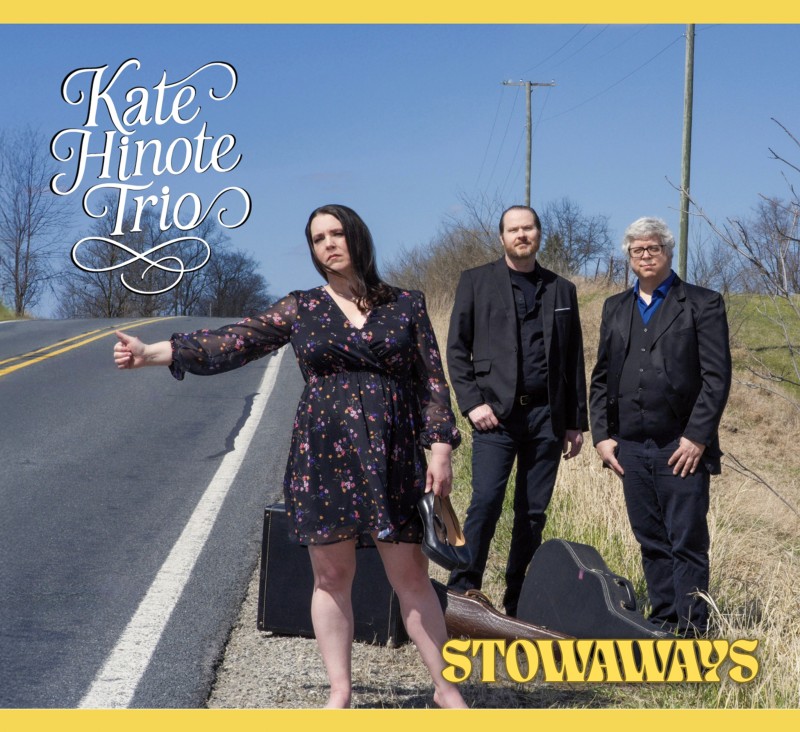
Whether fact or fiction, the Kate Hinote Trio uncovers buried emotions on Stowaways.
The Metro Detroit group explores everything from longing to disappointment to grief on its latest indie-folk album.
“These songs came out less like poetry than my typical lyrics because I was very focused on telling a story each time,” said Hinote, the trio’s vocalist and one of its songwriters.
“We wanted each one of these songs to be like a window into another world. We wanted the stories to be clear, and I didn’t want to be too vague about what I was saying.”
The 10 new original tracks featured on Stowaways are anything but vague. Many of the tracks include a vivid storyline about a protagonist examining the purpose of a relationship and the intense feelings that accompany it.
“One of the big differences in writing this record with Matthew is that he’s also a songwriter who’s been composing his own songs on his own for decades,” said Hinote, who co-wrote six of the album’s tracks with violinist Matthew Parmenter and one with guitarist David Johnson.
“The lyrics and story are very important to him, and we always talk about ‘What’s the story here? What does the song mean? What will it mean to others when they hear it?’”
The trio’s lyrics range from fictional to personal and encourage listeners to process their relationships alongside them. Those sonic experiences are further heightened by Hinote’s enchanting vocals and Parmenter and Johnson’s vibrant acoustic instrumentation.
To learn more, I spoke with Hinote about the inspiration behind the trio’s latest album.
Q: How long did you and the band spend writing the songs for the album?
A: We actually started writing shortly after releasing our first album, Near, in 2021, and it was slow going because by then we were focusing on gigging. It doesn’t help that I’m a very slow writer, especially when it comes to lyrics. It took a good long while to get the ball rolling, and the principal writing of the bulk of it took place in the last 18 months or so. Once the ball was really rolling, it was feeding on itself. As we finished songs, I’d get more excited to move on to the next, and I think the actual work inspired me, as did the concept of telling some stories.
Q: On Stowaways, “Call and Response” is about seeing a relationship disintegrate and hoping it might last. How did this track become a tale about questioning the future of a relationship?
A: We worked the hardest on these lyrics. Matthew had given me these beautiful fingerpicking chords, something we hadn’t really done, and it was his favorite instrumental that he contributed. The content of the lyrics was particularly important to him here. He wanted there to be an uplifting element. The melody came first, as usual, for me, but then we really labored over these lyrics together.
There’s a bridge where I say, “If I had / One more chance / I’d still choose love,” and the whole song builds to that. And then [at] the very end I have this exclamation of love, and it’s supposed to be hopeful, even though they’re [asking] the ultimate question: “Did we wait too long to let go?” For me, it’s [saying], “Should we even bother now? We’ve made it this far, let’s just ride it out.” But there are also these things to hold onto, and there are these things that still bring hope. I was trying to say if these people could do it all over, they would still do it and choose love.
Q: “If I Should Go” contemplates ending a friendship and weighing the repercussions of that decision. How did a past friendship inspire this song?
A: This is the first one that Matthew and I co-wrote for the record. The pandemic was still very fresh at the time. I think many people have dealt with relationships that fell apart during that time, whether it was a friend, a family member, or a romantic partner, I’m confident I wasn’t the only one who struggled. For me, it was one of my oldest friends who just bailed entirely. I took responsibility for my shortcomings in the friendship during that time, but there was no conversation or dialogue … she was just gone.
It was sad, and I had to get something out about it. It was just painful for me, and it lingered. It wasn’t just that relationship, I felt like many relationships got strained around that time. It was personal, but I also tried to make it a little more relatable and not so specific. I was getting into the general feeling of someone thinking, “I’m not sure; should I stay in this situation that I know is not serving me and I’m not being my best self in?”
Q: “Happy Anniversary” reflects on a couple’s long-term relationship and how those “17 years” can build secret, or not-so-secret, resentments. How did the three of you craft this spiteful story of love and deceit?
A: It’s like a sarcastic happy anniversary. This one was so fun to write and a complete surprise for us. David brought the chords to us early on, and as soon as I heard it, I said, “This sounds like something you would do.” I was determined to include these chords on our album because it’s a treat to have him involved in the writing part. As the writing went on, I returned to the chords, decided to write what felt like a weird melody over them, and then I passed it on to Matthew to write the lyrics. It’s a true collaboration between the three of us!
Q: “Cemetery Road” is about your late father who passed away last year. How was writing this track cathartic for you?
A: My father passed in the fall, and I hadn’t talked to him in 20 years at least. I think I was 21 when he came up for his own father’s funeral and that was the last time I saw him. There was no animosity. My parents got divorced when I was two, and he [had] moved out of state. I was the youngest and only girl, so I didn’t hold it against him, we just never had a relationship. I was never mad at him for not being around, he just wasn’t. He had a different life and had stayed close with my oldest brother.
The trio was traveling up north, and we were about to stop and eat when I got a phone call from my brother. I almost knew instinctively something had happened to Dad. Finding out that he had passed just brought up so many things, some regrets certainly, but it became a terribly sad thing for me. There were all these weird feelings because it was just a bizarre thing to grieve someone you just plainly did not know, but that you would not exist if it weren’t for them. There are only a couple of personal songs [on the album], and that was one of them. I’m proud of just how personal I made this one.
Q: You feature a haunting rendition of “Eleanor Rigby” on Stowaways. Why did you decide to cover that track from The Beatles?
A: We started covering this not too long after we started gigging heavily, and it’s a staple in our live show. We had recorded it as a B-side to our first single—a completely different recording—within the first six months we were playing it. We’ve been playing it at almost every single show ever since. Matthew wanted to include it on the new record because he thought people would like it, so we ended up recording a brand-new version of it. It’s special to us not only because of loving The Beatles, but also because it’s not a song that you’d expect people to cover.
Q: Tell me about the recording process for Stowaways at Tempermill Studio in Ferndale.
A: We started recording in January 2024 and knew we had to get started. We had to perform and write at the same time. We didn’t do as many shows, so we were able to give a little more time to writing. We did five sessions total, and four sessions that were principal recording. Those were three or four months apart, and then we did one last session of overdubs to include extra instrumentation and harmonies.
Q: How did you, your bandmates, and engineer Tony Hamera shape the album’s sound?
A: We wanted everything we contributed to be represented, but we still wanted to be presented as just our trio. Most people will see us live first, but for the people who will hear the record first and then see us live, I never want them to be let down compared to what they’ve heard on the record. We definitely wanted to keep it simple—it wasn’t—and have the vocals be very forward and not masked too much with production.
We always knew we were going to have overdubs and add some other layers this time, unlike our first album. Tony did have to come up with a different approach in that regard. He was very passionate about it, too. It was important that we were happy with the result and how the songs were represented. We got the sound we wanted; it was a little meticulous because it’s still sparse, and you can hear every instrument so well. It was important to us that it sounded clean and clear.
Q: What can people expect from your June 26 album release show at Belle’s Lounge in Ferndale?
A: Emily Rose will open and do a short set, and we will join her on a few [songs]. The trio will do a little over an hour—maybe 90 minutes—and we’ll do all originals, including the album in its entirety, as well as some favorites from our last album. Belle’s Lounge is a beautiful room, and the plan is to have it be a comfortable listening room for people to be able to hear every word.
Q: You have packed summer touring with the trio in Michigan, Ohio, and Kentucky. What are some of the places you’ll be performing at?
A: I’m excited about all of them. Some are first-time appearances for us, and others are familiar and cozy to us now. One particularly packed weekend is in July. We’ll be playing in the U.P. at the Erickson Center for the Arts’ Music in the Park series in Curtis on July 16, and we’ll have a slot at Marquette’s Music on Third Street on July 17. From there, we’ll head to The Beau in Cheboygan to perform on July 18, and that will be our third appearance there. On July 19, we’ll drive straight from Cheboygan back down to Ann Arbor for a festival at Moonwinks Cafe!
The place we’re playing at in Ohio is called the Eclipse Company Store. We’ll be playing there on August 1. It’s in this old general store in The Plains. It’s in the middle of the country in Southeastern Ohio, and it’s absolutely beautiful. This is our third time there, and they treat us very well. They have good food and a big outdoor wooden stage that is so fun. From there, we will head to Covington, Kentucky, for our third appearance at Wunderbar. We’ll be playing there on August 2, and they seem excited to have us back—that’s always a treat.
Q: You’re performing at ProgStock in Rutherford, New Jersey in October. What excites you most about being part of that festival?
A: It’s a progressive rock festival in New Jersey where Matthew’s other band, Discipline, will be playing. We’re fortunate that the trio has also been invited to play since both our group and Discipline are releasing new material this year. I’m excited to be a part of a festival of this scale—no doubt—and by playing in New Jersey, I get to add another state to the list. That’s always a big deal for me and makes me feel like a real deal touring musician.
Q: What plans do you have with your other band, The Blueflowers, later this year?
A: They’ve been writing stuff in the background and patiently waiting for me to get to it. Erin Williams, the keyboard player and backup singer for The Blueflowers, is a poet. She’s constantly sending me lyrics, so I have a treasure trove of lyrics just waiting for me to jump back into writing with them. I’m looking forward to that because it’s so different. We’re planning on going a little bit back toward our roots, tiptoeing back toward the Americana realm after rocking out for a few years. We’ve got a few shows lined up this summer. On July 26, we’ll be at Eaton Rapids Craft Company in Eaton Rapids. On July 31, we’ll be doing a Whitney Garden Party in Detroit. We’re definitely looking forward to the next chapter of The Blueflowers.
The Kate Hinote Trio performs June 26 with Emily Rose at Belle’s Lounge, which is located inside Valentine Distilling. The address is 161 Vester Street, Ferndale, Michigan. The show starts at 7 pm. For tickets, visit Eventbrite.
 The Stratton Setlist