

In high school, Billy Harrington started compiling iTunes playlists of his favorite music.
Those playlists included music recorded at Motown and Stax Records as well as songs and albums released in 1971.
“I became someone who was really interested in the liner notes, and I was making my own custom columns of [music] being done in [different] studios,” said Harrington, a drummer-producer based in Ann Arbor, Michigan.
“I also had playlists based on different years, and I kept noticing all of these great records that were happening in 1971. [That year] kept popping up, and it wasn’t just albums that I knew were famous and popular, but they happened to be my favorite albums. They were my cherished recordings, and they all kept coming out in 1971.”
Years later, Harrington and his brother, guitarist Michael Harrington, met Mark Jay, owner-engineer of Ann Arbor-based Immerisfi Recording Services. They would often discuss music while hanging out at the bar, and many of those conversations led to a love of music from the 1970s.
“We’re air-drumming to all of these songs, and it became a laughable inside joke,” said Harrington, who’s produced several artists and performed and toured nationally with different tribute shows. “We’d say ‘This is ’71 again.’ It kept coming up, and Mark was one of the inspirations to push it into the show world.”
What resulted is “Experience the Music of 1971,” a revue-style show that takes place October 11 at the Canton Village Theater and pays tribute to music recorded and released that year.
It’s a time when Carole King, James Taylor, Led Zeppelin, The Who, Marvin Gaye, David Bowie, and others released era-defining music.
“We had done a James Taylor show, and we had done a Beatles-themed show,” said Harrington, who’s co-producing Experience the Music of 1971 with Michael Harrington and working with Jay as one of the show’s sponsors.
“Both of those shows were at the Canton Village Theater, and we thought, ‘Maybe it’s time to do something new.’ And 1971 was highly requested by Mark, and I thought, ‘There’s so much great music that I want to play on stage with people.’”
I recently spoke to Billy Harrington, Michael Harrington, and Mark Jay about the show ahead of its debut at the Canton Village Theater.
Q: What excites you most about debuting the show on October 11?
Billy Harrington (BH): This is something we’ve been working on for almost a year. It comes down to us being connoisseurs and patrons of the music. Mike, Mark, and I have gone to see legacy acts because the music has changed our lives, and it provides us with more than a lifetime of listening. We want to participate in that as much as we can.
At the end of the day, this will be a show that is all live music. There won’t be tracks with different vocals and extra percussion. It will be a completely organic performance, and that’s in the spirit of the music, so we’re doing it the way that the people did in the early ‘70s, given the tech that we have. It’s live instruments and live music in a room, and hopefully, we’re connecting with the audience and reminding them, or introducing this music to them.
Michael Harrington (MH): It’s going to be a great show. It’s a lot of really challenging music, and it’s on our shoulders to perform and do it right. I think it will be fun, but it will be a lot of hard work and really rewarding. And hopefully, we’ll do more of these.
Q: Mark, why does music from 1971 resonate with you?
Mark Jay (MJ): A lot of those songs, I can remember going to sleep to an AM radio and listening to them. [At the time], I couldn’t really grasp the weight of what was going on, but a lot of those songs had hooks that [later] got into me.
What I found hanging out with Billy and Mike, even though they’re half my age, is that they have old souls. They have a real understanding of the breadth of pop, rock, soul, gospel, and funk. We’d start talking about music, and we’d say, “There were some really great years, but ’71! Why did all this great stuff happen in ’71?” More than once, I said, “Billy, you have to do a ’71 show.” The idea is to assemble all these disparate parts, and they can or will become something spectacular. ’71 was a watershed year for stuff like that.
When Billy said he was going to go ahead and do this show, I thought, “I need to get behind this.” And then I contacted Billy and said, “I’d like to sponsor this [through Immersifi Recording Services].” I feel like this show is in good hands, and I wanted to be a part of that.
Q: What do you hope people take away from Experience the Music of 1971?
BH: Mike and I are right in the middle of the people who know this music or are just getting to know this music. When I was in high school and playing drums to Led Zeppelin IV, it was blowing my mind, and I loved that music. And now, I’m 36, and our parents graduated in the early-ish ‘70s, and it’s like their middle school and high school soundtrack. In a way, we are playing music for these people that’s part of the soundtrack of their lives, so we want to do it justice.
But we also have this really unique opportunity to introduce it to people who are just picking up their instruments and thinking, “I’m not going to listen to what’s on TikTok or YouTube. I actually found this album that was my parents’ or my grandparents’. I’m going to go to a record store and see what’s highly recommended from the ‘70s.” We can be the liaison between the curators who can still play it and do it justice, and introduce it to another generation that will enjoy it.
MJ: What I would really love for the audience to be able to perceive—those of my age—is that the young folks are safeguarding these objects of art. It’s why I like Billy and Mike as much as I do. We have a lot in common in terms of music, but they get it. These are exceptionally well-crafted bits of music that came together at a time and place. I hope the audience gloms onto that and understands what it takes to pull this [music] together and actually perform it with passion and intent. To me, that’s the continuation of the thread. And that’s one of the reasons why I really wanted to help fund the show, get it out there, and make it happen.
Q: What will the format of the show be like?
BH: We will accurately represent the music, but also participate in showcasing it. No one is acting like a particular person, but hopefully it feels like a concert in 1971. That is something the emcee Cat Bradley is going to do, and she’s more of a newscaster. There’s a little bit of a spin on that that I’ll save for the time of the show, but they will guide us through the year with some things that happened historically. It will give you the social and cultural context of [the time]. It’s an immersive experience, and I like to think of it as being in between a concert and a Broadway revue.
Q: Tell me about the music that’s going to be featured.
BH: We will have a band on stage, and we will have lead singers. The focus will go from them, but we will also have keyboardist Loren Kranz as a lead. He will have a lead song, and I will be singing a lead song as well. I’ve also been thinking of being in the audience seat, and I want to give a well-rounded view of the year. A lot of rock fans will say ’71 is the greatest year, but at the same time, you also have the folk revival of the ‘70s.
It begins with this year and some key albums—like Carole King’s Tapestry, The Who’s [Who’s Next?], and James Taylor’s [Mud Slide Slim and the Blue Horizon]. The album he released wasn’t as famous, but he had several singles and was featured on the cover of Time. You also have virtuosic rock bands that came out with albums, and Yes is a great example. I chose to push the spotlight on a label that I think is a little under-recognized, and that’s Stax Records. Motown had moved from Detroit to L.A., and it was in L.A. by 1972. They had left Michigan behind, and a lot of players in a way. They were doing their own rebirth, but Stax continually churned out these amazing artists and singles. That label doesn’t always get the props that it deserves next to Motown or Atlantic.
Q: What will the lineup help bring to the show?
BH: Everyone that we’ve pulled in for the show is going to come so prepared to perform, and they’re also extremely pleasant to work with. I’ve been in musical theater shows with Jason Briggs, Ash Moran, and Chris Joseph. We have those experiences from that world. And with Amy Petty, we’ve done singer-songwriter shows together. [Working with] Loren Kranz is going to be a first for me, and Mike has played with Loren a lot in a show called Classic Women of Country Music.
I’m really excited to play with Loren because I’ve never played with him before. He’s not just a keyboard player; he’s a great drummer. Matt Martinez and I go way back, doing boatloads of weddings, and he’s been a colleague that I’ve really looked up to. He was there when I first started doing my bigger gigs, so he was someone who would always give me some advice on the side. He’s been like a mentor to me, and I’m really grateful he’s able to do this. I think it’s all sorts of avenues in the Michigan music scene that are coming together.
We have a three-piece horn section for the show, and Matt Martinez is acting as my liaison and my horn section leader. We’ll also have Scott Brown on trumpet, Ethan Moleski on saxophone, and Ken Pesick on bass. Violinist Sarah Wagner will make a guest appearance as well.
Q: What type of vintage instruments will the show feature?
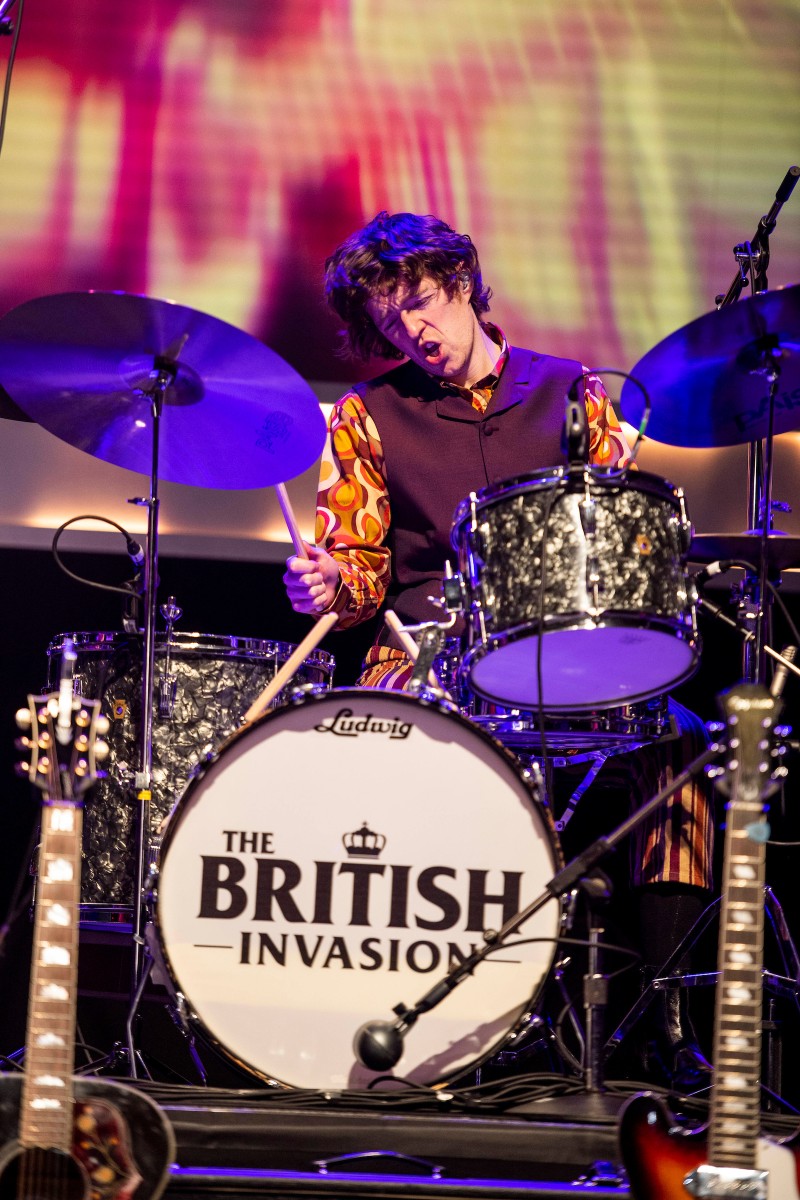
BH: I was going back and forth with a couple of drum kits that I wanted to use for the show. Not just because they’re vintage, but I needed the right drum kit work in the space that we’re in. I wanted to ensure it would mic up well and sound good. There was a particular set that I wanted to use because it looked so great. But the music and drum nerd in me could not let it go because it was a particular brand—Ludwig Vistalite—and it was gonna look so cool. They’re Plexiglass see-through drums, but we’re doing a show in 1971, and the Vistalite came out in 1973. I did settle on a brand called Rogers from the early ‘70s, so it’s definitely era-correct and accurate, and the finish is very ‘70s.
We want to do this show in 2025, and the lights aren’t the old-school little gels that feel like they’re 1,000 degrees. And the same with the sound, we want it to be a very pleasant experience for people. Pat Schrock will be doing sound for the show. We’re also bringing in a friend who did lights for The Simon & Garfunkel Story, and he is designing a light show.
MH: I have a couple of vintage Fender amps, so I’ll probably use one of those for the show. I have to figure out what’s going to work in that space as far as volume. I’m hoping to get some stuff from the early ’70s because you get into it more on stage.

Q: How does the Canton Village Theater serve as the ideal venue for the show?
BH: From the standpoint of someone who’s making a new show, I think it’s a really good place to debut a show. It’s a 400-seat theater, and it’s intimate. We have an unknown theater that’s next door to us and is literally state-of-the-art. Our lighting guy said, “I can literally do anything with the rig that they have.” It’s going to allow us to have a very involved production, and it’s going to be a little bit more than playing a smaller venue that is a little bit more limiting. I want to do more shows there because it’s definitely underutilized and needs to be more appreciated.
Q: What plans do you have for Experience the Music of 1971 going forward?
BH: This is the debut, and we’re hoping to do many more versions of this same show—and maybe even tour it around. The long-term [goal] is to have a show, move it around, and then also offer the opportunity for other people to perform the show.
That’s something I’ve seen with these tours—like The Simon & Garfunkel Story in particular—where the writer, Dean Elliott, was the original performer in the show. And then he let it go and turned into this huge thing that has three different casts from the world performing. If you like [our] show, then you might want to see Experience the Music of 1969 or Experience the Music of 1975. I could see either of those being an option.
“Experience the Music of 1971” is October 11 at the Canton Village Theater, 50400 Cherry Hill Road, Canton, Michigan. The show starts at 7:30 pm. For tickets and show info, visit OvationTix.
 The Stratton Setlist