
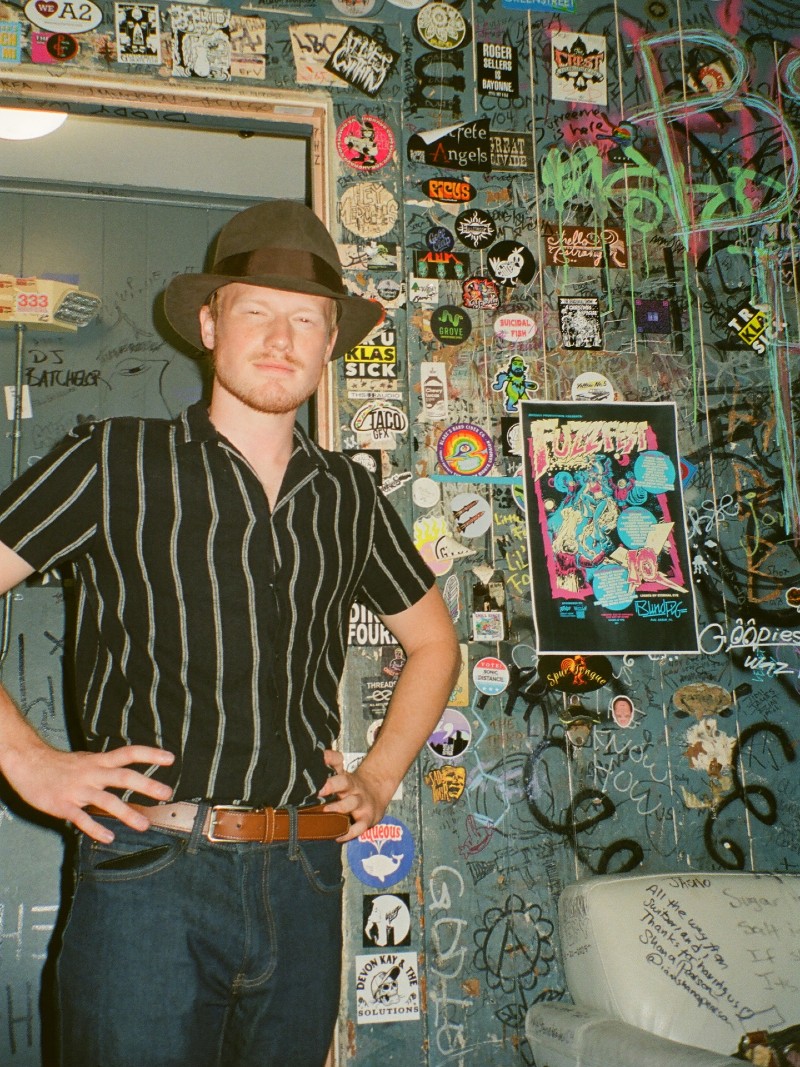
In eighth grade, Connor Parent had an epiphany.
The singer-songwriter and guitarist sat down at a middle school lunchroom table with friend Elliot Walker and pulled out his composition notebook.
“I said, ‘All right, we’re gonna make an album, and it’s gonna be called Everything Outward,’” said Parent, who hails from Walled Lake, Michigan. “It really just came to me.”
Parent spent the next eight years writing and recording 15 tracks for what would become his debut album, Everything Outward, under the artist moniker Sonic Distance.
“I started writing at the age of 14, going through high school, even a bit of college,” he said. “Those are the ages when your mind expands, and you’re learning a lot about the world. I’m still learning a lot, and I feel like I do have more to say.”
What resulted is an introspective alt-rock album that explores the quest for finding one’s purpose and understanding the world around us.
“When it comes to this collection of songs, the sequencing is very intentional. It tells the story from start to finish of a character who starts out angry at the world. The track, ‘Fire Trail,’ takes a spooky, haunting turn to the album,” Parent said.
“It has these mood swings to it, and then it goes into a silly [section] with ‘Chicken Fight,’ ‘Avenue,’ and ‘Jet Lag.’ Then, you get into the introspective meat of the album with the last three songs. It has this personal resolution at the end. A lot of it is fictitious, but a lot of it did come from [real life].”
I recently spoke with Parent about the inspiration behind Everything Outward.
Q: How did your musical journey start in Walled Lake?
A: When I was in eighth grade, I liked music, but I didn’t really think about it. I have an older brother, and as a younger brother does, I was snooping around his room looking for knick-knacks and troubles. I got caught, and I thought, “Oh, think fast. I have to have a reason why I was in here.” And I said, “Oh, I was just playing with your guitar over there. I feel like I have an interest.” I had no interest, but in the next few months, I was playing it up. I was hitting notes, and I thought, “This sounds like that one song I know. This sounds like ‘Corduroy’ or ‘Better Man’ by Pearl Jam.”
I went downstairs, and I showed my dad, who’s a huge Pearl Jam fan.” I said, “Listen to this; I think I’m doing it.” And he said, “You’re playing the guitar upside down,” and I said, “Oh!” That’s how I found out I’m left-handed, and at that point, it was March of 2017. I bought a left-handed guitar, and by September [2017], I was out performing at bars. I was strumming along with my neighbors, who are great mentors to me, even to this day.
By October [2017], I sang for the first time on stage. The first song I ever did on stage was “Wishlist” by Pearl Jam. It was a great song, but I didn’t do the best rendition because I was so new to playing guitar at that point. I didn’t realize that when you did a guitar solo, you had to have a rhythm guitar going in the background. So I learned a lot—it was a learning curve.
Q: What artists have inspired you?
A: I grew up with my dad’s CDs; he was always playing [them]. I think one of my earliest memories is being on somebody’s lap in the car, and the song “Brain of J.” by Pearl Jam was playing. I’ve seen Pearl Jam 10 times in concert. I finally got to see them play it live in Nashville [last] year. The Doors and Pearl Jam are my big two [favorite artists], as well as The Smiths, Radiohead, and Depeche Mode.
Q: What was the first song you ever wrote?
A: The first thing I ever wrote on guitar was probably around summer/fall 2017. It was just a simple two-chord thing, and it’s really fast. That ended up on the album, it’s called “Chicken Fight.” I thought, “You know what? That’s the first original thing I ever did. Why not put it on the album?”
Q: How did Sonic Distance become your artist name?
A: In essence, I’ve been Sonic Distance since 2017, at least. But the name itself, “Euro,” was the first song we recorded. It was done, and we were gonna put it out. I was in the car with my dad and mom, and we were [attending] one of those COVID clap-outs for graduation for a family friend of ours.
We were driving in the car, and the song had to come out in a few days because it was done. I said, “I don’t have a name,” so we were throwing out different names for a minute. I said, “Headroom,” which could have been a name. And then we said, “What if we relate it to COVID?” We thought it would be cool to relate the band name to COVID. [My parents] said, “What if you call yourself Social Distance? The sign of the times.” And then my dad said, “How about Sonic Distance?” I said, “Good enough!” In the logo, there are six little tick lines that represent being 6 feet apart or more. It’s just a product of its time.
Q: The album’s lyrics often reference spiritual themes. How has spirituality influenced your songwriting?
A: I was toying with spirituality as a teenager. I was raised Catholic, and I left the faith at 10 years old because I was just such a misbehaved kid. [I thought] not having to go to church anymore at the age of 10 was great. As a teenager growing up, it left a lot of lines [that] I had to draw for myself, a conclusion I had to come to on my own. I think a lot of that is reflected in the tracks on the album. I was just trying to figure things out.
In the past few years, I [returned to] the Christian faith, and it’s been great for me. I can look at it and say, “There is definitely a progression of spirituality.” It’s a huge part of my life every single day. Listening to the lyrics of some of the songs that were written further back in time, I wouldn’t write something like that today. That’s a little too testy for me. As you mature, your outlook changes. I was probably more of a fire pistol five years ago.
Q: “Domestic Gathering” questions the future of a relationship and the uncertainty two people face. How did a personal relationship inspire this song?
A: This is one of those songs, more or less, [that was] inspired by a past relationship. The riff came about, and I was just noodling on my guitar. I hit something and thought, “That sounds cool.” It was a five-note riff in the opening, and it sounded like a doorbell to me. It’s a doorbell, that’s like a greeting.
When we were coming up with [artist] names for [me], one of the names that was thrown out was Domestic Gathering. It didn’t become [my artist] name, but I thought, “It’s a gathering, or a coming together. It’s a good title for the first song.”
As far as what it’s written about, from a guy’s perspective, you start seeing cracks in a relationship. You realize, “Maybe this person isn’t the best person [for me],” and you start to see that it’s a toxic situation. You start to hold onto the idea of the person. We have an idea of every single person we meet, and we’re holding onto this idea of a person. That person who’s in your head isn’t there anymore.
Q: “Nine-Volt” is about taking risks and shocking those around you. Why did you name the track after a nine-volt battery?
A: It’s one of my favorites, too. It was my first-ever song to be on the radio; it [will] always have a special place for me. I came up with the hook, “I’m a nine-volt, baby. I’ll shock you.” It sounded like something Gord Downie from The Tragically Hip would have said. He was very spunky in his performance. At the end of the song, I say, “Zap!”
I was a firecracker back in high school. I was a wild child who liked to find trouble and be controversial. The song was written about a situation. It was high school, so this doesn’t hold any weight now, but when you’re in high school, it’s a big deal. It was about a relationship, and I guess I said something in front of her friends. She didn’t appreciate it because it got back to her from her friends. I said, “Tell all your friends, I’ll say it again.” I was probably just mouthing off about something, probably like some high-school drama.
Q: “Stranger Man” examines feeling lost and isolated during the winter. What role did Michigan winters play in sparking this song?
A: There are themes in there about Michigan winters being very cold. It takes a toll on the mind being locked in the house, especially [in] my room. I don’t know what the builders were doing back when they built the house, but they did not put insulation in my walls. My room is always freezing, and it’s actually upstairs. I guess it made the winters feel longer.
Q: “Jet Lag” features a jazzy/big band sound and explores a person’s adventurous spirit when they drink. How did you capture that sound and theme for the track?
A: This is a great example of how I wanted to air out my inspirations and what’s around me. This song was heavily inspired by The Doors, and at that time, I was listening to a lot of [Frank] Sinatra. There are lyrics about drinking again. I can’t even say there’s really a meaning to that song. It’s somebody who’s on the manic ups, and they’re going through it and having fun.
It all started from a jazz beat and “Sing, Sing, Sing,” and it went from there. That’s one of the most fun songs to play. As far as all the songs on the album, you really don’t get music like that anymore. I would love to dive more into that side in the future. It’s a feel-good song, but my mind is always geared toward writing more somber music. I really want to give people something happy and something to feel hopeful about. I don’t want people to think too hard, but my hands are always writing sad songs.
Q: The title track encourages relying on your inner strength and feeling hopeful about the future. How does this track give listeners an optimistic perspective?
A: The album walks through all these different emotions. You have anger, you have angst, you have uncertainty. You have these manic high episodes, like “Jet Lag” and “Avenue,” where it’s kind of baseless in a way. It just feels like you don’t know what’s going on, and then you have these low lows. It resolves with hopefulness and finding your footing in a way. It’s my favorite song on the album.
It was written about a friendship, and it didn’t necessarily end in the best way. And I do think some of that might have been my fault, but this was all in high school. The first half of the song, it poses questions. And then you do the key change in the second half of the song, that’s when the song starts delivering answers. I think it’s a really beautiful dichotomy of questions and answers. You switch from the minor key to the major key. I think it’s a beautiful way to resolve the album and all the questions that were posed previously. It finds its footing in the end there. That’s my proudest piece of work, and I love that song.
Q: What was the writing process like for Everything Outward?
A: For me, it’s like a spiritual process. It’s like you’re an antenna, and it’s coming through you. The majority of the songs came out like that; they kind of just wrote themselves. There were a few where it was deliberate writing, but even to this day, as I write [songs], it just comes out. My main inspiration came from social situations in high school.
A lot of inspiration for me comes either from being in isolation or being in nature. It lets me sit with my own thoughts, and that’s where a lot of it comes from. I go out to the lake, and I just sit there listening to the water hit the shore. It starts off as a feeling of thinking, “OK, what do I do with these emotions and feelings?” I just try to put them into a piece of poetry or just turn them into musical notes.
It’s more organic for me to write mellow, introspective pieces. That’s more my wheelhouse of writing, and that’s what comes to me more naturally. When I’m writing these rock songs, they don’t come to me naturally anymore … so I think [there’s] going to be a shift there.
Q: How did the album’s tracks come together while recording them at different studios?
A: My neighbors, Andy [Rice] and Ryan [Fisher], are great mentors to me. They helped me out on the album and did some arrangements. Andy helped me record the first few songs I put out. “Euro” was the first song we recorded. We started in March of 2019—and it was 14 months—so we finished in May of 2020.
My mentor Andy [Rice] used to be neighbors with [engineer/producer] Marty Peters [of Ozone Music & Sound]. Andy [Rice] has a band called Five Becomes West, and they recorded with him. I’ve been linked up with Marty since 2020. During COVID, with the first few songs, we would send notes back and forth over email.
For “Nine-Volt,” that was the first song [where] I went [into Ozone Music & Sound], sat there, and made changes with him. Songs five, six, and seven we recorded at the studio, and then I realized, “OK, I’ve got to start being budget conscious.” So I started recording a lot on my own, and that was a learning curve for me. Marty always put the polishing touches on [the album]. He [also] drummed on quite a few of the tracks.
Q: You perform regularly in Metro Detroit. What are some of your favorite venues?
A: I love performing at The Blind Pig [in Ann Arbor]; I think that might be my favorite venue. It’s such a great time. I just recently finished my residency at the Corner Pub & Grill in Canton. I was there for a few months performing every week. I also have a gig at Perfect Scenario [in Saline] on March 21.
Q: Elliot Walker recently joined Sonic Distance. What does he help bring to the project?
A: Elliot was the one who snapped the photo for the single cover of “Euro” in April of 2020. He can also be seen in the music video walking across the train tracks and dancing. Elliot also sat [in the studio] during the production of “The World As We Know It, Falling” at Ozone Music & Sound in the summer of 2022 to give his professional input on the production of the track. He made his performing debut with the band last July as a stand-in for The Token Lounge gig.
Q: What plans do you have for new material?
A: I have been tinkering around in my yellow basement studio. I’ve been playing with some new sounds. I want to preface that [there’s] nothing new coming anytime soon. It will be a few years. And whenever that next album comes out, I’ve already got a title for it, and I’ve written a few songs for it. If it does end up coming out, there’s definitely going to be some different sounds.
 The Stratton Setlist