
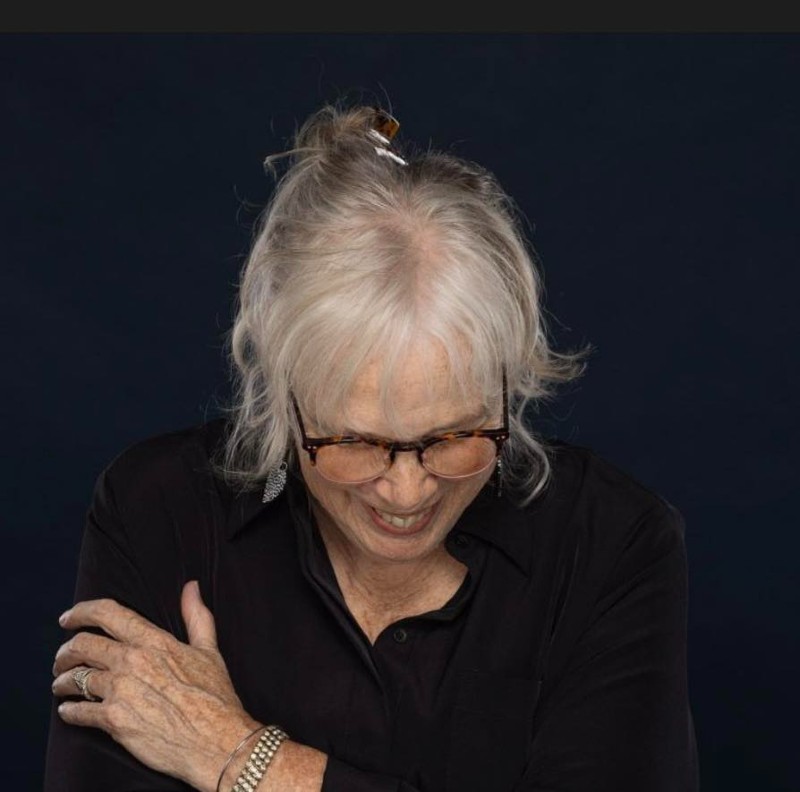
Jan Krist doesn’t mind sharing different perspectives.
The folk singer-songwriter gets candid about religion, politics, history, and relationships on Since You Asked Me.
“It does feel cathartic to be able to go ahead and say some of this stuff,” said Krist about her latest album. “It feels a little scary, too, to say what you’re thinking.”
The album’s title track explores having an honest conversation with an acquaintance about being banished from a church.
“I said, ‘Tell me about your experience with the church,’ and he said, ‘Well, since you asked me …,’” said Krist, who had the conversation at a writers’ retreat in Washington.
“And then he launched into this story about when he was young, he had a relationship with a young woman there in the church, and they both made mistakes. But he ended up getting banished, and he lived in Alaska in a little town. It really was hurtful for him to feel this heavy judgment every time he walked into a local place.”
Backed by somber acoustic guitar and cello, Krist sings, “You can’t claim the higher ground / When you’re pushing people down / And barring mercy’s door / And what are we thinking?”
“I have not had that experience, but I’ve had many experiences being in churches,” said Krist, who recently relocated to South Lyon from Fort Wayne, Indiana. “I’ve been Christian since I was 16, and I was a worship director at a church. And I’ve been to all kinds of churches, from high church to evangelical.”
The title track is one of 17 songs on Since You Asked Me, which features emotive instrumentation, narrative lyrics, and serene vocals. Each track immerses listeners in a different time period and provides compelling characters against a rich backdrop of folk music.
To learn more, I spoke with Krist about select tracks from the album and the creative process behind it.
Q: Since You Asked Me feels like a double album. How long did you spend writing it?
A: I had all the songs I had written through the pandemic, and then we had a move. It takes time to get resettled, and by the time we started to record, we had a stack. I still have two songs that I’ve held back, which we’ll release as singles down the road.
Q: “Hemingway’s Woods” is about your father and brother getting lost on a river in Northern Michigan. What was it like to revisit that experience for the song?
A: My dad had lung cancer, and it was in a brief remission. We were up in Northern Michigan, and my dad wanted to paddle this particular river with my brother. We dropped the two of them off at a canoe livery, and we were supposed to pick them up at noon down the river at a little campground. My dad figured it would be about a three-hour paddle, and mostly, they were going to steer and go with the current.
Noon came and went, then two o’clock, four o’clock, eight o’clock, 10 o’clock, and midnight [came], and they still weren’t there. My mom left [my sister], Denise, my youngest brother, and me at the park and drove to the sheriff’s office. She got the sheriff, and they went out with a search party. They found them after an hour-and-a-half to two-hour search. My mom was probably thinking, “Oh my god, I knew I was gonna lose my husband, but I don’t want to lose my son.”
I turned 14 that summer, and my dad died four months after that. Meanwhile, we had this Ford Galaxie [station] wagon, and Denise and I were sitting on the hood of it. We were laying back, and the Perseid meteor showers were going on at the same time. We were watching the stars and counting the [meteors] whizzing by.
Q: “Bonus War 1932” explores the true story of World War I vets, who were attacked by the nation’s troops while lobbying the government for a bonus they were supposed to receive. How did researching this historical event lead to writing the song?
A: When I found it, I was just doing research on something else. When I write songs, there’s always some research in it. I made a pact with myself that I would just go down the rabbit hole—wherever it takes me. A lot of times, it doesn’t end up being what I originally intended to write about. This was one of those times when I was researching something else, and this came up. And then I got into it, and I thought, “Holy cow! This is crazy; I don’t think people know about this.”
I was at a songwriting retreat, and the prompt was, “Find your way into a historical story.” I was looking for a story and found that one. That happened right before World War II, and the vets took their families with them. They hopped on trains and buses for Washington D.C., and there were between [at least] 20,000 and 30,000 men [and their families] there. That’s the beauty of that story; any piece of history like that can also be a foretelling. It’s not just some tarnish that you keep in the closet; it’s something that can be informative.
Q: “Selfies” examines the loneliness of the pandemic and the impact it had on people. How did a friend’s situation inspire this track?
A: It was the beginning of the pandemic in 2020, and everybody was stuck inside their house. We didn’t know how other people were doing, and I could imagine one person in particular. It’s somebody who loves a good book and keeps all kinds of magazines, but they don’t have a lot. They have all the old stuff, and they keep going through it. They couldn’t even go to the library; they were stuck there. It’s touching base with somebody and saying, “When we get through this, we’re gonna be here.” Those were very tenuous times; we just didn’t know what to expect.
Q: “Complicated” is about your relationship with your mother. How does this song reflect her personality?
A: She always used to ask, “Why haven’t you written a song about me?” And I would say, “I don’t think you want that right now, Mom.” It was a complicated relationship, but it was deeply loving.
Q: “American Dream” depicts the country’s political regression and erosion of civil liberties. How has the current political landscape inspired this track?
A: With “American Dream,” I feel like [the current administration] is being flagrantly careless or purposely so. Of all the institutions and all the things that have been built, the U.S. Department of Education, the U.S. Department of Health and Human Services, and the U.S. Department of Veterans Affairs, you’ve got all this stuff [happening].
On the song, I say, “There are sailers out here drunk on leave / They’re ordering shots of gasoline / They slam it like gin and light cigarettes,” and this is just the beginning. And then the last verse is, “Then caught in a corner was liberty / They’re pawing at her assets, pulling on her sleeves / Telling her how they’re gonna have their way / And rigging all the rules so they’ll never pay.” That is exactly what I see going on, and I don’t understand how some people don’t see that.
There’s also an allegory that inspired “American Dream.” In one of C.S. Lewis’ books, The Chronicles of Narnia: The Silver Chair, there’s a character called Puddlegum. The other characters get pulled into the underworld, and there’s a witch who’s taken power. She’s convinced everybody there is no such thing as summer.
Puddlegum is down there, and the children are down with him. The witch has thrown some chemical onto the fire, which creates this mist. She starts to hypnotize the children, and they cave in, don’t follow their quest, and believe her. Just as it looks like she’s going to have her way, Puddlegum sticks his foot in the fire, burns himself, and [feels] real pain in that moment.
It wakes not only him, but the children come awake, too, and they escape. All of this was written during World War II, and it’s all an allegory. In these times, it may be that the pain we feel is the only thing that will wake people. If you read those books, then you will understand the message.
Q: “The Moth” addresses the country’s growing division and the increasing falsehoods that perpetuate it online. How did researching a World War II event spark this song?
A: “The Moth” came to me because of studying and looking at historical events. I did not understand or know about it before that Japan had incendiary balloons that they would put into the wind. Thousands of these incendiary balloons had gas, and they would ignite when they hit the shore.
They sent them across the sea on the wind and let them take hold wherever they would. They did have a number of those balloons that reached the West Coast, but they kept mum because they didn’t want people to panic. There was a person who was injured and another who was killed by one of those fires on American soil.
I have a friend who’s involved with [an organization] called Braver Angels, and she invited me to take part in a national debate about whether the United States needed another revolution. I ended up being the last one to speak my piece, and I listened to these young Christian men talk about how they were ready to take up arms. I thought about that, and my response to them was, “You’re not talking about a revolution; you’re romancing the idea of the Civil War.”
War is never what we think it is. Some countries launch into them, and 50 years later, they’re still in a civil war. We don’t want to open up that box; we don’t want to go there. Then it came to me, just like Japan sent those incendiary balloons across, I think that [Russia], North Korea, Iran, and all of our other enemies have been sending misinformation through these channels these young men click into.
I think those are the incendiary balloons [of today], and they come up through a forest of screens. Now all of these guys are thinking about civil war, and that’s the power of reckoning. Again, it’s allegorical. It’s taking part of history, what I perceive happened, and how it’s brought us here.
Q: Tell me about the recording process for the album. How did it come together in your home studio?
A: I waited to record until I was back in Michigan because I had pieces of all of these songs, but I didn’t have them completed. For “Tattoo,” I had all of the verses, but I didn’t have the chorus—just other bits and pieces. I have a file that’s about three inches wide, and they’re all pieces of lyrics that are stuffed in there.
I thought, “It’s time. If I don’t get these recorded now, it may never happen.” It was like somebody shot the gun off, and we said, “Go!” And then my husband, Alan Finkbeiner, and I spent 12 hours a day in the studio during August and September.
We took each song and figured we had to rely on ourselves and do as much as we could. Alan has a degree in music composition, so he does a lot of really nice things with harmonization. I had him playing keyboards, and we have a harmonium, which I love. It’s on “Hemingway’s Woods.”
I also got this Gretsch hollow body electric [guitar] a couple of years ago, so I wanted to have that sound on the record. I tried to see which songs I could play on that would be useful. I ended up playing it on “Crazy” and a couple of other songs. [When] we finally got it done, we pulled in Jim Bizer to give us a listen and help us make the last edits. He’s like the cleanup crew because he can play anything.
Q: Since You Asked Me features collaborations with several Michigan and Indiana musicians. What roles do they have on the album?
A: We worked with Jane [Heald] in Fort Wayne; she’s a member of the Fort Wayne [Philharmonic]. She retired two years ago, and she’s a fabulous player. She has a great [cello] that sounds really warm and wonderful, and I leaned on her to help us with this [album]. I sent her a handful of songs, and she was onboard as soon as she heard [them]. She came up from Fort Wayne.
We always use Jim [Bizer] for more complex things. I’ll sit there, and I’ll say, “Jim, I tried all night last night to put a lead on this song, and I can’t. Help!” We got Jim and his dog to come in and do stuff. I always work with musicians who I know what they’re going to bring.
Danny Kolton plays a bass that was built in the 1850s, and he’s one of Ann Arbor’s jazz musicians. For the songs that we wanted that [feel and sound] on, we knew we could just bring him in and get what we needed.
And then I wanted some of my friends from the Yellow Room Gang—Jim Bizer, Annie Capps, Kitty Donohoe, and Matt Watroba—to do harmonies, so I brought them in. For Jason Dennie and Rod Capps, I play in Diamonds in the Rust with Rod, and I know what Rod brings. He’s so melodic, and he’s so fastidious about hitting the notes cleanly. And Jason is exact; he knows what he wants to do, and he does it. He built his little pieces on Rod’s pieces as a response to what Rod was doing.
Q: You assembled a “choir” of musicians and friends to sing on “Hope.” How did you bring everyone together?
A: I’ve always wanted to hear that song with a choir, and I was waiting for a choir to say, “Yes, we will do that song.” And then I thought, “No choir is going to come to me and say, ‘Can we do that song?’ I know a lot of people—let’s make a choir.” I just put out the word on Facebook about what I was doing, and all these people came. We had 20 people sitting in our living room. A couple of my neighbors came in and watched, and their eyes just popped open.
Q: What’s up next for you?
A: I’m performing with Diamonds in the Rust on February 28 at Trinity House Theatre. Alan and I are playing on March 18 at North Star Lounge in Ann Arbor. I also have two songwriter retreats that I’ll be working on [this year]. One is the Diamonds in the Rust songwriting workshop with Annie Capps and Jim Bizer in Chelsea, and this is our sixth year. For 24 years, I’ve been doing a songwriting workshop at the Grünewald Guild in Leavenworth, Washington. That will be coming up in June.
Jan Krist performs with Diamonds in the Rust on February 28 at Trinity House Theatre, 38840 Six Mile Road, Livonia, Michigan. For tickets, visit Trinity House Theatre’s website. She also performs with Alan Finkbeiner on March 18 at North Star Lounge, 301 North Fifth Avenue, Ann Arbor, Michigan. The event is free.
 The Stratton Setlist