
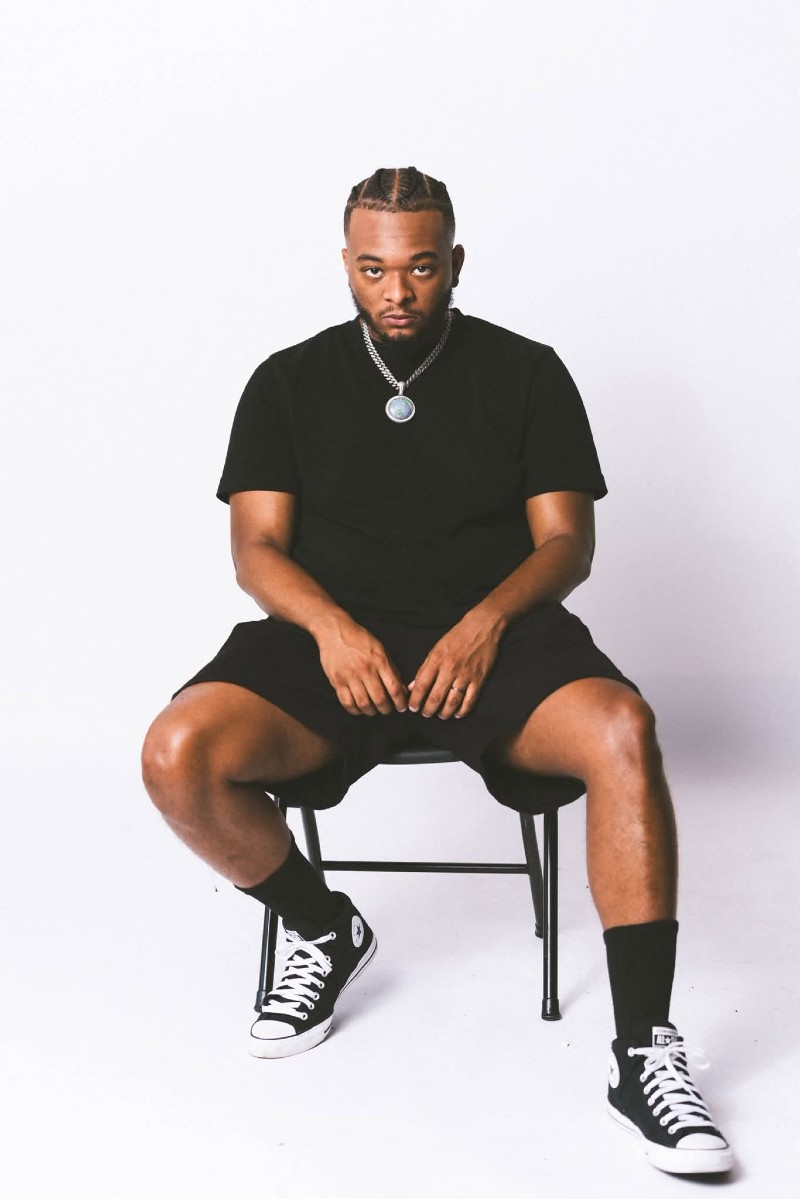
JOZA ROY revisits an old relationship on “Love Me.”
The Michigan hip-hop artist acknowledges and confronts past heartbreak on his latest single.
He raps, “Empty my cup as I pour into you / I do whatever you want me to do / I put on a smile just for a while / I run from the truth / So we live in denial.”
“That came from something beneath the surface that I never got closure from,” said JOZA ROY, aka Joseph Roy. “I just started writing, and then I made the song pretty short because I didn’t need as much closure as I had thought.”
While “Love Me” is under 2 minutes, its vulnerable lyrics and contemplative beats create a lasting emotional connection with listeners.
“The relationship ended around COVID, and I feel like everybody probably broke up during COVID,” said JOZA ROY, who’s a Navy veteran and Michigan State University alum. “After that time, it’s been such a blur for everybody, and so much was just going on.”
The song also reflects JOZA ROY’s creative evolution into both an MC and a producer.
“I said, ‘Let me not make this too long,’ and I was just testing things out,” he said. “It’s people witnessing my test of me producing for myself.”
To learn more, I spoke with JOZA ROY about his background and recent releases.
Q: How did your musical journey start in Detroit?
A: It was a back-and-forth period with me. I was born in Detroit, and when I was a year old, we went to Louisiana. Around the time they warned us about Hurricane Katrina, my family moved to Alabama, and then right around the time President Obama got elected, I moved back up here. I was about nine years old then, and music started when I came back to Detroit.
It wasn’t long before I heard “Weird Al” Yankovic. My dad showed me “Trapped in the Drive-Thru,” and that’s what kicked off my love of storytelling and rhyming. Some of my first songs were parodies, and Justin Bieber’s music had just come out. I did parodies of “Baby” and “One Less Lonely Girl.”
In fifth grade, I started doing more parodies, and in sixth grade, I kept it going, and then my dad passed away. After that, I was learning poetry in middle school. So I got into Edgar Allen Poe and Langston Hughes, and my homework became writing, and essentially, that led me to do more music.
Q: How did a middle school talent show inspire you to pursue music?
A: Everything kicked off for me as a performer and an artist during a middle school talent show when I was in sixth grade. I was new to the school, and I had written a song about my first girlfriend, but we had broken up.
I had made one of those heartbreak records, and it was very Kanye West-inspired. I ended up winning first place, and the principal, who was also the judge, made the crowd chant my name. Right there was when I said, “OK, I got it. This is what I’m supposed to do forever.” Every year after that, I kept progressing towards the craft.
I got into poetry, learned about Tupac Shakur, and watched 8 Mile. I also learned about Eminem, and I fell in love with Eminem’s style. His stuff is poetry, and he takes on a vulnerable persona in his music. I started studying other artists like that, including Drake, Kanye West, and Michael Jackson.
Q: How did you hone your craft on SoundCloud after that?
A: By that time, I started finding beats on YouTube, and I wanted to start rapping to them. Around eighth grade, I started posting music on SoundCloud. I loved the SoundCloud era, and I made all of my music on my iPod.
I recorded everything and sent it straight to SoundCloud, and when I got to high school, Big Sean had just gotten signed to Kanye West’s label [GOOD Music]. Big Sean had gone to Cass Tech High School, and I went to Renaissance High School. There’s a whole rivalry there.
In ninth grade, they started holding these ciphers, and I asked if I could perform at it. I was the only freshman, but it was mostly seniors and juniors. It was a shit-ton of pressure, and I said a line about the principal. Everybody had joked about the principal, and I said he was fat.
The video went viral around the school because I had said [that line], and they went crazy, but I didn’t know the principal was in the crowd at the time. I thought they were screaming at me because they thought it was such a good [line], but then the seniors grabbed me and threw me in a car. They said, “Dude, the principal wants to talk to you.”
From there, in high school, I started building an audience naturally by putting music on SoundCloud. I was building a fan base, and I made T-shirts—that was such an era. At that time, I went by Joe the Rapper. There were a bunch of Josephs at the school, and they started calling me Joe the Rapper.
Q: How did you balance doing music, joining the Navy, and going to MSU?
A: I was in Junior ROTC, and as we were approaching high school, my grades weren’t the best. It was mostly because I was dropping mixtapes, like I was taking my career so seriously at the time. In my senior year of high school, they hit us with either going to college or joining the military.
I told my mom, “I just wanna do music,” and she said, “Well, you need a back-up plan.” I signed up for the Navy at 18, and then I also started at MSU in 2017. My first semester, I spent the fall on campus, and I hit the ground running with music. I performed at the Wharton Center, and then spring came around, and it was time for me to leave for training.
During my career with the Navy, they sent me to training, and since I’m a reservist, they just sent me back home. I came back in 2019 and did the Netflix show Rhythm + Flow. I also went back to MSU that fall.
Q: What did you learn while doing Rhythm + Flow?
A: One day, I was on Instagram, and Chance the Rapper did a very vague post saying, “We’re doing the show, we have auditions, and you can sign up for the auditions.” They held a series of online auditions, and I had to rap virtually in front of a lot of producers. Then, that Christmas, they announced who had made the show.
They told me I got in, so I went to Chicago for the live auditions. I ended up losing, and everything came back to the name Joe the Rapper. This was my first show, so I didn’t know what the producers really wanted from the artists while they were shooting it. I thought it was like a rap competition, and they asked a lot about how I grew up.
At the time, I didn’t even think to tell them I was in the military. I had only thought about music, but not about branding. They essentially sent me home because I didn’t really provide them with anything. They couldn’t even use my audition footage; they just clipped up a moment of me and Chance the Rapper arguing over who came up with “the Rapper” name first.
It was a whole different result than what I expected. That was the first time in my career that I was discouraged. I thought, “Oh man, I did a great job performing. They cut everything, but they loved my performance.” And just randomly, Chance said, “Even though it’s great … unfortunately, it’s not enough to make the show.”
I learned so much, and it helped mold me as an artist, too, because when I came home, I didn’t know how much they had cut from the show. I told everyone on campus, “Hey, by this time, I’m gonna be on Netflix. Make sure you’re watching it.”
When the show came out, I trended on Twitter for a few minutes because people were trolling me because of “the Rapper” clip with Chance. I faced a lot of discouragement from that; I even got a few death threats.
It wasn’t the attention I thought I was going to get. I felt like that was important to note, because it was a vulnerable moment for me as an artist. Most people would probably stop, but I decided to do the complete opposite.
Q: How did winning a Grammy U contest rejuvenate you musically?
A: From 2019 until 2024, it was a lot of the same [stuff]. I had finished college in 2023, and so in 2024, I was in the middle of post-grad depression. Then I joined Grammy U, a music membership program for college students and emerging music professionals pursuing careers in the music industry.
They have a contest that’s similar to NPR’s Tiny Desk Contest, and I sent in a video of a performance I did with WDBM-FM (Impact 88.9 FM). Six months later, they emailed me and said I had won the contest out of 300 people.
I was so thrown off, and they said, “You will be performing at our annual event in Chicago at Millennium Park in three weeks.” I had to find my way there and prepare a 30-minute set. I had never done a 30-minute set before, and I used the majority of my SoundCloud discography.
I did the show, and it was life-changing, to say the least. It showed me that I’m meant to do this, and I came back home so recharged. After that, I started my job, and I was going through all of these things. I just started writing, and that’s when the Pops album began.
Q: How was doing the Pops album a cathartic experience for you?
A: My dad passed away when I was 11. I named it Pops because I would have called him that if he were here today. Not too long ago, I lost the engine in my car and thought a lot about my dad, who was a mechanic. For nine straight months, I went through a whole legal [situation] to get the car’s engine fixed, and I know if my dad were here, he would have fixed the engine.
It was a long nine months, and once I got my car fixed, I released the album and closed that chapter. I just named it after him, and I felt like every song was me showing off to him. He liked my music, and he was the first person who knew I was into music. When I was a kid, I got into trouble one time for writing parody songs at school.
My school was going to send me home, and they asked which parent I wanted to call. I said my dad, so he came and put on an angry dad character. When we got in the car, he pulled out the song I had written and started reading it. He said, “This is pretty good,” and I said, “I know.”
He told me that he and my mom were getting me my first microphone for Christmas. That was the last Christmas I had with him. The microphone was actually part of a karaoke machine, and I used it until I learned about other audio devices. It was the perfect toy for me.
As one of four boys, he was always so proud of us. That’s why I wanted to make sure the album was something he would have approved of. It was me reflecting on perseverance, faith, and other things adults go through. It felt like I was checking in with him.
Q: “Feet on Land” explores leaving the past behind and rediscovering your path. How did writing this song help you reconnect with yourself?
A: “Feet on Land” was the first record I wrote coming back from the Chicago [Grammy U] show. I was so inspired; I wrote it almost immediately. If I could recap how that experience felt, it was “Feet on Land.” It was everything that I needed to remind myself of who I am.
I selected that beat from a producer through an app called BeatStars, and I wanted something that sounded wavy. As soon as I heard it, I started writing. And before that moment, I had had writer’s block for so long.
Q: What was it like to do the video for “Feet on Land?”
A: It was shot in early spring, and everybody on set was from MSU. It was directed by my friends Wallace Hill V and Nolan Duff. We had already shot a music video for “DD 214 (I’ma Need That).”
I had spent too much money on that one, and it was my first time handling logistics for a video. With “Feet on Land,” I said, “Let’s work with a lower budget and go to Lake Lansing.” We shot that in one day. The video was really fun, but it was pretty cold that day.
Q: “Street Lights” is about overcoming challenges and focusing on the future. How did it become a song about perseverance?
A: I wrote that song on the bus. It was one of those things I had written and forgotten about. In that moment, I wrote what was on my mind, and then I dropped it after the Kanye West concert [in Chicago in September].
I was just inspired to put out music, and I wasn’t gonna release it because it’s more personal. I was literally walking home [from work], and there weren’t streetlights lit on my street. I wasn’t used to it, and I had to walk past my broken-down car that was sitting there in the dark.
Q: Why did you release two versions of “Street Lights?”
A: Version 1 was the one I made when I was living in the apartment [in Lansing] without the streetlights being lit. After going to the Kanye West concert, I wanted to experiment and became inspired to make Version 3, which sounds more like Kanye West, especially because of the synths.
While Version 1 is more lighthearted and has stringy melodies, Version 3 is my favorite. Coming off of the concert, I felt like I could do anything. I ended up purchasing a beat pack inspired by Kanye West’s greatest albums. I leaned into it and said, “This is what it would sound like if Kanye produced it.”
Q: How have you evolved as a producer?
A: Lately, I’ve been producing my own stuff. During the Pops album, I was home a lot, so I wanted to find something else to do. I said, “OK, let me just learn how to produce,” because it saves me a lot of money and I want to be more well-rounded. I got more comfortable after doing Pops, and the songs that are currently out now, “Street Lights” and “Love Me,” are fully produced and written by me.
I would love to produce for other artists, and I definitely see myself producing more for myself because I’m just naturally building confidence. It’s only going to get further and further. One of my biggest inspirations is Kanye West because he can produce and be the artist. He’s so well-rounded. That’s something I take seriously as an artist—becoming familiar with all the different parts of a record.
Q: What plans do you have for 2027?
A: I’m creating music all the time, but coming out of [college], I learned the importance of marketing, getting into the content space, and figuring out different ways to communicate this product to people. I put out a couple of records this year that haven’t gotten enough attention, so I want to build an audience for them. Once I pull in more people, it’s like, “Boom! Here’s my latest record,” and I’m building things along as I go.

