
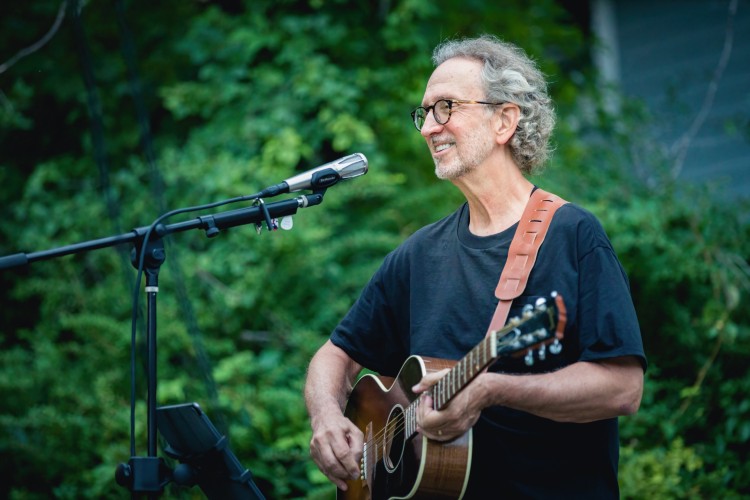
Bill Edwards isn’t afraid to follow his heart.
The Ann Arbor, Michigan singer-songwriter and multi-instrumentalist searches for clarity and purpose on his new country album, A Home in My Heart.
“It’s not all autobiographical, but I like to think that it’s all feelings I have had,” Edwards said. “I think the idea of hope is important, even if it’s hard to find in these times right now, but it’s something that you have to hold yourself to.”
He shares that sentiment over 10 introspective tracks, which explore taking risks, overcoming obstacles, and having a positive attitude.
“It’s been 18 months since I’ve released anything, so that seems like a decent interval,” said Edwards, who last released So Far in October 2023.
“It’s not like right on the heels of the last one. It’s only 10 songs—this record. I tried to constraint myself; I actually said, ‘I’m gonna do 10 tracks,’ and then I kept writing and recording. I switched in and out a couple, and I played it for my wife and got her input. I played it for some other people and got some input, so this is where I ended up.”
Edwards landed nicely with A Home in My Heart due to its seamless storytelling, infectious lyrics, and upbeat instrumentation. Sonically, the album includes timeless elements of country wrapped in heartland rock, blues, and folk.
“It’s a limited palette compared to some [previous albums],” said Edwards, who plays all the instruments on the album. “That was another intentional thing. I really wanted the record to have a sound rather than going off in all kinds of different directions.”
I recently spoke with Edwards about the inspiration and creative process behind the album.
Q: How are things? What have you been working on recently?
A: The record has been finished for a couple of months now. I’ve been working on new stuff, which I’m always doing. I’ve been playing shows about once a month this year, which is about what I want to do these days. I can keep it to the gigs I want to do and not be playing gigs that are a chore.
Q: The opener, “Hit My Stride,” highlights starting over and taking the initiative to improve your life. What inspired this empowering anthem for you?
A: I call that my Bob Seger song; it’s got that rockin’ three chords to the truth kind of feel to it. It is autobiographical; I think all of us, at one time or another, have been plagued by self-doubt and that feeling of “Oh my gosh, why am I doing what I’m doing?” And this song is an anthem about overcoming that and saying, “No, I’m hitting my stride. This is me putting all that behind me. I’m not listening to those voices in my head, and I’m moving on in a positive way.”
Q: “Let It Be Love” overthinks a relationship and welcomes the unexpected arrival of true love. How did relationships with intelligent women prompt you to write this track?
A: I’ve always been attracted to intelligent women, so that’s where the song came from. It’s tongue-in-cheek, and it’s a little bit over the top. It’s saying, “Let’s not overthink this; let’s just be in love.” Intelligent women have always been my downfall. It’s worked out great because I’ve been married to my wife for 45 years. I [also] had two sisters and a mother who were as sharp as tacks, so I’m used to being around intelligent women. That’s the background for that song from a personal standpoint.
Q: “Let It Be Love” is gaining traction on Spotify with nearly 4,000 streams. How have people been connecting with this song?
A: I released [this] song as a single, and I’m doing some Spotify promotion on that. I’ve had a better response to that than I’ve ever had before. For me, it’s taking off. I’ve never really gotten the knack of doing Spotify, but I’m working with a playlist promotion company on this one. It’s the first time I’ve done that. It’s being picked up by a bunch of playlists, and the encouraging thing is that already in the first week, over 90 people have added it to their own playlist.
Q: “Don’t Fight the Moon” explores the challenge of growth and accepting new things that come your way. How did this track become an ode to following your path and opening yourself up to change?
A: That’s exactly what it’s about and not ignoring the fact that you’re gonna go in a [different] direction, and sometimes you fight it. But your inclination is to go in a certain direction, and [it] will change from time to time. It’s saying, “Don’t try to fight that tug of gravity because you won’t win.”
Q: “I Have to Stay Strong” is a thoughtful tribute to overcoming alcoholism and fighting for sobriety. How did your journey to sobriety inspire this song?
A: This one is personal. I have been in recovery now … today is my 300th day of sobriety. This is the early remission song, those first 90 days when it’s just calling to you, and you’ve got to fight it off, and it’s hard as hell. My wife said not too long ago when she heard this song, “Is it really that bad?” And I said, “Well, not anymore.” I think it’s really honest about the way it feels. I hope it will maybe reach out to somebody else and help them. I’m so grateful that I’ve been able to make this journey over the past nine-plus months. I’ve had a lot of help, a lot of support, and a lot of techniques that I’ve learned to keep me going.
Q: “If I Could Pray” addresses the struggle with prayer and its purpose in life. What was it like to explore that theme while writing this track?
A: It’s one that I feel is important because religion is a tricky subject. A lot of people have moved away from religion, according to the statistics. I think it was Leonard Cohen who said that a song is basically a prayer, and that’s what I was trying to convey. Maybe I can’t pray in the traditional way, but it even says “Amen” at the end of the song.
It could just be an activity in your life, which is your way of praying. It doesn’t have to be sitting down, folding your hands, and then saying some specific words. My father was a minister, and two generations before that were ministers, so I had a very religious background and upbringing early on in my life. It just wasn’t working for me, so [I] found a way to do that because spirituality will happen. You’ll find a way to get to [its] meaning, and in particular, when you love others, you’ll want good things for them.
Q: The title track acknowledges having a positive attitude regardless of how powerless people might feel about the outside world. How did the current state of the world and your outlook on life inspire this song?
A: It’s about hope coming when you least expect it; it’s being surprised by hope. Part of that was my recovery and that feeling of possibility despite what was going on. It talks about hope sweeping into the room and catching you by surprise. That is a palpable feeling for me, so it’s personal. I specifically put it as the last song on the record as an uplifting thing. Despite everything that’s going on, we can always hope.
Q: You continually write and record new material. How do you keep the creative process fresh?
A: I’m all about the process of writing and then recording—that’s what I take great delight in. Even as I’m recording, I’m not thinking of where it’s gonna fit on a record or if it will fit in with the record. I’m just doing it and enjoying the process. I feel like every time I’m learning something, I’m making progress.
It’s getting up every day, and I write pretty much every day. We have a song group that meets once a week, and that helps me stay on track. I’ll write something, and if I play it at a show or a couple of shows and people like it, I’ll say, “Well, OK, I’m going to record that.” And it will be at the same time as I’m writing another song, so it’s a continuous process.
Q: How did the album’s 10 tracks come together in your home studio?
A: I do it as a gradual thing. I will write something, and if I feel like that’s worth recording, I’ll record it. This has been 18 months in the process. Once it reaches the point where I feel like I’ve got an album, then I start putting it together, arranging it, and figuring out how it should fit together as a record. I play bass, drums, guitars, lap steel, and a little bit of dobro on it. It also has electric [guitar], acoustic guitar, and some nylon string guitar.
I’m just fortunate that I can do all the recording myself. I don’t have to book a studio and say, “OK, I’m gonna record an album now.” I can do it in an incremental and organic way, and it just comes together that way.
Q: You’re playing a sold-out house concert on April 26 in Ann Arbor to celebrate the album’s release. What do you have planned for the show?
A: My neighbor two doors down, Chris Barry has for a long time said that she wanted to host me for a house concert … this is a bucket list thing for her to do. It came together perfectly, and we’re getting help from Johnny [Dow Williams] of Johnny’s Speakeasy. Judy Banker is gonna sing with me on some of the songs. We’ll do two sets with a break in the middle. I’m gonna play a couple of new ones in the first set and a bunch of stuff from earlier records. And the second set will be playing through the record.
Q: You’re headed to the Grand Mesa Songwriter Festival in Cedaredge, Colorado, to perform June 6-8. How did you become part of the festival’s lineup?
A: I did it last year, and it came my way via my connection with Rodney Crowell. He asked me to be an honorary instructor at his song camp, not this past year, but the year before. I met somebody there when I was doing that who runs this festival. It’s in this little town on the west side of Colorado, and you drive over the Rockies from Denver to get there. It’s an amazing, beautiful scenic area.
They have this very active arts center there and this is the second year they’re putting this [festival] on. They sold out last year—it was really something. It’s so great because it’s a writers-in-the-round thing, and I think they’re having six stages this year. I’ll play at four of them, and it’s four songwriters on each stage at a time. It’s professionally run, and they make you feel like a million bucks. It’s the kind of thing I love to do because the audience is paying attention, and they care about it.
Q: What plans do you have for your next album?
A: As far as the next one, with my writing and recording, I’ve gone in a different direction than the stuff that’s on this record. It’s a little bit more acoustic and organic, with a lot of fiddle, acoustic guitar, and mandolin. That’s what’s been coming out lately, so we’ll see.
 The Stratton Setlist