
Editor’s Note: This article originally appeared on the Ann Arbor District Library’s Pulp blog.
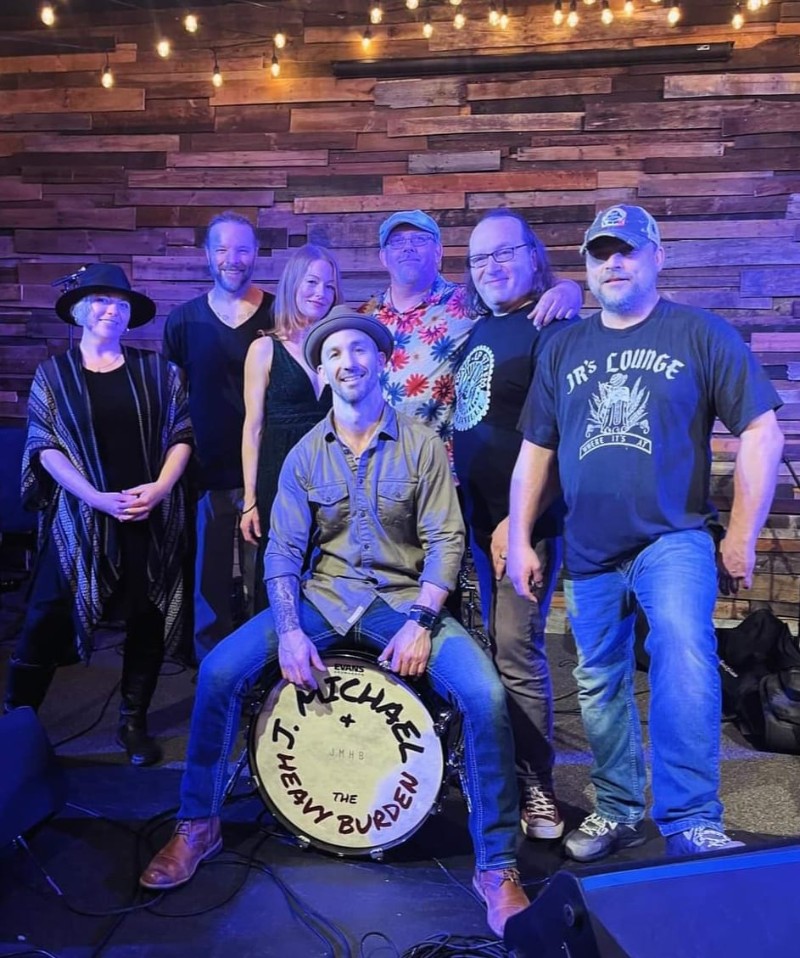
Despite the band’s name, J. Michael & The Heavy Burden wants to lighten the emotional load for people.
The Ann Arbor-Metro Detroit band provides a cathartic outlet for processing feelings—ranging from hope to heartbreak to euphoria—on its latest album.
“A lot of the music that I write, it all comes from a very emotional place,” said Jeff “J. Michael” Brach, frontman for the Americana-jam rock band, about Where We Belong.
“When I’m at my peak creatively and writing a lot of music, which I’m actually doing more of right now, it’s when I’m going through difficult things.”
Brach examines a spectrum of emotions while rediscovering his purpose—both personally and vicariously—across eight tracks.
“Universally, the music that I love, you can identify with it, even if you’re interpreting it differently,” he said. “We all come from our perspectives, but you can universally tap into certain things that are being said.”
Brach’s relatable songwriting comes to life alongside the spirited instrumentation of The Heavy Burden, which includes lead guitarist Andrew Pfeiffer, drummer Christopher Georges, vocalist Shannon Lee, keyboardist David Roof, vocalist-violinist Hilary Finchum-Sung, and bassist Kevin Howard.
“Once I started listening and focusing on the lyrics, I [don’t] think of us as the heavy burden, but that’s the funny joke part of it,” Georges said.
“A lot of the songs have heavy, emotional tones sometimes, even though they’re light in their presentation and fun and groovy. There’s also this behind-the-scenes bit of toil and heartbreak, and that story-work in there. It’s delivered nicely and sweetly almost to the ear.”
I recently spoke to the band about its album ahead of an August 1 headlining set at the River Rhythm Music & Arts Festival in Manchester.
Q: How did the band form during the pandemic?
Jeff Brach (JB): Shannon and I have known each other the longest because Shannon was brought into my previous project, Stella Noon. That had started back in 2016, and then she was brought on maybe a year or two into that. And that project fizzled out, a little bit before COVID.
At that point, I was looking for a new lead guitarist [and] a different drummer. First, I reached out to Andrew … and I think we met in my basement for our first meeting. I had a couple of tunes that were just holdovers from the other projects. I [also] had a couple of new ones I was tinkering with, and he listened to what I was doing [during] that first meeting.
And then by the second time I had him over again, I could tell he had spent a lot of time on [the songs] and had come up with these cool counter melodies. I was just blown away, and I thought, “Wow! This is exactly what I would want to add to these tunes.” And Chris, I had been speaking with him … and so I brought him on to see if he’d be interested. I think the three of us got together at one point, and then shortly after that, I brought Shannon along.
Shannon Lee (SL): I loved Jeff’s music as soon as I heard it. His previous guitar player in Stella Noon was headhunting for Jeff. He found me online and listened to my stuff, so he was the one who introduced me to Jeff. As soon as I heard the old band, Stella Noon, I thought, “Oh my god, this is great! I would love to sing harmonies with this.” I’ve just been a fan of Jeff’s music ever since, and Jeff and I click so well. It’s been really easy to keep it rolling, and then Jeff also graciously allowed me to come back in the band after my eight-month hiatus in New Mexico.
Q: How did you bring the newest members into the band after that?
JB: We had Dave recording our first demo tracks and stuff. There wasn’t any talk of Dave joining the band or anything. I was talking to Shannon about how I wanted to get a keys player, and I wanted to add as many elements as I could. That’s why I ended up having seven band members.
The most recent member is Kevin. We replaced our bassist in early spring, so Kevin came on board. We took some time to get him gelling with the band. And before that, we brought on Hilary. That was a new element bringing the fiddle/violin into the mix.
David Roof (DR): During the recording of the [first] record, there was a discussion of wanting to have keys on a few tracks. I thought, “Well, I can throw keys on there,” and I ended up playing on the record as supporting keyboards. It was after that [Jeff] said, “Man, now we gotta get a keyboard player in the band.” And nobody mentioned that to me until I saw a post on social media saying, “Hey, does anybody know a keyboard player?” And I’m like, “Hello!”
Hilary Finchum-Sung (HFS): I don’t think Jeff envisioned this band ever with a fiddle in it until I joined. I joined because Shannon was taking a hiatus to care for a family member out of state. I had met Shannon not that long ago, it was 2023, and then we gelled. She asked me if I would consider singing backup vocals because that’s [a key] part of the band’s whole sound. And Jeff knew that I played violin … and so we tried it out, and it works. It’s [also] great partnering with Andrew on lead parts.
Q: What inspired the band’s name?
JB: I had a list of names, and for some reason, I felt like that sounded good. And I gave myself this moniker of J. Michael, which I have no idea why. Shortly after looking back … the website had already been created, so I thought, “OK, you can’t turn back now.” I felt like it had a nice ring to it, and it’s not meant as the band [being] a heavy burden.
I don’t think I consciously did this, but a lot of the material off the first album, and a lot of the early songs I wrote, were based on heartbreak and stuff that was written around the time I was going through tough things with my now ex-wife. I think that’s where the heavy burden stuff came in.
Q: On Where We Belong, “Blind Luck Eddie” examines looking for a quick solution and living on the edge. What prompted you to write a character-driven song about bank robbers?
JB: I was able to expand it a bit and come up with a theme. I thought, “This doesn’t really fit me,” but the theme I had in my head was some down-and-out guy. I had a war veteran coming back from Afghanistan, and he’s dabbling in things that are not good for his life. Then he meets a girl and robs a bank. That’s how that evolved.
Q: “Firework” explores dealing with heartbreak and processing a breakup. How was writing this track cathartic for you?
JB: I was going through a breakup at the time. When those heavy emotions are hitting me, writing and being creative are perfect outlets for me. It’s perfect therapy, and that’s when I’m most creative. That is exactly what that song is about.
Q: “Sue Bear” is a contemplative and soaring instrumental. Why did you include an instrumental track on the album?
JB: It was an instrumental that I had been working on just solo as a guitarist and had attempted to put it into a song with lyrics, but could not make anything fit. I felt it worked well as an instrumental track. I named it after a previous dog that my ex-wife and I had, so it was dedicated to [the dog].
That was recorded with a 12-string guitar in front of a mic. What I did have in mind when recording that and then getting with Dave to do some of the overdubbing … was “Bron-Yr-Aur” by Led Zeppelin. That’s one of my favorite instrumental songs, and there are some tricks they do with panning and adding some delay. Dave added some of that panning into it to give it some cool effects. I was going to start the album with that track, but Dave talked me out of it and said, “Hey, I think this would be a nice break in the middle.”
Q: “Hard Lesson” tells the demise of an old steamboat during a storm and the struggle to leave it behind. How did stories of shipwrecks inspire this song?
JB: This is an older tune I brought to finish out the album. There was a trailer for a shipwreck movie, and I was sitting there fiddling with my guitar. I had this little riff I was doing, and I started writing about what I was seeing on TV. I had “The Wreck of the Edmund Fitzgerald” idea in my head. This is another one where I [put] on my character hat of saying, “There’s this guy on this ship and they’re encountering this difficult storm,” and it expanded from there.
Q: Jeff, tell me about the writing process for Where We Belong. How did you present the album’s songs to the band?
JB: My process for writing has always been pretty much the same. It’s tinkering around with stuff and coming up with something that I think sounds interesting. When something hits, words will start forming, and then I can build around those words. That’s how a lot of these songs developed, at least initially.
From there, I get to rely on these great musicians to come up with different pieces. Sometimes I’ll say, “Hey, I think this would sound great, Andrew,” and then I’ll show him that. He’ll do that, but then he will come up with something that’s 10 times better. Everybody in the band is gracious enough to listen to it and then put their spin on it.
Q: Where We Belong was recorded at Rooftop Recording and Willis Sound. How did the album’s eight tracks come together across those two studios?
JB: It was mostly recorded in 2024 [at Rooftop Recording], and then we did a session at Willis as well. Dave’s affiliated with Willis, too. I think we tracked four at Dave’s place and then another four tunes at Willis. There were a lot of overdub sessions and whatnot that happened between 2024 [and] 2025.
Q: What was the recording process like for the band?
DR: I think everybody in the band worked in a production capacity of “this is good, this is not good.” We woodshedded rehearsals and worked out arrangements, and then we went into the studio, and we documented that. That’s mostly how the discovery went for the second record. And then after the initial tracking was done, it was time for overdubs.
That was mostly Jeff and me getting together and hashing through what needed to happen. Andrew had to come in and do parts later because [he was] doing some basic guide stuff during the initial tracking. It was a pretty organic collaborative process, seeing how the band worked together and how everybody’s attitude was part of what attracted me to want to reach out and grab that keyboard seat … as the first album was just finished.
Andrew Pfeiffer: As soon as I got the roughest mixes possible, I took them onto my computer and sliced them up to where I had to do the leads. And it ended up being a lot, and I kept practicing them over and over again until I went in to record. It’s definitely a work-in-repetition thing, but as a musician, I’ve had to learn to enjoy that repetition to become better. And then you hear the final results and think, “OK, all that work was worth it.”
Q: Shannon, a signature part of the band’s sound includes harmonies from you and Jeff. How do you work on harmonies together?
SL: I feel like I have the easiest job in the band. For one thing, harmony singing has always come easily for me, and I love singing harmony with Jeff’s voice. I feel like our timbres blend really well. It seems like as soon as he throws a new song at me, within minutes, organically, I have something in my head already. As soon as I do have something and share it with Jeff, he’ll say, “Yeah, yeah, do that, and he never says no, no, no.”
Q: Chris, how do you flesh out your drum parts with the band in the studio?
Christopher Georges: Everybody in the band makes my job pretty easy. They’re solid in their time and solid in what their vision and approach are. Jeff is very lenient and communicative when I’m exploring beats, patterns, or transitions. He’ll say, “I like when you’re doing that, or I like this, and I’m hearing this in my head.” I love what Kevin now brings to the band, that special thick glue, and he’s already playing around with the songs and making them his own. But he also still explores the vision of what Jeff and [the band had] when we collaborated to make the songs.
Q: Hilary, how did you help shape the sound of “Blind Luck Eddie” in the studio?
HFS: The violin [on that song] created this different effect that we played off on, and it framed a little bit of a rhythmic underpinning of the song, which was cool. [For this band], I feel like an active part of the collaborative process, even though I only recently joined the band. I think that Jeff listens to a lot of what people are doing, and he’ll say, “I like that. Do that again, and let’s see what we can do with that.” During the time we were recording, we were still revising and developing ideas for how songs would ultimately play out. I think that was a lot of fun and scary at the same time.
Q: Kevin, how do you act as the “glue” for the band on stage?
Kevin Howard: The satisfaction with this whole thing is being the glue … because that’s how I’ve thought of the bass for years. It’s the glue between the drums and everything else. And about the repetition, [it’s] what makes music music. If it weren’t for repetition, it would be all abstract and nothing [else]. Repetition makes things memorable and [makes] people want to dance.
Q: You’re headlining the River Rhythm Music & Arts Festival on August 1 in Manchester. What plans do you have for your set?
JB: It’s a big deal for us because this will be our first headlining [set]. We played River Rhythm a couple of years back, and the Sheets family was gracious enough to invite us back. They seem to really dig our sound, and that’s one of our bigger [shows] coming up. It’s such a cool place if you haven’t been there; the land they have out there is amazing.
[The show] will be a mix between the first and second albums. We’ve talked about starting [the show] off with “Firework” to give it that grand entrance, and we have a setlist that we stick to. It’s gonna be a mix of that, and we’ll have a couple of covers in there.
Q: What’s up next for the band?
JB: We haven’t had the time to work on any new material, but I’ve got about six or seven songs. I’m looking forward to taking some time when we’re not gigging as much and [can] work on those. I think they have the potential to be some of the better stuff we’ve done.
We’ve also talked about rerecording a couple of tracks from our first album. I feel like they’re some of our better songs, but when we recorded them at the time, they weren’t fully developed. I’ve thought about us going back into the studio with Dave and rerecording those [songs] and releasing them as singles.
J. Michael & The Heavy Burden performs August 1 at 9 pm for the River Rhythm Music & Arts Festival in Manchester. The festival runs through August 3. For event information and tickets, visit the festival’s website.
 The Stratton Setlist
One thought on “Lighten the Load — J. Michael & The Heavy Burden Provides a Cathartic and Emotional Outlet on “Where We Belong” Album”