
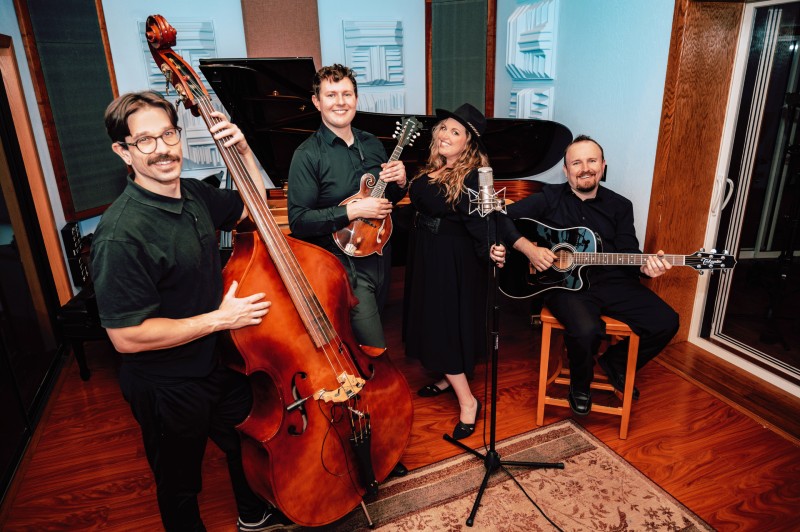
Blockhouse Valley finds a silver lining in life’s disappointments.
The Americana band embraces the growth and wisdom that comes from personal and professional challenges on It’s Alright.
“A lot of it was the decompression of our days and things that were weighing on us,” said Ashleigh Glass-Cooper, Blockhouse Valley’s vocalist, about the Metro Detroit band’s latest album.
“It also was thoughts we were having and things that were racing through our minds that we were able to capture in those times and hold onto for moments where we could make something better out of them.”
Glass-Cooper traded those thoughts and feelings with husband, musical partner, and mandolinist-guitarist Cody Cooper during their daily commutes home from work.
“It wasn’t that we sat down and said, ‘Let’s write songs about this,’” she said. “We tend to talk about [things] on our commutes, and our brains get a chance to decompress in ways that we don’t always set time apart for otherwise.”
Those conversations laid the groundwork for It’s Alright, which features eight tracks filled with soulful vocals, clever lyrics, and infectious instrumentation.
“We gave them a structure, a context, a musical home that we could potentially share with other people,” Glass-Cooper said. “And we think [the songs] are really relatable because we don’t want to dwell on all of the negativity. We don’t want to give it more power through what we’ve done, but we do want to provide that release.”
To learn more, I spoke with Glass-Cooper and Cooper about the album, its themes, and the creative process behind it.
Q: On It’s Alright, the title track examines the struggle of trying to be resilient. How did it become an anthem for putting on a brave face?
Cody Cooper (CC): I think we use the imagery of a building. You see these large, strong buildings, [and] you assume they’ll stand forever. There can be just one small thing, and the whole building collapses. In your mind, you can’t conceptualize that from the outward façade.
Ashleigh Glass-Cooper (AGC): I think we try to paint that with the music of it, where the intensity builds throughout the song. In the vocals, I try to convey a little bit more panic and a little bit more stress as the song continues. To the very end, it’s getting higher, and you can hear the building come down going into the third verse over the instrumental bridge. You’re thinking, “OK, it’s all going down, and everything feels really big right now.” It’s definitely trying to paint that picture that I think we all experience at some point, and hopefully, not all the time. But I think there is an undercurrent of how everything ebbs and flows throughout our lives and in our stress levels.
Q: “Dying in a Dream” is about recognizing the end of a relationship and trying to overcome heartbreak. How did reflecting on a past relationship bring you some clarity?
CC: The inspiration from it was a relationship I had between high school and college. It was puppy love that lasted way too long. It never had the stresses of the actual real world behind it. When those stresses came out, the people we became were very unfamiliar to us, and I think that’s where the dream comes from and where the [lyric] comes from: “You cut me apart / With words that you never said before.” It’s saying, “You’ve never been this way to me. What is this?”, and trying to reconcile that.
AGC: What I like about it is that it’s accusing of the other person, but it’s also saying, “I didn’t realize how naïve I was. I didn’t know that I should be looking for these red flags. I didn’t know this was not something that I could rely on, or that I needed to be more self-sufficient, or that I needed to be leery of you. That I couldn’t trust you or that I should at least have some sort of a backup plan.” The pre-chorus line is: “But I know better now.” Then, it’s saying, “I have learned from this relationship, and I’m going to protect myself better. I’m going to move on with you as the villain, and me as whatever I can hold myself together as.”
Q: “Swing” chronicles the challenges of adapting to a career in the corporate world. How did that career change serve as a wake-up call about understanding corporate politics?
CC: This one does have kind of a duality in the lyrics [with] facing life’s choices. The inspiration for this was stepping into corporate America, so that’s where the imagery of cannibals came into play. You find some very interesting personality types, especially when you go into the corporate world.
This was a release from that. There were some struggles in terms of transitioning into that interaction style, and that’s where that song came from. But it does also have that idea of trying to make that work, because ultimately, in the world we live in, it’s very difficult to just be an artist and a professional musician. You still also have to be a bit of a corporate type at the same time to be successful. It does have that duality in it of saying, “All right, I’m going to make this work, but at the same time, ah!”
AGC: It definitely is about those abuses of the interpersonal relationships where they’re relationships of convenience and not necessarily affection. You’re trying to be professional, you’re trying to be part of a team, and yet something goes wrong, and somebody has to be to blame.
Q: “Phoenix (Burn It Down)” examines making rash decisions and worrying about the consequences later. How did witnessing people’s impulsive behavior inspire this song?
CC: This is one of our songs where it’s from the perspective of a character. It’s a character written from a few different people in our lives. The phoenix aspect is more of a wish or a hope. In the chorus, they’re saying, “Next year is gonna be my year. It’s gonna be so much better.” We have had some people in our lives where [we] didn’t know if they had the resources necessarily to just burn it all down and say, “Next year, I’m gonna be 10 times the person I am.”
AGC: We’ve known people who are quick to throw in the towel, are not resilient, and will not take any more. Whether it’s merited, a long time coming, or an impulsive choice, you get people who will say, “So I quit my job! I just threw everything I’ve been working on out the window because it was intolerable, and I’m just gonna start over.” They’re going to throw out everything and burn it all to the ground and not have anything to do with it anymore. We’re asking, “Do you really have that next step figured out? Have you thought about what you’re doing?”
We all hope that’s the case; we hope that they’re going to rise from the ashes. They have this vision of throwing it all out and starting over. And when they do, we applaud them, we want them to succeed, and we support where we can, but there are times when it makes us nervous.
Q: “Notice” explores working in a hostile environment that’s filled with microaggressions. How did reflecting on that experience prompt you to write this song?
AGC: It comes out of an experience that I had working in an entry-level role in a fairly male-dominated area. There were microaggressions and not-so-microaggressions. It’s not exactly about one particular experience I had, but thinking back to who I was as a young person in a professional environment and what my expectations were. It’s also what I know now as somebody who has worked in a lot of professional environments and particularly has an interest in making sure that people are taken care of and that everyone knows they should be respected.
I do have a role in it now, and it’s reflecting back on that experience as a teenager and seeing somebody that I saw as a friend. We were all co-workers, [and] we weren’t hanging outside of that environment. But we were about the same age, we were in the same place, we were having our first work experiences, and instead of being able to be in a healthy, team-centered environment, I was going into a place for minimum wage every day and having to feel like I was playing defense—that I had to protect myself.
And it was really uncomfortable, and it was hard to feel like I wasn’t being taken seriously by other co-workers about it. Everybody thought it was a joke and not something to do anything about. I was just going to be the butt of the joke, and to have co-workers that I know heard things, I know saw things, and I know could have spoken up for me or been helpful. It’s calling them out and saying, “Why are you acting like you weren’t there? Why is it that you’re making me look like I had some crazy interpretation of what just happened?”
Q: How did a songwriting retreat in Hocking Hills lead to penning songs for the album?
CC: A year and a half ago, we went out to Hocking Hills [in Ohio], and we said, “We need to set aside a long weekend and do nothing but write.” It was a beautiful weekend in Hocking Hills, and we just sat in a cabin and hashed out a lot of ideas that we had on phone recordings and things of that nature. That ended up being somewhere in the ballpark of a little over a dozen songs overall. From that, we arranged it out and took it into the studio, recording a bunch. Then, we found the common themes between the songs. Ultimately, we said, “These eight songs really seem like a good batch for this kind of idea,” and that’s how It’s Alright came together.
AGC: We thought, “Well, maybe we’ll decide a few of them don’t quite fit, or we’ll want to do maybe a longer album than we were planning.” And then we said, “It’s almost like we had twins, and we gestated all of these songs,” and we realized they were two [different] personalities—the two albums. Obviously, they have the same heart and soul, but there were several that came out of my life growing up in West Virginia that will be a part of the next release.
This one was more like the tongue-in-cheek response to the grind. It’s those things that we can share with each other at the end of a long day and say, “It was rough, but we’re gonna find the silver lining.” We’re going to make jokes about this, we’re going to figure out how to get through and over it, and move on. There were two schools of thought in those songs, and it makes sense to give each of them its own album.
Q: It’s Alright embraces a variety of genres, ranging from Americana, bluegrass, and folk to pop-punk and alt-rock. How do those genres inspire you as songwriters and musicians?
CC: What’s great about being from the Midwest … and being in between the coasts is that we get everything. Ashleigh grew up in Northern West Virginia and [took] dulcimer classes. We have bluegrass in this area, [and] we have both coasts of music.
We grew up listening to Foo Fighters and Nirvana … and having a lot of alternative genres. I was a metalhead through high school, and then I went and studied jazz in college. Ashleigh’s really into opera and sang with the Toledo Opera. I think this region of the U.S. gets a lot of flavors just naturally that you get to hear. I don’t think a lot of the rest of the world or the country really understands that.
There’s a lot that gets melded together here, and I think we’ve tried to do that in our music. I know that the music we put out won’t make any of the bluegrass purists happy. Using the Americana moniker, there are certain people who fall into different camps of that. I know somebody who might tend more towards John Prine and Gillian Welch might not identify as well with ours, but that’s part of why we like that broad umbrella where we can exist in that as well as some of these other artists.
Q: How did the album come together at Stone Soup Recording Studios in Maumee, Ohio?
CC: I think it was a few sessions in 2024, and then I think we had a final session in 2025 to finish up some things, specifically bringing in some of those instruments. Eric [Sills] primarily likes to work with jazz groups … and a lot of jazz musicians. The way he’s set up his studio is to have multiple isolation booths because people need to play off of each other, and they need to improvise.
It’s great to be able to go in there and, with the core quartet, be able to record all at once. We kept the recording sounding very clean while being able to correct some things, so that worked out well for us. And then after we got the core group done, we made decisions about what else we wanted to bring in. For “Close My Eyes,” I said, “I want an accordion,” so we were able to find William Bennett, who’s Toledo-based. He was able to come in and do some accordion for us.
Q: How did bandmates Jon Howard (guitar) and Danny Steinkopf (upright bass) help shape the album’s sound?
AGC: When we went to do this [band], we knew [Jon] was the guitarist that would best fit with our goals and our vibe and be a part of making the music that we wanted to make as a band. It’s fun because Cody and Jon are both guitarists, and Cody’s first instrument was guitar. Watching their interaction is always a treat for me because they’ll be talking about the intricacies of something that’s on one of our songs, and I’ll say, “OK, guys, you’ve got this.”
It’s fun to watch the guys work and hear how it comes through and how I can add to it. It’s especially satisfying for me because I’m more of a lyricist. I write melodies, but I’m not an instrumentalist. I have these ideas that I bring to Cody, and then Cody works some magic, and somehow we’re in a rehearsal with other people doing something that was in my brain.
CC: I might start the charts for some of our original songs, and [Danny’s] still able to bring his experience and knowledge into it as well. I think he makes a lot of decisions in terms of when things should be bowed, and some of those things, I might not even have thought of.
Q: What did Ryan Crum (upright bass) and Dan Kesterke (drums) help add to the album’s tracks?
CC: Ryan was a big help in cleaning up some of my less idiomatically written bass stuff. We had a day in the studio, and I said, “I need a top-level guy to come in here and guide me a little bit on bass.” He was actually off-tour because he does national tours with theater pits. He was just off the road with Mean Girls at the time. I said, “Do you want to come hang out in the studio with us for a day?”, and he said, “Yeah.” I sent him over the charts, and he came in and fixed some things for me.
AGC: We’ve known Dan Kesterke for a long time through theater pits. When we listened to our mix with just the quartet on the songs for this album, we thought, “There are a few of them that could use a little bit more driving in the rhythm.” And we knew that he would do a fantastic job to come in and do it backwards from the “normal” recording process. He came in and he had listened to what we had recorded so far. Dan has been a good friend, and we know he’s the best drummer around. When he came in and added to a few songs, we were just thrilled.

Q: What was it like to work with TYPFY and Lad Strayer on the album artwork?
AGC: We wanted something that shows like a total calamity behind us, and the tangible understanding that everything is falling apart, everything is crazy, everything is danger. We didn’t want it to be scary. It’s this idea of “Oh, OK. This is Godzilla attacking Mothra.” There are natural disasters, there are human disasters, there are cryptids everywhere, and there are frogs raining from the sky.
But we wanted it to be something that’s almost comforting, something that makes you laugh, and something that doesn’t feel threatening. We’re addressing things that are heavy and scary and might feel like too much, and the whole idea is taking that energy away from it. It’s draining it of its power, focusing on things that are going to help us to get through this and to be better people.
We thought, “It should be kind of cartoony,” and we were thinking about the world of Richard Scarry and the Rugrats style, where it’s a little bit chaotic in and of itself just to see it. And that’s what we talked with TYPFY about and said this is our vision. We sent him the track “It’s Alright” to give an idea of all of the things that could be happening as a part of this chaos.
CC: And then I will give some credit to our headshots, which are by Lad Strayer. Being from an artist background with jazz and things, I love having multiple collaborators on things. So having this mixed media piece where we have these headshots that we Photoshopped onto the artwork, I love that aspect of things. I love having so many people involved.
Q: What plans do you have for an album release show?
CC: For this one, we’re not doing a proper album release show. As we’re performing, we’ll bring the songs out. We have some gigs coming up that are going to be mostly originals-focused. We’ve got another hour set scheduled [on October 3] for [Ann Arbor’s] North Star Lounge, which is a space that responds very well to original music. It will be mostly the album for that.
We’re baking it into places that we know will respond well. With our group, we have the covers that we do [and] that we have our own arrangements of. That goes really well at various venues, and then we have certain venues [for] original music, that’s what people are coming out for. We love both audiences, and we tailor it to who we’re going to have that night.
Q: What’s the status of your next album?
AGC: I think it will be [out in] early 2026.
CC: We have a couple of more songs that have come together since our last studio dates that we’ll try to get on this upcoming one. We’re always trying to continue writing; it’s about finding that time to get it all hashed out and then arranged.
Blockhouse Valley performs October 3 at North Star Lounge, 301 North Fifth Avenue, Ann Arbor, Michigan. The show starts at 5:30 pm and is free.
 The Stratton Setlist