
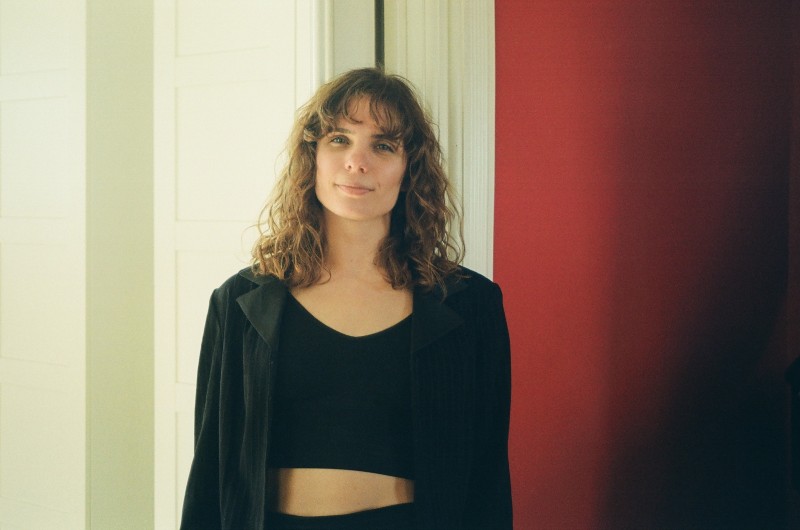
Sammie Hershock recognizes diligent women whose valuable contributions often go unnoticed on “Gold Sticker.”
The Marshall, Michigan, singer-songwriter and pianist pays tribute to women who support family, friends, and community behind the scenes on her new indie-folk single.
“That’s really where the song came from, and originally when I wrote it, I was thinking about my mom,” said Hershock, who’s also a mother of three children. “It just put it all in perspective for me, and it came from realizing how much she actually did.”
On “Gold Sticker,” she sings, “But can she get a gold sticker / Can she get a prize / Or maybe a metal around her neck to reflect the light in her eyes / It took me long enough to see / That in the race of humanity / There is no winner / But can we get a gold sticker.”
“When I play this for people, I can’t even tell you how many people come up afterward and say, ‘I needed to hear that,’” Hershock said. “I almost always play that song, and at the end, I have free gold stickers.”
“Gold Sticker” features an A-list roster of musicians, including Dominic Davis on bass, Mike Shimmin on drums, Spencer LaJoye on violin and background vocals, Kyle Joe on background vocals, and producer Chris DuPont on guitar.
“When I started working with Chris DuPont, I already had amazing musicians on it, and the skeleton of the record was perfect,” said Hershock, whose new single will appear on her upcoming album, Wings. “I loved it, but I just knew that I wanted it to be filled out a little bit more.”
Hershock also recently entered “Gold Sticker” in the Grassy Hill New Folk Competition for Emerging Songwriters, which is affiliated with the Kerrville Folk Festival in Kerrville, Texas.
She placed as one of 24 semi-finalists for the competition and is traveling to Kerrville this weekend to perform at the festival on May 24.
I recently spoke with Hershock about her background, new material, and upcoming plans.
Q: How did your musical journey start in Marshall?
A: My mom has a song that I wrote when I was three. It’s just always been something that I’ve done, but the songwriting was a separate thing. It was just something that I did for me, and I never showed them to anybody. When I was six, I started taking piano lessons. It didn’t really stick, but my parents forced me to stick with it.
And then when I was 12, I switched teachers, and I locked in. She was amazing, and whatever she did matched perfectly with how I needed to learn it. Then, I went all in on that. We were homeschooled at the time, and I would wake up, finish school in two hours, and practice piano for six hours. When I was 13, I wrote a full-length piano sonata for my piano recital. I was composing [large-scale] pieces and was classically trained.
Q: What artists first influenced you?
A: My parents were big into James Taylor, Joni Mitchell, and Indigo Girls. I remember sitting in my dad’s Jeep, and he was playing the Shaming of the Sun record.
He said, “Listen to this song, you need to listen to the lyrics,” and then he’d play it once and then go back and replay it. He’d say, “Pay attention to what they say here.” I was just recently listening to some of their harmonies, and I thought, “Oh my god, this is how I harmonize.” That was a huge influence on me.
Q: How did singing and playing piano in church influence you as well?
A: I sang in the church choir from third grade through high school. My high school piano teacher was the music director at our church, and I would apprentice with her. I filled in for her as choir director a couple of times. We grew up in a traditional Catholic church in Marshall, so there was a lot of Latin stuff.
Q: How did your musical journey evolve after high school?
A: I ended up majoring in the pipe organ for a year, and I went to Franciscan University in Steubenville, Ohio. I was seeing other people my age, or some a little older, graduating with a music degree. Then, they would go home and teach private lessons. I thought, “I already know that I want to teach private lessons,” and I had already been doing it. Then, I thought, “Why don’t I just do that and not deal with all the debt?”
I came back after that and continued to write songs. Part of it, too, was that I had realized that majoring in music was just so intense for me, and I’m not a super theory-forward person. It was starting to kill what I really loved about it. It really wasn’t until four years ago that I started playing songs for people. Before that, I had never played my songs for anybody.
Q: Your debut EP, The Giantess, came out in 2021. What did you learn while working on your first release?
A: I remember thinking, “I have so many songs, if I died, my kids would have no way of knowing that these things even existed because they’re just sitting in my head.” I had secretly always dreamed of doing this, but I had really shoved it down. Having my kids was the first thing that opened up a little door. I wanted to encourage these little human beings to do things that excite them. I thought, “I get to model that for them, which means I have to do it for myself.”
It was actually a lot of emotional work for me. I realized that I am where I am because of the art that has inspired me. I stepped back and thought, “All of those people are just as scared as I am.” Everybody is scared of being vulnerable, but where would I be if those people didn’t share that stuff? And who am I to decide what impact my art has on someone? You’re just like the vessel for it.
I just decided that I’m going to make an EP for myself. I had no money and thought, “I’m just gonna do it on my laptop.” I didn’t really know what I was doing either, but I just knew I wanted to put some songs out. I didn’t plan to play live, but then I did, and it felt so good. I thought, “I could totally do this again, and I think that I want to play out.” It was a crazy thing because I had so much performance anxiety.
After I released The Giantess, I thought, “If I want to keep doing this, I have to play live.” I came up with a plan to attend an open mic every week, but it would not be in Marshall. I would go as far away as possible. One of my first open mics was Jen Sygit’s [in Lansing]. I met Jen and Mike Lynch there. He said, “Hey, I have people that you should meet.” That’s how that started.
Q: You’re currently teaching piano full-time. How is that going?
A: I work with kids and adults, ranging in age from five to 67. Working with them is one of my favorite things, and I truly love teaching music. I have about 20 students each week, and I feel like I work 20 different jobs. The lessons are so wildly different. I have some real mathy, brainy kids who appreciate theory and sight reading. They love the flash cards and getting timed on them.
I love working with adults, and so far, most of the adults that I’ve taught start piano lessons after some big life event. I love teaching adults because they all have very specific goals. I had somebody come to me and say, “I want to learn how to play The Beatles,” or “I want to learn how to play Christmas carols for my kids when they come home for the holidays.”
I also love working with neurodivergent kids, and I think the creative brain works differently. I love figuring out the best way to teach kids and matching that with how they see the world.
Q: “Gold Sticker” was first released as part of the Gold Sticker Visual EP with Dogtown Studio in 2023. How did that song and EP become part of that video series?
A: That was my first time working with Robby Fischer, and he is one of the greatest humans. He’s so good at what he does, but he’s also really passionate about the creative journey. I had the idea for a visual EP, and he was all on board with that. I also worked with him again for this upcoming record. We did two live music videos, but I called him up and said, “Hey, I have a couple of ideas. One is weird lamps, and the other is hanging a bunch of cardboard birds from the ceiling.”
Q: Your upcoming album, Wings, is inspired by birds, raptors, and other winged creatures. How did these creatures inspire the album thematically?
A: I had never really paid much attention to birds until about four or five years ago. I had originally decided to start doing music and taking it seriously. There was a red-tailed hawk, and it made a nest in the window outside my house.
I remember one day I felt like someone was looking at me, and I looked out the window. I locked eyes with it, and we just stood there looking at each other. And it happened three days in a row, and it was so profound that it felt like more than just a coincidence. I thought, “OK, this feels important,” and so that started the bird thing for me.
I feel like birds would come in as omens, or as [signs] saying, “Hey, you’re going in the right direction—you’re doing well.” I love that, but I think some people write that off as just being coincidental or silly. As crazy as it is, it’s so much more fun to believe that.
After the red-tailed hawk situation, it was right around when a lot of stuff was going down for me, and I had big decisions up in the air. The first time I talked about this, I was with my friend. We were on a walk, and all of a sudden, I heard a group of owls. I was thinking about that the next day and thought, “That’s kind of crazy.”
[Another time,] I was driving at 6 pm, and three owls flew over my car. I thought, “Maybe this is a coincidence, but also these owls were put on earth for me.” Since I’ve been talking about this a little bit more, the people who have had experiences with birds have said, “Yes, we are the bird people.” I think we are so much more interconnected than we realize.
Q: How has Wings evolved since you first started recording it?
A: This album has had so many different lives. I first tracked piano and vocals with Ian Gorman at La Luna Recording & Sound. Mike Shimmin also tracked drums there. At one point, Kyle Joe and Spencer LaJoye came over to my house—they’re two of my best friends. This was when things were changing in my personal life, and I had just started working on this record.
Then, I said, “I don’t think I’m going to be able to finish this.” They showed up at my house and said, “We’re finishing your record.” Kyle tracked acoustic guitar, and then Kyle and Spencer did backup vocals for “Gold Sticker.”
I had never worked with Chris [DuPont] before, but I’ve been a huge fan of his work. I started hearing more about my friends working with him. For me, my first way in was through Spencer, and then Kyle Joe also put out something. I’m so happy with the way this record has turned out. When I play a show, it’s just me and the piano, but when I listen to music, I love music that has a lot going on.
Q: What’s the status of Wings?
A: There are four or five songs that are done, and then there are 10 songs total. They’re mostly done, but we’re just adding a few things. The album is coming out on my birthday, which is September 4.
Q: How did you become a finalist in Kerrville Folk Festival’s Grassy Hill New Folk Competition for Emerging Songwriters?
A: I have applied to Kerrville before, and I have sent in the same two songs for three years. I sent in “Gold Sticker” and “Proof,” but the last two times that I sent them, they were phone recordings. And now I have these beautiful full recordings of the songs.
I’ll be playing those two songs on the piano, but it’s primarily [people playing] guitars at the festival. I don’t even have to do anything, and I’m already a little different. I feel like it’s worthwhile for me. It sounds like they will make a final announcement [of the winners] Sunday night.
Q: What other songwriting competitions have you entered?
A: I did finalize in another songwriting competition—it’s the Great River Folk Festival. That’s in La Crosse, Wisconsin, and that’s in August.
Q: What’s up next for you?
A: I don’t really have anything solidified right now, but I will say I write so many songs. I have a decent amount brewing in me. Some of it is logistics for me, but as soon as I can make another album, I’m gonna do it.
 The Stratton Setlist