
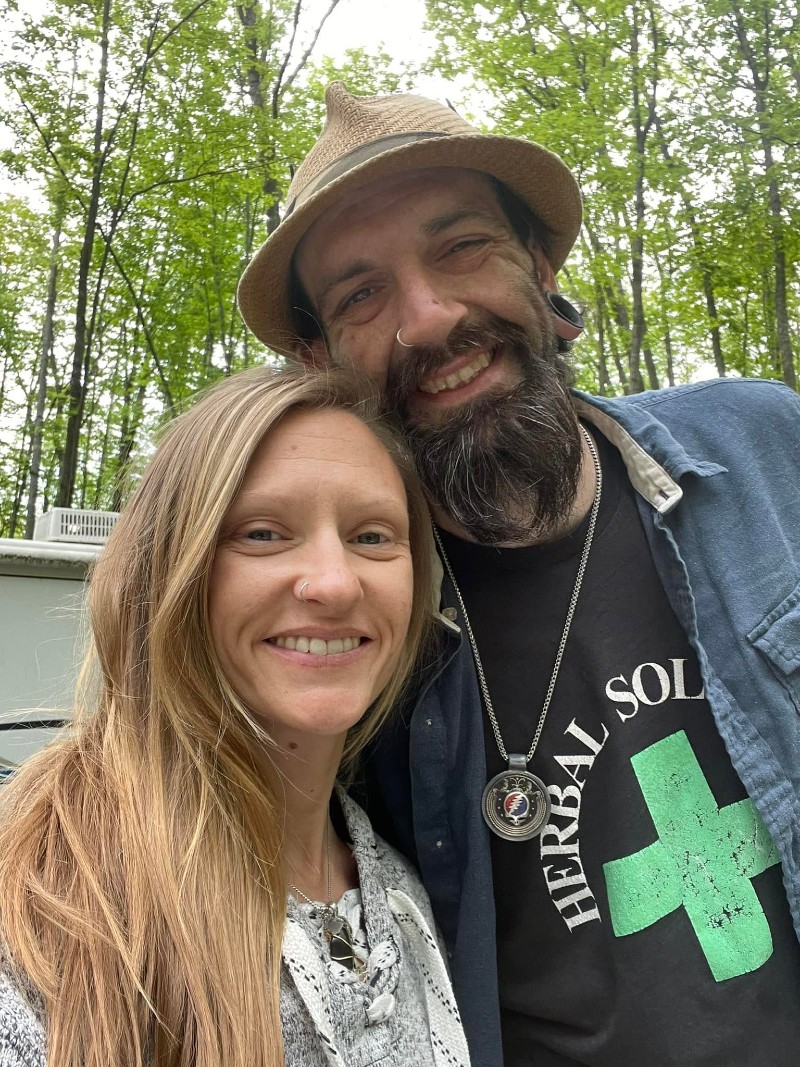
Editor’s Note: Lori Stratton is on the board of GIG: The Art of Michigan Music Foundation.
For one of his latest posters, Jonathan Doyle decided to step outside his musical realm.
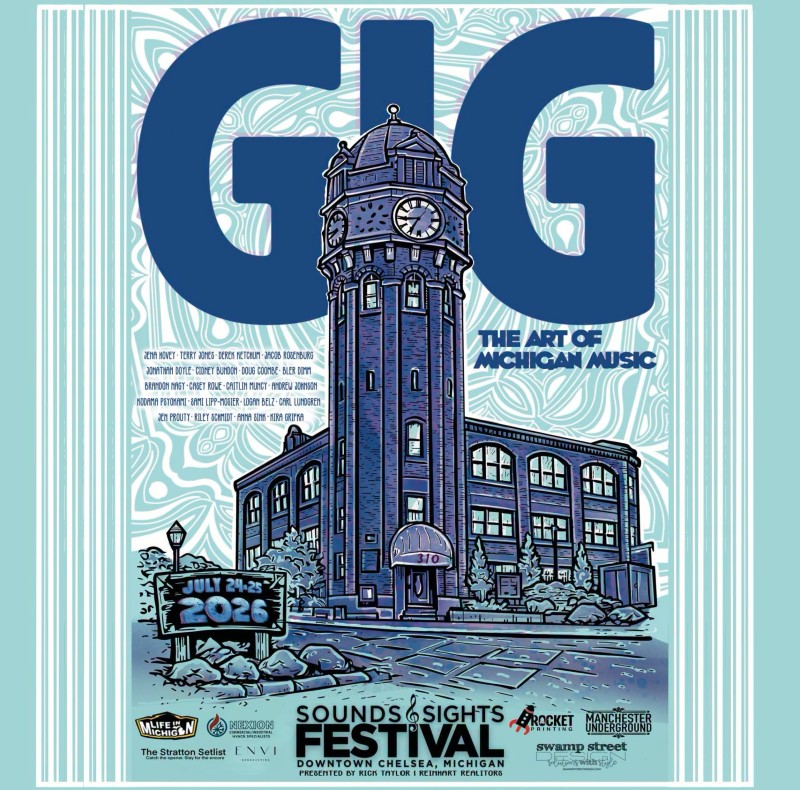
The Manchester, Michigan, graphic designer and poster artist took an architectural approach and drew a picture of the Chelsea Clock Tower.
“I love that building, so I took a couple of pictures of it, and I just drew it,” said Doyle, who owns JK Doyle Art & Design and creates concert posters for the Manchester Underground Music and Art monthly concert series.
On the poster, he created a majestic blue-and-purple version of the clock tower against a light blue and white mandala background.
“I tried to keep it as fun as possible, and I didn’t want to go full psychedelic because it’s Chelsea,” Doyle said. “But at the same time, I didn’t want to go mayonnaise, so that’s where I ended up.”
Doyle’s artwork is the featured poster for GIG: The Art of Michigan Music, an annual event showcasing the creations of visual artists, graphic designers, and concert photographers who work in music.
This year’s edition of GIG takes place July 24-25 in Chelsea as part of the city’s Sounds & Sights Festival. Doyle is one of 20 artists featured at the event, which is spearheaded by Ann Arbor residents Chuck and Brenda Marshall.
“Being a musician and an artist, I have been in both realms, and it’s the only place I’ve ever seen where those two groups of people are brought together,” he said.
To support that community, GIG includes a gallery of artwork and photography by the featured artists, a music market filled with prints, photos, records, and merch, and workshops focused on mental health, websites, graphic design, and photography.
“I’m kind of a hermit, and a lot of my artist and musician friends are hermits, so there’s nowhere for us to go,” Doyle said. “The community inside the community [at GIG] is really big for me.”
I recently spoke with Doyle about his background and work as a graphic designer and poster artist.
Q: How did your musical journey start in Daytona Beach, Florida?
A: My mom was musical, and she played the oboe. We had a little keyboard in our house, and I was probably six or seven when I started pushing the keys of the keyboard while listening to songs and thinking, “Oh, that’s the same sound.”
Then, I was at an age in school when we had band. I played the trumpet, and the guitar was always taken. Maybe a year after that, I got an old, broken guitar from somewhere, strung it, and learned how to play it by listening to songs and picking the notes until they were right. In high school, I got into bands, and it took off.
Q: How did that lead to studying music engineering technology in college?
A: Music was always my number one, so that’s what I went to school for [in Florida]. I went to Full Sail University, and they were starting up when I was in high school. My high school had a co-enrollment deal where we could take Full Sail classes and not actually have to go to school. We’d take them at the community college, and then sometimes we went to Orlando.
I graduated high school with an associate degree in engineering, and I took that all the way to the top. I went as far as I could go, but then COVID happened and changed the entire music industry. I had studio work lined up for months, and then the lockdown happened, and within two days, I had nothing.
Q; How did you develop a passion for art?
A: My mom was a school teacher, and we didn’t have a TV. We had a radio, and art was pretty much it. That was our [outlet], and I don’t think I can put a finger on a specific type [of art].
I have a younger brother, and he’s a year and a half younger than me. I was responsible for him, and my parents kicked us out of the house during the summertime. We had to learn how to do stuff, like make toys and build stuff. I’m a musician, and since I was a little kid, I’ve been into all types of different art. My brain is very, very visual, but I was never formally trained—I taught myself.
I’ve always tried to brighten up my life in any way that I possibly could, and even when shit was dull, there was always art. And for me, it’s evolved over the years. I tattooed for years, and I tattooed right out of high school. That was my first actual job, and I worked at a tattoo shop. It just happened, and I never wanted to be an artist per se.
Q: What inspires you as an artist?
A: I draw pictures that I think look good, and I don’t really follow rules. I don’t really like rules, but I’m an introspective thinker. If I follow the rules of art, and I don’t allow my creativity to do what it wants to do, then I’m not creating art to my fullest potential.
Being able to [use] my brain like that keeps things fresh because I don’t get locked in a style or a mode. Screen printing is my fetish, but I love doing things that are unconventional because I learned unconventionally.
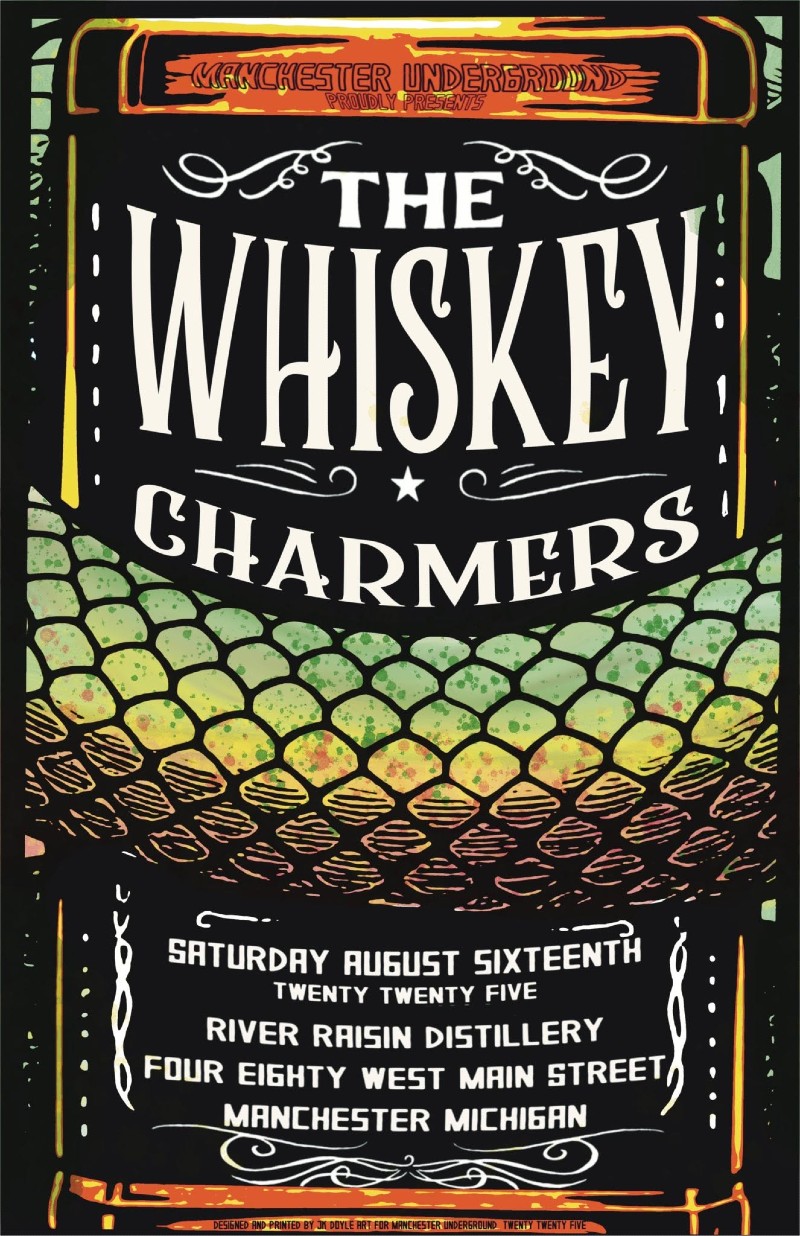
For example, The Whiskey Charmers poster [for Manchester Underground], all of that color is watercolor. I water-colored all of those pieces of paper before I printed them, so each one is completely different.
Q: How did you start screen-printing posters?
A: I’d been dabbling in screen printing for years, and with COVID, I didn’t have a job anymore. For the last 10 years of my life, I had been in school for music, and then it was pointless. I had literally built myself screens the best I could.
I had a Cricut vinyl cutter; I would take the sticker vinyl, and negative-cut my image out of that and stick it to the screens I had made on both sides. I’d do a positive and a negative, line them up, and get 20 prints out of it.
Then, I’d have to switch it, and so I did that. I sold prints, bought more equipment, and along the way, taught myself. Because before COVID, I had never thought of printing art—only T-shirts.
Q: How did your bootleg artwork of Jerry Garcia and Bob Weir take off?
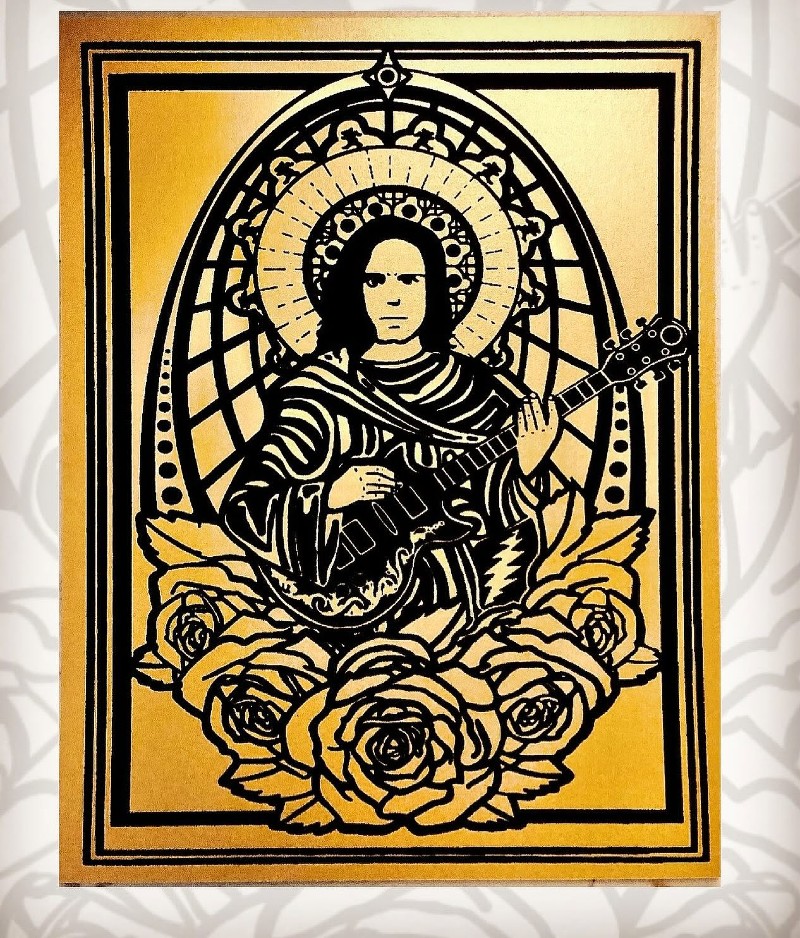
A: I started making bootleg Grateful Dead fan art T-shirts and sweatshirts and selling them on Facebook—it exploded. I did Jerry Garcia and Bob Weir as stained-glass saints. I think I sold 50 of each of those, and right off the bat, people just freaked out over those. I was making things that I thought were cool and selling them. I started getting messages from people after I did the Bob Weir one, and they were asking, “When are you going to do the rest of them? My walls are lonely.”
Q: What brought you and your family to Manchester?
A: We used to live in Ann Arbor when we first moved to Michigan, and then we moved to Ypsilanti. I owned a head shop in Depot Town called OneLove Culture Shop, and we sold hippie stuff and bongs.
Our first child was born, and when he got to be school age, we came to Manchester. I’ve come to find [Manchester] is where all the people who are creative and tired of the city come [to live]. It’s full of pot growers, hippies, and people who are tired of noise.
Q: How did you start JK Doyle Art & Design?
A: I like drawing pictures, and a buddy of mine said, “Hey, dude, can you make me a logo for my company?” And I said, “Absolutely,” and so I did it, and he loved it. And then somebody else said, “Hey, I saw Joel’s logo. Can you make me a logo?” And I did that, too, and then it just grew from there. I thought, “I should probably do something about this as far as professionalism.”
As a graphic designer, branding for me is a big thing. I have worked with bands in the past as their unofficial merchandise director. Having a series of things—having a collection of things—that all match makes sense in my brain. Branding myself was a good way for me to advertise and spread my name.
I had an art business before when I was selling bootleg stuff called Fractal Paws Art. I wanted to legitimize it a little bit, and that’s when we were vending at festivals with Fractal Paws Art.
My logo was a cat paw, so I wanted to get away from that and legitimize myself a little bit. It’s way easier to hand someone an invoice that has JK Doyle Art & Design on it. It’s my way of not being a vagrant hippie in the art world. (The “JK” in JK Doyle Art & Design stands for Jonathan Kole.)
Q: How did you become the poster artist for Manchester Underground?
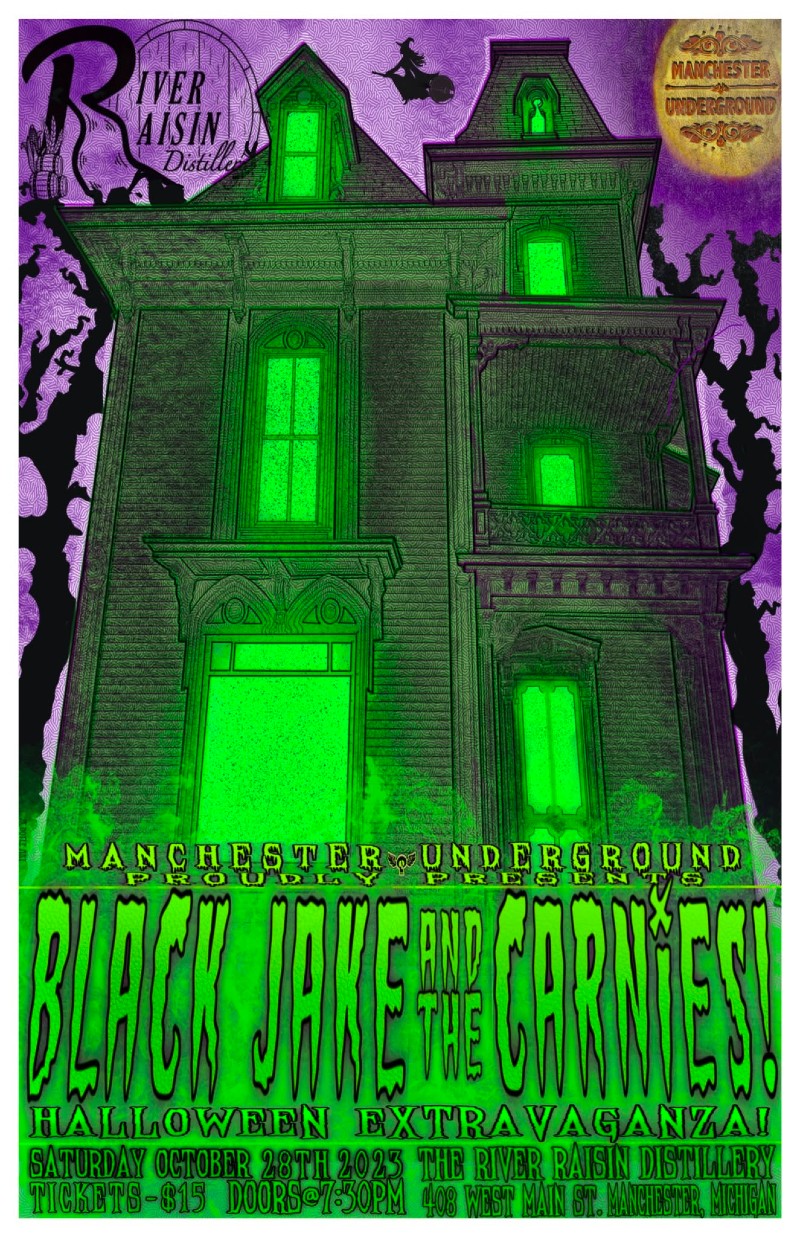
A: When we lived in Ypsi, my wife and I got into Depot Town culture. We were on the Ypsilanti Heritage Festival board, and we ended up meeting Jake “Black Jake” Zettelmaier from Black Jake and The Carnies.
I knew nothing about Manchester Underground, and I saw a show advertised on Facebook with Black Jake and The Carnies. They had a poster, and it bothered me. I made a poster for them, and I sent it to Black Jake. He had shown Steve [Girbach] the poster, and Steve said, “Wow! That’s awesome.”
And then I ended up meeting Steve, and boom, it all happened. I’ve been doing posters for Manchester Underground for three years. Steve invited me to do the first two or three posters, so I did those, and then I made some merchandise.
I made T-shirts and stickers just for fun. I designed the Manchester Underground logo and gifted it to Steve and John [Mooneyham]. We decided to sell the merchandise and put all the proceeds toward Manchester Underground.
I love those guys at Manchester Underground, and as a poster artist especially, being able to make a poster every single month is insane. That’s kind of like the holy grail, if you will.
Q: How do you develop custom posters for Manchester Underground artists and shows?
A: Before I even start to make a poster for anyone, I look them up on the internet and pick a random song. I listen to it with my eyes closed and 99 percent of the time will have close to the final product in my head by the time I’m done with the song. That’s as organic as it gets.
I give [each artist] a poster because that’s who I’m really doing it for. I do the art for them because I’m listening to their music and going off of their feel. More than not, they will look at the poster and say, “Did you know this is my favorite flower? Did you know that my favorite animal is a bear?” All these things are in the posters, and they’re things that I visualized by listening to their music.
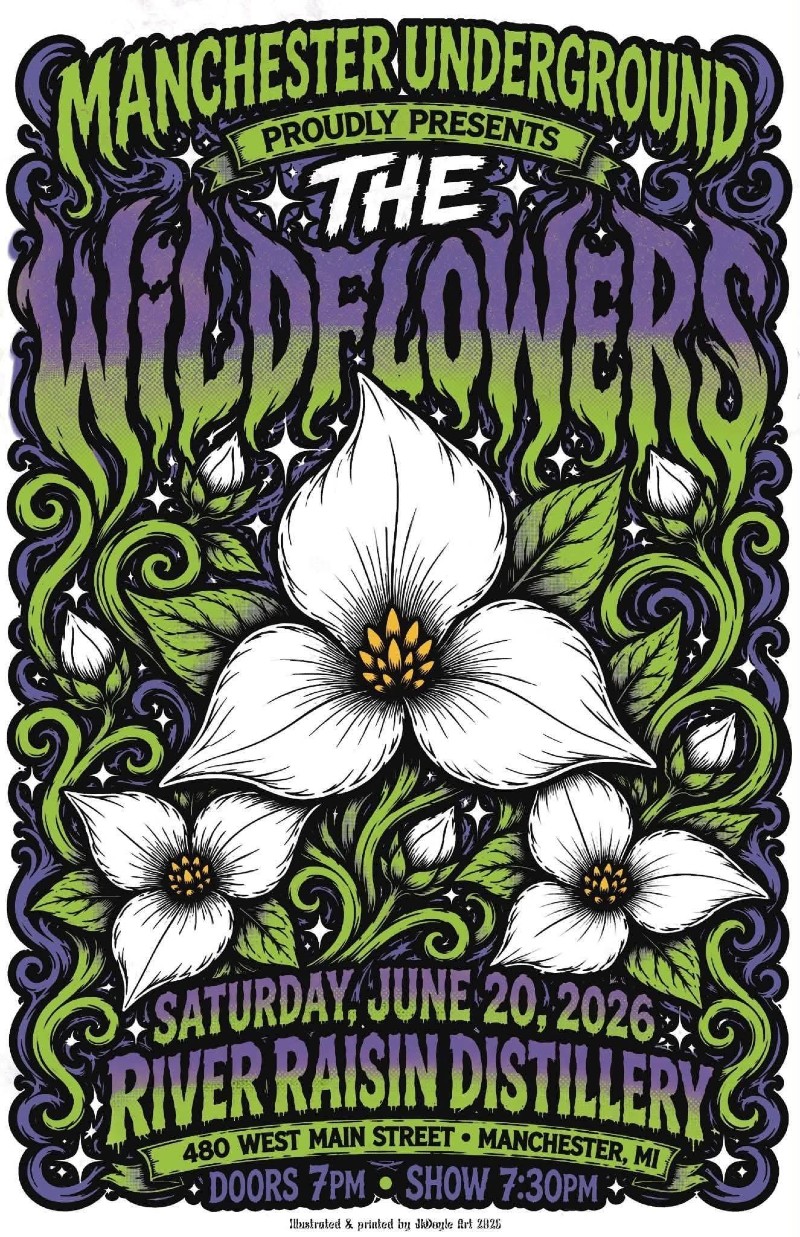
Q: What inspired The Wildflowers poster you did for their June show at Manchester Underground?
A: They’re really nice, and they’re great musicians. I heard some of their live stuff, and then I listened to them individually. And then I thought, “There are three of them. We’ll do three flowers.” It’s like a melting pot of everything. Vines and fruits are going through it, and everything is melting on top of it.
I put so much time into it, and it’s completely out of the ordinary for three women singing folky bluegrass tunes. I gave them each one, and they lost their minds. They said, “Oh, this is so amazing!”
Q: What do you enjoy most about being part of GIG: The Art of Michigan Music?
A: Like Manchester Underground, it extends into so many different groups who would normally not be talking to one another. GIG is amazing, and it should be a national thing, maybe even a traveling [event]. The contacts I know that have been made, and that I have made personally with people who I had no idea were in the area, is insane.
Q: How has Carl Lundgren inspired you as a poster artist?
A: I have a couple of Carl Lundgren posters, and I cherish them because they’re real; they’re hand-printed. When I met the man, I shook his hand and said, “Holy shit! I own artwork of yours.” When I met him originally, it was in 2024 [at GIG], and I was there with Manchester Underground as their artist.
The only wood frames with glass in my house have Lundgren art behind them. I have a Grateful Dead one, and we talked about that. He said, “They were hand-printed,” and that almost gave me goosebumps. It’s a huge inspiration, and he’s so humble. (Carl Lundgren is a featured artist for GIG.)
Q: What plans do you have for new Manchester Underground projects?
A: I am thinking up a new winter line of merchandise for Manchester Underground. Some new logos, some new designs like that. Make some koozies and some coasters. Manchester Underground is continuously keeping me busy, which is phenomenal.
Q: What are some of your other upcoming projects?
A: I’m working on an album cover for a mid-Michigan band. I’m a graphic designer, so I’ve always wanted to have a backstock of art prints of posters that I’ve done. A lot of times, I do them specifically for the artists, but there are some posters I spent a ton of time on that I really did for the art that are just as viable to me as posters.
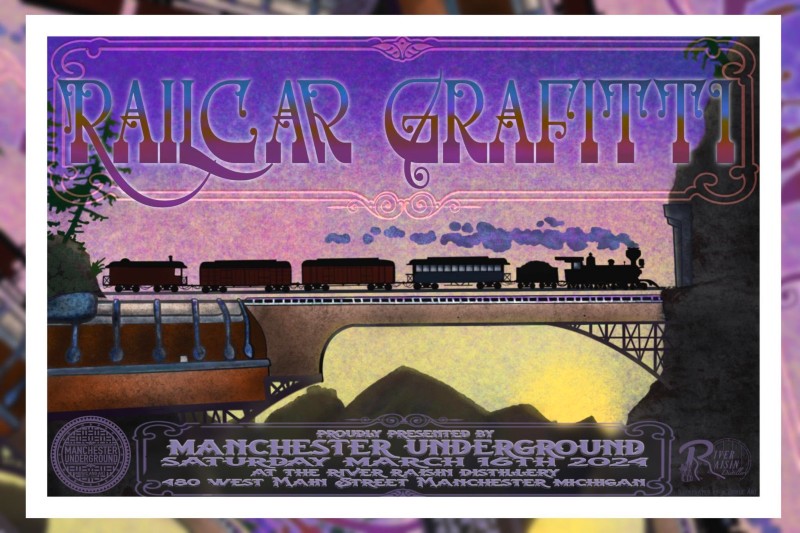
For the the Railcar Graffiti poster, I spent far too long drawing that train, but I was really into it. I draw everything on Procreate, so everything has layers. I want to reprint all the posters I’ve made that are not screen-printed. I want to screen-print them, and then I want to take a couple of them that are more on the art side and print them as just art.
It’s been a busy year; I haven’t had a lot of time to do that kind of stuff. At the end of the day, I would like to just screen-print posters for other people … because there aren’t a whole lot of people who do it anymore.
Q: How do you want to leave a legacy as a graphic designer and poster artist?
A: I’ve found out that there are singular people who have purchased every print I’ve ever done, and that they have a [space] in their house [for them]. What a cool, simple way of leaving your mark on the world. I don’t care if those people know me, but somebody’s gonna enjoy that piece of paper—it’s gonna raise an emotion. My name is attached to that, and in my mind, that’s like immortalization
GIG: The Art of Michigan Music runs July 24-25 at the Sounds & Sights Festival in Chelsea, Michigan. For details, visit GIG’s website.

