
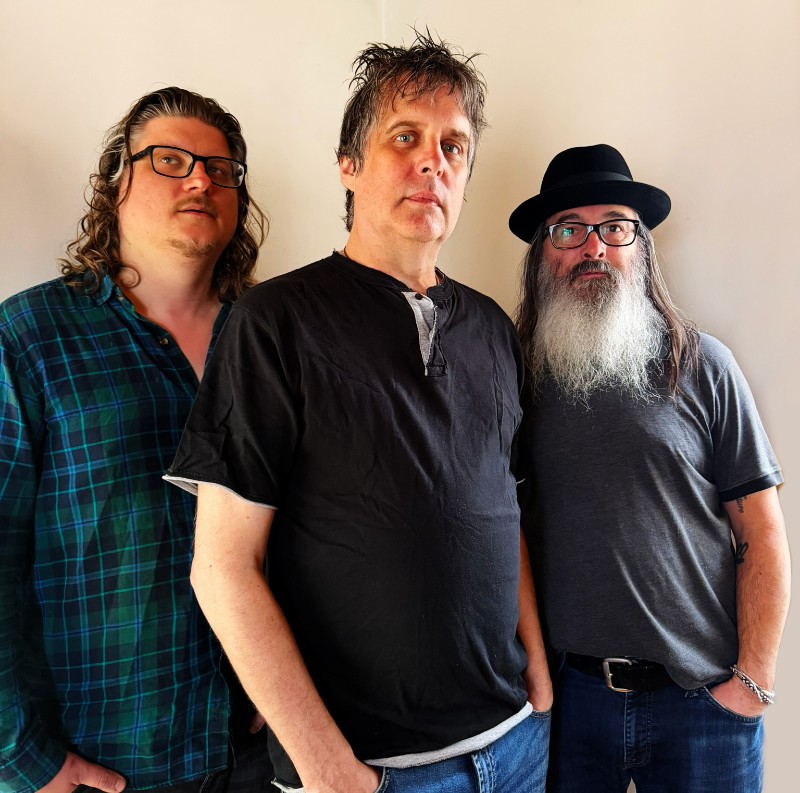
As a proficient songwriter, Jeremy Porter brings compelling characters to life.
His characters range from dogs and kids to Shakespearean sidekicks and ranch hands, and together they face regrets, challenges, and hard lessons in different situations.
They’re prominently featured throughout the 12 tracks on Sell Their Souls, Porter’s latest multigenre album with The Tucos.
“It wasn’t really intentional,” said Porter, who’s based in Plymouth, Michigan. “I think you just summed up all the different things that I tend to write songs about. Regret is a constant theme, and it seems in my lyrics that I keep coming back to that.”
To create relatable protagonists, Porter draws inspiration from a variety of TV shows and films, including Wes Anderson movies, neo-Western dramas, and true-crime documentaries.
“I get a lot of inspiration from that,” Porter said. “If I hear somebody say something on the screen that catches my ear, I’ll put it right into my phone, and I’ll build a song around it.”
But his storied lyrics are only part of the equation for Sell Their Souls. The turbocharged, fearless instrumentation from Porter (guitar, vocals, piano, lap steel) and Tucos bandmates Gabriel Doman (drums, vocals, percussion, piano, guitar) and Jake Reilly (bass, vocals) provides the other crucial portion. (The band’s current live drummer is Troy Toma.)
“This is a bit of a heavier record for us, and it’s a bit more rock than we usually do,” said Porter, who released the album via GTG Records. “I always like albums like The Who’s The Who Sell Out. I wanted [the album’s title] to be like that, like a news headline—Jeremy Porter and The Tucos Sell Their Souls—that’s a sentence.”
I recently spoke with Porter ahead of an October 10 album release show at Parts and Labor Bar in Melvindale.
Q: You recently lost your friend Nate Presley. How did you pay tribute to him at a recent show in Lexington, Kentucky?
A: He was a really talented rock ‘n’ roller with a lot of history. I went down there on July 10 and played a tribute show for him at a big venue there called The Burl. It was a really special night, and of course shrouded in tragedy, but it was a great night with so much love.
They had me sing a couple of songs and play a set of my stuff and his stuff because we were pretty close. He was a big advocate for my band, and I was for him. We had him up to Michigan a couple of times, and he had me down there a whole bunch of times.
He was in a punk band called Infected, and they were a fairly big deal out of Lexington. When I knew him, he was playing in NP Presley & The Ghost of Jesse Garon. He had convoluted ties back to Elvis Presley in his bloodline, and Jesse Garon was Elvis’ stillborn brother. That’s why he called his band NP Presley & The Ghost of Jesse Garon.
The funeral home had never seen so many people, and during the motorcade to the cemetery, people wondered if it was for a mayor or a governor. They covered his casket in punk-rock stickers. It was pretty cool, and I think he would have liked all of that stuff.
Q: How did drummer Troy Toma become part of the live band?
A: Gabe had to step down for some reasons, and Troy came in. He’s a really good guy, a fantastic drummer, and fun to work with. Gabe drums on the record, and Troy joined as we finished up the mixing. Gabe is still in the picture, and there is a very good chance his tenure behind the drum kit is not done yet either. It’s unclear how it will play out, but it’s all amicable, and everybody’s still brothers.
Q: What type of sound does Troy Toma bring to your live shows?
A: Troy embraces the Americana, quiet alt-country side of our sound. Gabe definitely comes from punk rock and rock, and Troy does too, but most of us aging punk rockers have embraced that alt-country thing.
Q: On Sell Their Souls, “Nutmeg” pays tribute to the character of the same name from Isle of Dogs. How did that character inspire this song?
A: I’m always fascinated by the junkyard dog kind of thing. The song is from the perspective of Chief, who’s the main guy. It fits with so much of my other songwriting, where the protagonist is chasing a girl who’s out of his league.
It’s saying, “You’re too good for me, or I blew it, and you deserve better. You’re this princess, or angel, who deserves a prince, and I’m a junkyard dog.” I’m always attracted to that kind of story. I’m always looking for the next angle on a relationship song, and everybody writes relationship songs, but I want to find the creative angle.
Q: “Fuss” explores fretting over things and jumping to conclusions. How did that theme emerge while writing the song?
A: That one came out really quickly. I was up north with my wife, and we had rented a cabin on Lake Huron. She was down on the beach reading her book and listening to the waves. I was up there strumming my guitar, and that came out in one afternoon.
It’s not about anyone or anything in particular, but it tells the story of a girl who’s leaving town or getting out of a situation. The listener can take it however they want to. It’s saying, “What is all the fuss about?” I probably had that phrase from somewhere and thought, “Well, that’s a chorus.” It’s a little more ambiguous than some of the other songs on the record.
Q: The video for “Fuss” was filmed at Livonia’s Trinity House Theatre. What was it like to work on the video with your wife, Noreen Porter?
A: I volunteer up there from time to time, and I do lights up there, but it’s been a long time since I’ve been able to do that. But they’re really good people up there, and it’s a beautiful spot. We rented it out for an afternoon and got that done.
Noreen did the “Big Spender” video too. I think it was a really good step forward, and she’s still finding her feet a little bit, but I think she did great. She’s way more of a perfectionist than I am; she works really hard, and she comes in prepared. I think I’ll keep her on the payroll.
Q: “Murielle” is a character study on a real person. What did you find intriguing about her?
A: For “Murielle,” I was watching a documentary called Who Killed Little Gregory? before the pandemic. It was on Netflix, and it’s a five-part documentary. It’s about this four-year-old French boy from a little town in rural France who was kidnapped, tied up, killed, and thrown in the river. It’s a fascinating story because there are a lot of complexities around it.
There was a small-town judge who fancied himself a celebrity, and the news media swooped in on it. They couldn’t figure out who did it. Was it the mom? Was it the dad? Was it one of the disgruntled employees at the dad’s shop? Was it a relative?
And there’s a girl named Murielle, who I believe was a [relative of] little Gregory’s. She testified that it was [another relative] who did it, and she said, “He picked me up from school, then we stopped at the river, and he threw this bag in the river.” I don’t have it exact, but it’s something along those lines.
They thought they had their guy, but she recanted her whole testimony. In the documentary, they strongly imply that the family pushed her to recant her testimony, avoid the media to protect this guy, and stay out of the spotlight.
She was a compelling character to me because she was a 14- or 15-year-old girl doing what she thought was right, and then people told her it wasn’t. But now, there’s even more doubt than ever.
Q: Why did you include a reprise of “Murielle” near the end of Sell Their Souls?
A: That was all recorded as one song with that long ending, and sometimes we’ll do that live. We’ll drag out that ending if we have extra time. It felt really meandering when we recorded it. Side A of the album was a minute and a half longer than side B. It was too long for vinyl.
I love the Hotel California record by the Eagles, and they do “Wasted Time” closing out side A, and then they do “Wasted Time (Reprise)” opening up side B. I thought, “We have this cool backwards guitar and that sitar; why don’t we chop the last minute and a half off? We’ll put it near the end of the record as a reprise and a callback to side one.”
It solved the problem of the song being too long and the side being too long, and it evened out the sides. It also made for a nice transition between the last two songs.
Q: “Rosencrantz” is a character study on a fictional person. What compelled you to explore a Shakespearean character on this song?
A: For “Rosencrantz,” I was messing around with the slide and doing a Jack White / Joe Walsh kind of riff. And then I wrote the song, and I had to go back because I thought, “Who the hell was Rosencrantz?” because I had Shakespeare when I was in college.
It was at eight o’clock in the morning at Eastern Michigan University, and I slept through it every single day. I got almost nothing out of it, and that was no one’s fault but my own. In the song, it’s like, whose perspective is it? Is it Gildenstern’s perspective? Is it Hamlet’s perspective? Is it completely unrelated?
To me, that tune was way more about the riff than the lyrics. The line, “I found a coin from the future / In the pocket of my pants,” is from Somewhere in Time. When my dad worked for the State of Michigan, he went to Mackinac Island every week to help people get jobs at the Grand Hotel and other places.
He went there regularly while they were filming it, and he saw a lot of it while it was being filmed. And then we actually went to the world premiere at the theater at the Grand Hotel when I was a kid. The line doesn’t tie in with the rest of the song, but that’s never stopped me before.
Q: “Strychnine Bouillabaisse” chronicles a person’s growth and transformation over time. How did experiences from your teen years spark this song?
A: Lyrically, it starts talking about my own youth a little bit. It was originally a little more literal, and we pulled it back a little bit. It may surprise you that I was a bit of a troublemaker when I was young. I was a vandal; I was a thief. I wasn’t in and out of youth homes or anything like that. I came from a good family, but I was a brat.
My grandfather was the county sheriff in the town where I grew up, and that added some complexity. I moved from a small town to a slightly bigger town and then to Detroit, and each time I got out, I left that path. I often wonder what would have happened if I had stayed. In the song, I say, “Not everybody from those days made it out alive / I haven’t seen those guys in years, or know if they survived / But I’m still here / I’m still here.”
I didn’t really like the song at first, and then I played the demo for Jake. When we were listening to the demos for the record, Jake said, “Oh my god, I love this one!” Then he came up with that bassline that opens it up. The lyrics weren’t very good originally, so we rewrote part of it. In the end, I think we got there, and it’s a short song that rocks pretty hard.
Q: “Watchin’ Otters Play” examines feeling foolish and self-conscious around someone. How did watching an episode of Yellowstone lead to writing it?
A: The song started with the line, “Well, I didn’t have this planned beyond walkin’ up here.” I was watching Yellowstone, and there’s a ranch hand [character] who gets into rodeo. He’s not the brightest bulb in the batch, but he’s got a big heart. He walks up to this girl at the rodeo, and she’s this really cute cowgirl.
She says, “Aren’t you going to say something?”, and he says, “Well, I didn’t have this planned beyond walkin’ up here.” He knew he wanted to walk up there and talk to her, but he hadn’t thought about it past that.
The song just took off from there, and it has the “rock and roll clown” line I stole from Def Leppard, who stole it from Mott the Hoople—that’s two times stolen. The otters [reference] is a bit of innuendo; it’s that feeling you get when you’re younger, and you see this totally hot person and feel all funny inside.
Q: When did you start writing songs for the album?
A: I’m always writing, and I usually write about 30 songs for each record. They don’t all make the record, but about a third of them do. When we’re working on a new record, a lot of the new stuff has potential to make it, but I’ll also go back and see what we didn’t use on the last record. Maybe it’s a whole song, maybe it’s just a line, maybe it’s a chorus.
Some of it came shortly before we started recording. We really work hard in The Basement, ironing out the arrangements. We demo the entire album before we record it, so we basically record the record twice.
Q: How did Sell Their Souls come together during the recording process?
A: We started it about two-and-a-half years ago. Steve Presti at Black Sheep Audio in Novi engineered all the basic tracks, like drums, bass, guitar, and vocals. Then, we did all of the harmonies, a lot of the guitar overdubs, and percussion in my basement. When we were done, we went back to Black Sheep Audio, and we mixed there.
We brought in Tim Patalan to mix it, and he’s been involved with every one of our records. We did that last summer and over the winter. Gabe and I usually go in with a good idea of what we want. Steve did a great job getting everything on tape, and he heard shit that I never heard. When it comes to the special sauce, Tim Patalan’s the guy who gives us that. After Tim finished, Gabe and I made some final adjustments.
Q: What plans do you have for your tour?
A: We’re definitely going to hit the record; that’s the one we’re going to be out there trying to sell. We do a lot of different kinds of gigs, so it depends on the situation. If it’s like a punk dive, we’ll probably lean on the more aggressive stuff.
If it’s a matinee somewhere in Kansas, we may start out a little twangier. If it turns hostile, we’ll do the heavier stuff. We will go in with a setlist, but we tend to stray from it pretty quickly.
It’s kind of a blessing and a curse because I think sometimes people don’t know what to make of it. Are they trying to be Uncle Tupelo? Are they trying to be X? Are they trying to be The Replacements? Are they trying to be Naked Raygun? It’s yes to all.
Q: What can people expect from your album release show?
A: That’s our only real local show of the fall. It will definitely be a celebration of the record, but I don’t know if it will be any more or less than the other shows. We’re having Checkered Lilies open the show. They’re super talented, and they’re carrying the rock ‘n’ roll torch to a new generation.
Lisboa are some friends of mine, and they were around in the late ‘90s and 2000s. We did a bunch of shows together when I was in The OffRamps. They weren’t playing very much for a while, but they’ve been getting out there more lately. It just seemed like an old-school Downriver [tradition] to have them on [the bill].
Q: What’s up next for you and the band?
A: We already have a bunch of new songs that are ready for the next record. I think we’ve decided, “Well, what can we do differently next time?”, and it’s gonna be the polar opposite. I think we’re not going to demo anything, and I think we’re gonna record in The Basement.
We’re just going to go a lot more low-budget punk rock, not the big studio, not the massive pre-production. What haven’t we done yet? We definitely haven’t done that. We’ll see how it goes; it might backfire, but it’s never stopped us before.
Jeremy Porter and The Tucos perform October 10 with Lisboa and Checkered Lilies at Parts and Labor Bar, 17993 Allen Road, Melvindale, Michigan. Doors are at 7 pm, and the show starts at 8 pm. For tickets, click here.

