
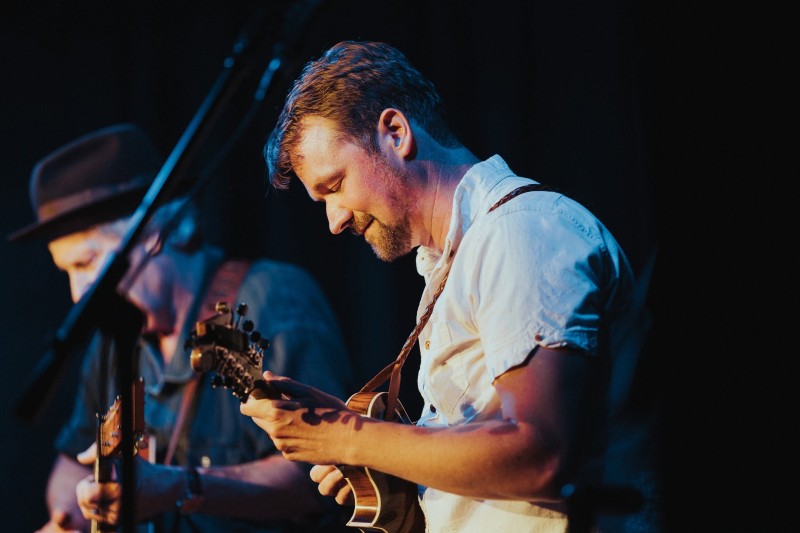
After years of working as a sideman, Brad Phillips realized it’s time to be front and center.
The Dexter, Michigan, singer-songwriter and multi-instrumentalist is focusing more on his own material and live shows.
“I’m at this point where I’m looking back at the whole road that I’ve traveled; I’ve done a lot of stuff, and I’m grateful for it,” Phillips said. “It’s exciting to think about what comes next, and instead of waiting for who’s going to call me next, I’m calling me. And so, I’m trying to be intentional about just doing that on purpose.”
Phillips spent four days this summer revisiting his musical purpose in the woods by writing and practicing music. Playing a variety of different instruments—acoustic guitar, mandolin, and violin, to name a few—helped him feel reconnected to it.
“I brought my little recording rig and creative-vomited for four days, and I got back to basics and practiced my scales and my etudes,” he said. “It was like: ‘Oh yeah, this is a part of who I am, and it always has been.’”
Before taking his musical retreat, Phillips had been touring on and off with actress and singer Patti LuPone for the last two to three years. He also collaborated with LuPone on her 2024 album, A Life in Notes.
“That’s been the primary thing, all while trying to understand what inspires me musically as an individual and as the musician Brad under my own name,” Phillips said. “My whole thing over the last 20-25 years has been: ‘How can I best serve other people’s visions?’ And of course, that is essentially a side man, which I love, and I will always love.”
While he enjoys collaborating and performing with a roster of Michigan musicians, including May Erlewine, Joshua Davis, Chris DuPont, Rachael Davis, and Jeff Daniels, he’s begun releasing his own material.
Americana-folk songs like “How Sweet the Sound” and “Dance Again” demonstrate the musical depth and breadth he brings as a singer-songwriter.
“I’ve gone through a lot in the last decade—a lot of transition, a lot of change—and all of it has brought me closer to living more truthfully, more authentically, which then allows for the creativity to flow a little more organically,” said Phillips, who’s a lecturer at the University of Michigan’s School of Music, Theatre & Dance.
I recently spoke with Phillips about his career ahead of a November 6 show at Rancho Tranquilico in Dexter.
Q: What does your music mean to you now?
A: I feel very recharged and very much reoriented around my purpose these days. Sometimes you go on a 15-year distraction, and I keep talking about little Brad. Oftentimes, people talk about their inner child work, and I don’t think I’ve done any official version of inner child work. But I certainly understand the value of that mindset, and in a lot of ways, I feel reconnected with the goals that that little kid had and honoring that and doing the things that he would really think are very cool. It’s a great way to stay grounded, centered, and focused.
When I was a kid, I stole my dad’s Neil Diamond record collection and listened to them on my Fisher-Price record player. That was the original goal, and I said, “I’m gonna do this.” Then, the violin came into the scene, and I did that—and still do that. But it’s all coming full circle now, where I’m starting to write again, perform my own shows again, and do the singer-songwriter thing. It’s a lot of fun, and it’s really good for little Brad.
Q: What impact has the Celtic crossover band Millish had on your career?
A: I had a crazy experience about two years ago; I was in New York for Patti [LuPone’s] rehearsals, and I went to an Irish session in a pub in the Village. It was a tiny place, and people were playing Irish tunes there. I was with a friend, and he introduced me to the group. He said, “This is Brad; he used to play in a band called Millish,” and everyone in the session said, “Oh my god, Millish!” And I thought, “What?!”
Then, later I met Martin Howley from We Banjo 3, and he played at the Ebird & Friends [holiday] show. The first thing he said to me was: “I had the Millish record.” He grew up in Ireland, and he had the record. He said all of his friends had it, and everyone he knew at that time was obsessed with that album to the point where everyone could play along with the whole record. It’s so wild that this [band and album] I did in my 20s has made a historical impact on the Irish music community.
Q: How does it feel to perform your solo live shows again?
A: I haven’t done my solo show in a long time, and I’ve done three of them so far since August. It feels so good, and not only does it feel good in the way that it used to, but it feels good in the way that it does now. It’s free of me trying to prove something or defending who I am.
I’m just going to go out there, do what I love to do, and share that with whoever’s there. Beyond the creative process of preparing for something like that, I forgot there’s something that happens when you walk out on stage when it’s your show.
Something happens where I transform into this elevated consciousness, and it’s something that I’ve learned that not everyone has access to—and I forgot that I do. I was standing behind the door, about to walk on for my JD’s Stage Bistro show [in Chelsea], and I could hear everyone out there. I could tell the vibe was up pretty high, and I knew it was going to be good.
It was this moment of thinking, “Just trust that it’s going to work.” So I put my hand on the doorknob, opened the door, walked out, and as soon as I was out there, it came alive. I became this other version of myself that is heightened. There was a crackle, or an energy, and I could feel in the room and feel with the people out there.
I have to trust that the audience is going to be there for me and with me, and it always is. Every audience has a different resonant frequency. Every single night is different, but it’s there, and it’s going to carry me through it, and it always does. I can’t wait to do it again.
Q: “How Sweet the Sound” is about creating a lasting musical connection with people. How did performing live outside during the pandemic inspire this song?
A: I wrote it during the pandemic because everything had shut down. I got a gig playing at Sava’s in downtown Ann Arbor, and it was every Saturday for about six or seven weeks. I would take all my stuff down to State and Liberty [streets], and they’d shut down the street so people could eat at the restaurants outside.
I played in the street there by the State Theatre, and it was a real lifesaver. I got to play for humans for the first time in however long, and sometimes there’d be a lot of people out there—sometimes only a few. Sometimes there would be one table of four with one person who’s trying to stay engaged with the conversation, but also clearly turning around to pay attention to what I was doing.
So then it becomes about that one person, and that’s just as special, if not more special than [playing] in a 3,000-seat venue somewhere. But on the nights when nobody was out there, I would play it and think, “Well, maybe somebody somewhere can hear this.”
And then there’s the apartment building right there at Washington and Liberty [streets] where Buffalo Wild Wings [was], and I’d look up, and there would be lights on in those windows up there. I thought, “Well, maybe there’s somebody up there who knows every Saturday I’m going to be playing.”
So I started closing my set with “Amazing Grace,” and every Saturday at 9:30 pm, people knew that I was going to do that. It was maybe the one thing they knew they could count on at that time. Every Saturday at 9:30 pm, that guy’s going to put down the guitar, pick up the violin, and play “Amazing Grace.”
And maybe that one apartment window up there was Benny, maybe that other window was Caitlin, and maybe that other window was Sarah. I just invented these characters and thought, “Maybe they need this,” and so that’s what that song is about.
Q: How did the song come together while recording it?
A: I started recording that song, and it took two or three years to get it done. I was at [producer] Chris DuPont’s place recording for someone else’s project, and we got through that pretty easily, pretty quickly. So I said, “Well, let’s put the violin on my song.” We pulled it up, and that was one take straight through. There were no edits in that violin part—it’s just one take. It just felt really good; I may have tuned a couple of notes, but it just felt very natural and organic.
Q: What’s it like to perform “How Sweet the Sound” now for audiences?
A: When I do my solo show, I play that song with the guitar, and then I get to the end, and people are probably thinking, “Are you going to do it?” So there’s this awkward moment where I have to put the guitar down, and then I’ll do [“Amazing Grace”]. A lot of times I’ll do it off the mic; I’ll come downstage, go out into the audience, and do it.
And then it’s hard to do anything else after that, but usually I do because it’s hard to leave them with that. It’s a beautiful thing, but I usually leave them with something more upbeat. When I write a song, put it out, and play it for people, it seems like I’m onto something. It seems like I have a message that people usually connect with.
Q: What classes are you teaching at U-M?
A: I have two full sections of an improvisation-based music theory class, which I love. I get to integrate my life as an artist in the real world with what I’m doing in the class. In the class, we learn something, but then we talk about what it means to [the students]. They take a concept, improvise and create with it, and develop a connection to it.
It’s different than a normal written theory class, and I get to share what I’m doing in the world and how I use what we do in the class at a gig . I also have a roots music and improv for strings class, which is just a fancy title for fiddle tunes in college. I have tons of string players and guitar players. Last year I had a saxophone player who took the class and can now shred fiddle tunes on the saxophone.
But that’s my project class that I’m trying to build in the School of Music, Theatre & Dance for weirdos such as myself who didn’t really have a home. As an undergrad at U-M, I was a jazz major, but a string player in the jazz department. There were no violin parts in the jazz band, and I wasn’t in orchestra, but I took classical violin lessons.
I was this guy who drifted between the two departments, knowing there are other kids in the world who are fiddle players like me, but there’s not really a home for them in a major music school. I’ve been trying to design this program since grad school, and my little roots class is taking off.
Q: What plans do you have for new material?
A: I have two new songs that are ready to record. One I started writing as a kid when I was seven years old. It’s called “I’ve Been Waiting for You All My Life,” and here I am in adult life 2.0; [my fiancée] Hope [Shangle] is around, and I could finally write the song. I’m really proud of it, so that’s ready to go. I wrote a song about being a dad called “Fighting Dragons.” Chris DuPont helped me write a bridge, so that one’s really great, and I’ll have to get those going.
I’m just looking forward to continuing to build the new [material]. Now that I’ve got three or four songs that have become [actual] songs, it feels like I can actually do this. I wasn’t so sure for a while; it felt like I had to wait for some cosmic event to write a song. Now, I just have to sit down and start, and they write themselves.
Q: What advice would you give young people pursuing music?
A: I’m so inspired by having the opportunity to talk to my young students now. If there’s anything I could tell a 20-year-old or a 22-year-old, it’s this: If you want to do this, or something like this, and you feel like you have something to offer, then you should do it—and be selfish about it.
You don’t owe anyone anything, but you owe yourself a shot, and you deserve a chance. You have to be your own cheerleader and be the first person to believe in yourself, and then you’ll pick up others along the way. And you have to want it more than anyone, but it’s worth it—it’s worth a shot. You can do it.
Brad Phillips performs November 6 at the Rancho Tranquilico house concert series in Dexter, Michigan.

