
Editor’s Note: For a related article, see the One Track Mind feature from Pulp.
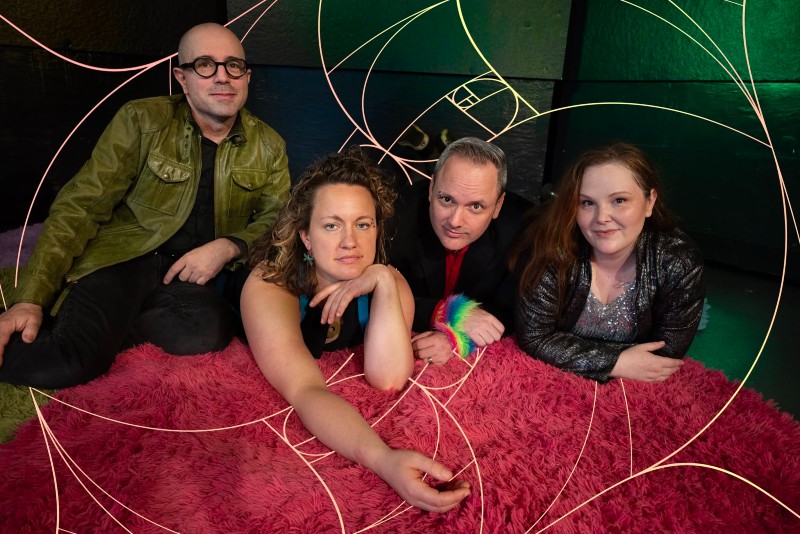
Kat Steih & The Ferals confront evil forces and conquer the dark side on Feral Geometry.
The Ann Arbor, Michigan, band sings about courage and resistance while exploring different life struggles on its new art-rock EP.
“To me, the songs are about forces in life that can hijack our brains: despair, denial, addiction, and compulsion,” wrote Kat Steih, the band’s vocalist and songwriter, in an email interview.
“What is interesting and new in this record is that the singer in each song is a voice outside of the hijacking force—a voice that is offering a bigger perspective.”
Steih shares that perspective through confident vocals and evocative lyrics across Feral Geometry’s four tracks, which are backed by spirited instrumentation from bandmates Alex Anest (guitar), Bob Zammit (drums), and Marlo Williams (bass).
“The real creative process of this EP was the long period of The Ferals living with these songs, even though the writing took place across a whole decade,” wrote Steih, who’s releasing Feral Geometry on November 5.
“We’ve been playing them in our concerts since right after our first EP came out, so for three years. Arrangements got tighter, more detailed, and the stories of the songs started blending into a new bigger outline.”
As the band crafted the songs for Feral Geometry, they also explored a variety of genres, ranging from pop punk and doom metal to experimental rock and punk rock.
“So even though some of these songs are more than 10 years old, the record itself feels very current to me,” Steih wrote. “The songs had to travel through all these different versions of me, different collaborators, and finally this particular band before they could become Feral Geometry.
To learn more, I recently did an email interview with Steih and Zammit ahead of a November 5 EP release show at Ziggy’s in Ypsilanti.
Q: It’s been over two years since the band has released an EP. What excites you about the upcoming release of Feral Geometry?
Kat Steih (KS): As artists, we’re always excited about our most recent work, but in this case, we’re getting a lot of positive reactions from people we admire, and it’s very encouraging.
Dave Roof of Rooftop Recording recorded both of our EPs and called this one “a definite elevation.” Life in Michigan’s Chuck Marshall reviewed our record early and generously called it “a masterpiece.” That recognition really means a lot to all of us. Also, we are really proud of the song “iO,” and we can’t wait for people to hear it!
Q: You describe Feral Geometry as “creating a world that always seems on the verge of flying apart, while somehow remaining completely locked in.” How did that concept spark the EP’s title?
KS: I found an article on PubMed called “Navigating the Paradox of Creativity: Pathways to Fostering Talent and Innovation,” which states: “Creativity possesses an inherent paradox, composed of opposing forces that must coexist in dynamic tension rather than reconcile into stable equilibrium.”
This phrase 100 percent describes The Ferals. In our band, we have two opposing energies in constant tension—Saturnian structure seekers and Uranian structure destroyers. That dynamic is constantly shaping our musical expression. Feral Geometry is a perfect [EP] name to reflect our dynamic state.
Q: What does each member of The Ferals help bring to the band’s sound?
KS: [Guitarist] Alex [Anest] is the Mick Ronson to my David Bowie: My musical foil who matches and complements my energy. His playing is perfect for every song. He is a shining North Star and a nurturing bandmate that both Marlo and I have played with for many years.
[Drummer] Bob [Zammit] brings an incredible amount of structure, precision, and clarity. He has this drum-corps exactness, which is really good for The Ferals. The record features him in amazing form, with a lot of very subtle auxiliary percussion just below the surface, locking everything in like a Swiss watch.
[Bassist] Marlo [Williams] is our newest member. She comes from an orchestral background, has run her own chamber group, and has put on shows with music and dancers—a personal goal of mine. She is a gifted arranger, describing sounds in flavors and in textures, like when she said she wanted her tone on the record to sound “like a black pearl as big as your head.”
The lyrics, the intention, the melodies and vocals, and the frontwoman energy—this is my wheelhouse.
Finally, there’s Samn [Johnson], my sidekick and our silent bandmate in Kalamazoo, who arranges the first drafts of the songs so they can be brought to the band.
We are all very different people, but the one thing all The Ferals have in common is very high levels of musical skill and emotional intelligence. It would be impossible to keep a band like us going without this.
Q: “Christopher” addresses someone’s irrational fears and helps them find comfort in reality. How did Christopher Moltisanti from The Sopranos inspire the song?
KS: I was so touched by Christopher’s character when I watched the show during the pandemic. He is a sweet, sensitive person trapped inside his own perception, always trying to prove himself. He couldn’t let go of trying to become someone else.
I feel super protective of Christopher. The voice in the song is trying to interrupt his spiral and tell the person underneath that “all that burning is [his] glory,” i.e., all of his struggles are actually the rare jewels of his life.
The Adriana line is more of a throwaway joke. He loved her and complained all the time before she died, but after she died, that’s when shit really hit the fan.
Q: “Christopher” reflects the genres of pop punk and alt rock. How did those genres influence the track’s sound and production?
KS: “Christopher” was creatively downloaded as an entire chorus of pop punk. Pop punk was the music of my childhood. It created a blueprint of a musical roller coaster that rides on a very forward-leaning drum beat, barrels around hairpin turns, twists, corkscrews, and climbs up a mountain to sail over the top. It is the perfect vehicle for a song like “Christopher.”
Q: “Prison Below” is about resisting the underworld’s pull and the demons that control it. What inspired the song’s dark subject matter and its themes of resistance?
KS: The words to “Prison Below” honestly just came out of me before I completely understood what they meant. Over time, though, the song has become a little psychological myth in my head.
Marlo, our bassist, calls the visions in her head that come with music her “brain movies,” and I’ve started using that phrase, too. In my “brain movie,” the “Prison Below” is a real place beneath the world—a giant pit under streets and houses—where everything is lit with neon green and purple lights.
Psychologically, the “Prison Below” is any force that develops its own gravity. Depression, addiction, a destructive relationship, hopelessness—they are all the “Prison Below.” Evil demons climb up from the depths to collect the protagonist, and the protagonist basically says, “No, you can’t have me. You can’t beat me.” I love that because the resistance itself becomes a force: The darkness may have gravity and crawling evil demons, but the person has strength and will.
It’s a great doorway into Feral Geometry. It’s very theatrical, and it tells you immediately that we make music that is strange and psychological. “Prison Below” is actually not the strangest song on the record, though. It’s just an entrance to a circus funhouse full of impossible rooms.
Q: How did “Prison Below” become a doom metal song?
KS: The original version started with me taking a beat in GarageBand and putting an effect on it that added delay and pitched it down an octave. The beat sounded so filthy and echo-y. It was lurching forward and made me feel like I was in hell being pursued by a huge monster.
If “Prison Below” lands somewhere in doom or sludge [metal] territory, I think it’s because those genres are very good at creating the lurch. We weren’t trying to imitate those genres so much as preserve the lurch.
Q: “iO” examines being enchanted and overpowered by someone. What was it like to explore those sensations while writing the song? How does the song also pay tribute to your iO Megaji persona?
KS: The name iO Megaji, which was the name of my previous project about 10 years ago, came from a dream I had around 2012. In the dream, I was standing in front of this enormous being of light, and just being in her presence felt like a blessing. She told me her name was iO Megaji. I asked her what that meant, and she said, “I’m so mesmerized, I’m amazed.”
Around that time, people often told me that when I performed, I naturally drew people’s attention and never seemed nervous. I started to think that maybe this ability to project energy outward was my gift, and I wanted to name my music project after it.
Over time, though, I got a little confused about what power was supposed to look like. As I was very good at projecting energy onstage, I started to think that I also needed to be forceful—very “yang”—in the rest of my life. That didn’t always work particularly well.
Eventually, I realized that, paradoxically, I’m actually an extremely receptive person. I usually begin an idea or a structure, but then I need to absorb what other people are doing. I watch their ideas develop, notice possibilities inside them, and then my brain starts fusing all of those pieces together into something new. So even when the final result looks very assertive, the process underneath it is often much more “yin”: listening, receiving, waiting, combining.
Around the time I wrote “iO,” I knew someone who embodied almost the exact opposite kind of power from the power I was trying to have for myself. He was incredibly restrained in his presentation, but somehow that restraint made him seem even more effective. I found that fascinating. How can someone have so much to give and remain silent? What kind of things does this silence make possible?
Being around people with that kind of energy can make me feel exactly the way the song describes: enchanted, intensely curious, almost like a suspended animation. At first, I found that feeling uncomfortable because it ran against what I was trying to cultivate in myself. So “iO” became an exploration of that quieter form of power—the power of restraint and openness.
The song was born around 2014, and it has now lived three different musical lives: the original electronic version, a version with the iO Band I played with back then, and now this Ferals version. I’ve learned a lot since 2014 about not needing to generate or control things myself, and having “iO” on Feral Geometry allows me to celebrate that.
Q: “iO” features a long instrumental section that’s rooted in experimental rock. How did that section evolve while working on the song?
KS: In the first electronic iteration of “iO,” this instrumental section had a hypnotic, undifferentiated electronic drum pattern that made the listener feel like they were being carried away by a strange rhythmic current. Over that, the synths built in harmonic intensity, and eventually, Cory Tripathy’s live drums would crash through the electronic drums. The song became this back-and-forth between two completely different sonic worlds.
When we remade “iO” for The Ferals, this instrumental section became Samn’s playground. He really went to town on the intricacy of the arrangement—overlapping three-against-two patterns, a section that basically functions as one enormous rhythmic puzzle, then suddenly a section in 4/4, and finally a section in 7.
I think the new arrangement creates a similar sensation to the original. Multiple worlds exist at once, but instead of confronting each other, now they overlap and interlock. In my mind, it feels almost like quantum universes occupying the same space—different systems of time happening simultaneously.
The amazing thing is that Bob, Marlo, and Alex can actually play this song. It’s truly a celebration of Samn, Bob, Marlo, and Alex, who are such gifted and strong musicians.
Q: The closer, “I’m So Dead,” is a provocative tale about sexual desire and fatal attraction. How did it become an empowering punk-rock song?
Bob Zammit (BZ): Hey there, Lori, and hello to your readers! I play drums for Kat [Steih] in The Ferals and have for years now, which comes in handy in moments like this. To be the band around someone like Kat Steih is to be an artisan in service to an artist, which includes answering urgent text messages to beat a press deadline!
To the question—which none of us are inside her mind as she writes—I can say we’re all inspired by the fearlessness she displays when tackling topics like this one. Even if she is sometimes narrating from a character’s point of view, these are words she has to perform each night with tremendous exposure.
Every time, she delivers them with a generous vulnerability that draws the shyest wallflowers and crustiest cynics toward the stage. Watching it happen, it seems like Kat is constantly striking the same essential bargain with our audiences. [It’s] something like, “We don’t need to be embarrassed to talk about what we want, where we’re weak, and how we feel. I know that’s scary, so I’ll go first.”
Q: Tell me about the creative process for Feral Geometry. How did the songs come together while writing and recording the EP?
KS: The funny thing about Feral Geometry is that these songs were not all born anywhere near each other. They are more like four objects that were floating around in different parts of my life and eventually got pulled into The Ferals’ gravitational field.
“iO” and “I’m So Dead” both go back to around 2012. “I’m So Dead” already had a rock arrangement because my college friends Summer Krinsky and Sam Naples, who were in a rock band called Pocket Candies, helped me arrange it back then. “iO,” as I mentioned earlier, was completely rebuilt for The Ferals by Samn.
“Prison Below” came later, around 2018. I brought it to Samn years afterward so we could turn it into something the band could play. “Christopher” came later still, around 2022, when I was working on Songs From a Far Away Galaxy … and West Park.
We recorded the EP with Dave Roof at Rooftop Recording, whom we LOVE. For this record, we mostly worked “in the box,” layering the parts rather than trying to capture the entire band at once. That suited these songs because there are so many tiny architectural details inside them.
We could build the music almost like a little city: Bob puts something down, then Marlo adds weight underneath it, Alex creates another plane of information, I add the voice, and suddenly, there are windows and staircases and weird hidden rooms everywhere.
Q: What plans do you have for your November 5 EP release show at Ziggy’s?
KS: For the November 5 show at Ziggy’s, the current Ferals lineup—me, Alex, Bob, and Marlo—will be playing and bringing in some friends we really love. By the Willow is coming down from Flint to join us, and Milan & The Ellipses will also be on the bill.
The ideas are still germinating, but we hope there will be some special guests to fill out some of the arrangements from the album.
Q: What’s up next for you and the band?
KS: We already have four new songs in various stages of being born, and the band is learning them now.
Feral Geometry actually feels like a beginning. For me and my songwriting voice, it is a total beginning. My songs used to be about the powerful forces that pulled me down, but now there is another voice that can see the force clearing without being swallowed by it.
Musically, Samn and I also know the band much better now. We understand their preferences, their strengths, and the kinds of musical problems they actually enjoy solving, so we’ve started custom-building the songs for them.
Both sides of the project are evolving at the same time: The psychological world inside the songs is changing, and the musical world around it is becoming more specifically us. It feels like we’ve finally built the strange Ferals machine, learned how all the gears move, and now, we get to see where it can actually take us.
There are definitely new forms on the horizon. I just can’t reveal them until Feral Geometry has had its moment.
Kat Steih & The Ferals perform November 5 with Milan & The Ellipses and By the Willow at Ziggy’s, 206 West Michigan Avenue, Ypsilanti, Michigan. Doors are at 7 pm, and music starts at 8 pm. $10 cover at the door.

