
Editor’s Note: For a related article, see the One Track Mind feature from Pulp.
For Toadally, the struggle is real on Crash.
The Ann Arbor, Michigan band explores the ups and downs of personal and professional challenges on its debut EP.
“We had a general vibe of what we were writing, and it just seemed to impact the songs in that kind of way,” said Spencer Mullins, Toadally’s vocalist and guitarist.
“And then later on, once we started organizing and revising the songs, that’s when it started to take shape as one project—one EP. We chose Crash at the very end because we didn’t know what to call it.”
On Crash, the band addresses themes of impulsivity, courage, and disappointment across five multigenre tracks that primarily reside in the indie-rock world.
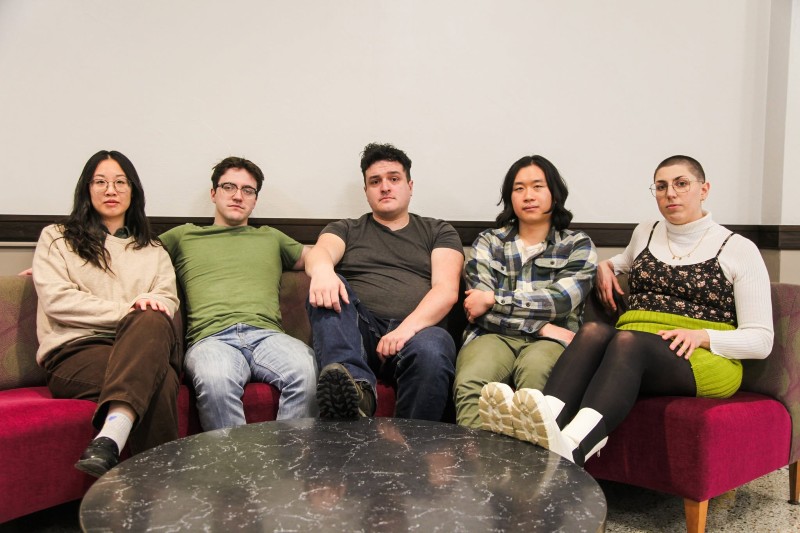
Bandmates Victoria Horne (vocals, piano, synth, flute), Fangbo Yuan (vocals, guitar), Jake McCarthy (drums), Kim Truong (bass), and Mullins weave a compelling tapestry of tongue-in-cheek stories and energetic sounds that resonate with all kinds of listeners.
“I’m sure you’ll pick up on those themes of being dissatisfied with the way the world is or being dissatisfied with yourself,” said Kim Truong, who’s also Toadally’s loremaster.
“Even though a lot of our music tends to be a mishmash and in the moment and reactive, I think those themes of how we navigate ourselves, the world, and other people are pretty common.”
I recently spoke with the band about the inspiration behind its latest EP.
Q: How did Toadally initially form?
Spencer Mullins (SM): It started with me in 2023, and I had been looking for band members for a while. I had met one person through Craigslist, and his name is Nick. He’s now a former member of this band, and we just started jamming together.
Nick then found Victoria through Craigslist, and they decided to come to my house at one point and jam with us. It formed from there: Victoria knew Kim, and I think Nick found Jake as well. It was that five-piece for about a year. We weren’t doing anything serious, but we were jamming and writing some songs.
We played live once or twice, and after that, Nick decided to leave the band because he had accomplished everything that he wanted to do. Then we decided we needed another person, and that’s when Fangbo came in. We auditioned him after a couple of other people.
Q: Victoria, what was it like to join Toadally back then?
Victoria Horne (VH): For me, it was a desire to play in a band, but it hadn’t really been something that I had put a lot of thought into. When I had started thinking about it years before, I thought, “Only cool people are in bands.”
Back when I was a teenager, I had only played the flute, and I didn’t play a band instrument. I went to school for music therapy at Eastern Michigan University, and I learned guitar and piano and took some voice lessons. I had a bit more confidence in those things, and I had a bit more confidence in myself.
After I graduated, I didn’t have a music ensemble, so I said, “I’m just going to join a band.” I didn’t know how to do that, so I went on Craigslist and ended up showing up to Spencer’s basement. And then we were looking for a bassist and a drummer, so I reached out to Kim.
Q: Kim and Jake, how did you join the band as well?
Kim Truong (KT): A lot of the band is through friends and friends of friends, so that’s how I joined. The original band was super nice about teaching me [bass], even loaning me equipment or letting me buy equipment from them.
It’s been a journey because I started through orchestra. I was playing the upright string bass, and something translated this way when going from vertical to horizontal [bass]. Over time, it worked out great, but it was a big transition, though. I’m really grateful the band allowed me the chance to explore a different music genre.
Jake McCarthy (JM): It was similar to Spencer in a way. I had spent a while looking for a band, but I hadn’t had much luck. There’s a site called BandMix, and it’s kind of like LinkedIn, but it’s just for musicians. In July of 2023, Nick had reached out to me, saying the band needed a drummer. I met him a week later, and we jammed, and then I met the whole band.
Q: Fangbo, what brought you into the fold for Toadally?
Fangbo Yuan (FY): I found out later there was an audition process. They brought me into the studio and had me play a few of their songs that they had written at the time. Kim and I were friends from college, and we had been on a road trip together. I knew Kim was in Toadally, and she shared that the original guitarist had left.
She remembered that I played guitar, and we had met through the Michigan Pops Orchestra. I had played guitar in a few guest spots here and there throughout the years. I had been looking for a band—similar to Spencer—since I was an adolescent, but had given up on that a little bit.
College life is so transient, and it’s hard to make things stick. I was really excited for this—just coming out of nowhere. They said, “You can’t just [join] because you’re friends with the band. You have to go through the formal audition process just like anyone else. They sent me a couple of songs that they had written, and I had to learn them. I practiced very hard, and I guess I made a good impression.
Q: How did an affinity for toads spark the band’s name?
JM: We were thinking about naming the band Toad, and then I said, “We could name the band Totally, but just have the word ‘Toad’ in it.”
SM: We had voted as a band, and we had Toadally with a bunch of other forgettable names.
VH: But they were mostly toad-related.
SM: Everyone voted for Toadally, and hence, the band name. It was really a thoughtless process of saying, “Hey, I have this [name] on the brain.” The band name is important, but the music is definitely more important.
KT: When I joined the band, I absolutely freaked because I had a big interest in frogs and toads at that time.
Q: What does the band name mean to you now?
FY: People have pointed out more and more to us lately that you can emphasize the “ally” part of the band name. We’ve been on our journeys of self-exploration, and it turns out there are a lot of intersecting identities and experiences that are reflected through the band.
To name a few: neurodiversity, queerness, BIPOC, and things like that. The “ally” part definitely resonates, or at least in the way that people have pointed that out to us.
I don’t go into it thinking, “Oh, we’re gonna have to reflect what ‘Toadally’ means.” But I think it’s cool the name is whimsical, and when we play our shows, there’s a whole buffet—there’s something for everyone. We span all sorts of genres; people have compared us to bands we don’t even listen to. I think that is a really cool aspect of it.
Q: How does your band name reflect your creative vision?
SM: I definitely [take] pride [in] us being able to create space for things like that because that’s always needed in the world. I do very much appreciate my band members in that way of just like how they all bring something. Not even just musically to the music, but something of themselves, like things they want to talk about or how they represent themselves.
We’re consistently told that our style is fun, and it’s this eclectic combination of genres—you can’t quite pin us down. It’s exciting because it means we’re experimenting and doing what we think sounds good.
VH: As a band, we haven’t talked about what the band name means to us or what it means externally. We’ve all had similar experiences of hearing what others think. It’s cool hearing our own interpretations and how they intersect like a Venn diagram.
For me, Toadally is very silly and almost cartoony, in a way. During our rehearsals, we’re so goofy. As Fangbo said, the whimsy of the name and the silliness that’s inherent in all of us really comes through the band name and how we are on stage.
Q: Crash reflects several music genres, including indie rock, pop rock, metal, and punk. How do those genres continue to influence your songwriting and production?
VH: Because of our different musical backgrounds, it’s really such a melting pot. Speaking for myself, I grew up with classic rock, Motown, musicals, and classical music. I think all of those things are naturally imbued into the music because that’s what we’re used to hearing and that’s what we like hearing.
“Car’s on Fire” is a very dynamic, contrasting song. Every time I hear a song from the 2000s, especially a pop-punk or Avril Lavigne song, I think, “Oh, that’s why I write all these verses and scream in the choruses.”
SM: It’s like a melting pot of genres. I think that’s the natural progression of music with people who experiment. Because we listen to so many different things, we all try to replicate what we like.
I’ve been listening to indie rock from the 2000s and 2010s, and it’s very reflective in the kind of guitar playing and writing I do. We’re just trying to create something, and how it turns out is just the culmination of that process.
FY: Victoria and I come from that early background where they started on flute, and I started on violin. I had a traditional classical education and liked alternative music on the side. I always thought, “This is what I want to play,” but obviously, that [classical music] influence has crept in quite a bit.
With my approach to songs, it’s really about the harmony, and not even about the melody or the lyrics; it’s the way they’re actually constructed. The guitar part in “You Brighten My Life,” and it’s all over “Full Body Headache,” a lot of the movement comes from the way the chords change.
There are a lot of ascending and descending lines going through that. I think that’s the classical type of infrastructure, and I don’t deliberately try to do that. I think that bare-bones [aspect] gets translated to any type of music.
I had a phase recently where I was getting into a lot of anime music … and translating it through that lens of what I grew up with. It’s no surprise we have all sorts of genres blended… and if somebody has a cool idea, we roll with it and see what happens.
Q: “Car’s on Fire” examines the risks of being impulsive and spontaneous. How did those experiences inspire this song?
VH: It’s more about being impulsive and doing something you know is harmful. Or you’re just engaging in one of your bad habits … but it just feels comfortable, and it feels right. You’re saying, “I don’t care—I’m just gonna crash,” and that’s why a lot of the off-kilter sounds are there, due to those guitar parts. It’s more like a commentary on my experiences with that.
Q: “Costco Cutie” is about admiring someone from afar and wanting to approach them. How did a past interaction with someone at Costco lead to writing it?
SM: I wouldn’t say it’s about a specific interaction. It’s more about being single, looking for a new partner, and seeing someone who’s cute. It takes nerve to go up and talk to them and put yourself out there, which is scary.
It’s also an innocent thought to think, “Oh, that person’s beautiful,” and they’re the only person you notice like that. Jake, Fangbo, and I wrote that song last year when we were jamming. Fangbo and I worked on the lyrics for about two sessions, and then I wrapped up the structure of the song.
Q: How does the Cuties brand of oranges tie into the song?
FY: I joke that the song is about [Cuties] oranges, and we were laughing about that. You can buy a lot of oranges at Costco, like too many for you to finish. I thought it was a cool phrase, but the more common interpretation is glimpsing at somebody at Costco.
At most stores, you can’t really see people through the shelves, but Costco’s shelf height is such that you can see people walking across [the store]. That setting really lends itself to that idea that you’re just catching a glimpse of somebody and hoping that they don’t go away.
You’re hoping you don’t actually have to do anything and that they’ll just come to you. It was informed by real-life situations that we all found ourselves in and can relate to.
Q: “Full Body Headache” reflects on feeling overwhelmed and trapped in life. How did this sensation arise from working at a past job?
FY: The whole idea is: When you wake up in the morning, and you feel OK—like new day, new me—I’m gonna make the most of it. And then you’re basically realizing that it’s gonna go the exact same as it has been, and by the end of the day, you’re feeling this soreness, like that feeling you got hit by a car when you’re down with the flu. That’s a full-body headache.
It’s basically that tension between trying to pretend everything is OK because your life depends on it, and you’re basically wilting away on the inside, wondering, “How do you maintain that?” In this case, you can’t, so the tension overtakes the calmness that you’re projecting onto yourself.
Q: How did your songs come together during the writing process?
SM: We wrote all of the songs during the fall and winter of last year. “Car’s on Fire” is the oldest song from that. Someone may come up with an idea, and we try to make it better. That’s what happens when you’re in a band with so many wonderful artists who want to contribute.
Q: Tell me about the recording process for Crash.
SM: We recorded it with Whit Fineberg at Square Lake Sounds, and he’s based in Bloomfield Hills. He’s a great guy, and we’d love to work with him again. Whit is worth all of his expertise and time. He has a background in jazz, and he’s played in a metal band, so he has really good ears for music. Whit really helped us elevate the EP through all of those sessions, and it was very collaborative too. He was always open to what we thought of and if we wanted to add things or whatnot.
Whit came out to meet us in March 2025, and he met us at Grove Studios in Ypsilanti. We played our songs for him to talk about them, and he wanted to get a few of our ideas. We also wanted to get a few ideas from him. We started recording the EP last April, and we were laying mostly drum and bass tracks around that time. We had sessions here and there through the next couple of months. We finished recording last fall.
Q: Do you anticipate working on new material soon?
VH: Someone’s always writing something. There was a month before our gig season started, and we had finished recording the EP. We were writing more because we said, “We missed writing.” And even with this break and things in the fall, we said, “Let’s write some more things and recenter ourselves after the big EP push.”
SM: During that period, we wrote four new songs in a month and a half. We have a lot of material that we can work with.
Q: What plans do you have for the fall?
SM: We have a couple of other shows in the works, primarily for the fall. As a band, we’ve talked about taking a break for about a month because we’ve always been up to something. We’re no longer beaten down by life; we’re ready to play some more music for the world. We’re focused on sharing the EP with everybody and then going from there.

