
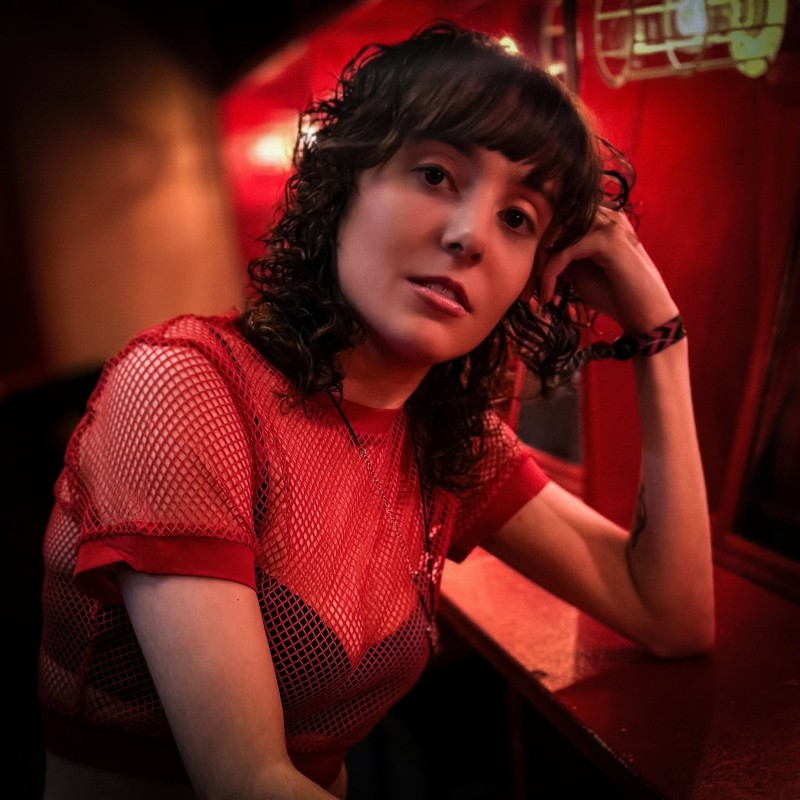
Kelsey. follows her passion on LOVE HARD.
The Ann Arbor, Michigan, singer-songwriter and multi-instrumentalist embraces that intense emotional state on her full-length debut album.
“It was written about one relationship, and it’s very dynamic,” said Kelsey. (pronounced Kelsey period), aka Kelsey Detering.
“There are a lot of layers to it, and every relationship is kind of like mini relationships all in one. It was one epic encounter, and that’s why I felt the need to write this whole album about it.”
On LOVE HARD, Kelsey. explores the intimate cycles of a volatile relationship—love, heartbreak, and longing—and its trajectory across 16 tracks.
“It was more like my own therapy when this happened to me,” she said. “I had to communicate my feelings about all of this … and whatever was going on with it, a song would just come out.”
Featuring a detailed storyline, LOVE HARD is an immersive, multigenre release that lands somewhere in between a concept record and a double album.
“I wanted it to be a cohesive piece of art that you sit down and listen to, and you immerse yourself in,” Kelsey. said.
“It has those segues, instrumentals, and things to really keep you in there. It’s very much for the music lover, especially if you’re the kind of person who wants to put your headphones on and really immerse yourself in something.”
Kelsey. also plans to recreate that immersive experience live on August 21 during her album release show at The Arboretum in Saline.
“It’s going to be a cool format, and I want to play [the album] by side,” she said. “We’ll play a side, and then we’ll talk to the audience for a minute. Then, we’ll play the other side, and it’ll literally be like you’re listening to the record.”
I recently spoke with Kelsey. about her new album ahead of the show.
Q: You spent a lot of time working on the album. How does it feel to have it out?
A: It’s a little scary, but after two years of doing this, it’s actually out there. It was weird to be done at first, and when I was out of the studio, it was weird not going there.
Q: How did releasing five singles help build momentum for LOVE HARD?
A: With streaming, you have to be consistent to try to build your numbers and your reach. I thought, “If I want to do an album, then I’ll try to play the game a little bit.”
I steadily put out some singles to build hype, so that when my album came out I wasn’t just dropping it into the void. Even with all the singles that have come out, there’s still a full meal to enjoy now that the record is out.
Q: Do you consider LOVE HARD to be a concept record and a double album?
A: It became a light and organic conceptual album, but I didn’t set out to make it one. I thought, “Why not embrace it? Because no one does that anymore.” It’s all very ‘70s in how we recorded, so I said, “Why not lean into that?”
It’s also just under an hour runtime, so it clocks as a single album, not a double album. For my debut album, it would be a bit much to ask people for their attention to listen to a double album.
Q: How did you arrive at the album’s title?
A: I titled it after something about me and not the muse of the album. This is how I am, this is how I love, and that’s what the album is about. I had no idea what the title was for the longest time, and then the title came to me one night at the end of mixing.
Q: LOVE HARD takes inspiration from several genres, including pop rock, alt rock, new wave, and disco rock. What attracts you to those different styles?
A: I think I can get away with it because the album is so conceptual and that’s what ties everything together. I’m allowed to experiment with genres, and I think it’s fun to let the song lead you and not put yourself in a box.
Q: What artists influenced you while working on LOVE HARD?
A: The song “Say Hello” is like a club track. I call it “Club Coldplay” because it starts with a “Fix You” organ and launches into an electric bass-driven club beat with this “Lovers in Japan” wall of guitars. At the end, it’s just so weird how the sounds came together, but I love how that one turned out.
John Lennon is a big writing influence on me, and “Answer to Love” is very John Lennon. The bass on “Girl Loves Boy” is very Paul McCartney for me. When I wrote “February Storm,” I thought, “This really sounds like ‘Drive’ by The Cars,” and I love that song.
Q: “Our Eyes” depicts a new relationship between two people and their shared sense of connection. What inspired the song’s themes of authenticity and validation?
A: That’s really the core of it, knowing that someone sees you almost chillingly well, that they understand the core of you, and in this case, your music. It’s almost too good to be true, just the connection itself.
And what this song is really about is wanting to be the person they see, that they love and believe in. And also the reverse, which is how you see deep inside of them, and how all that is conveyed in just one look. You feel like you’ve truly known this person your entire life.
Q: “Girl Loves Boy” examines the dynamics and behaviors of people as they fall in love. How did this song become an uplifting love story?
A: For that song, I just wanted to boil down to the simplicity of love, and how no matter who you are, no matter what your circumstances are in your life, when you love someone, that’s it. That’s what I felt, so I just wrote it.
Q: “Eternal Flame” is about feeling seen and heard and taking a risk on a new relationship. How did it become a song about trusting your instincts and having faith?
A: A lot of love is about having faith, and I’m not a religious person, but music is my religion. It’s having faith in how you feel and that things will work out.
You’re saying, “Please let this work out. Can this work out for me? Can I keep believing in it and hope that I’m not wasting my time still believing it?”
Q: “Breathe” is an interlude filled with meditation. How does it help set the tone for “Say Hello?”
A: I thought of that in the moment because Eric Wojahn has a Hammond organ in the studio at Solid Sound Recording Company. It was super fun to play that, and I came up with that intro.
We did the intro first, and I said, “What if I did some breathing on that track leading into ‘Say Hello?’” I liked it because it has a lot of meaning to me, and it felt right to do that.
Q: “Say Hello” is a tale of infatuation, intimacy, and connection. How does this track help convey a strong sense of passion?
A: There is a lot of passion, and these days, it’s cool to not care about things. It’s cool to play the dating game, but be sure to care about something—that’s bravery.
Q: How did “Animal” become the most primal song on LOVE HARD?
A: That song is about when you meet someone, and you look at them and have those primal urges. I was changed as a woman writing that song because people talk about biology, and when you grow up, you say, “I’m a feminist.”
But then it happens, and you say, “OK, so the biology is real.” Your body literally starts telling you things. In today’s society, there’s this separation of love and sex, but this album is meant to put them back together.
Q: “Love” is about being there for someone—no matter what. How did this song become the unofficial title track for the album?
A: The song title “Love” is close to the album title LOVE HARD, but it’s about the ultimate act of love, which is being there for someone else. I wrote that song in five minutes, and I said, “I need to do this. I need to offer this comfort.”
And then I had an idea to do a string arrangement for it, and so Eric Wojahn brought in Stuart Carlson and Ben Maxwell, who are both very emotional players. They were perfect for the song, and it came out so beautifully.
Q: “Answer to Love” serves as the final plea to keep a relationship alive. What inspired the song’s themes of perseverance and resilience?
A: It’s about what’s going to happen next. When I wrote it, I thought, “This is what I’ve been looking for, but can we make it work? Can we get past all the things that are in the way?”
There are some obstacles and life circumstances throughout the album, and it’s taking care of those things and figuring it all out.
I also played a lot of synth strings on that song, which added to its epic feel. I wrote it one night, and I was so upset. It was one of those nights when I was starting to lose hope, so I sat down and poured out my feelings.
I thought, “I believe in this. Is it gonna happen? What are you gonna choose?” Because at the end we both have to choose what we’re gonna do with our lives.
Life is about choices, and on the album, I talk about having faith and believing in things that are outside of your control. But, then on the other hand, you make your own choices. I don’t really know what’s gonna happen next, and that’s where we left it.
Q: How did the songs come together during the writing process?
A: Most of these songs were written early 2023 through 2024. I finished writing [everything] right before we went into the studio, and I had written “Good Devil” a few weeks before that. It just came to me, and I thought, “This is cool.”
I wrote that riff on my bass. Those are also some of my favorite lyrics I’ve ever written, and it was originally half a song. I was changing a few things, putting bits of songs together, and piecing it together those last couple of weeks.
I thought “Good Devil” could be a good bleed track for “Animal,” so that worked out. “Animal” was originally two songs, too, and there were actually in two different keys. There was “Animal,” and then there was another song that was a bridge. I met them in the middle and put it all together.
Q: How long did you spend working on the album at Solid Sound Recording Company with co-producer Eric Wojahn?
A: It was 14 months in the studio, and it was November 2024 when I started. There were so many layers and instruments to sort through … and it took a while to get in there and decide what was important and what we had to cut.
Q: What did you learn during the recording process for the album?
A: It was a lot of fun, and I just really enjoyed having the freedom to take my time with everything. I also liked having the freedom to explore, create, and come up with really weird stuff when it felt right to try things. We even did that with the mixing.
My album has a lot of collaborations on it, and I liked bringing in the musicians and having everybody’s input on everything. The album features Michael Harrington on guitar and pedal steel, Billy Harrington on drums, Stuart Carlson on violin and viola, and Ben Maxwell on cello.
Once they were gone and their parts were done, I said, “OK, I can play all of these instruments, and I can come up with all of these ideas by myself.” I played bass, synth, guitar, piano, organ, and percussion. This is both a product of me and also a collaboration.
Q: What excites you the most about playing at The Arboretum in Saline?
A: It’s an experiment. It’s different playing in a new kind of venue when there’s a lot of change going on. Things like: we’re moving the stage, or we’re still figuring this out on our website. It’s been interesting dealing with that, but at the same time, I have a lot of control over how I wanted the seating to look.
They were really great about that and wanting me to make those decisions. I feel like we help each other with it being a new venue, and it’s a nice partnership to have. Jenni Roby really cares about music.
Q: What comes after the album’s release?
A: The next step for me is opening for national acts and getting to play bigger venues. I’m trying to get into those places to get more exposure.
I also might go into the studio and lay down a bunch of acoustic versions [of songs] from the album. I’ve also written stuff on and off, but I’m not really writing a lot right now. When it’s time, it will be time. Maybe next year, I’ll do a single or two because I never want to go quiet for too long.
Kelsey. performs August 21 at The Arboretum, 984 East Michigan Avenue, Saline, Michigan. For tickets, visit The Arborteum’s website.

