
Editor’s Note: For a related article, see the One Track Mind feature from Pulp.
OMO x Le Dawg’s self-titled album provides a brief respite from the outside world.
On their debut release, the Ann Arbor, Michigan, electronic duo creates different vibes and sonic spaces for people needing an escape.
“I want to get into that place where I’m no longer in my consciousness, but I am depersonalized completely into the music,” said Evan Haywood, aka Le Dawg.
“When you’re in that music, it frees you from all of the other things going on: all of the bills you have to pay, all the things you have to worry about, all the craziness in the world. It’s like a place of peace, and it can sound like anything.”
Featuring six tracks, the album is a collection of minimalist, ambient techno that explores a spectrum of sounds, ranging from meditative and percussive to dreamlike and intergalactic.
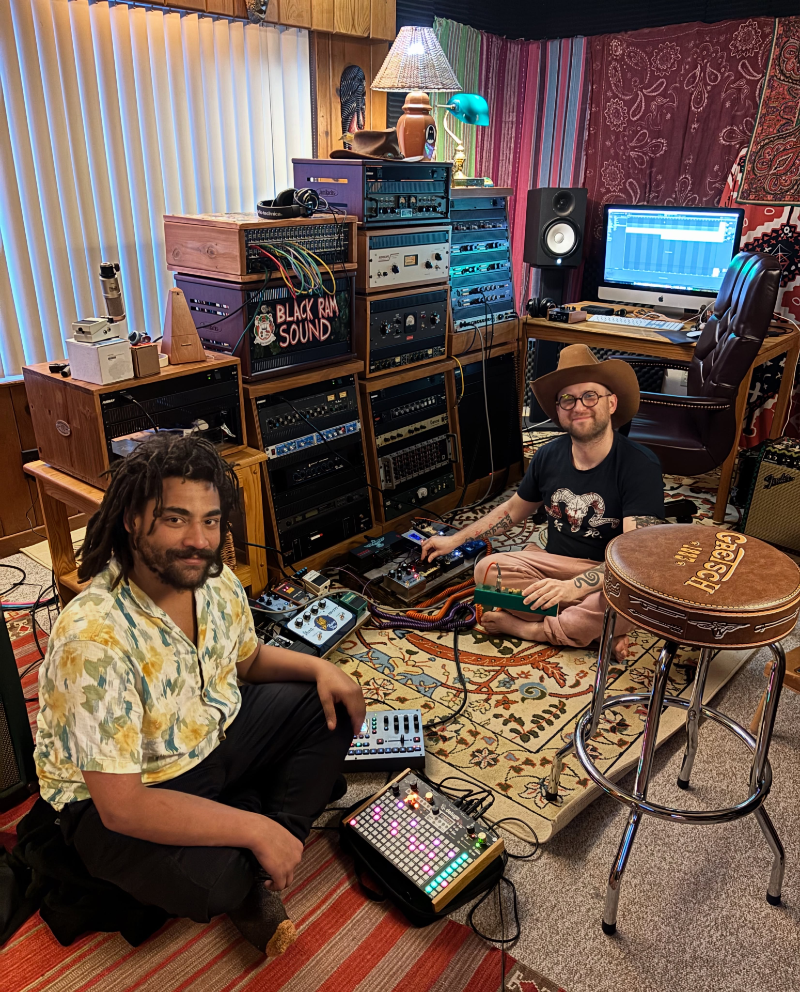
The music emerged over a series of jam sessions the duo had at Haywood’s home studio.
“We met once a week for a good couple of months,” said Javan Cain, aka OMO. “It turned into a lot of different jams, and there’s going to be a lot of different projects with different sounds. We were jamming together and growing within that, seeing what we could build because it’s endless if you really think about it.”
Those jam sessions quickly reflected the different roles the duo had while making the album: OMO as the creative force and Le Dawg as the editor and observer.
“It’s great because we both have so much going on musically, especially me with my studio work and Javan with all of his live performances that he’s been doing,” Haywood said. “It’s like we’re both bringing those skills and bringing those sensibilities into the process.”
To learn more, I spoke to OMO x Le Dawg about the creative process for the album.
Q: How did you develop a love of techno music?
Javan Cain (JC): Being so close to Detroit, and as I started making music, my sound naturally felt more techno and leaned in that direction. I just started following it more.
Evan Haywood (EH): That’s something I got into with my good friend Ian Finkelstein. The two of us had this group back together in the day, and then we would go to Detroit a lot, go to Movement, go to these after parties, and meet people there.
It just has always been a welcoming scene with a lot of really creative and brilliant people, including the late DJ John Collins. When I first went to Detroit and was excited about the music and what was going on there, people would say, “Oh, you want to learn about this? Come along and let me show you how I use my MPC [music production center],” or whatever it might be.
Both of us have benefited a lot from the community of electronic musicians in Michigan, which is obviously a strong cultural anchor that has been there for 30 or 40 years now. Maybe Berlin is one, but there are very few places in the world with more great producers than Michigan.
Q: How did you two meet and start working together?
EH: I’ve been doing so much work in the studio, and Javan has been doing so much work live playing at shows. He had all these patterns worked out and all these beautiful things that he would play live.
When it came time to finish them, master them, and get them ready for release, he came to the studio and said, “Hey, I want help sorting through all of these and getting another ear on them.”
We went through 13 tracks and mastered them here. Some of them will be on another album in the future. We started working together in that capacity, and then we just realized we have a lot of the same influences and enjoy a lot of the same music.
We said, “Let’s try jamming sometime,” and then we jammed, and it went well. And then we jammed a bunch more times, and then we edited the jams, and then we made this album from some of the first jams we did.
Q: How did the album become a collection of minimalist, ambient techno?
JC: He hit me up about jamming every week, recording a bunch, and seeing what came from it. When I came over, he had an idea, and I took some of his samples from the stems of his other recordings.
I used voice [samples] on a couple of different machines, but he just wanted a minimalist vibe. It put me in a different place because a lot of my music is very fast and driving. I took a laid-back approach, and I stepped outside myself a little bit.
I was building it live on the spot. A lot of times, we had a synth line going, and then I would slowly add in drums. One of my samples, the Octatrack, has a fader, and I can program different changes on the fader.
When I slid it over, it just pushed the sound differently. The idea was not to do too much, but I want to stay busy when I’m creating. I was trying to do a lot of things, but I was trying to approach it in a really small way.
EH: It gave a lot of room for subtlety and room to really dig into the tonality of things differently. We slowed it down, and now that it’s a little slower and more minimal, every sound matters a lot. Every sound had to be just right, so we were filtering things, and we were bringing things in and out very slowly.
One thing about electronic music that I love is that because it is so repetitive, the changes happen slowly over time; it forces your brain and neurology to slow down and comprehend it as it is. I think a lot of people who don’t really listen to techno music have trouble with that because they hear it as the same thing.
You have to zoom in on those tiny changes, and that’s what really gives it emotional meaning and texture to me. We were exploring a lot of that stuff together silently, and when we were listening to the music, we were both tweaking knobs and pressing buttons. I was dialing things in on my boards, and EQing things live.
It’s all very live, and we did some editing, but we didn’t really layer a lot or change much after the day we did the jams. It was about making them as strong as they could be.
Q: “Illusion of Time” features sounds that range from cyclical to otherworldly. How does this track help set the tone for the album?
JC: It’s like [being on] a different planet, but time doesn’t really exist—it’s moving differently. That’s what I thought it evolved into … and I’ll hear a song and think, “It’s that feeling or that action.”
EH: I think we’re looking for an alternate reality, partially because this reality is such trash sometimes. The way that this world has been going, we’ve said, “This is not it, right?” And then we said, “How can we actually use these machines to create another world with sound that allows us to live the way we want to live and be the way we want to be?”
Q: “Visions of Eternity” blends meditative, pulsating beats and percussive rhythms. How does this track reflect the different roles you had while making the album?
JC: We had a couple of hours of material—maybe three or four—and we went through and got all the best parts for some of them, but we also changed a lot of things. I like to blend sounds, and I think there are a lot of parts, especially with some of the longer ones, where I was trying to blend different things and work with our structure, but then explore what I like to explore.
EH: Whatever he started to do, I would react to that and maybe dial something in to suit the changes that he was making. Then, I added little synth textures that were barely audible. I did a lot of the window-dressing-type stuff, but a lot of the drums came straight out of his Octatrack. But then a lot of the samples were from my Perfumed Gardens album. We sampled some of my vocals from that.
The first track [“Illusion of Time”] and the third track [“Visions of Eternity”] have a lot of vocal samples, and he dumped them into his machines, and then he messed with them a bit. He repatched and changed them up, so we both had a collaborative process. We both added what we added, and it came out something that neither of us would have made by ourselves.
Q: As the longest track on the album, “Visions of Eternity,” was composed during a series of jams you had together. How did you find the right balance between building momentum and maintaining a sense of tension?
EH: It was about putting different chunks together from these jams, where we had momentum building, and then we basically had a narrative arc. If you listened to the whole jam by itself, we were slowly developing things and tweaking sounds, but when we cut all of that out, it just left the tension.
Q: “Nature of Reality” features city and wildlife sounds. What inspired the convergence of those of sounds for the song?
JC: I always think of life as a balance. You have some chaotic sounds, but you also have some smooth sounds. Capturing the feeling of both is like life in a sense. It’s like the nature of reality; everything is always happening all at once.
It was cool because [Evan] captured some of the rain sounds and some of the water sounds, and I had a bird sample in my Octatrack.
EH: You have to find the consistency underneath the chaos, but the beat is there. I like that the sirens are completely off-time. We didn’t try to sync it to the BPM; it was supposed to be very random, but everything else is 100 percent locked in. It’s like one giant sound aside from that.
Q: “Dimension Jumping” features dreamlike, intergalactic sounds that shift from one place to another. How does this song capture that feeling?
JC: I’ve always thought about it like I’m opening portals with the sounds and frequencies that I’m putting together.
EH: We gave it that name on purpose, and it came from the same jam as “Elemental Vibrations.” It was a continuous jam that started in one place and ended in another place.
We felt both of them were like bookends because “Elemental Vibrations” is the second track and “Dimension Jumping” is the last track.
Those are nice, lighter tracks that give you a bit of a breath from the heaviness of something like “Nature of Reality” and “Illusion of Time.” Both of those are so serious, and these [two] are a little bit more fun, a little bit more playful.
Q: How did the album come together during the recording process?
JC: For one of the sessions, I just had an Octatrack and a Deluge, and I’d start switching it up. It’s like an evolution of sound and of yourself because you keep getting better and better with these machines. But you’re also playing and constructing something that could be timeless because it lives on.
EH: When we started recording the jams, I was ready to dial everything in on the EQ and in the compressors and get everything exactly how I wanted it to sound. And he was ready to put the machine down and start creating stuff, and we put those skills together.
We used different instruments on pretty much every jam, so we would switch off different things and experiment. Almost every jam that we’ve done has been a different configuration.
It’s been a really nice method for us. We haven’t had the pressures of fitting into all of these boxes that you usually might have to fit into if you’re doing a traditional performance of music.
Q: What plans do you have for new material?
EH: The next album is already done. We’re going to release it either by the end of this year or next year—we’ll see.

