
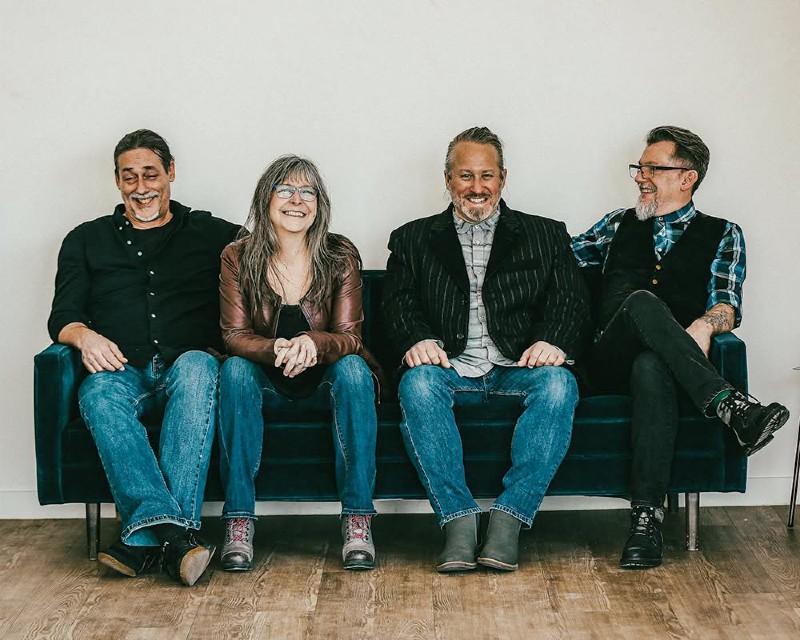
For Annie and Rod Capps, self-improvement is a lifelong process and commitment.
The Chelsea, Michigan, couple explores that concept and the lessons they’ve learned on their latest folk album, Never Done.
“I’m always trying to do better, be better,” said Annie Capps. “I don’t always succeed, but the best kind of growth is that which creeps up on you after a long time of doing a lot of inner work.”
As part of that inner work, the duo examines the impact personal growth and wisdom have on them over time. They also reveal epiphanies about past behaviors, decisions, and actions that surfaced while writing the 10 tracks for Never Done.
“It’s almost as if a light bulb goes off and those self-improvements start to show themselves in real ways,” said Annie Capps. “I write what I’m feeling, and my lyrics often reflect a combination of reality—the kind of person I am—and the kind of person I want to be.”
Annie Capps (songwriting, vocals, guitar) shares those self-reflections through lyrics that range from personal and anecdotal to conversational and humorous.
“Part of the healthier version of self-reflection is not to take myself so seriously, especially when lamenting the mistakes of my youth,” she said. “I guess I’m in the season of life where reflecting on the past is natural, but I’m also looking at it through a more compassionate lens.”
Through another lens, Annie and Rod Capps (guitar, viola, vocals) view Never Done as a milestone of sorts—it’s their 10th studio album.
They recorded the album in their Chelsea home studio and at Ann Arbor’s Big Sky Recording with bandmates Jason Dennie (mandolin, vocals), Dan “Ozzie” Andrews (bass), and Michael Shimmin (drums, percussion).
“Fast forward, I think we have gotten very comfortable with certain musicians and certain ways of recording,” Rod Capps said “I think we’ve learned what we can do and what works and what doesn’t.”
To learn more, I spoke with Annie and Rod Capps about their album ahead of an August 27 show at The Ark in Ann Arbor.
Q: After doing 10 albums, what valuable lessons have you learned during the recording process?
Annie Capps (AC): It doesn’t matter how many records we’ve made; every single record presents new challenges and new experiences. When we first started making records, we were trying to do it at home, and now we’re back to doing them at home, but in a completely different way.
The key, though, is to find the right people to play with. We’ve been very lucky that our core band—Jason, Ozzie, and Mike—is very talented and their instincts are great. I may write these songs and put them together, but it isn’t until the layers get added that they sometimes inform how I play.
As far as learning, it takes a long time to trust yourself, and it helps if you’re working with the right recording engineer, Geoff Michael, in the right studio, Big Sky Recording.
Rod Capps (AC): We have set up an area [at home] where we can capture good-sounding takes, and then we can take those takes to [Big Sky] because they’re so portable now. We do it over email half of the time, and now, everything is asynchronous. We’re not all married to the same time event stream, and we can take 20 takes if we want to get something right.
It’s also letting go of a desire to have the whole studio in your house, and I think that was part of the maturation of it. We said, “We can do this; we don’t do that well; we should let the person who’s very good at doing that do that.” We’ve learned how to take as many instruments live as we can for a vibe and feel, even if we come back through later and replace some of them.
Q: What inspired your personal approach to songwriting on Never Done?
AC: Right now, I’m exploring nostalgia. With that theme, I’m living in this place of: “I survived all that, but also look how much fun I had.” I can’t tell you how many people said they relate to “Stupid Things.”
Perspective is so much of it, and sometimes I’m writing songs from my perspective, but about somebody else. That’s where songs like “Splinter” and “Repair” come from. I pulled myself out of those and made it a “you and her” thing where I’m one of those people, but you have to figure out which one. Sometimes, I’m the “you,” and sometimes, I’m the “her.” Deciding when to use first person, second person, or even third person, and how you do that is part of the expression.
RC: When we’ve been on stage, I’ve been nodding my head to some of the things [she says in the song “Stupid Things”], like she used to live on Cheez-Its, and she still does. I think [she] does a really good job of picking those nuggets out, but she presents them in a way that makes them seem universal.
Q: “Here’s to the Moments” is about dealing with change and experiencing growth in unexpected ways. How did this song evolve over time?
AC: It’s about getting rid of the inner critic, and that is all metaphor. This song took a long time, and it’s been in the works since COVID. I think the first time we shared a version of this song was during COVID when The Ark was doing their livestream series.
Rod and I had spent some time working on it because he really contributed to the song’s chord progression. It is probably the most complex chord progression we have done in a long time. I don’t feel the need to be super fancy with chord progressions, but I’m also not trying to be too predictable.
Q: “Pardon My Dust” explores the importance of self-improvement and self-reinvention. What inspired the song’s construction-related themes?
AC: I think this song, in particular, is more about how we need to be kinder to ourselves and others who are struggling with life, as well as all the challenges and curve balls it throws at us along the way.
Also, those who have done therapy will get that you have to tear stuff down to rebuild something better. Thus, the self-destruction reference. Not all self-destruction is necessarily bad if it reveals what needs fixing.
Q: “Who Am I?” questions your role in society and addresses feeling powerless in today’s environment. How did this song become an anthem for sharing your voice and supporting your community?
AC: It was the last thing we added to the record, and I felt it really belonged because of the way the song ends. It is a little bit of an outlier thematically, and it falls into [the theme of] looking inward and exploring what’s going on currently in the world. It’s about my inability to communicate why I am so viscerally affected by some of what’s going on, but also not knowing what to do or say. It could also be distilled down into just wanting to help a friend.
I wrote that when I was at an artist residency in Good Hart for one week. I was mostly working on other things I wanted to polish, and the annual peace concert was coming up at The Ark. I wanted to bring something new to it, and so I started that guitar part. While thinking about the peace concert, I said: “Right now, I can’t think of anything to say in a song, let alone in person.”
The lines, “Words don’t come easy,” came out, and so did the whole song. It was probably the fastest I’ve ever written a song in a very long time. What Rod did on the recording with the viola and through the recording process is just a way to bring out the emotion of the song in such an intense way.
Q: Never Done features a variety of genres, including folk, rock, jazz, and country. How did those genres influence the album?
AC: By now, all of that music we’ve absorbed over the years has embedded itself into our subconscious, so I’m not really intentionally chasing a sound or genre. For me, keeping things interesting for myself, and hopefully, our listeners, has played a big role in how I approach every song.
After 10 albums, there’s inevitably some “reusing” that happens, but mostly I work hard to make sure the new song I’m working on doesn’t sound too much like something I’ve done before. It definitely helps to have a lot of musical influences to tap into.
Q: Tell me about the recording process for Never Done. How did it come together at your home studio and Big Sky Recording?
AC: We went into Big Sky in March 2025 and recorded first with Mike and Ozzie. We wrapped up recording the album in January 2026, and the final master was in March 2026. It was a solid year by the time we got the finished product.
RC: These things are happening often in parallel, and as that parallel process starts, we’re back at home, and we’re starting to take vocal tracks. We would bring Jason over and take some of his things, and sometimes we might do a session where Jason and I would go into the studio and take six or seven passes.
Then, we would take all of those back to our place to make a “Frankenpart,” or a mash-up of different takes, and [later] give it Geoff Michael so he could make it play well with the other [parts]. There are a couple of ways we would go at these parts—both at home and at the studio. They get cross-pollinated back and forth, and we’ve gotten fairly adept at doing that.
Q: Never Done features intricate acoustic and electric guitar work. How did the guitar parts emerge during the recording process?
AC: On the last album, Love and Rain, Rod didn’t play any acoustic guitar; it was all electric. This time, it was almost all acoustic, but the electric shows up in a few choice spots. The part he plays on “Pardon My Dust” gives me such joy every time I listen to it. The baritone guitar on “Imitation of Happy” is another stand out for me, and it brings in a little bit of our rock edge, which we still love.
RC: I try to find something that serves a song but is new and challenging to me, and it’s something that’s not too formulated and still has feeling to it. I can evoke certain textures, and sometimes, I’m trying to be the pedal steel player.
We take a snapshot, we do a recording, but we also have to function as a duo, a trio, and a quartet. When the drummer shows up, I start cutting parts and playing less. We end up having three or four versions in our heads of how these songs can be played.
Q: Never Done features collaborations with a talented group of musicians. How did they help elevate the album’s songs?
AC: Oh gosh! A huge part of the production and arranging is figuring out what the songs need. The core band—Rod, Jason, Ozzie, and Mikey—has always been a dream team, as far as their treatment of my songs. We feel so fortunate to have them on this ride with us. We’ve included Drew Howard (pedal steel) on almost all of our albums. Again, such an incredible talent.
And we’ve certainly admired Mike Lynch’s work (piano, organ) with other Michigan artists, and he’s been on our radar for a while, but this is the first time we’ve used him—and wow! All of them are in demand both on stage and as session players for good reason. Their incredible instincts and collaborative natures make every song they touch so much better.
Annie Bacon, Jim Bizer, and Jan Krist are all dear friends and incredible harmony singers. For the most part, we try to create a sonic experience that represents what we do live, so Jason, Rod, and I do most of the harmony singing on the album, but when you have such talented friends, I like to take advantage of a bit of special sauce.
Q: What can people expect from your August 27 show at The Ark?
AC: We’ll do the album in the first set, and the second set will be a mix of even newer songs we’re road-testing and some old favorites. We’re planning on a five-piece band with Jason, Ozzie, and Mike, along with guest harmony singers Annie Bacon and Jan Krist. We have a blast playing together and hope our audience feels that.
Q: What plans do you have for new material?
AC: We have another album in the works. There were three songs we recorded that we decided not to put on this record, and they were all some form of love songs … so at least for now, that looks like the theme of the next album, and it may be a more stripped-down acoustic recording, but we’ll have to wait and see.
Annie and Rod Capps perform August 27 at The Ark, 316 South Main Street, Ann Arbor, Michigan. For show information and tickets, visit The Ark’s website.

