
Editor’s Note: For a related article, see the One Track Mind feature from Pulp.
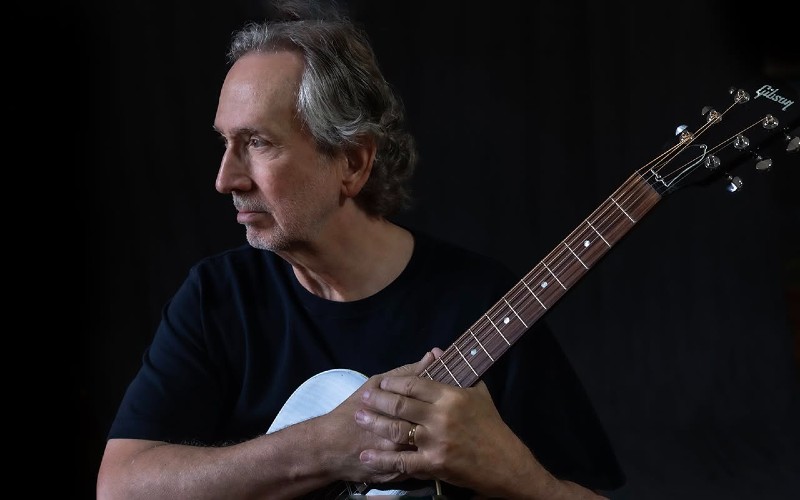
Bill Edwards is satisfied with having one less personal collection of music in the world.
The Ann Arbor, Michigan, singer-songwriter adopts that mindset and overarching premise for his new album, Enough About Me, and its title track.
“I read American Songwriter magazine, and there’s an article on the cover that says, ‘So-and-so has put out their most personal album yet,’” said Edwards, who’s also multi-instrumentalist.
“I don’t think a statement is intrinsically more important because it’s your personal history. It can be, if it’s something you’ve gone through and it’s really important and something that people will recognize and feel themselves, but there are other ways to do it too.”
On the title track, Edwards sings, “Must we keep dronin’ on / About ourselves? / It’s a big ol’ world out there / Can’t we talk about somethin’ else?”
“I don’t mean anything against anybody,” he said. “People do what they need to do or what they want to do, but just for me at my stage of life and stage of music production, I was ready to say, ‘You know, I want to write about something else; I want to write about other people.’”
Featuring 14 tracks, the country-bluegrass album explores songs from the perspectives of several characters, including women, men, teens, veterans, sanitation workers, and drifters.
Enough About Me also includes the subtitle Fictions to reassure listeners that it’s not an autobiographical album.
“My goal, particularly with this record, was to try and step into somebody else’s shoes and see the world from where they’re standing,” Edwards said. “I just thought [the subtitle] might be a little hint that it’s works of fiction.”
However, when it comes to his September 15 album release show at The Ark in Ann Arbor, he’s taking more of a personal approach for it.
The show doubles as his birthday celebration and marks a significant milestone for him as a songwriter.
“It’s such an honor and a thrill to play where so many of my heroes and friends have played,” he said. “It also celebrates my 60 years of songwriting because I wrote my first song at age 14.”
To learn more, I spoke with Edwards about his album ahead of the show.
Q: How long did you spend writing songs for the album?
A: I write probably 50 songs a year, and I put out a record about every year. It’s been 18 months since I last put one out. Boiling those 50 songs down to 10 or 15 songs that really fit together and make a statement is the hard part. It’s also hard to figure out what to leave out, but my wife helps me with that.
Q: How did Enough About Me come together during the recording process?
A: When I put out my last album in April 2025, I already had some of this album coming along. I had two or three songs in the can for this one, at that point.
With the recording, it was just me down in my little man cave working on the album at home. It’s largely an acoustic album with me playing guitar, mandolin, dobro, and fiddle. The banjo, bass, and drums—the drums are really not that prominent—were programmed.
The creative process is a very solitary effort for me, which I think has its pleasures, but it also has its challenges. I get feedback on my songs from my Song Salon [songwriting group] friends, and my wife tells me when I’m getting off track.
But sometimes I wish I had a producer who could look at the entire album and who could then steer me a little bit. The positive side of my [current] way of working is that nothing has to be done until it’s ready to go.
Q: On Enough About Me, “Goodbye Misery” explores the perspective of a woman starting over after leaving a difficult relationship. Why did you select this song as the album’s first single?
A: It establishes the genre of the record, which is bluegrass-y and string-bandy. From that perspective, it lets people know what kind of record it is, and it’s clearly written from somebody else’s point of view. I think it also has a nice groove that works for a single.
Q: “Enough for Me” and “The Damage Nobody Can See” examine the perspectives of two characters, a veteran and a woman, who are interested in each other. What was it like to write a song from each of their viewpoints?
A: I wrote “Enough for Me” first, and then I thought, “Hey, why not explore the other person who’s been introduced here and see if there’s something that would be evocative from her point of view?” I think the challenge was not so much the two different perspectives—that was pretty straightforward.
Not having been in either situation, my fear with both songs was: Am I doing something that might be inappropriate without knowing it? Is some veteran going to be offended by this in some way, or is someone who’s a survivor of abuse going to think that it was insensitive in some way?
Finally, it comes down to knowing that you can’t know that; you just have to be as careful with the person in the song as you can be. If it feels true to the person in the song, that’s about the best that I can do.
Q: “Nobody I’d Rather Be” reflects on being grateful for family and work. What inspired the sanitation engineer’s optimistic outlook on the song?
A: Years ago, I was working in corporate America in a really high-pressure job. I saw a garbage collector, and it was a beautiful day, and I thought, “You know, that ain’t a half-bad job, and you’re outside—at least in this weather. It’s probably decent pay with union wages. I bet some people really like that job.”
I wrote the song and played it for somebody in the Song Salon group. When referencing the phrase about “Droppin’ the bins just so,” somebody in the group said, “I worked at a manual labor job, and you get your satisfaction from getting that one thing you’re doing over and over again just right.”
Q: “Walk Across the Tracks” is about unknowingly escaping danger. How did an encounter at a train station during your childhood inspire this song?
A: This comes from a true story from my youth. I was a little kid living in Princeton, Illinois, and we went to the train station because my grandmother had come to visit. At the very last minute, an elderly gentleman had decided to cross the tracks right in front of the train.
People reached for him, trying to pull him out of the train’s way. The engineer was blasting the horn, and it was frightening, but he made it. Happily, I wasn’t scarred for life. I thought I’d have [the song] come from the point of view of a sister who is just fed up with her brother after he had just done that.
Q: “The Drifter” explores the importance of wisdom and forgiveness. How did this theme emerge while writing the song?
A: What inspired the song is the line, “We’re all livin’ life for the first time,” which is something I read in a book of fiction. I couldn’t even tell you which book, at this point. But when I read something like that or hear it out in society, I jot it down in my phone. When I need something to write about, I look through there and see what inspires me that day.
That line, “We’re all livin’ life for the first time,” is another way of saying we’re all rookies at this, and nobody knows what they’re doing. I liked the song’s parting message: “Let’s just try to be kind to each other and try to be forgiving.”
We all have situations where we haven’t been at our best, so I thought that would be a good way to end the album. It’s also a quiet little song with not much instrumentation.
Q: What do you have planned for your September 15 show at The Ark?
A: Kathy Wieland will do an opening set. Then, Judy Banker and I will do a few songs together because we’ve been singing together for years.
We’ll start with just a handful of songs; then we’ll bring the band on and play through the album. The band includes Grant Flick on fiddle, Jason Dennie on mandolin, John Holkeboer on bass, and Judy Banker on vocals.
Q: What’s up next for you?
A: On November 7, I’ll be playing at North Star Lounge with my friend David Starr, who is from Colorado. He’s coming into town, and we’re also playing on November 6 in Toledo, Ohio. That will close out the year for me.
Bill Edwards performs September 15 with Kathy Wieland at The Ark, 316 South Main Street, Ann Arbor, Michigan. For show info and tickets, visit The Ark’s website.

